A printing mistake left its mark on the back of the embossed sixpence. Some sheets had been stamped on their gummed side because the clear adhesive was hard to see against the pale paper. The solution was to tint the gum green, making the correct side easier to recognise. [1]
Stories
The mistake that turned the gum green
The mistake that turned the gum green
The sixpenny stamp acquired an unusual feature because workers at Somerset House sometimes embossed it on the wrong side of the paper.
The sheets were gummed before embossing. Unfortunately, the adhesive was almost transparent, and its appearance was so similar to the pale paper that the operators sometimes struggled to tell which side had been coated. A few sheets were impressed on the gummed side and issued before anyone noticed. [5]
On 28 February 1855, Ormond Hill, Assistant Supervisor of the Stamping Department, wrote to an official named J. Pitt about a faulty half-sheet that had been returned. He explained what had happened and described his solution: "To prevent the recurrence of this fault, I have had the gum slightly coloured." [6]
The tint was green. Introduced towards the end of 1854 or early in 1855, it made the gummed side easier to recognise. A small mistake in the printing room had left a permanent mark on the appearance of the stamp. [5, 7]
The stamp that waited more than two years
The Treasury authorised a sixpenny postage stamp on 8 September 1851. Yet the finished stamp did not appear until 1 March 1854.
William Wyon, the Royal Mint engraver who had supplied the portraits for the earlier embossed stamps, died on 29 October 1851. His death complicated the preparation of the new design, although the surviving records do not establish exactly how much of the delay resulted from it. [5, 7]
In December 1852, the Board of Inland Revenue wrote to the Post Office explaining that difficulties with the die had delayed the stamp. Those difficulties, it said, had now been overcome, and the stamps should be ready very shortly.
They were not. Another fourteen months passed before the Board finally announced, on 26 February 1854, that it was prepared to issue them.
The records leave part of the mystery unresolved. A stamp that appeared simple enough to resemble its two predecessors had taken an unexpectedly long time to manufacture.
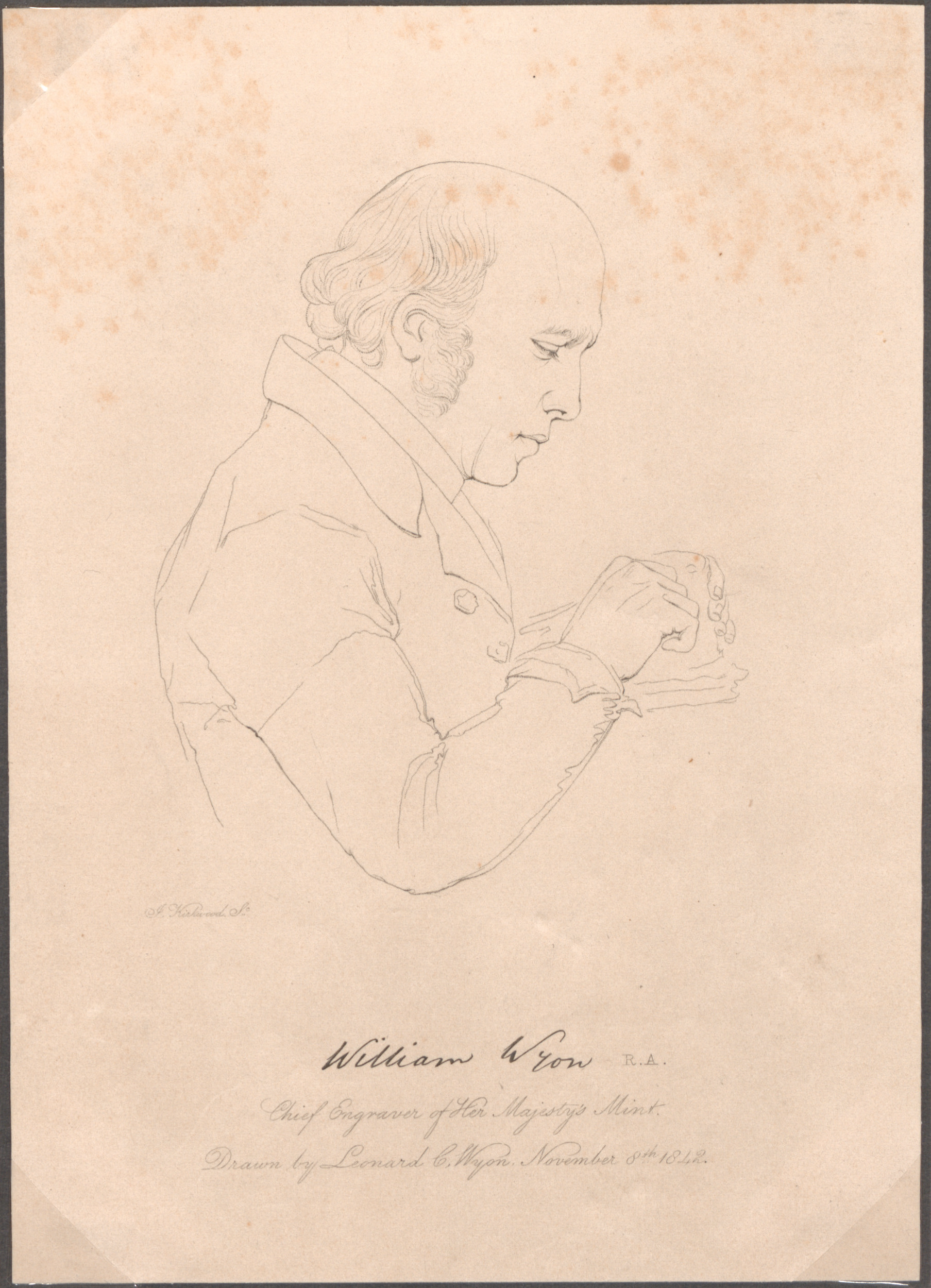
William Wyon at work, drawn by his son Leonard Charles in 1842.Image information
Click image to magnify
Pencil drawing of William Wyon in profile, holding a small object, with identifying inscriptions beneath.
Credit
Leonard Charles Wyon, William Wyon, R.A., chief engraver of Her Majesty’s Mint (1842). The Metropolitan Museum of Art, Thomas J. Watson Library; Gift of Romano I. Peluso. Public domain / CC0.
The sixpenny stamp's paper came from Rush Mills near Northampton, a business with a history reaching back to the Penny Black.
Stacey Wise had taken over the mill in 1833 and secured government contracts for security paper. After his death, his widow Elizabeth continued the papermaking business. In 1847, much of the mill was destroyed by fire, but it was rebuilt and production continued. [8, 9]
By the time the sixpenny stamp was being manufactured, Mrs Wise's mill was supplying specially watermarked, handmade paper. Every sheet carried forty repetitions of the letters V R, positioned so that each finished stamp would contain a complete watermark.
The paper varied in thickness, as handmade sheets often did. Some impressions were consequently much more sharply embossed than others. [5]
The stamp's creation was not confined to government offices in London. It also depended on a widowed businesswoman and the papermakers working at a rebuilt mill beside the River Nene.
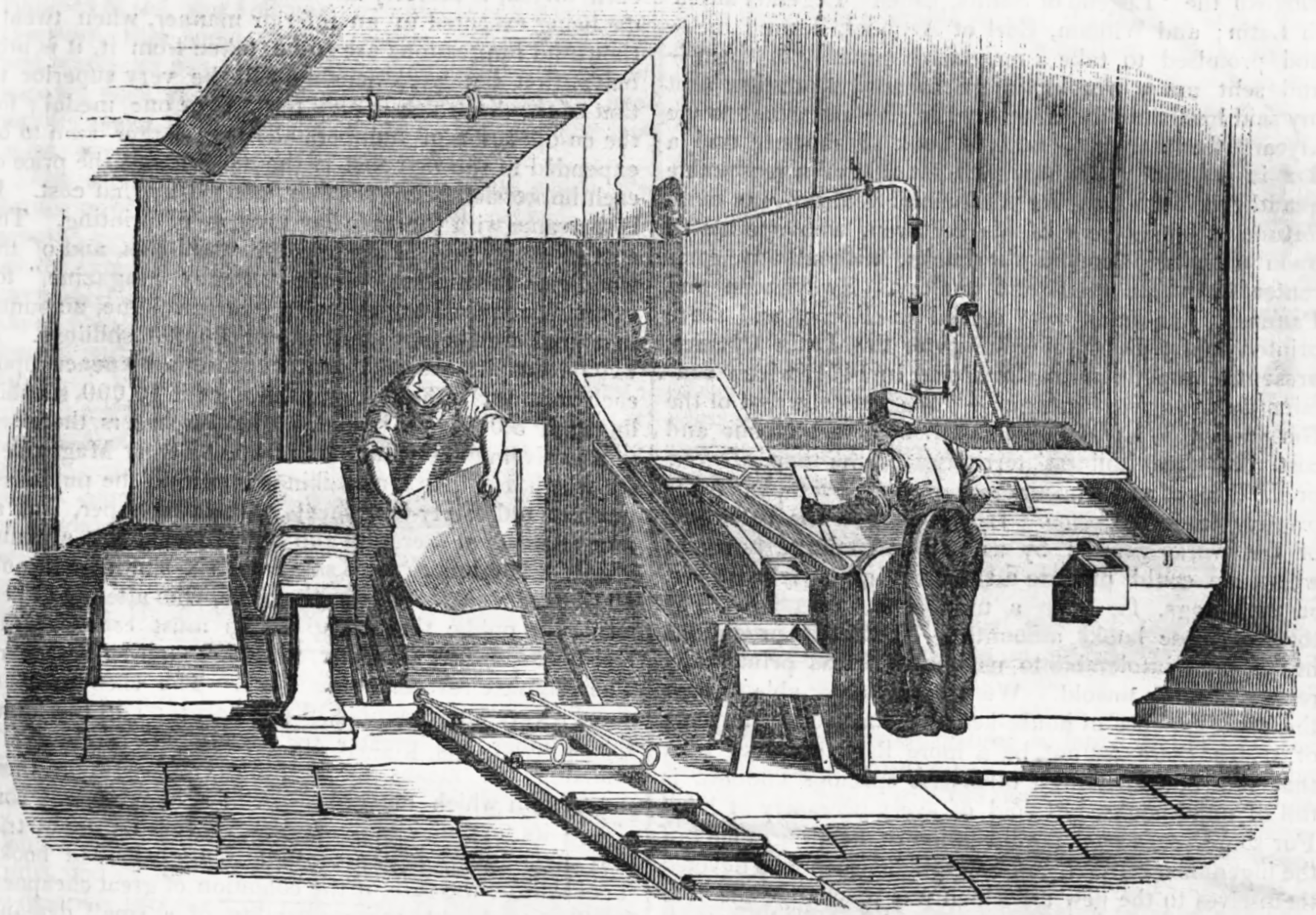
Hand papermaking in 1833. This is not a view of Rush Mills.Image information
Click image to magnify
Woodcut showing workers making paper by hand among vats and frames.
Credit
Unidentified illustrator, Paper Making by Hand, The Penny Magazine, 28 September 1833; HathiTrust via Wikimedia Commons. Public domain.
The Penny Black was printed from a plate containing 240 stamps. The embossed sixpence was produced one impression at a time.
At Somerset House, workers used embossing presses made by the Dryden Brothers of Lambeth. A sheet of paper was fed into the press by hand, positioned beneath the die and struck. The operator then had to move it into position for the next impression. [5]
Each sheet of sixpenny stamps contained forty impressions, in two groups of twenty. Producing a complete sheet therefore involved forty separate operations.
Keeping the impressions evenly spaced was difficult. Sometimes they were too close together; occasionally they overlapped. The operators could not simply depend on the mechanical precision of a large printing plate.
The resulting irregularities reveal how much human intervention was involved. The finished stamps may look identical when separated, but a joined block can preserve the small mistakes made during a long day's work.
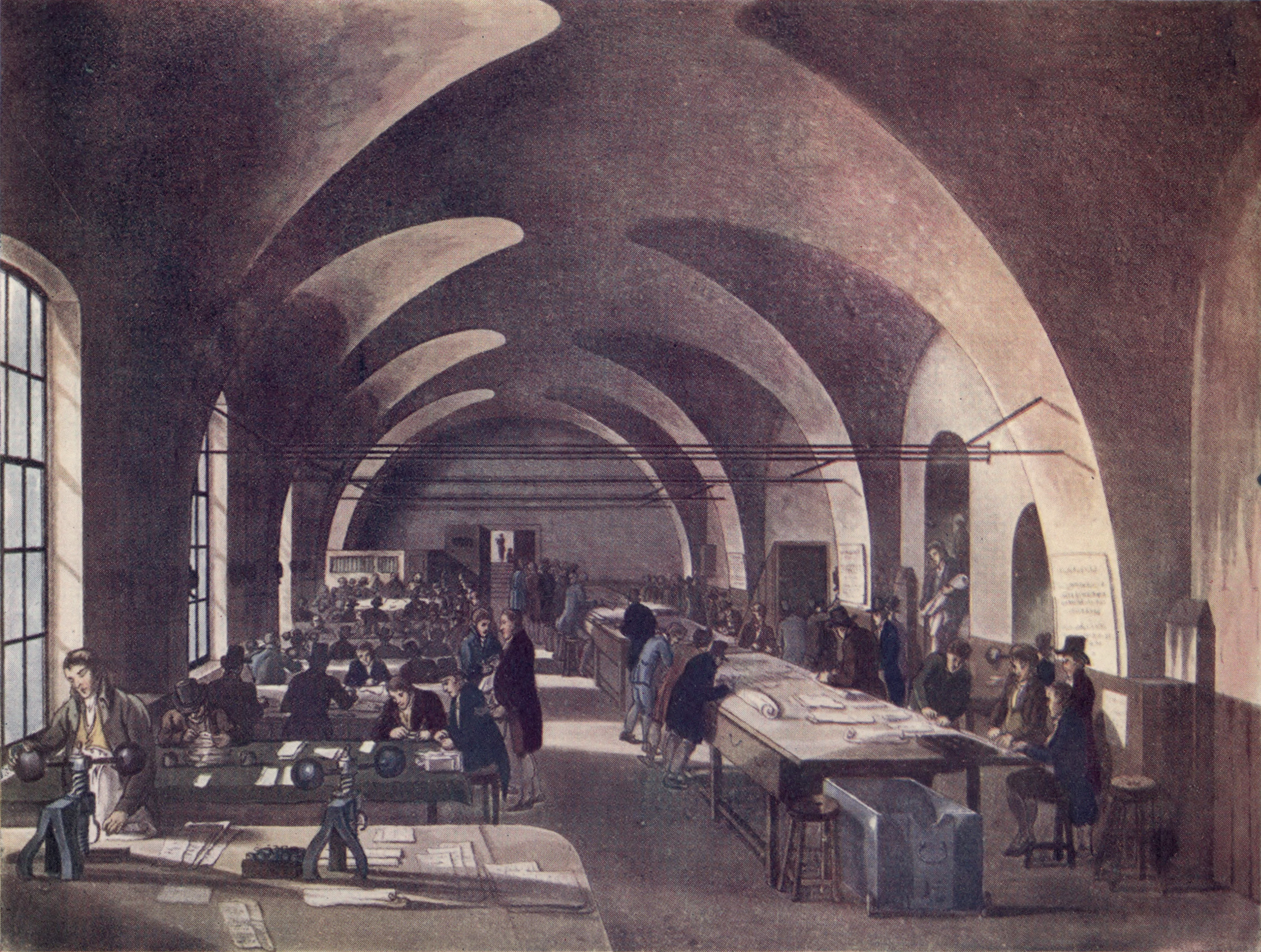
The Stamp Office at Somerset House, c.1809–1810, decades before these embossed stamps were made.Image information
Click image to magnify
Coloured aquatint of clerks and workers at long desks beneath the vaulted ceiling of the Stamp Office at Somerset House.
Credit
After Thomas Rowlandson and Augustus Charles Pugin, Stamp Office, Somerset House, The Microcosm of London, plate 74 (c.1809–1810; 1904 reproduction), via Wikimedia Commons. Public domain.
Almost three million stamps that never reached the public
The embossed sixpence was a slow stamp to manufacture, but the government continued producing it even as plans for a replacement were advancing.
The surviving production records show that almost 6.7 million impressions were made. Yet only about 3.7 million were sent out by the authorities. Nearly three million stamps remained unissued. [5]
Of these, more than 2.2 million impressions were produced during 1856, after the last supplies of the embossed sixpence had been released for distribution in September 1855.
A new surface-printed sixpenny stamp, manufactured by De La Rue, appeared in October 1856. The old embossed impressions were no longer needed.
Wright and Creeke, writing in 1899 after examining the official records, concluded that the unused stock was probably destroyed by burning. The records do not establish the fate of every sheet.
The figures conceal an extraordinary amount of work. Millions of individual impressions had been made by hand-operated presses, only for much of that effort to leave no trace in the post offices.
Another member of the Hill family enters the story
Rowland Hill is remembered for transforming the British postal system, but the embossed stamps also involved his nephew, Ormond Hill.
Ormond was the son of Rowland's brother Edwin. He had entered the government department responsible for postage stamps in 1841 and was working at Somerset House when the new embossed stamps were developed. [5, 9]
Ormond contributed to the design of the new stamps. William Wyon, Chief Engraver at the Royal Mint, supplied the royal portrait, while the surrounding ornament and lettering were developed for the embossing dies.
Unlike the earlier Penny Black, which had been printed by the private firm Perkins, Bacon & Petch, the sixpenny mauve was produced by the government's own stamping department.
The Hill family's connection with postage had extended into the workshop. Rowland's reforming work was being carried forward by people who included his own nephew, helping turn a new design into something the government could manufacture.
Why do some stories appear on several pages?
Every page is written to make sense on its own. Visitors often arrive directly at a particular stamp or subject, without having explored the rest of the site.
Some stories are relevant to several stamps, so they are repeated where they help explain what you're looking at. For those exploring a series, the details specific to each stamp generally come first, with the more familiar stories further down the page.
This way, you can explore the site in any order without missing interesting background.
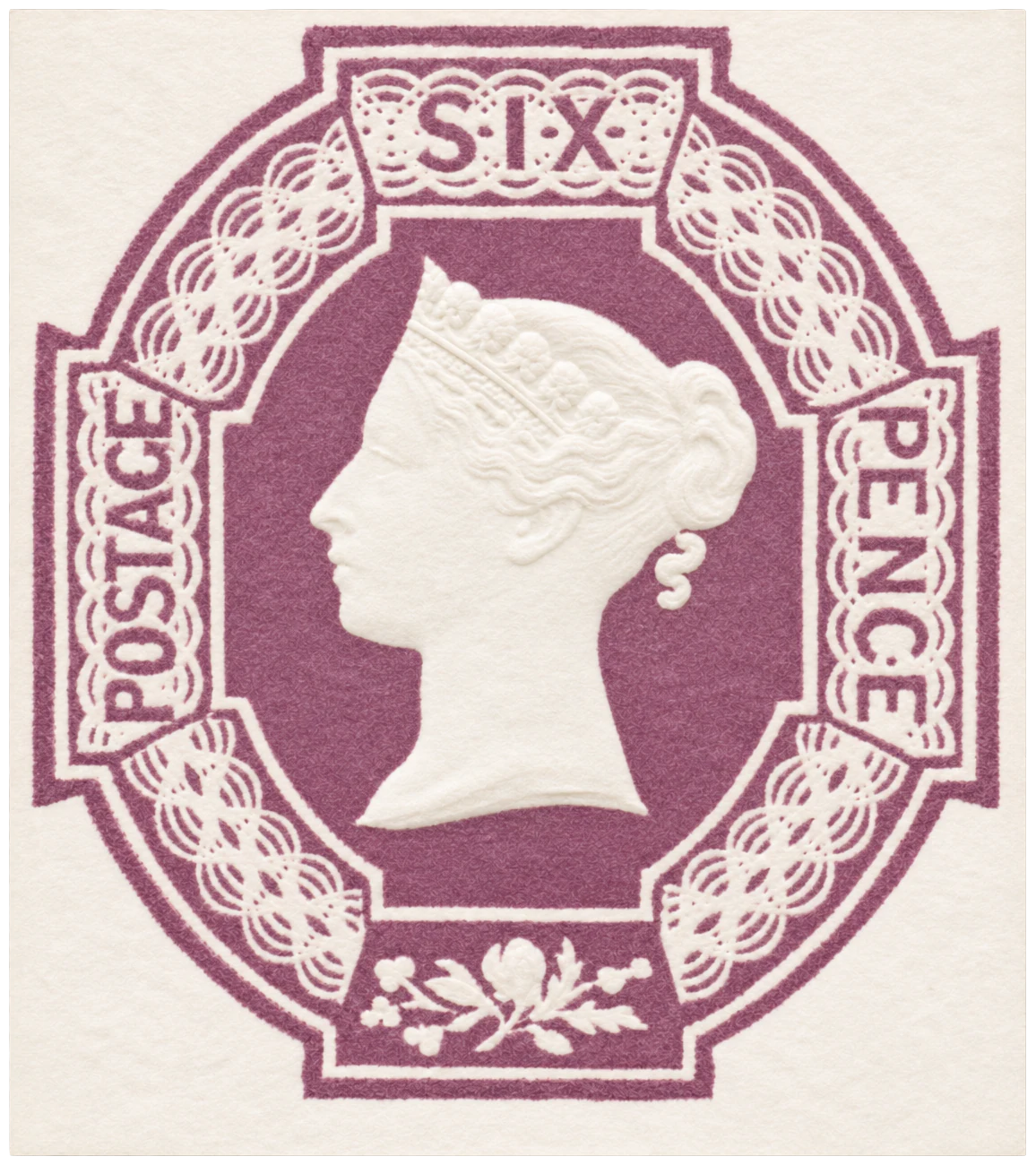
The sixpence softens the earlier octagon with outward-curving corners. Three projecting panels carry the words; a fourth holds a small floral spray. William Wyon’s portrait survives within Ormond Hill’s reshaped frame. [10]
A stamp can be printed, sent to post offices, put on sale and made valid for postage on different dates. An official notice or instruction can establish when it was intended to be used; a dated letter shows that a particular example was actually used.
An early surviving cover is evidence of use by that day. It does not necessarily identify the first day of sale. A year in the heading may also cover later printings of the same design.
On this stamp
The 1854 embossed sixpence was first issued on 1 March 1854.
Embossing changes the shape of the paper. The recessed parts of a metal die receive the raised portions of the design as the paper is pressed against a softer counterpart underneath. Ink on the die’s surface colours the flatter areas, leaving the portrait and fine ornament in uncoloured relief.
Each adhesive stamp was struck separately. An operator repositioned the paper for the next impression instead of printing a complete sheet from one plate. Uneven spacing, tilted impressions and overlapping designs are consequences of this process.
On an original, the white portrait has actual shallow relief. A flat photograph can suggest it through light and shadow, but cannot establish the depth or condition of the embossing.
On this stamp
The 1854 embossed sixpence was made one impression at a time. Its original raised portrait is represented here by a digital reconstruction.
Imperforate means that the sheet had no punched rows of holes for tearing the stamps apart. Each stamp had to be cut from the paper. The octagonal or curved outline belongs to the printed design; it did not dictate the shape of the piece of paper.
A stamp cut square retains the blank paper outside the design. A stamp cut to shape has been trimmed around the frame. Closely spaced or overlapping impressions could make it impossible to cut out one stamp with clear margins all round, even before later damage or trimming is considered.
For an original specimen, look for an intact design, genuine paper margins and undamaged relief. The complete rectangular margins in these reconstructions illustrate the intended design; they are not evidence about a surviving stamp’s condition.
On this stamp
The illustration shows the 1854 embossed sixpence with rectangular paper margins around its complete design.
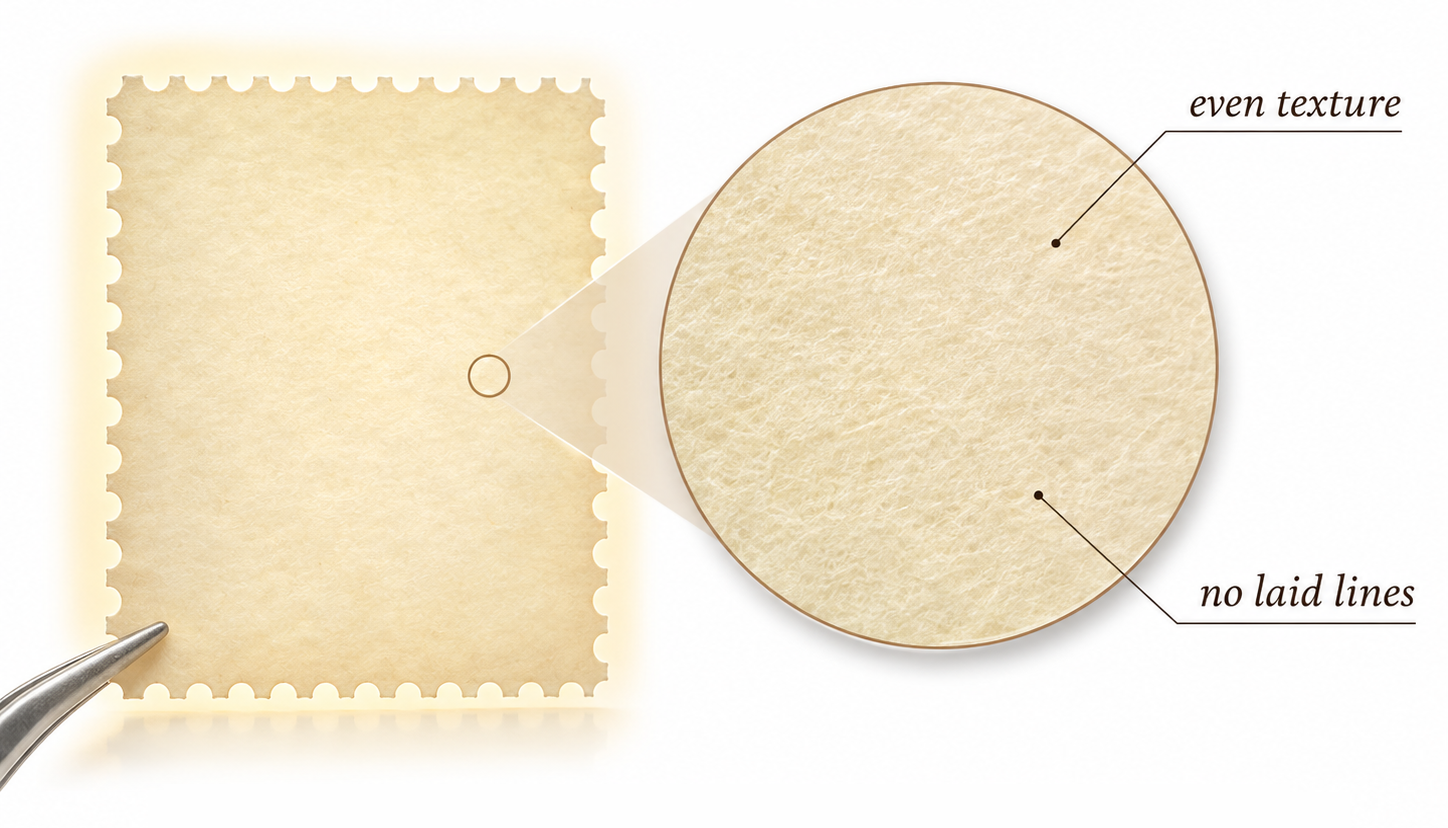
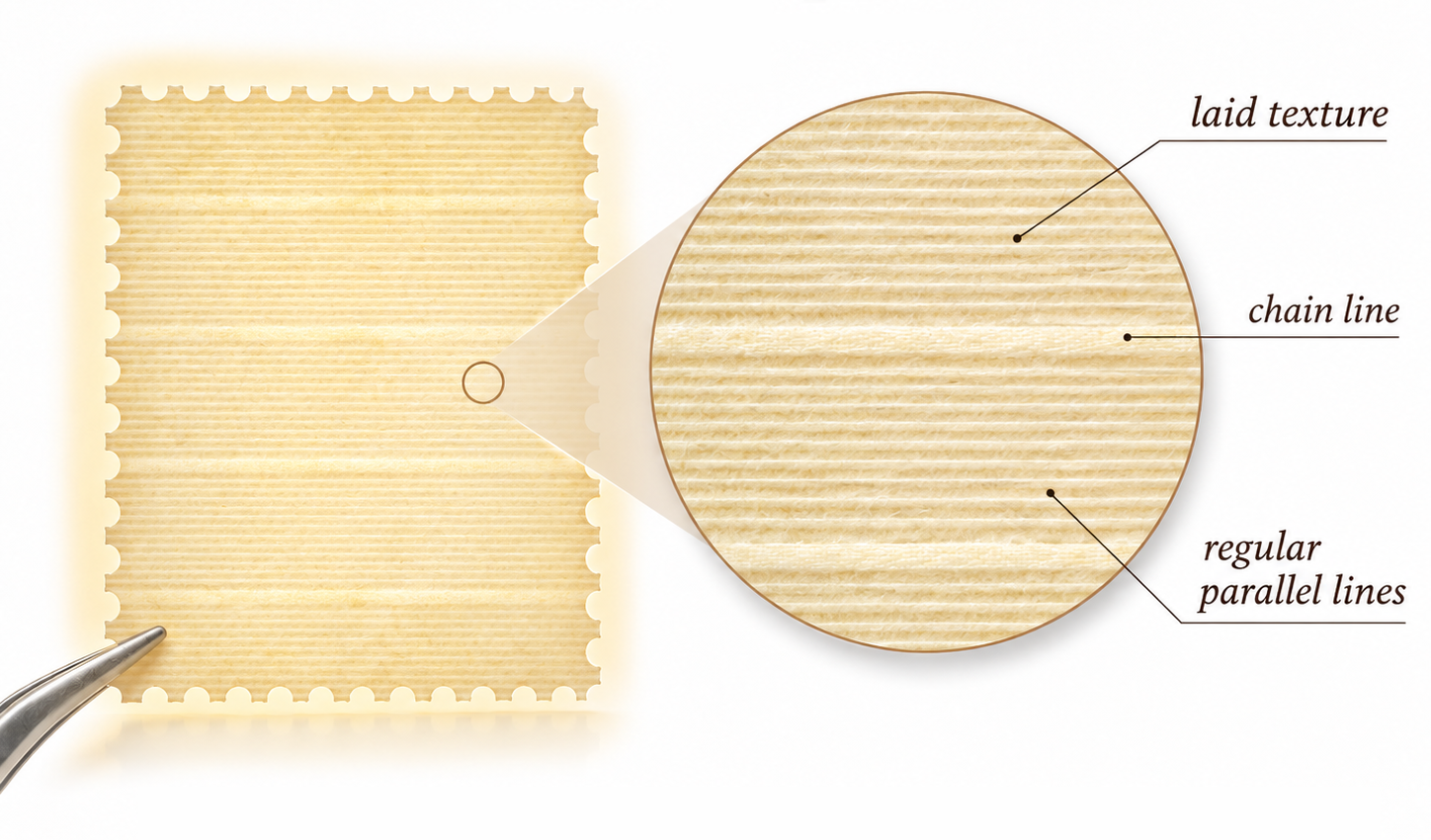
Wove describes the structure of the paper. Viewed against the light, it has a fairly even appearance. Laid paper instead shows a regular pattern of lines left by its manufacture.
Paper structure and watermark are separate characteristics: wove paper can carry a watermark. Both can help distinguish stamps with similar printed designs.
Wove paper: even texture without laid lines.Image information
Click image to magnify
Diagram of wove paper with a magnified inset showing an even texture without laid lines.
Credit
Stunning Stamps · 2026
Notes
Digitally constructed
Laid paper: regular parallel lines, shown for comparison.Image information
Click image to magnify
Diagram of laid paper with a magnified inset showing regular parallel lines.
Credit
Stunning Stamps · 2026
Notes
Digitally constructed
On this stamp
This sixpence belongs to the VR-watermarked issue; the watermark cannot be read from the front-view reconstruction.
The letters VR stand for Victoria Regina: Queen Victoria. On the embossed sixpence they form a large, plain-lettered watermark made in the paper, rather than printed in ink.
The sheet was prepared with forty VR watermarks, one for each intended stamp position. Hand placement of the impressions means that the relationship between printed design and watermark must be examined on the actual paper.
A front-view reconstruction cannot establish the watermark’s position or orientation. Paper structure, watermark and the coloured design are separate features; identifying one does not by itself confirm the others.
On this stamp
The sixpence has a VR watermark rather than the pair of embedded blue threads used for the shilling and tenpence.
A post-office sheet is the unit supplied for sale and accounting. All three embossed values were arranged to total one pound: twenty shillings, twenty-four tenpences or forty sixpences. Their different stamp counts follow from their face values.
The shilling sheet had five rows of four; the tenpence had six rows of four. The sixpence sheet comprised two panes of twenty. A pane is a group within a larger sheet.
These arrangements describe the intended layout, not a plate carrying twenty or forty designs. Each impression was made singly, so the spaces between neighbouring stamps could vary.
On this stamp
40 stamps: two panes of twenty. The two panes each contained five rows of four.
A working die is the metal tool that directly impresses the paper. It is distinct from the original portrait die and the intermediate tools used to reproduce the design. These stamps were made one at a time, so a working-die number is not a sheet position or a printing-plate number.
Small W.W. initials refer to William Wyon; an accompanying numeral identifies the working die. These marks lie at the base of the bust. Weak embossing can leave them incomplete or unreadable, so absence of a clear mark is not enough to identify a variety.
The dies recorded for issued adhesives are 1–2 for the shilling, 1–4 for the tenpence and 1 for the sixpence. Higher numbers also occur in the history of postal stationery and telegraph forms; those later uses must be kept separate.
On this stamp
Die 1 for issued adhesives. No microscopic die number is assigned to this reconstruction.
Gum arabic is a water-soluble adhesive. The paper was gummed before it went into the embossing press, so the operator had to present the correct side to the die. Contemporary supplies ranged from nearly clear to yellowish or brown.
Some sixpence sheets were accidentally impressed on the gummed side. Ormond Hill’s letter of 28 February 1855 explains that the gum had been coloured to make the two sides easier to distinguish. The resulting greenish gum is a feature of later sixpence supplies, not the colour of the printed design.
The gum on an original belongs to its condition history: washing can remove it, and a later application is not original gum. Its presence or colour cannot be assessed from a front-only illustration.
On this stamp
Later sixpence supplies had green-tinted gum to help operators recognise the gummed side. Some earlier sheets had been stamped on that side by mistake.
A stamp catalogue gives each listed issue a reference number. SG means Stanley Gibbons, the publisher of the catalogue used here. These numbers help collectors refer to the same issue; they are not serial numbers printed on individual stamps.
A range of numbers groups related entries. Colour, paper or perforation differences may account for separate listings within that range.
On this stamp
This illustration represents SG58–60 design family. It does not certify an original’s shade, gum, margins or working die.
Somerset House housed the Inland Revenue’s Stamping Department. Its work included manufacturing stamps and controlling their supply. In 1914 the relevant staff and responsibilities passed to the Post Office.
On this stamp
The Inland Revenue’s Stamping Department at Somerset House produced the 1854 embossed sixpence, striking each embossed impression separately.
William Wyon was a medallist and engraver at the Royal Mint. His models of royal heads were made for coins and medals and also became sources for stamp portraits.
On this stamp
Wyon’s earlier portrait die was reused for the sixpence, with alterations to the hair; he did not prepare this later frame.
Thomas Moss engraved stamp ornament and lettering. His recorded work on the Victorian embossed adhesives includes their frames and the curls added to the royal portrait.
On this stamp
Moss is credited with engraving the frame, inscriptions and added curl.
Ormond Hill worked in the government’s Stamping Department. He helped prepare stamp designs and deal with manufacturing problems, later becoming Comptroller of the department.
On this stamp
Hill adapted the earlier embossed design for the sixpence, with curved portions in the frame and a floral panel below the portrait.
The country identifies the postal authority that issued the stamp. The monarch identifies the ruler whose portrait it carries. A definitive is an everyday stamp intended for regular postal use.
On this stamp
This is a Great Britain definitive bearing Queen Victoria’s portrait.
The denomination is the stamp’s face value: the amount of postage it represents. Its price to a collector can be quite different.
In Britain’s old currency, 12 pence made one shilling and 20 shillings made one pound: 240 pence altogether. The abbreviations were d for pence, s for shillings and £ for pounds. The d comes from the Latin denarius. A halfpenny, written ½d, was half an old penny.
On this stamp
Sixpence was half a shilling. Forty sixpences made one pound.
A shade is a variation within a stamp’s colour. Some variations receive their own catalogue numbers even though the design and denomination stay the same.
Compare known examples under consistent lighting. Fading can change a stamp’s appearance, and photographs or screens can alter how colours look. A catalogue colour name helps describe a shade; it is not a colour test by itself.
On this stamp
Mauve/purple describes the colour family represented here. The reconstruction is not a calibrated example of an individual catalogue shade.
These three values share a method of manufacture: pressure moulded the paper into a raised design while colour was applied to its flatter surface. The shilling appeared in 1847, the tenpence in 1848 and the sixpence in 1854.
They are adhesive stamps, made on gummed sheets and cut out for sticking to letters. Embossed postal stationery carries its stamp directly on an envelope or other form. Related designs and dies were used for that work too, so an embossed impression is not automatically one of these adhesives.
On this stamp
This 1854 sixpence belongs to the three-value embossed adhesive series.
A higher denomination let a sender pay a substantial charge with fewer stamps. These values served overseas postage; the sixpence also paid the registration fee. A face value alone does not identify the service for which a stamp was used.
Foreign postage depended on the date, destination, route and weight. Several stamps could pay a heavier letter or combine to make a rate for which there was no single denomination. Registration was an additional service charged separately from ordinary postage.
A complete cover preserves evidence that a loose stamp has lost: address, date, routing instructions and the other stamps used with it. Those details are needed before assigning a particular postal rate.
On this stamp
The sixpence could pay certain overseas rates or the registration fee. Paying registration did not also pay the letter’s ordinary postage.
A cancellation marks a stamp as used, preventing it from paying postage again. A dated postmark and the obliterating mark over the stamp can be separate impressions.
The prominent white head was considered useful for cancellation: it met the cancelling device readily, and its uninked surface took the obliterating ink clearly. This was one reason the authorities favoured embossing for the higher values.
A cancellation can obscure the tiny die marks or interrupt the apparent outline of the portrait. On a loose stamp, a numeral or part of a date may be informative without proving the destination or charge paid.
On this stamp
The unused reconstruction has no cancellation. On a used original the inked obliteration may partly conceal the relief and die initials.