
The design of the 1s green and carmine
Queen Victoria · Great Britain · Thomas De La Rue & Co. · 1900
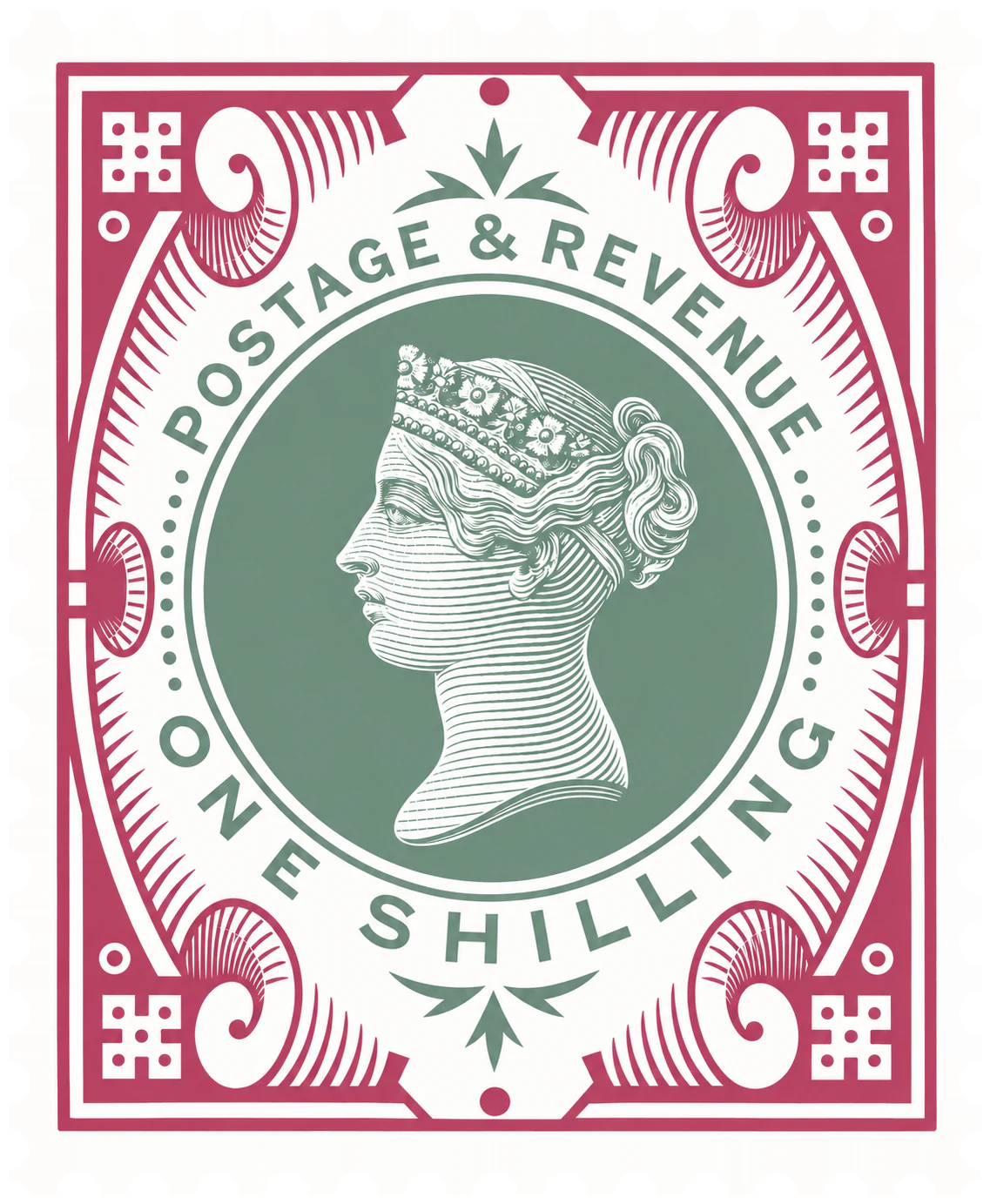
The green centre and carmine frame
The 1900 shilling retained the familiar design of the earlier dull-green stamp, but divided it into two colours.
Victoria's portrait, the oval inscription band and the denomination remained green. The surrounding ornamental frame became carmine-red.
This made the shilling more distinctive from the newly green halfpenny. [1]
The engravers did not need to invent a completely different composition.
Instead, they separated an established design into two parts that could be printed independently.
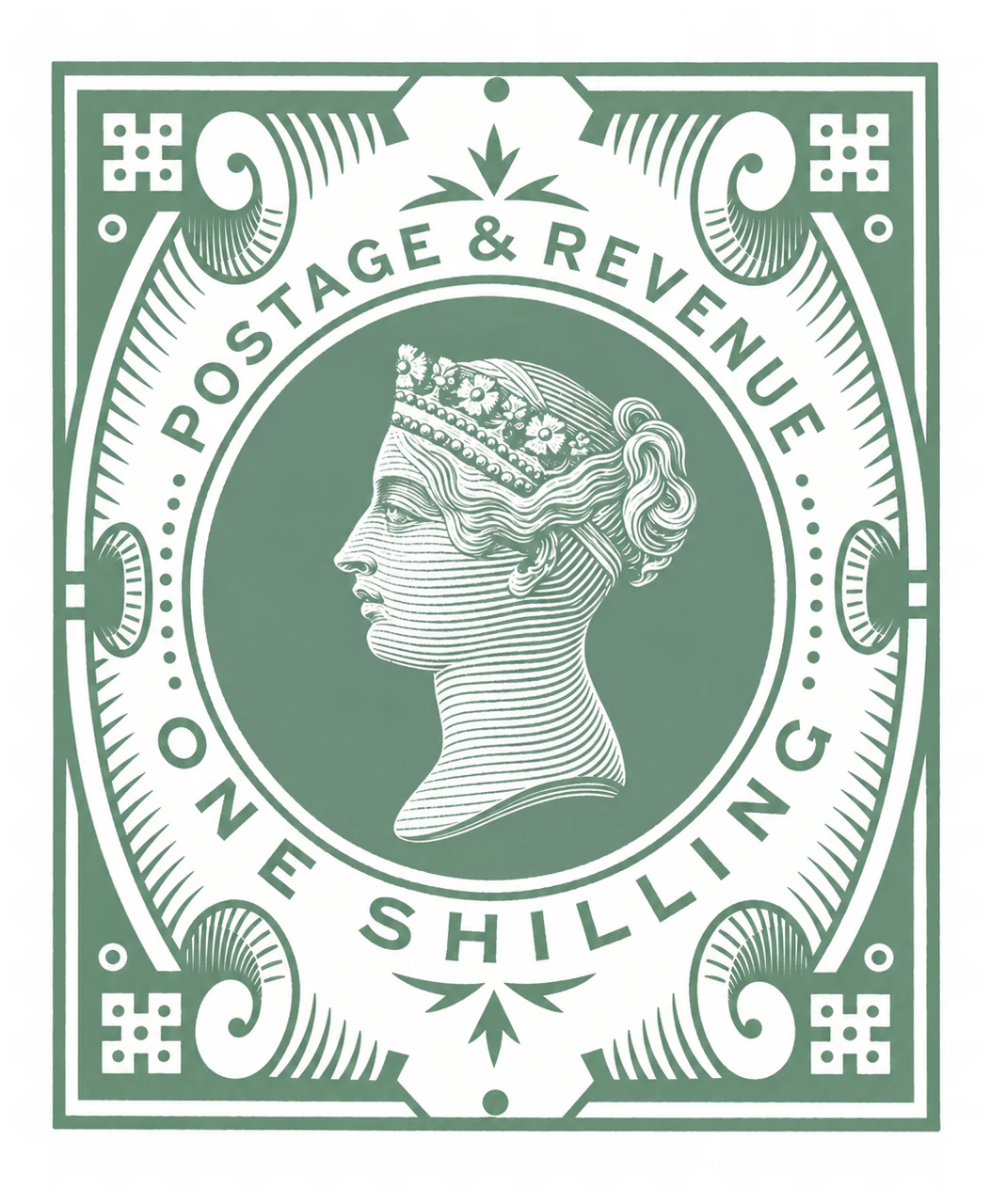
Compare the same composition before and after it was divided between two printing colours.
Click either stamp to magnify
The colours chosen with scissors and paste
The final colour combination began as an experiment with existing stamps.
De La Rue printed the old shilling in a range of colours, then cut out the central portraits and pasted them into frames from other impressions.
Five sets of eighteen combinations were prepared. The winning arrangement, numbered 9A, combined dull green with carmine-red. [1]
The trial was approved in December 1899.
The finished stamp therefore originated not as a newly engraved design, but as a miniature collage assembled from pieces of differently coloured stamps.
Two engravings instead of one
The original green shilling had been printed in a single colour.
For the 1900 version, De La Rue separated the design into two engraved printing surfaces.
The green plate carried Victoria's portrait, the inscriptions and the value. A separate plate printed the carmine outer frame. [2]
This differed from several earlier bicoloured Jubilee stamps, where a separate duty plate supplied the denomination.
The two impressions had to align accurately to form the finished design.
A familiar single-colour stamp had become a considerably more complicated object to manufacture.
The proofs that show the two parts separately
Surviving die proofs reveal how the design was divided.
The green centre engraving was proofed on 6 February 1900, with the instruction BEFORE HARDENING. A separate proof shows the outer frame without Victoria's portrait. [3]
The frame proofs continued through February, and further impressions were taken later in the year.
Seen separately, the two engravings look almost like incomplete postage stamps.
Only when printed together do they produce the familiar green portrait surrounded by carmine ornament.
The carmine frame that sometimes broke
The separately printed carmine frame could develop defects without affecting the green portrait.
One surviving shilling shows missing portions of carmine in the lower-left border, together with a stray carmine mark above the S of SHILLING. [4]
Other examples have breaks in the outer frame.
The green portrait could remain clear while the surrounding red ornament was incomplete.
These small irregularities reveal the independence of the two printing operations. A defect affecting one plate did not necessarily affect the other.
The coloured lines around the sheet
The shilling was printed in sheets of 240 stamps, divided into two panes of 120.
Each pane could be divided into smaller groups of twenty. The margins carried protective rules and positioning marks associated with the printing plates. [2]
The rules helped protect the printing surfaces from wear, while the positioning marks assisted accurate perforation and colour registration.
The bicoloured shilling used one principal marginal setting.
A marginal block can reveal the working arrangement of the two-colour printing that is hidden when examining a single stamp.
The crown hidden beneath the colours
The shilling was printed on paper carrying the Imperial Crown watermark.
The crown was formed within the paper during manufacture rather than printed in ink.
R. D. Turner & Co. of Roughway Mill in Kent supplied the watermarked paper for the Jubilee series. [2]
The watermark was already present before the green portrait and carmine frame were printed.
The finished stamp therefore combined three distinct contributions: the papermaker's hidden crown and two separately printed colours.
A portrait of a fifteen-year-old princess
Victoria's familiar profile ultimately derived from William Wyon's medal portrait, based on a sketch made in 1834 when she was fifteen.
Henry Corbould adapted Wyon's likeness for Britain's first postage stamps, while later engravers developed versions suitable for De La Rue's surface-printing machinery. [5]
The shilling of 1900 retained the familiar youthful Queen.
Victoria was eighty-one when the stamp appeared, but the engraved portrait continued to recall the young princess of the 1830s.
Joubert’s engraving supplied the earlier surface-printed version of the likeness inherited from Corbould’s drawing and Wyon’s medal. These are earlier portrait sources, not new commissions for 1900. De La Rue’s later work divided the established shilling design into a centre carrying the portrait, inscriptions and value, and a separately printed outer frame. [6, 7, 8, 5, 9, 10]
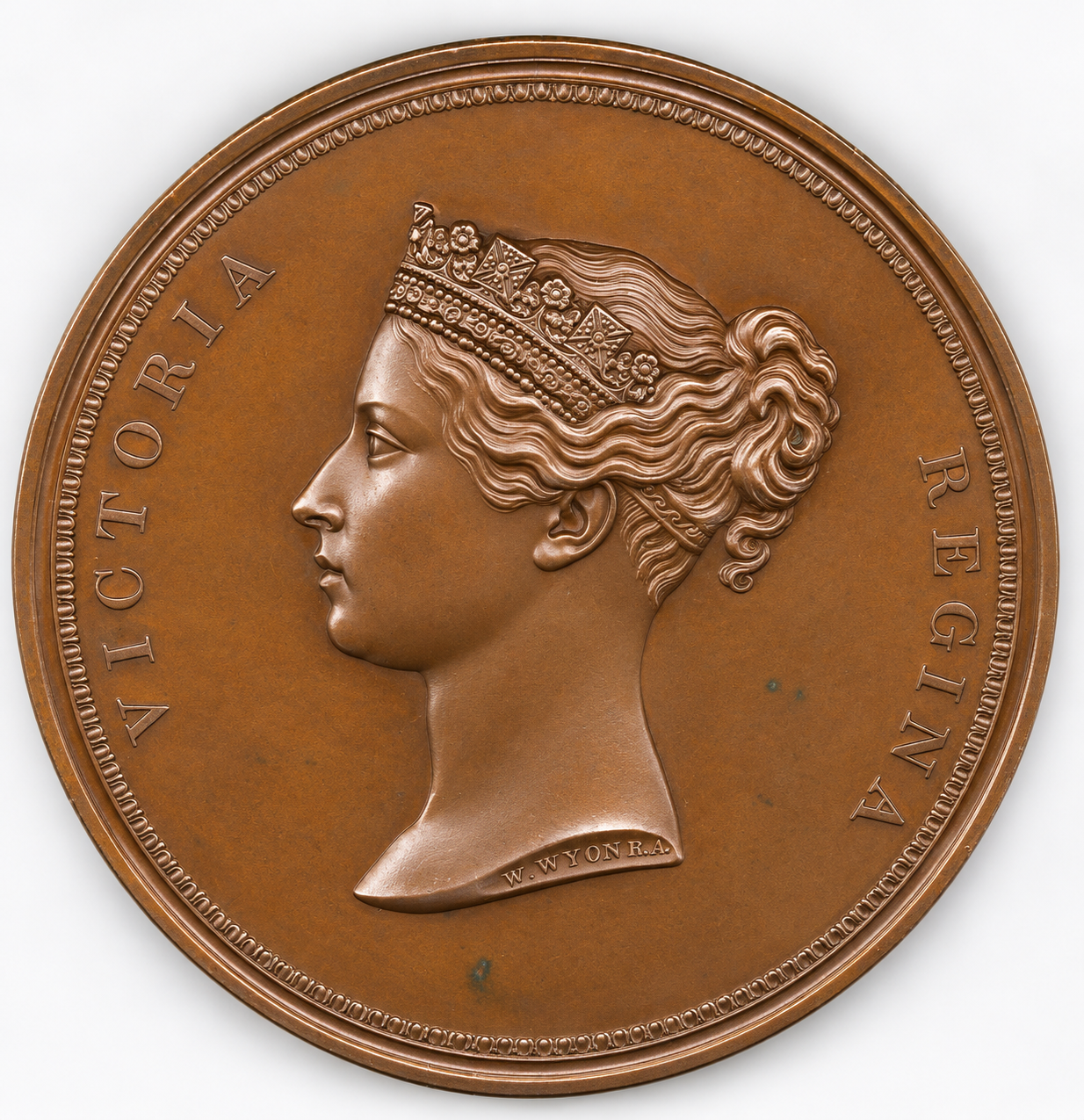
Image information
Click image to magnify
Bronze medal showing the young Victoria in left-facing profile, wearing the diamond diadem, with the inscription VICTORIA REGINA.
- Credit
- Heritage Auctions, via Wikimedia Commons. CC BY 3.0.
- Notes
- Brightness, contrast, sharpness and colour balance adjusted by Stunning Stamps.
The diamond diadem made for a king
The ornament in Victoria's hair was commissioned for George IV's coronation in 1821. [11]
It contains 1,333 diamonds, with crosses and the national emblems of the rose, thistle and shamrock.
Victoria later wore the diadem in portraits, and it became a familiar feature of British postage stamps.
On the green-and-carmine shilling, its jewels are reduced to tiny printed marks. A magnificent royal ornament had become part of one of the last postage stamps introduced during Victoria's reign.

Image information
Click image to magnify
Digitally created illustration of the diamond diadem, with crosses, floral emblems and rows of pearls, resting on a blue cushion.
- Credit
- Stunning Stamps.
- Notes
- Digitally created.
Sources
- The 1887 Jubilee Issue: One-Shilling Essays and Colour Trials
- The 1887 Jubilee Issue: Technical Information — bicoloured printing, paper and marginal rules
- The 1887 Jubilee Issue: One-Shilling Die Proofs
- GB Stamps: One-Shilling Green and Carmine with Broken Frame
- Douglas N. Muir, Royal Mint Museum: William Wyon & the Penny Black
- Robert B. Galland, The First Low Value Surface Printed Postage Stamps of Great Britain (RPSL, 2014), p. 3: earlier Joubert portrait engraving after Corbould
- Douglas N. Muir, William Wyon & the Penny Black, Royal Mint Museum
- Philip Waud and David Willmer, The Story of the QV Jubilees, GBPS display at RPSL (2019), development, laydown 2 frames 2–3 and chronology
- Heritage Auctions, William Wyon medal photograph, via Wikimedia Commons (enhanced for display)
- Wyon medal photograph: Creative Commons Attribution 3.0 licence
- Royal Collection Trust: George IV's Diamond Diadem
