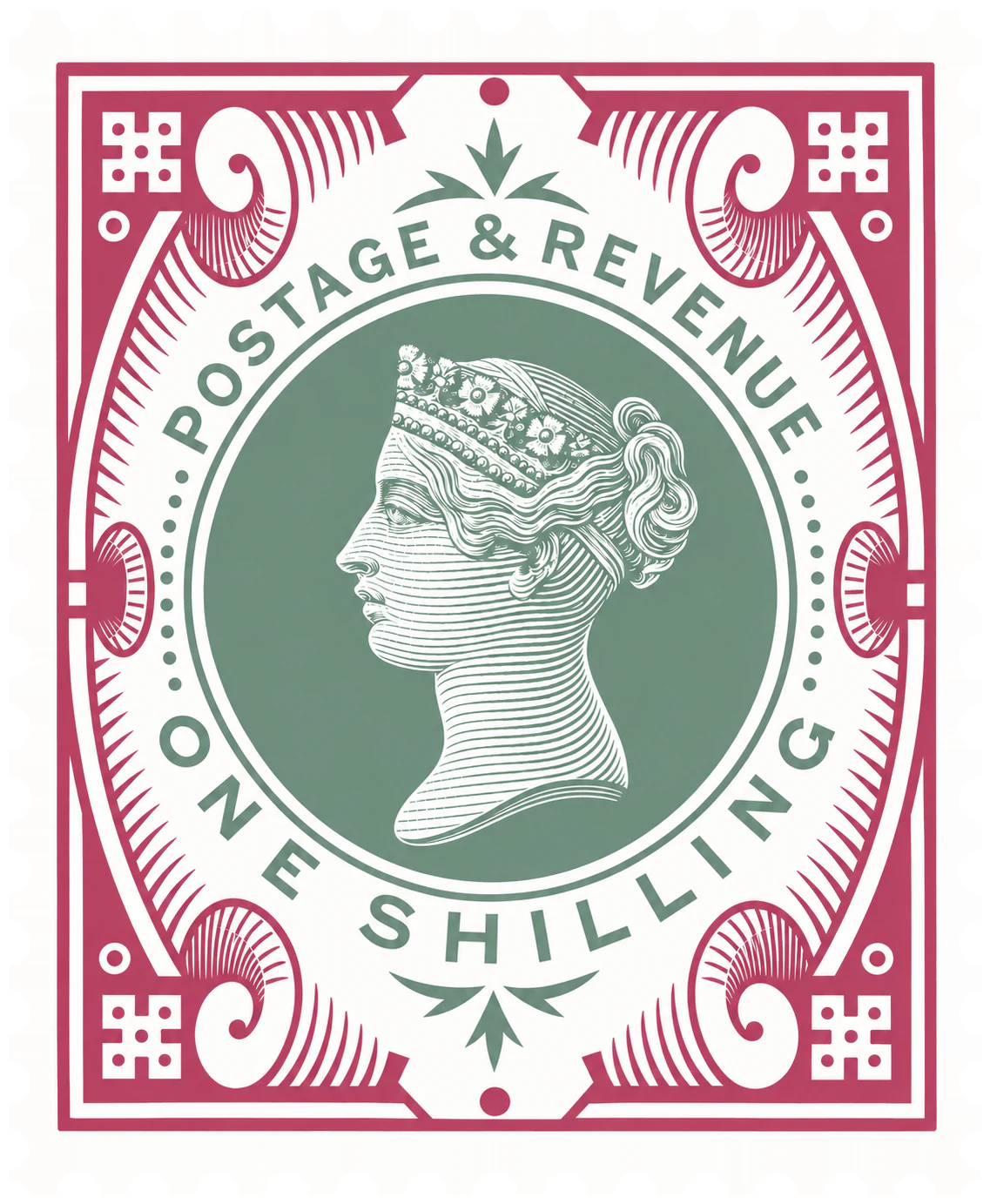
The final Victorian Jubilee stamp appeared on 11 July 1900, after the new green halfpenny forced a change to the existing green shilling. De La Rue experimented with eighteen colour combinations before selecting a green portrait and carmine frame. Rather than abandon the established design, the engravers divided it into two separately printed parts. The result was a striking two-colour stamp that retained Victoria's familiar portrait during the final months of her reign.
Stories
The halfpenny that forced the shilling to change
The halfpenny that forced the shilling to change
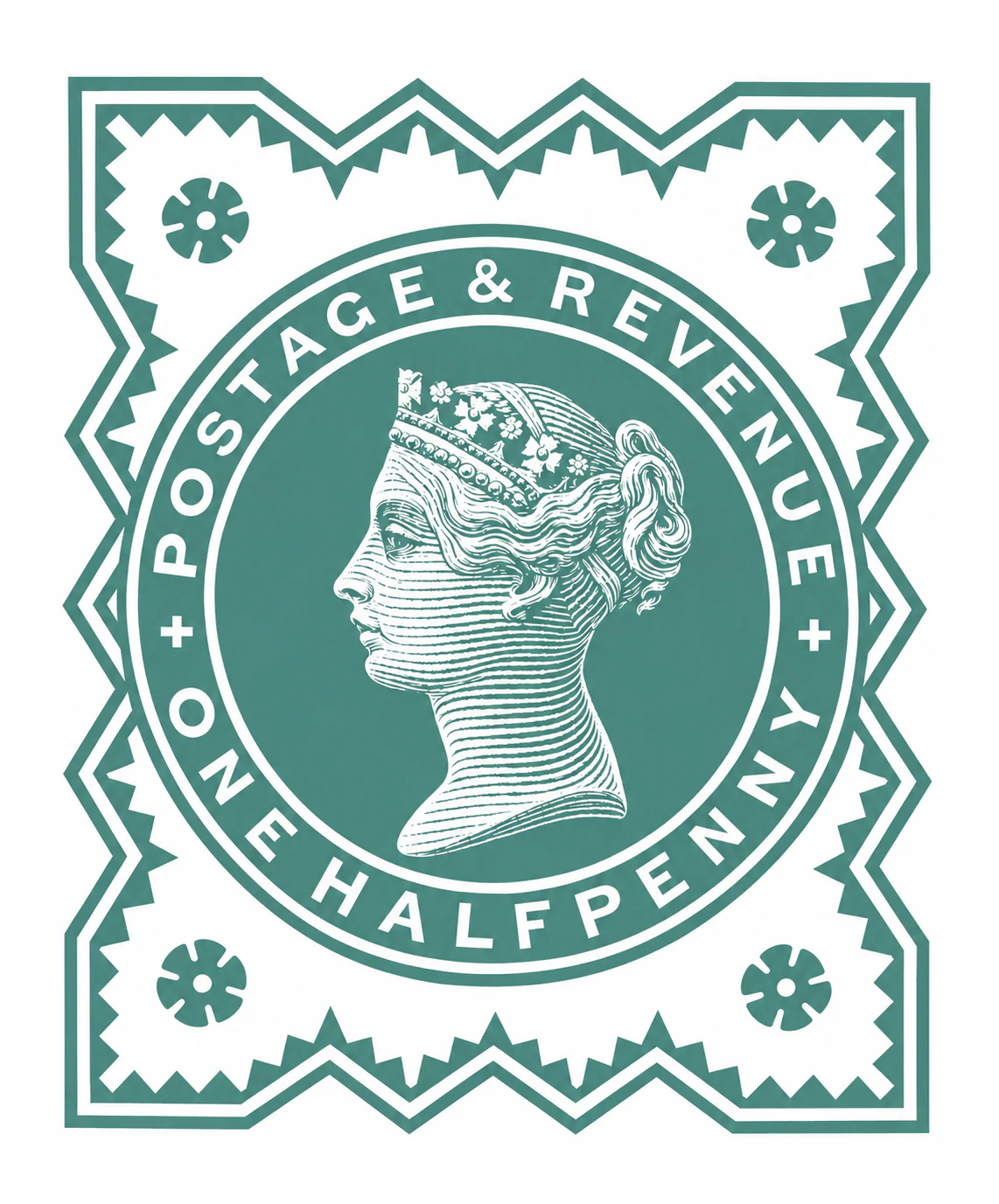
In 1899, the Post Office decided to change the halfpenny from vermilion to blue-green, following international recommendations on stamp colours. The new colour was introduced on 17 April 1900. [14]
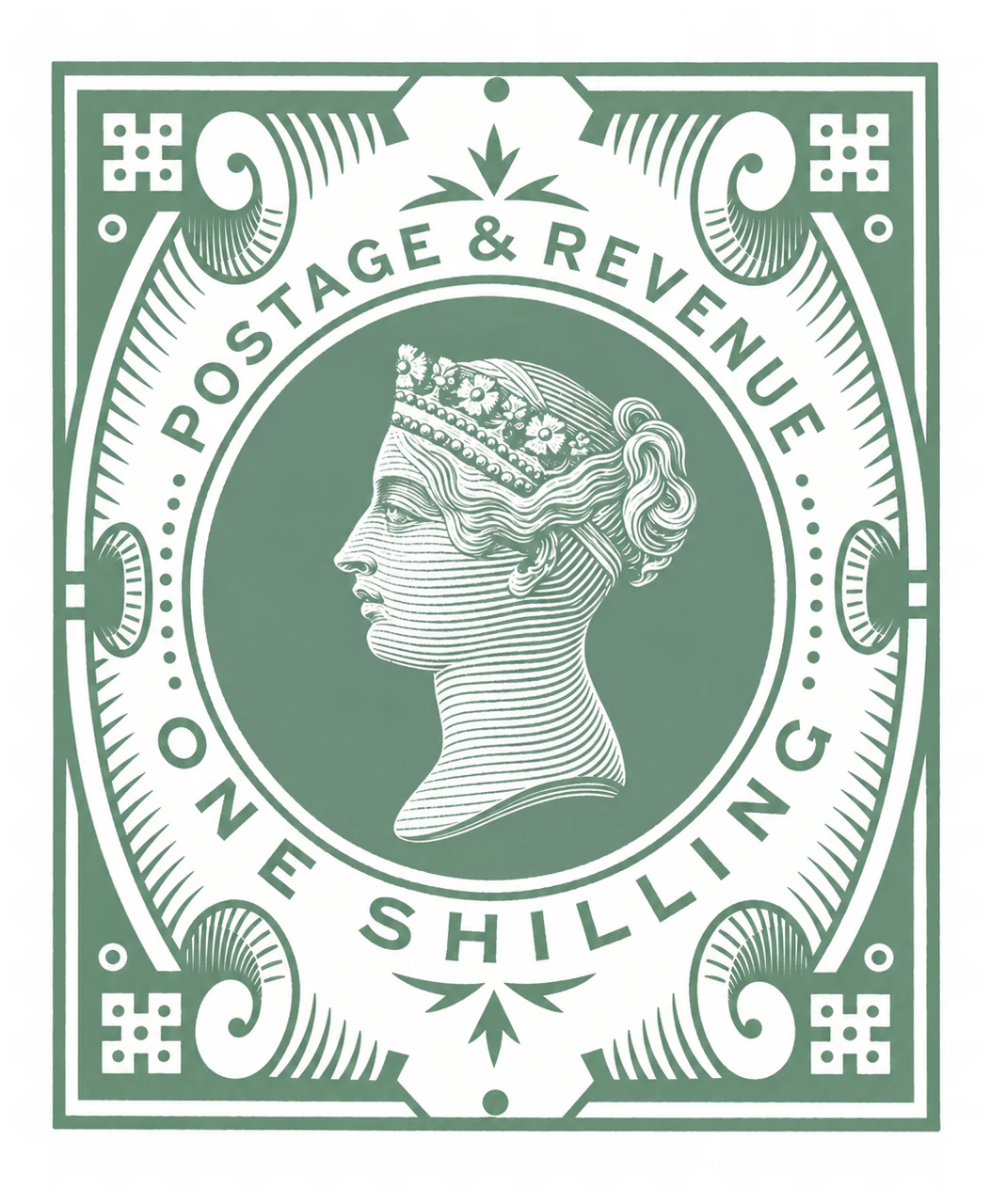
That created an awkward problem. Britain's existing one-shilling stamp was also green, and officials feared that the two denominations might be confused.
The Post Office therefore asked De La Rue to prepare a two-colour shilling, retaining the familiar design if possible. The request was made around 25 August 1899. [15]
The finished stamp appeared on 11 July 1900.
The change had been prompted not by a problem with the shilling itself, but by a decision affecting the country's smallest denomination.
The three issued designs involved in the change of shilling colour.
Click a stamp to magnify
The artist who tried painting the stamp by hand
De La Rue's first attempt to redesign the shilling was remarkably simple.
An existing green stamp was carefully overpainted, turning its outer frame rose-lilac while leaving Victoria's portrait and the centre green.
The work was painstakingly slow. A surviving example still shows the artist's brushwork, including details added in Chinese white. [16]
The printers soon abandoned this approach.
Instead, they printed the existing shilling in several different colours, cut out the central portraits and pasted them into frames of contrasting colours.
The resulting miniature collages allowed officials to judge the possible combinations without commissioning a new engraving for every experiment.
Eighteen designs and one marked Approved
On 27 October 1899, De La Rue received an order for sixty sheets of paper to produce experimental shillings.
The printers made five sets of eighteen colour combinations. Some used green portraits; others used purple. The surrounding frames appeared in colours including blue, grey, orange-brown, violet and carmine. [15]
One set was retained by De La Rue, its impressions crossed out with a pen. Four others were sent to the Inland Revenue on 9 November.
A surviving set contains the combination numbered 9A, endorsed "Approved" in red handwriting.
On 23 December 1899, De La Rue was formally informed that 9A had been selected.
A few tiny cut-and-paste experiments had determined the appearance of Britain's last Victorian shilling.
The engraver's blue tick
With the colours approved, the engravers could prepare the final printing tools.
A remarkable surviving proof records work on the Queen's portrait between 24 January and 5 February 1900. Several dates were written in the margin, and a blue tick appears in the upper-right corner. [17]
On 6 February, another proof was marked BEFORE HARDENING.
The outer frame required its own engraving, with further proofs prepared during February.
The printers were converting a design chosen by arranging pieces of coloured paper into two steel tools capable of producing millions of identical stamps.
The handwritten dates and blue tick preserve an unusually personal record of the work.
The printing plate that failed
The two-colour shilling required separate plates for the green centre and the carmine frame.
De La Rue prepared four plates for the centre, numbered 9 to 12, continuing the sequence from the earlier green shilling. Five frame plates were also made, but one proved defective. [16]
The remaining plates were used in different combinations, although the surviving records do not establish exactly how they were paired.
The faulty plate represented work that could not be used as intended.
Even after years of experience with two-colour printing, De La Rue could still encounter difficulties preparing the equipment needed to bring two impressions together.
The two stamps removed from an official sheet
On 10 April 1900, the new shilling was officially registered.
A complete printing sheet was retained as evidence of the approved design and printing equipment. It combined head plate 9 with frame plate 2. [18]
Only two stamps were removed from the sheet.
These individual impressions survived outside the official archive, while the remainder continued to document the government's approval.
The sheet was not merely a collection of stamps. It was a record of the engravers' and printers' work, preserved at the moment their new design was accepted for production.
Why do some stories appear on several pages?
Every page is written to make sense on its own. Visitors often arrive directly at a particular stamp or subject, without having explored the rest of the site.
Some stories are relevant to several stamps, so they are repeated where they help explain what you're looking at. For those exploring a series, the details specific to each stamp generally come first, with the more familiar stories further down the page.
This way, you can explore the site in any order without missing interesting background.
An established green design gains a carmine frame. Explore the colour combinations assembled with scissors and paste, the separate centre and frame engravings and the proofs that show how the two impressions were aligned. [19, 20, 21]
De La Rue grew from a playing-card business into a major security printer. It supplied British postage stamps from the Victorian period and printed the Edward VII issues before the contract changed in 1911.
On this stamp
Thomas De La Rue & Co. adapted and printed the shilling in green and carmine in 1900. The green centre plate carried the portrait, inscriptions and denomination; a separate plate supplied the carmine outer frame. This arrangement differs from Jubilee values whose contrasting duty plate printed the denomination.
Jean Ferdinand Joubert de la Ferté was a French engraver and photographer. He trained in Paris and later worked in London, where his engraving helped establish De La Rue’s surface-printed postage stamps.
On this stamp
Joubert engraved the earlier surface-printed Queen’s head after Corbould’s drawing. On the 1900 shilling green and carmine, this identifies an inherited portrait model, not a documented commission to engrave its later die or frame.
William Wyon was a medallist and engraver at the Royal Mint. His models of royal heads were made for coins and medals and also became sources for stamp portraits.
On this stamp
Wyon’s City of London medal supplied the youthful likeness inherited on the 1900 shilling green and carmine. He is credited as an earlier artistic source, separate from De La Rue’s later stamp design.
Henry Corbould was a draughtsman and book illustrator. He trained with his father and at the Royal Academy Schools, where he received a silver medal for a life study.
On this stamp
Corbould’s drawing after Wyon’s medal supplied the model for the earlier surface-printed Queen’s head. His connection to the 1900 shilling green and carmine is that inherited portrait source, not the preparation of its later frame or die.
The country identifies the postal authority that issued the stamp. The monarch identifies the ruler whose portrait it carries. A definitive is an everyday stamp intended for regular postal use.
On this stamp
This 1s belongs to Victoria’s Jubilee family. Its youthful royal likeness inherits earlier portrait models rather than depicting the Queen’s appearance in 1900.
The denomination is the stamp’s face value: the amount of postage it represents. Its price to a collector can be quite different.
In Britain’s old currency, 12 pence made one shilling and 20 shillings made one pound: 240 pence altogether. The abbreviations were d for pence, s for shillings and £ for pounds. The d comes from the Latin denarius. A halfpenny, written ½d, was half an old penny.
On this stamp
The face value is 12 old pence. There were twelve pence in a shilling and twenty shillings in a pound; this is a postal payment value, not a present collecting price.
An essay explores an idea; a die proof records work on an engraving; a registration sheet records approval of printing material. None of these dates is automatically the day on which a stamp became available at a post office.
The December 1886 circular announced the first ten Jubilee denominations for 1 January 1887. Later notices and contemporary reports establish the added values. For the 10d, Wright and Creeke distinguish the advertised readiness on 22 February 1890 from sale on Monday 24 February.
A date attached to a design does not necessarily date every shade, paper batch or die state. Read the individual note for the category illustrated. Old designs could remain in use while stocks were exhausted after a replacement appeared.
On this stamp
The green-and-carmine shilling was issued on 11 July 1900 to distinguish it from the new green halfpenny. Its April registration and earlier colour trials are preparation dates.
A stamp’s colour can come from its printing ink, its paper, or both. The Jubilee 2½d, 3d and 6d use coloured paper beneath purple printing. The two-colour values instead combine impressions from separate inked surfaces.
Printings can differ in intensity without a change of engraving. Inks can also fade, wash out or change after chemical treatment. A pale green original is not automatically a previously unrecorded blue shade.
Catalogue shade names provide useful comparisons, but a screen is not a colour standard. Identify the correct paper and design first, then compare sound original examples under consistent lighting. The illustrated colour category is identified in the individual note.
On this stamp
The illustrated category is SG214, green and carmine. The two colours come from separate printing impressions. Shade and condition require comparison with original material.
The name Jubilee is a convenient name for the definitive designs introduced during Victoria’s Golden Jubilee year. They emerged from the review of the unpopular Lilac and Green stamps, rather than being a single commemorative picture of the celebrations.
Ten denominations from ½d to 1s appeared on 1 January 1887; the Penny Lilac continued alongside them. The 10d and 4½d were later additions, and the halfpenny and shilling changed colour in 1900.
The sixteen articles here also distinguish two twopenny colour categories and the two fivepenny duty dies. Those editorial divisions should not be mistaken for sixteen denominations or sixteen simultaneous issues.
On this stamp
This 1s is one of sixteen articles covering twelve denominations, two halfpenny/shilling colour changes, two twopenny colour categories and the fivepenny duty-die distinction. The Penny Lilac continued separately.
A catalogue number identifies a defined combination of design, colour and sometimes die or paper. It is a starting point for comparison, not a guarantee that two stamps share the same printing plate, marginal setting or condition.
The twopenny colour articles and fivepenny die articles retain their own references. The 1900 halfpenny and shilling are later colour issues of established designs. A missing margin can remove the evidence needed to identify a specialist setting.
These reconstructions illustrate the intended stamp designs. Their recorded specimen references support the drawing, but the printed face cannot certify an unseen watermark, original gum or the chemical identity of an ink.
On this stamp
The recorded reconstruction brief identifies SG214 for this 1s. The colour category is retained separately from specialist plate and marginal-setting claims. No unseen watermark or gum is certified.
Typography, also called surface printing, transfers ink from the raised parts of a printing surface. Recessed spaces leave the paper unprinted. A white detail in the design therefore need not have been printed in white ink.
De La Rue multiplied engraved designs through moulding and electrotyping to make working printing surfaces. For a bicoloured stamp, the parts assigned to each ink required separate surfaces and accurate alignment.
The diagram explains the principle of relief printing. It does not represent a particular Jubilee press or establish the order of the two impressions. The individual colour-separation note identifies which part of this design each ink supplied.
Surface printing, shown from the side. The paper is pressed onto the inked surface.Image information
Side view of surface printing. Paper is pressed down onto ink on the raised parts of a printing plate; the lower spaces do not touch the paper.
Credit
Stunning Stamps · 2026
On this stamp
De La Rue printed this 1s from raised inked surfaces. Separate impressions supply the two printed colours. The white details are unprinted areas, not an additional white ink.
A stamp printed in two inks requires the impressions to meet accurately. Their alignment is called registration. Head plate usually means the surface carrying the portrait; duty plate usually carries the denomination and associated ornament.
The 1900 shilling is an important exception: its green centre carries portrait, inscriptions and value, while the other plate prints the carmine outer frame. The names describe the division of the design, not a universal sequence through the presses.
The 2½d, 3d and 6d obtain their second visible colour from the paper and need only one purple impression. Both halfpennies and the 1887 green shilling are also single-ink designs. The schematic below illustrates two-colour alignment, not every stamp in this family.
Principle of two-colour printing. Shapes and colours are schematic; this does not show a particular stamp’s plate design or printing order.Image information
Two separate coloured impressions align on the same paper to make a complete design. Abstract oval and tablet stand for the two printing elements.
Credit
Stunning Stamps · 2026
On this stamp
The green centre plate carries Victoria’s portrait, the inscription band and the denomination. A separate plate prints the carmine outer frame. Unlike the other bicolours, the contrasting plate does not supply the value.
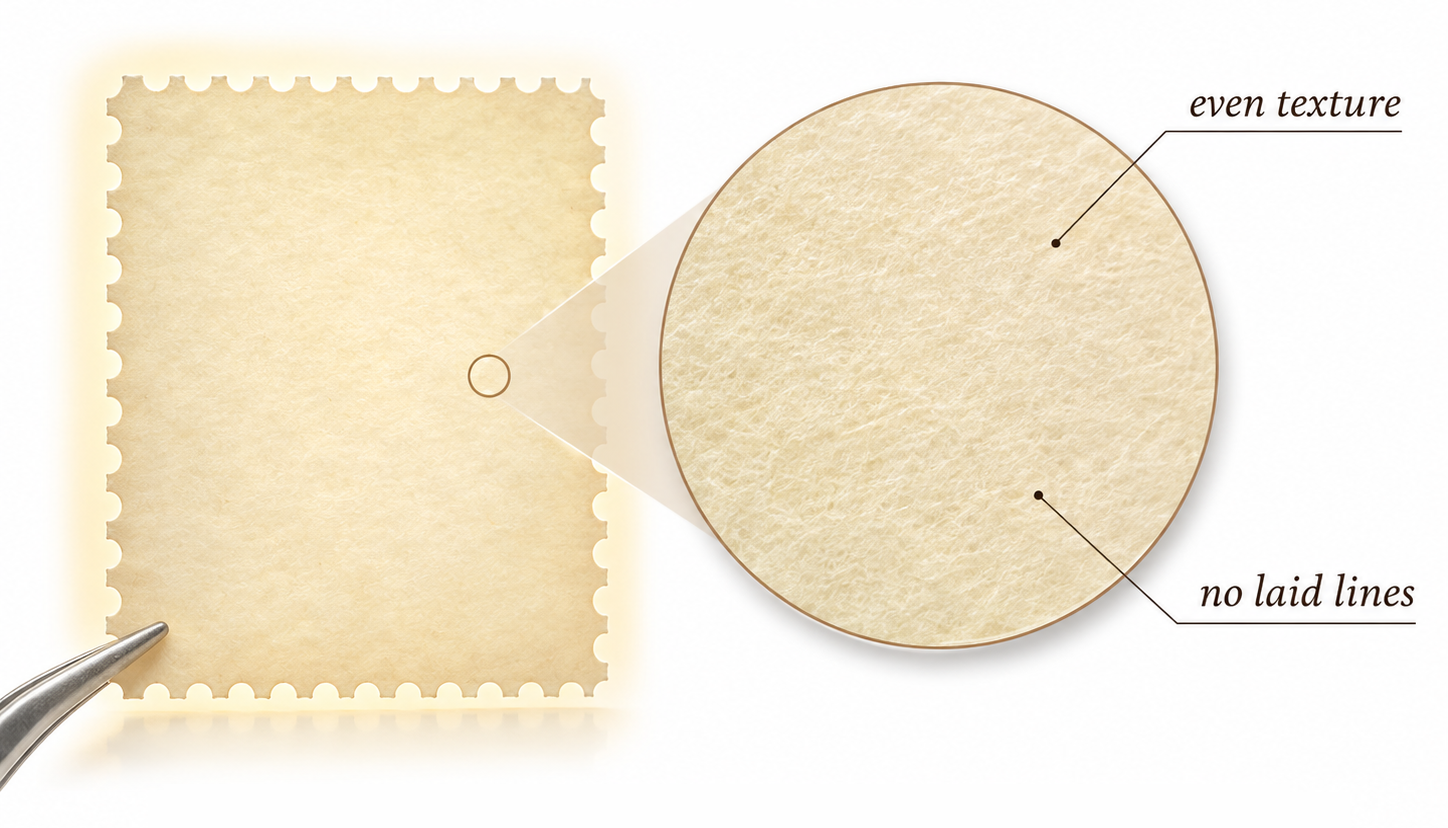
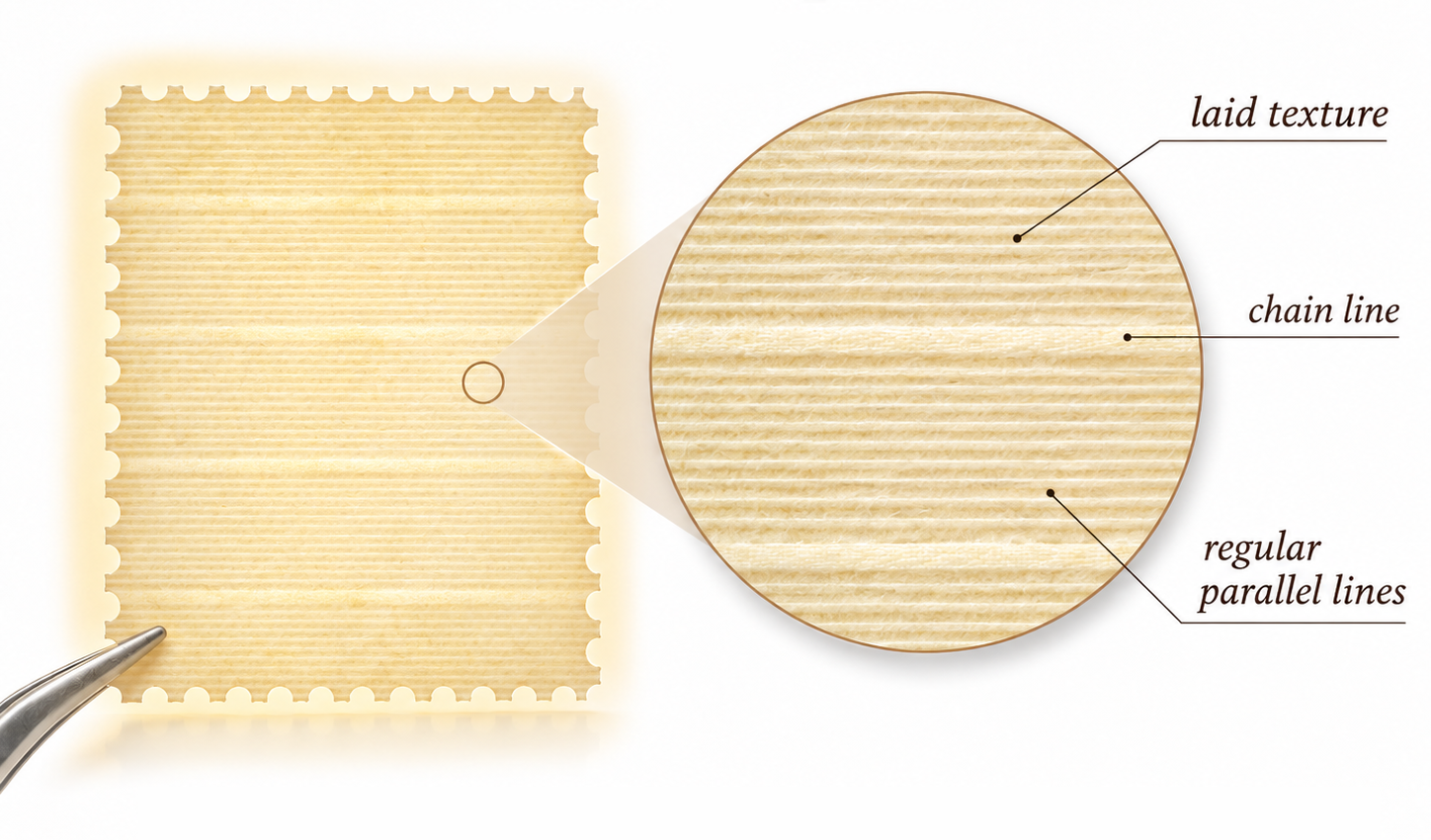
Wove describes the comparatively even structure of the paper, in contrast to the regular lines of laid paper. Structure, colour, watermark and gum are separate properties: a wove sheet can be coloured and watermarked.
Jubilee stamps were printed on machine-made Crown-watermarked paper supplied by R. D. Turner & Co. The paper carried its watermark before it reached the printing press. The mill-sheet arrangement depended on the denomination.
The two comparison illustrations explain wove and laid structures. They are diagrams, rather than photographs of Jubilee paper. The individual note identifies the stock used for the issue, while an original’s reverse is needed for a detailed examination.
Wove paper: even texture without laid lines.Image information
Click image to magnify
Diagram of wove paper with a magnified inset showing an even texture without laid lines.
Credit
Stunning Stamps · 2026
Notes
Digitally constructed
Laid paper: regular parallel lines, shown for comparison.Image information
Click image to magnify
Diagram of laid paper with a magnified inset showing regular parallel lines.
Credit
Stunning Stamps · 2026
Notes
Digitally constructed
On this stamp
The 1s uses machine-made wove Crown paper, supplied for the Jubilee issue by R. D. Turner & Co. Wove describes the fibre structure, separately from the white colour and hidden watermark.
The blue of the 2½d, yellow of the 3d and rose-red of the 6d belongs to the paper. Purple printing leaves that coloured paper exposed in the unprinted parts of the design and around the impression.
Paper batches could differ. The threepenny is also known on orange-yellow paper, while the sixpenny’s pink and red paper tones need to be distinguished from changes in the strength of its purple ink.
White-paper bicolours work differently: their contrast comes from separate printing inks. Paper colour should be assessed in unprinted areas and on the reverse, with allowance for staining and age; the colour of the portrait alone is insufficient.
On this stamp
The 1s is on white paper. Its contrasting colours come from separate printing inks. The coloured stocks of the 2½d, 3d and 6d are different paper categories.
A fugitive ink reacts to treatment intended to remove a cancellation. Doubly fugitive describes sensitivity to water and chemical treatment; it does not mean two colours or two impressions. The Jubilee security scheme relied chiefly on green and purple.
The original vermilion halfpenny was an exception to that green-and-purple scheme. Its 1900 replacement used several green formulations: the early lead-based ink was followed by zinc-based and then organic ink. Their history cannot reliably be reconstructed from visible shade alone.
Red duty inks present another problem. The 1994 RPSL study distinguishes ink formulation from apparent scarlet or carmine shade and discusses ultraviolet examination. A digital illustration cannot establish that reaction, and soaking a fugitive stamp is not a suitable identification test.
On this stamp
The 1s incorporates green head ink within the Jubilee security scheme. Its contrasting carmine outer frame printing is a separate ink; visible shade alone does not establish an exact chemical formulation.
The watermark is a thinner pattern formed in the paper, not an image printed on the back. Jubilee stamps use the Large (1880) Crown, also called the Imperial Crown, normally with one device behind each stamp.
The spacing of the devices follows the intended sheet layout. Larger lettering and crosses in the margins help identify parts of a mill sheet; they are distinct from the Crown behind a stamp and from coloured rules printed on the face.
An off-centre or inverted device must be established from an original. A reconstruction of the face cannot prove its position. Read the Crown together with the paper, format and issue: earlier line-engraved stamps used different Crown watermarks.
On this stamp
Each 1s normally covers one Crown watermark. Its paper belongs to the 480-Crown mill-sheet arrangement. The device is formed in the paper before printing.
The gauge counts the spacing of holes over two centimetres, not all the teeth on an edge. Written as 14 × 14, it gives the horizontal gauge first and the vertical second. Different stamp dimensions can produce different totals of teeth at the same gauge.
The ordinary Jubilee issues are comb perforated 14. A comb punches several adjoining sides in one movement, and its progression can leave diagnostic extension holes in a sheet margin. A change of perforator direction is not automatically a new gauge.
Margins may be perforated or left unperforated, and exceptional errors or imperforate proof material require separate identification. None of those categories creates a grouped ordinary perforation alternative among these sixteen articles.
Enlarged spacing diagram, not to scale. Match the spacing with a perforation gauge.Image information
Enlarged perforation spacing: fourteen equal intervals between hole centres span 20 millimetres. This is a schematic, not a ruler.
Credit
Stunning Stamps · 2026
On this stamp
The ordinary 1s gauges 14 horizontally and vertically. Different endpoint tooth counts or the treatment of a sheet margin do not establish another gauge. No grouped perforation alternative is present.
De La Rue used white gum arabic, applied before printing. The gum belongs to the reverse of the stamp and is distinct from the paper’s watermark and the inked image on its face.
Original gum, disturbed gum, hinge traces and regumming describe condition. A front photograph cannot settle those questions. The period account records accidental printing on the gummed side for some halfpennies and 2½d stamps.
Such errors need evidence from the original and its reverse. A smooth, clean reconstruction is not a claim of original gum, and a used stamp that has lost its gum does not reveal when or how it was removed.
On this stamp
De La Rue’s preparation gummed the paper before printing the 1s. The reverse of an original is needed to establish its gum condition; the front reconstruction does not claim mint gum or an accidental gummed-side printing.
A mill sheet is the large sheet supplied by the papermaker. Printing arrangements and the smaller units delivered to post offices are different measures. A pane is a block of stamps; a gutter separates panes; selvedge is the outer margin.
Most Jubilee values use 480-Crown mill sheets, commonly described through 240-subject arrangements with two panes of 120, each ten rows of twelve. The 4d, 4½d, 9d and 10d use 320-Crown mill sheets and small twenty-stamp panes, four rows of five.
Four panes of twenty stamps form an eighty-stamp block; eight panes make 160 stamps, and sixteen make the 320-stamp mill sheet. Production practice changed, so the word sheet needs a stated unit. The diagram illustrates pane and gutter terminology, not every Jubilee layout.
Sheet, panes and margins: a simplified example.Image information
A schematic printing sheet contains two panes separated by an unprinted gutter and surrounded by a margin.
Credit
Stunning Stamps · 2026
On this stamp
The 1s uses the familiar 240-subject arrangement of two panes of 120, each ten rows of twelve. The full mill sheet has 480 Crown devices. This is distinct from the smaller units prepared for post offices.
Large printed sheets could be divided before distribution or sale. The denomination and practical accounting requirements affected the size of these smaller units. A face-value total is an accounting sum, not a collector’s price.
Wright and Creeke describe 120-stamp 2½d panes worth 25 shillings, sixty-stamp fivepenny units of the same value, forty-stamp sixpenny units worth £1 and twenty-stamp shilling units worth £1. They describe the threepenny panes as divisible into forty-stamp units.
For the fringe values, twenty-stamp panes and four-pane eighty-subject units both occur in descriptions. State which is being counted, rather than presenting every intact block as the original mill sheet or assuming every office received the same form throughout the issue.
On this stamp
A twenty-stamp shilling unit totals £1, within the 120-stamp pane and two-pane 240-subject arrangement. The introduction of the carmine frame did not turn the shilling into a small fringe-value pane.
Jubilee lines are rules added around printing panes to protect their edges from the inking rollers. The printed lines are evidence of those working parts; they were not an extra border intended for each stamp.
The fringe values also used striped blocks in the wide gutters. These supports, sometimes called pillars or ladders, helped control curling and colour registration. Their purpose differs from that of the protective rules, even when both appear on the same marginal block.
A marginal setting describes an arrangement of rules, cuts and supports. Different denominations had different sequences, and a line absent from a trimmed single proves little. Use a sufficiently large marginal piece and the correct denomination’s study to identify a setting.
On this stamp
The bicoloured shilling has one principal marginal setting. Its green and carmine rules belong to separate printing surfaces; this does not reproduce the two-setting history of the earlier single-colour green shilling.
The halfpenny used an account or control letter in the lower sheet margin. Vermilion printings progress through letters A to Q; the 1900 green uses R. The letter helped account for production and paper rather than spelling out the denomination.
These letters are not the corner letters of earlier Victorian stamps, and a control is not interchangeable with a printing-plate number. Other Jubilee denominations do not share this halfpenny control-letter sequence.
A detached single normally loses its control evidence. An unperforated margin can still belong to an ordinarily perforated stamp, so the treatment of the selvedge and the gauge of the stamp must be recorded separately.
On this stamp
The 1s does not use the halfpenny’s A–R control-letter sequence. Its plate and marginal-setting evidence must be read in its own records. There are no corner position letters in this Jubilee design.
A die is an original engraved tool from which the printer can multiply a design. A head die and a duty die describe different parts of a bicolour. Die states and working plates are related, but are not the same object.
The Jubilee small-head work included models for solid and white backgrounds. More specific distinctions include the fivepenny’s two duty dies and the ninepenny’s two head engravings with different pendant curls.
For the fivepenny, the dots beside d are useful but can be obscured by printing or wear; the left-hand 5’s position is another check. Both duty dies were prepared in 1886. The 1994 study reports one plate from Die I and subsequent plates from Die II, rather than a die newly invented to replace damage in 1888.
On this stamp
De La Rue divided the established shilling design into two engraved parts. The head or centre includes the denomination; the other part is properly described as the frame rather than a separate value tablet.
A working plate holds repeated impressions of a design. On bicolours the two plate sequences can differ, and a registration unit can combine several pairs of small plates. The original die, a plate number and a marginal setting answer different questions.
Jubilee stamps do not carry the corner position letters of the earlier surface-printed issues. Plate and current numbers can instead occur as handwritten records on registration sheets or in production records. A plain single is not thereby assigned to a numbered plate.
The fringe values used small twenty-subject elements assembled into larger arrangements. Their positions and the alignment of the two colours help explain the changes to gutters and marginal supports. A recorded count of plates at one date is not a lifetime total.
On this stamp
The registration material identifies head plate 9 with border plate 2. Head and frame plate histories must be distinguished; that recorded pairing is not automatically assigned to this illustration.
An essay is a proposed design or colour scheme. A die proof tests the original engraving; annotations such as BEFORE HARDENING describe the preparation of that tool. A plate proof shows work at another stage of manufacture.
Registration sheets preserved approved impressions. An imprimatur cut from one can be imperforate, but that does not make it an ordinary unperforated stamp sold to the public. Removed positions and surviving margins are part of its provenance.
Jubilee material includes rejected painted designs, separate head and duty proofs, complete-design proofs for single-ink values, and later colour trials. The individual note identifies the relevant distinction without treating every trial as an issued colour.
On this stamp
Separate centre and frame proofs show how the established design was divided. The earlier cut-and-paste colour essays explored combinations without representing ordinary issued shillings.
An imperforate item can be a proof, a registration impression, an issued error or a perforated stamp with its teeth cut away. Paper, gum, margins, adjacent impressions and provenance help distinguish those possibilities.
Normal Jubilee perforation is 14. Variation in the margin’s perforating, the direction of a comb or the number of teeth at an endpoint is not evidence of an ordinary gauge-12 or gauge-16 alternative. The grouped perforation alternatives used for earlier Victorian sets do not apply here.
The period account records halfpennies printed on the gummed side or on both sides and a 2½d gummed-side printing. A known error in one value should not be assigned to another simply because the same printer made both. No exceptional error is claimed for these illustrations.
On this stamp
The 1s illustration represents an ordinary unoverprinted perforation-14 stamp. A proof, trial or claimed imperforate error needs its own paper, margins and provenance. No exceptional variety is assigned here.
SPECIMEN and administrative CANCELLED markings belong to reference, distribution or workshop material. They are separate from the postmark later applied to a stamp that paid for a service.
Departmental overprints such as GOVT PARCELS identify official-use stamps derived from these designs. Overseas overprints and surcharges are further issues with their own rules. The unchanged portrait does not make them ordinary unoverprinted British postage stamps.
A marking should be read with its type, ink, paper and provenance. These illustrations show the unoverprinted designs; an official specimen used as a drawing reference does not transfer its overprint or administrative status to the reconstruction.
On this stamp
The 1s is shown without SPECIMEN, administrative CANCELLED or a departmental overprint. Such marked originals require their own identification and do not change the status of the unoverprinted design.
A plate flaw repeats from a damaged or altered printing surface. A temporary speck or weak impression may disappear on the next sheet. Repetition at the same pane and position is stronger evidence than an isolated blemish.
On a bicolour, a defect can affect one colour while the other remains intact. Misregistration is different again: it shifts the relationship between complete impressions. Compare the affected colour, the surrounding design and a documented example.
Specialist names such as the 1½d horns refer to specific varieties, not every example of the value. These illustrations are not assigned to a named flaw. A reconstruction can explain a design but cannot establish a constant plate defect on an original.
On this stamp
No named plate flaw is assigned to this 1s reconstruction. A flaw in one ink can leave the other impression intact; a shift of the two colours is misregistration instead. Use documented originals for attribution.
A Crown can be displaced relative to the printed design if the sheet was positioned differently. Inverted watermark means the device is upside down relative to the stamp; it is not the same as turning an upright stamp over.
The Jubilee series has recorded inverted-watermark varieties, including the halfpenny and twopenny. Marginal crosses, large lettering and later mill-sheet letters provide other evidence about where a piece came from.
Identify such details from an original, with the viewing direction stated. The paper’s orientation cannot be certified from these front illustrations, and a named variety in one denomination is not proof that every other denomination exists in the same form.
On this stamp
The printed face of this 1s does not establish the Crown’s orientation. A variety reported for another Jubilee value should not be assigned to this one without evidence. Marginal devices belong to the paper, not the printing plate.
The printed denomination is the amount paid, not a description of a single permanent postal service. Letter weight, destination, route, registration and other services affected the total franking.
The halfpenny served printed-paper uses, while the 2½d was important for overseas letters. Later additions met particular needs: the 10d provided four units of the 2½d foreign-letter rate, and the 4½d paid a parcel rate when introduced.
Rates changed during the long life of the Jubilee designs. A complete cover or parcel label, with its date and endorsements, is stronger evidence than a loose cancelled stamp. Fiscal and official use should be distinguished from an ordinary posted letter.
On this stamp
The new colours retained a one-shilling face value. Higher postal and other charges could be made up with it; the complete item is needed to identify the actual payment.
The December 1886 circular made the new values available for postal, telegraph and revenue purposes. Their inscriptions reflect that combined role. The Penny Lilac continued alongside the new series rather than acquiring a Jubilee replacement.
A fiscal cancellation records a payment on a document, not necessarily travel through the post. Departmental overprints and specimen markings identify different circumstances again. Read the whole item when interpreting a pen mark or an unusual cancellation.
The tenpenny’s later notice likewise mentions postal, telegraph and Inland Revenue use. The revenue connection helps explain the concern about inks that resisted attempts to clean off a mark and reuse a stamp.
On this stamp
The 1s carries the Jubilee combined-purpose inscription. The series continued the combined postal and revenue role announced for the first Jubilee values. A fiscal cancellation or official overprint must be interpreted separately from an ordinary postmark.