
The design of the 5s rose
Queen Victoria · Great Britain · Thomas De La Rue & Co. · 1884
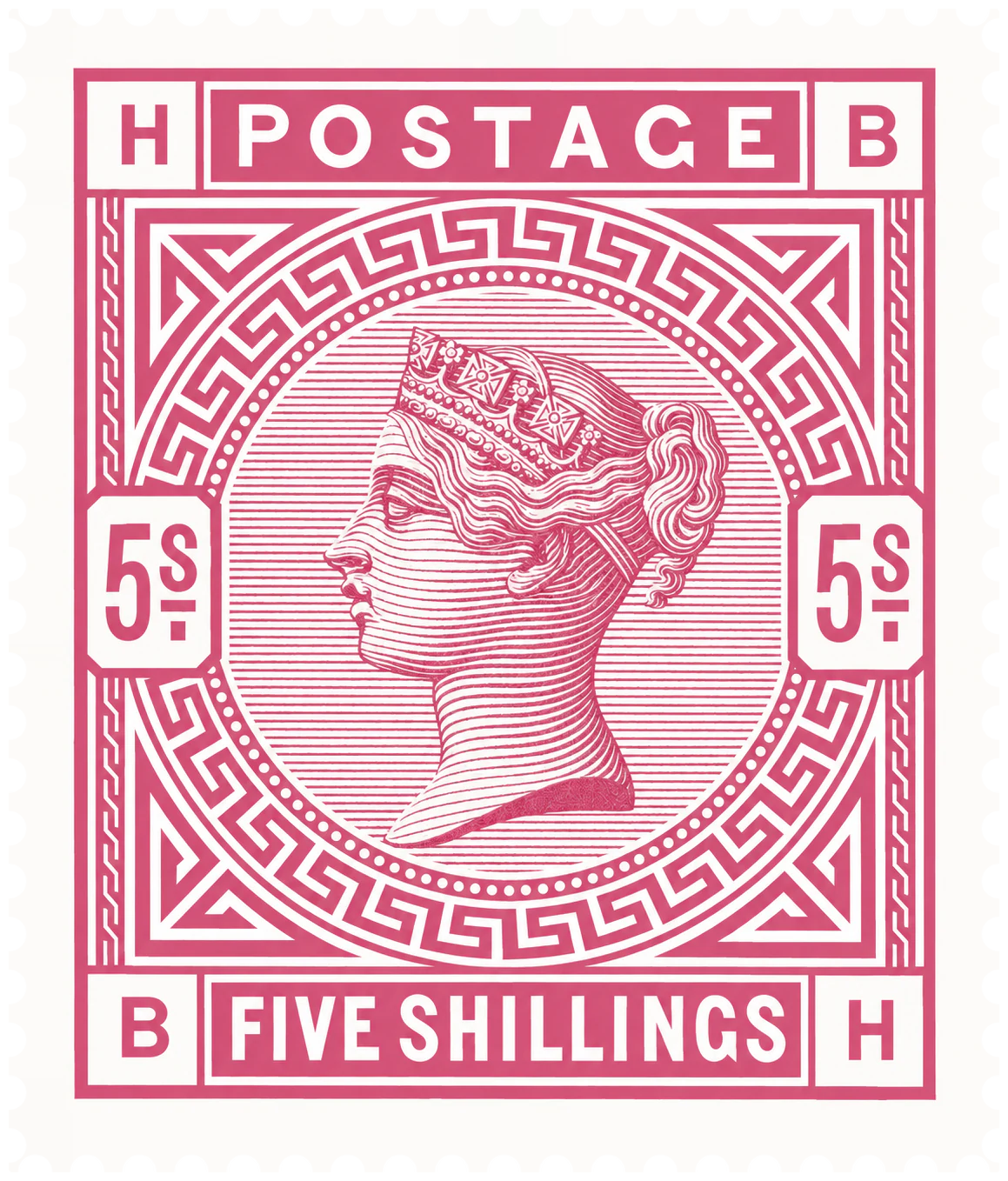
The Greek-key pattern around Victoria
The five-shilling rose has a broad circular frame decorated with a Greek-key pattern.
The ornament consists of repeated angular turns, arranged continuously around Victoria's portrait. A row of small pearl-like dots runs immediately inside it. [1]
The design reflects the Victorian fascination with classical and geometric ornament.
A related pattern had appeared on the earlier five-shilling stamp of 1867, associated with Owen Jones's decorative work.
The revised issue retained this visual connection while changing the surrounding lettering and frame.
The earlier surface-printed likeness traces back through Joubert’s engraving and Corbould’s drawing to Wyon’s medal. These portrait sources and Owen Jones’s earlier ornamental design are distinct from De La Rue’s revised frame and die of 1884; no individual engraver of that later die is established here. [2, 3, 4, 1]
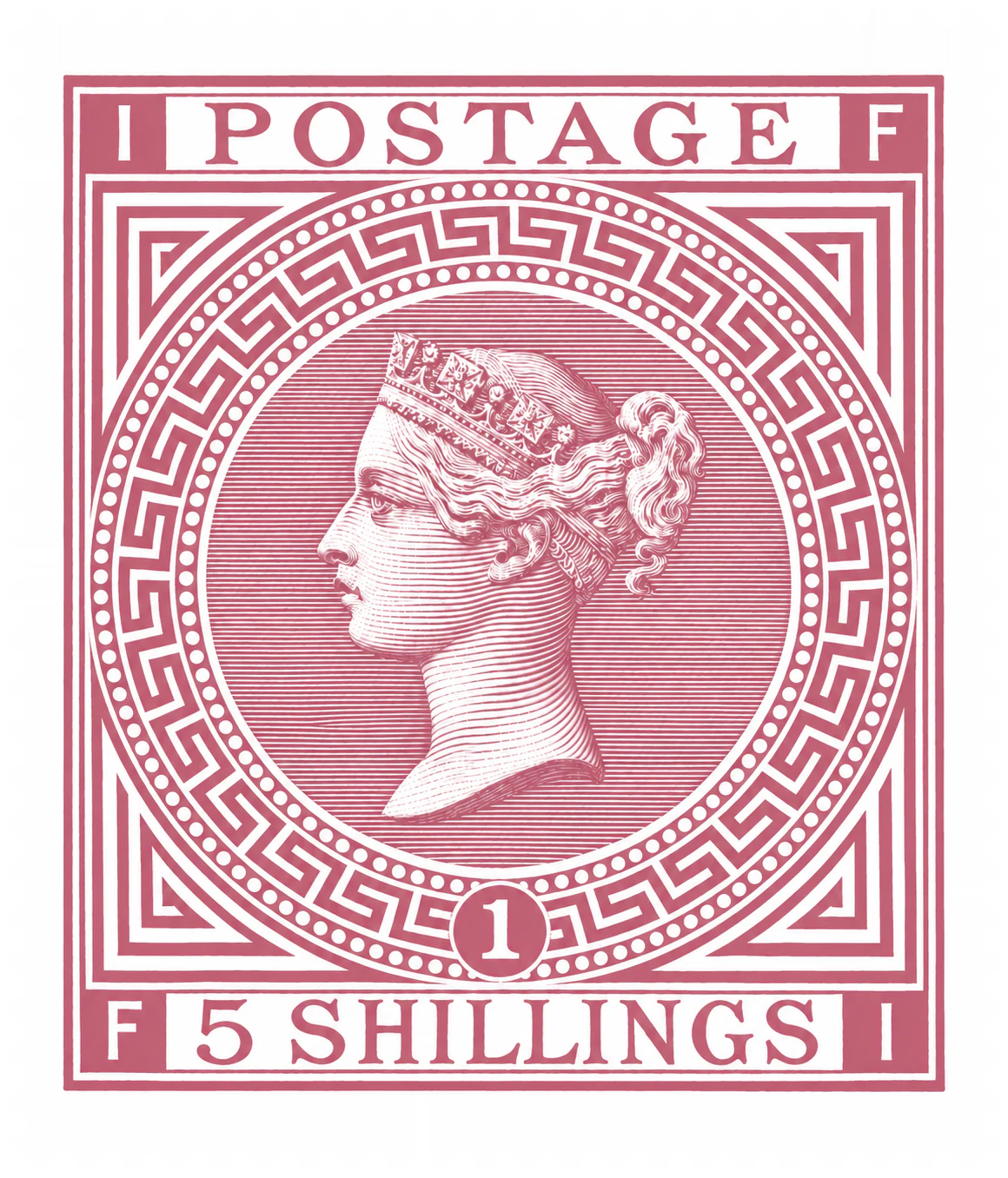
Compare the circular Greek-key ornament and the changed inscriptions and value figures.
Click either stamp to magnify
Two large figures beside the portrait
The denomination appears both in words and figures.
FIVE SHILLINGS is printed in white capitals beneath Victoria's head. A large coloured 5 occupies a white panel on either side of the circular frame.
POSTAGE appears above the portrait in a matching coloured panel. [1]
The large figures give the value a more conspicuous position than on the earlier five-shilling.
The engravers balanced the repeated denomination against the elaborate ornamental circle, preserving a strong central place for the Queen's head.
The frame that combines Greek patterns
The spaces between the circular portrait and the rectangular outer frame are filled with geometric decoration.
The corners contain conventional Greek ornament, while the narrow side borders carry another repeating pattern.
These details complement the Greek-key band surrounding Victoria. [1]
The patterns were intended to appear attractive while presenting fine detail that was difficult to imitate accurately.
The stamp therefore combines classical decoration with the practical requirements of security printing.
The proof without corner letters
A surviving die proof dated 11 July 1883 shows the five-shilling before its corner letters were added.
Printed in black on glazed white card, it carries the instruction BEFORE HARDENING. [5]
The portrait, inscriptions and permanent ornament are complete, but the four corner squares remain blank.
These spaces were intended to receive interchangeable letters during the preparation of the printing plates.
The proof reveals how the engravers separated the permanent design from the changing characters needed for each stamp position.
Four letters in the corners
The five-shilling has coloured letters against white square panels in all four corners.
The lower pair identifies the stamp's position within the printing sheet. Those above repeat the same letters in reverse order.
The arrangement was intended to reveal attempts to construct fraudulent stamps from uncancelled pieces of used examples.
A plate contained 112 stamps, in two panes of fifty-six. [1]
The four-letter system allowed each impression to be identified while the Queen's portrait and ornament remained identical.
The anchor hidden beneath the rose
The five-shilling was printed on Large Anchor watermarked paper.
The anchor was formed within the paper during manufacture, not printed in ink. It helped make the stamp more difficult to imitate.
Some sheets had a faint bluish tint, while others were substantially white. [1]
The printed colour ranged from pale rose to deep carmine, producing further differences in appearance.
The stamp's final colour was therefore influenced by both the ink and the paper beneath it.
The diamond diadem made for a king
The ornament in Victoria's hair was commissioned for George IV's coronation in 1821. [6]
It contains 1,333 diamonds, with crosses and the national emblems of the rose, thistle and shamrock.
Victoria later wore the diadem in portraits, and it became a familiar feature of British postage stamps.
On the five-shilling rose, its jewels are reduced to tiny printed lines. A magnificent royal ornament had become part of a stamp worth five shillings.
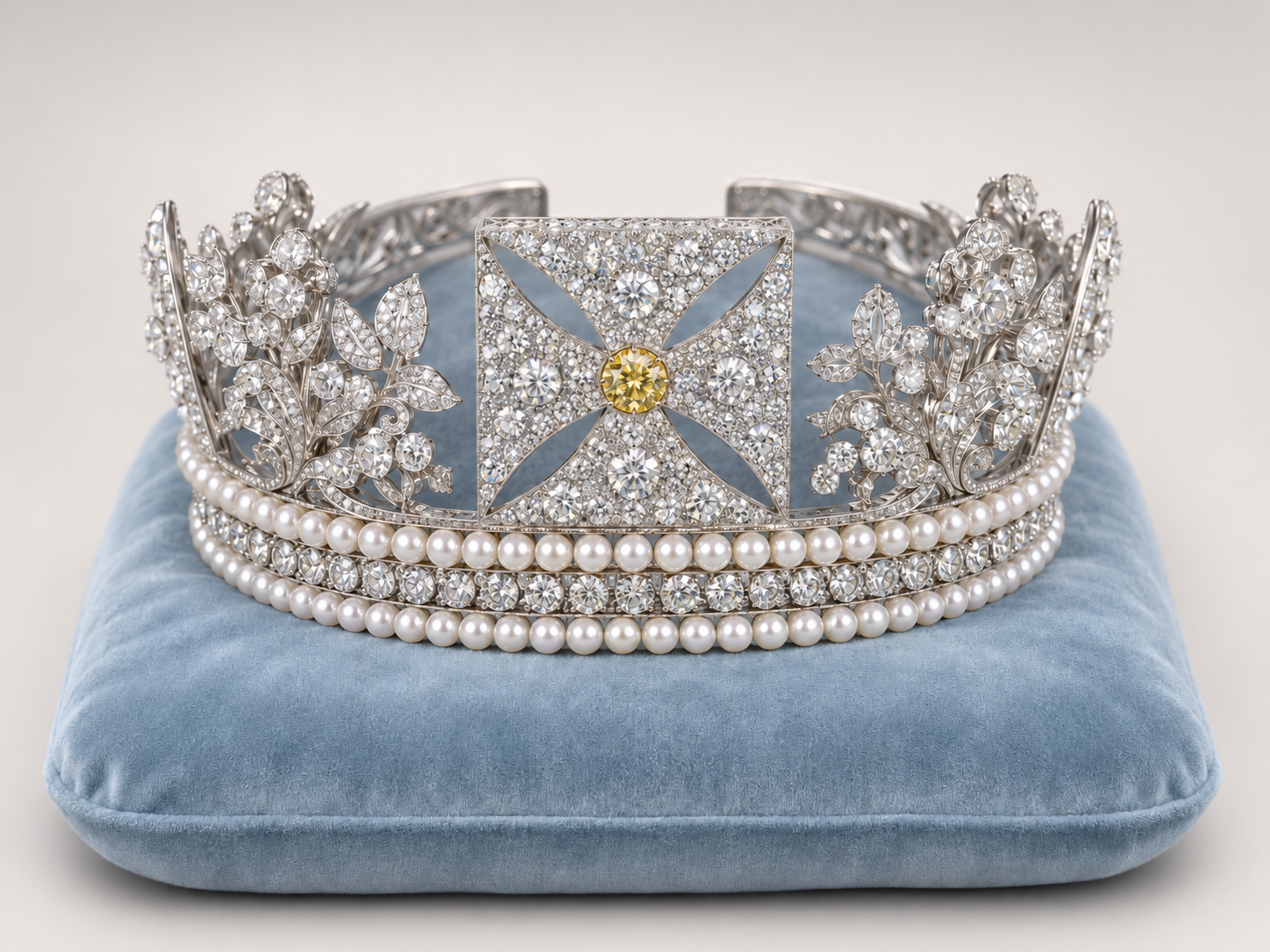
Image information
Click image to magnify
Digitally created illustration of the diamond diadem, with crosses, floral emblems and rows of pearls, resting on a blue cushion.
- Credit
- Stunning Stamps.
- Notes
- Digitally created.
Sources
- Hastings E. Wright and A. B. Creeke: A History of the Adhesive Stamps of the British Isles (1899), p. 162
- Robert B. Galland, The First Low Value Surface Printed Postage Stamps of Great Britain (RPSL, 2014), p. 3: earlier Joubert portrait engraving after Corbould
- Douglas N. Muir, William Wyon & the Penny Black, Royal Mint Museum
- Wright and Creeke, A History of the Adhesive Stamps of the British Isles (1899), pp. 69 and 160–163: De La Rue manufacture and the 1883–1884 high values
- Grosvenor Philatelic Auctions: Five-shilling die proof, 11 July 1883
- Royal Collection Trust: George IV's Diamond Diadem