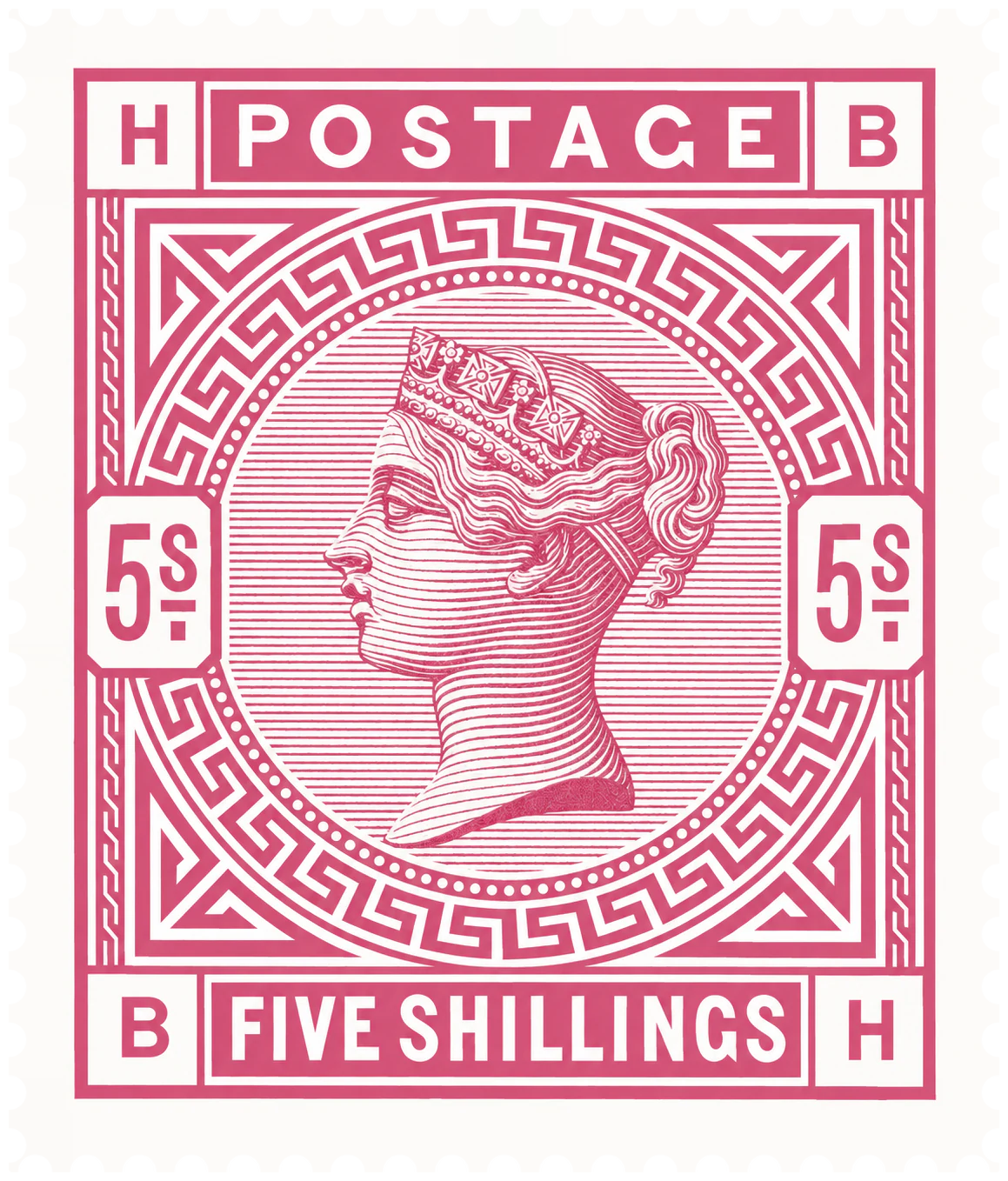
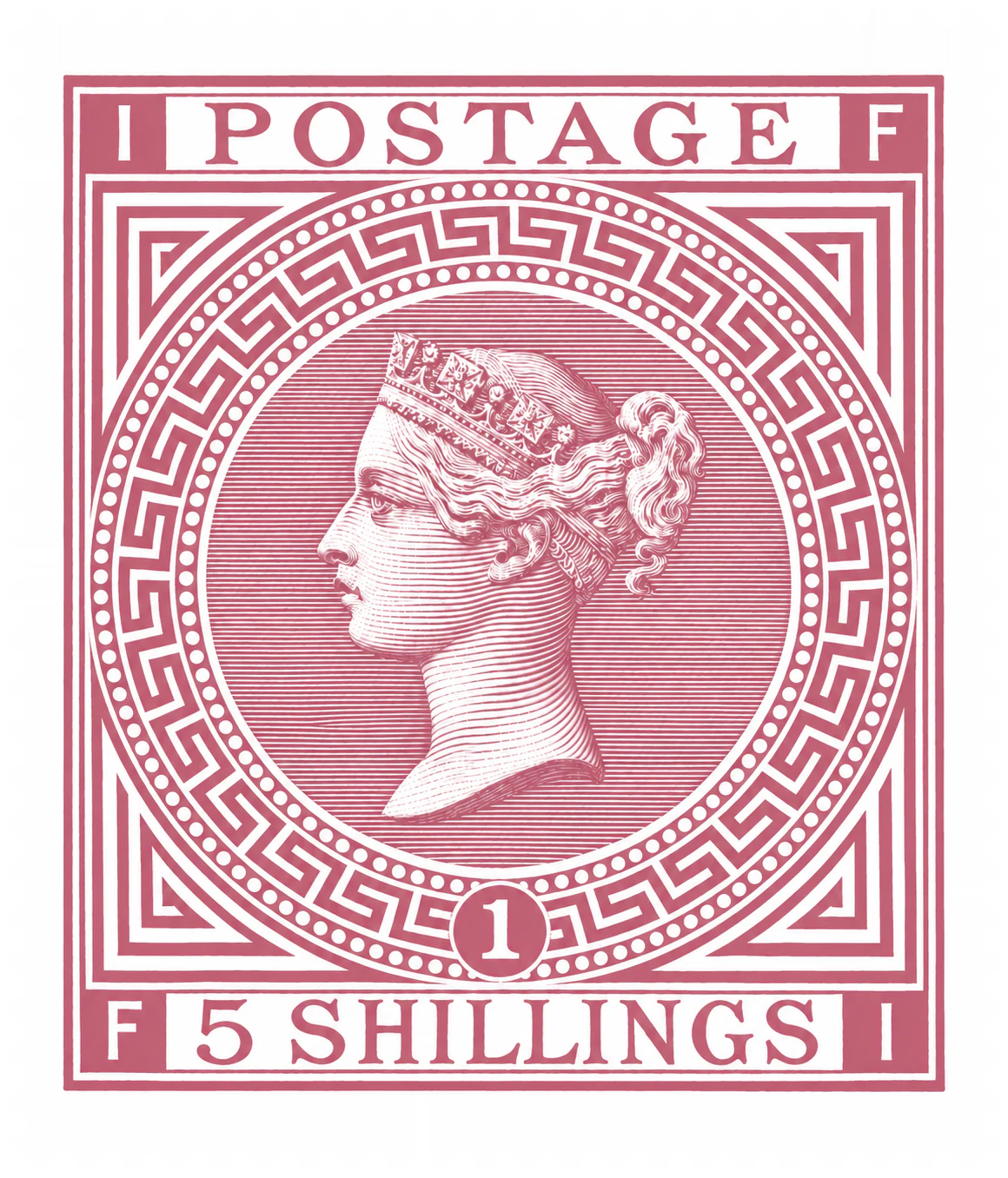
The five-shilling rose was redesigned in 1884, replacing an engraving introduced seventeen years earlier. De La Rue retained the classical Greek-key ornament around Victoria's portrait but created a more compact arrangement with large value figures at the sides. A surviving proof records the new engraving in July 1883, nine months before issue. The stamp was printed in shades ranging from pale rose to deep carmine, sometimes on faintly blue-tinted security paper.
Stories
The engraving completed nine months early
The engraving completed nine months early
The five-shilling rose appeared on 1 April 1884, but its engravers had finished the new design long before then.
A surviving De La Rue die proof is dated 11 July 1883. Printed in black on glazed white card, it bears the instruction BEFORE HARDENING. The corner-letter panels are still blank. [14]
The two printing plates were approved on 6 September and brought to press on 16 October.
The printers could therefore manufacture the new stamps months before they were released.
The proof records a moment when the artist's work was complete, but the engraving still needed to be hardened and adapted for mass production.
The stamp that kept its Greek ornament
Britain had already issued a five-shilling postage stamp in 1867. Its design had been influenced by Owen Jones, the celebrated Victorian designer associated with the Crystal Palace.
When De La Rue prepared the replacement, the engravers retained the broad circular ornament and its classical Greek-key pattern, but rearranged the inscriptions, value figures and surrounding frame. [15]
The result was recognisably related to its predecessor, yet considerably different in appearance.
Instead of abandoning the established design completely, the printers developed a new version suited to the unified series.
The revised stamp carried forward an artistic idea that had already survived for seventeen years.
Compare the circular Greek-key ornament and the changed inscriptions and value figures.
Click either stamp to magnify
The stamp announced without a special circular
The five-shilling of 1884 was introduced without the kind of individual announcement that had accompanied some earlier new stamps.
Instead, the Post Office displayed a large illustrated card showing the denominations that would be available from 1 April.
The illustrations were lithographed and comparatively crude, but allowed officials and customers to recognise the new designs. [15]
The card included the five-shilling rose, alongside the other new values.
The printing works had produced intricate engravings, but the Post Office needed only simplified pictures to demonstrate their appearance.
The surviving publicity material reveals how the government communicated a major change in stamp design before colour photography was available.
The rose that looked different on blue paper
The five-shilling was printed on special Large Anchor watermarked paper.
Some early sheets had a faint bluish tint. The effect was less pronounced than on the contemporary half-crown, but it was still visible on certain impressions. [15]
The printing colour also varied, from pale rose to much deeper carmine.
Together, these differences could give the stamp noticeably different appearances without any change to the engraving.
The printers had to coordinate the work of the papermaker and ink-maker, both of whom influenced the finished colour.
An impression that appeared slightly purple or unusually pale might owe as much to its paper as to the ink itself.
Two plates carrying millions of portraits
De La Rue prepared only two printing plates for the new five-shilling, numbered 5 and 6.
Each contained 112 impressions, divided into two panes of fifty-six. Both plates began work on 16 October 1883. [15]
The numbers continued the sequence from the earlier five-shilling design rather than beginning again at one.
The new plates could produce the stamp in complete sheets, with carefully arranged impressions ready for perforating.
The system was a far cry from Britain's first embossed high values, which had required individual impressions from hand-operated presses.
Decades of experimentation had transformed the manufacture of high-value postage stamps.
Why do some stories appear on several pages?
Every page is written to make sense on its own. Visitors often arrive directly at a particular stamp or subject, without having explored the rest of the site.
Some stories are relevant to several stamps, so they are repeated where they help explain what you're looking at. For those exploring a series, the details specific to each stamp generally come first, with the more familiar stories further down the page.
This way, you can explore the site in any order without missing interesting background.
Greek-key ornament circles Victoria, flanked by large value figures. Explore the connection to the 1867 design, a proof with empty corners and the paper beneath the rose-coloured impression. [16, 17]
De La Rue grew from a playing-card business into a major security printer. It supplied British postage stamps from the Victorian period and printed the Edward VII issues before the contract changed in 1911.
On this stamp
Thomas De La Rue & Co. designed and surface-printed the revised five-shilling rose issued on 1 April 1884. Plates 5 and 6 continued the earlier five-shilling numbering. The Greek-key ornament recalls Owen Jones’s 1867 design; that inherited connection is separate from the later rearrangement and engraving.
Jean Ferdinand Joubert de la Ferté was a French engraver and photographer. He trained in Paris and later worked in London, where his engraving helped establish De La Rue’s surface-printed postage stamps.
On this stamp
Joubert engraved the earlier surface-printed Queen’s head after Corbould’s drawing. On the 1884 five-shilling rose, this identifies an inherited portrait model, not a documented commission to engrave its later die or frame.
William Wyon was a medallist and engraver at the Royal Mint. His models of royal heads were made for coins and medals and also became sources for stamp portraits.
On this stamp
Wyon’s City of London medal supplied the youthful likeness inherited on the 1884 five-shilling rose. He is credited as an earlier artistic source, separate from De La Rue’s later stamp design.
Henry Corbould was a draughtsman and book illustrator. He trained with his father and at the Royal Academy Schools, where he received a silver medal for a life study.
On this stamp
Corbould’s drawing after Wyon’s medal supplied the model for the earlier surface-printed Queen’s head. His connection to the 1884 five-shilling rose is that inherited portrait source, not the preparation of its later frame or die.
Owen Jones was an architect, designer and writer on ornament. He devised the Crystal Palace’s interior colour scheme, published The Grammar of Ornament and worked with De La Rue on printed objects.
On this stamp
Owen Jones designed the earlier five-shilling of 1867. Its Greek-key ornament provides the design ancestry of the 1884 rose, whose inscriptions and frame were rearranged by De La Rue. This is an inherited ornamental connection, not a new commission to Jones, who died in 1874.
The country identifies the postal authority that issued the stamp. The monarch identifies the ruler whose portrait it carries. A definitive is an everyday stamp intended for regular postal use.
On this stamp
This 5s belongs to the Later High Values of Victoria’s reign. The youthful head is inherited from earlier artistic models; it is not a new portrait of the Queen at the issue date.
The denomination is the stamp’s face value: the amount of postage it represents. Its price to a collector can be quite different.
In Britain’s old currency, 12 pence made one shilling and 20 shillings made one pound: 240 pence altogether. The abbreviations were d for pence, s for shillings and £ for pounds. The d comes from the Latin denarius. A halfpenny, written ½d, was half an old penny.
On this stamp
This stamp represents 60 old pence. A 56-stamp pane totals £14 and the complete two-pane printing sheet £28.
The design can look different when either its ink or its paper changes. Rose on bluish paper, for example, should not be assessed in the same way as rose on white paper. Inspect the unprinted areas as well as the portrait.
Period descriptions include purple for the half-crown, carmine for the five-shilling, blue and cobalt for the ten-shilling, and brown-violet for the first long pound. Modern catalogue names make further distinctions. These names describe families of impressions, not calibrated screen colours.
Fading, cleaning, staining and lighting can also alter appearance. Compare appropriate original material and its condition before treating a colour difference as an issued shade. The reconstructions illustrate the intended colour families.
On this stamp
The illustration represents rose as catalogued for SG180. It targets the white-paper category, whose appearance should not be confused with the same ink on bluish paper. No calibrated shade or condition is certified.
These dates describe different events. A die proof records work on the original tool; a registration sheet records approval; the press date records manufacture; the issue date concerns public availability. Their order and spacing can explain apparent contradictions.
The half-crown was issued on 2 July 1883. The redesigned 5s, 10s and brown-lilac pound followed on 1 April 1884, after months of preparation. The half-crown’s second plate was used before its first, so a plate number is not a chronological guarantee.
For the green pound, the circular is dated 27 January 1891. Wright and Creeke say it was in use by the end of that month, possibly on the circular date. This is narrower evidence than a securely demonstrated first-day cover.
On this stamp
The redesigned five-shilling was issued on 1 April 1884. Plates 5 and 6 had been approved on 6 September 1883 and were printing from 16 October. The illustration represents white-paper SG180.
This family brings together the half-crown of 1883, the redesigned five-shilling, ten-shilling and pound of 1884, and the pound’s green printing of 1891. It is a useful design grouping, not a claim that all five appeared together.
The first three have upright designs on Large Anchor paper. The unusually long pound was adapted from a telegraph design and covers three Crown watermarks. Its change to green retained the established engraving.
Earlier upright high values and the five-pound orange belong to separate groups. Blued paper, the pound’s Orb-paper error and officially marked examples need to be identified within their own histories rather than treated as additional denominations.
On this stamp
This 5s is one of five articles in the family. It replaced an earlier upright design, while retaining a high denomination.
A catalogue reference identifies a combination of design, colour, paper and other features. It does not identify every printing plate or certify the condition of a particular stamp. Similar printed faces can conceal different watermarks or paper colours.
These illustrations represent the white-paper 2s 6d, 5s and 10s, the Crown-watermarked brown-lilac pound and the green pound. The first-appearance date may describe the design’s introduction before the particular paper category illustrated.
Read the reference with the individual note and the recorded original specimens. A digital reconstruction is useful for studying the design, but cannot prove an unseen watermark, original gum or a calibrated shade.
On this stamp
The recorded specimen references identify SG180 with B–H below and H–B above. The paper category is white Large Anchor. The reconstruction does not authenticate the reverse of an original.
Typography, also called surface printing, transfers ink from the raised parts of a printing surface. The recessed areas leave the paper unprinted. White lettering therefore need not be a second impression in white ink.
De La Rue engraved steel dies and used moulding and electrotyping to multiply their designs into printing plates. By this period the company used steam presses. Gumming, printing and perforating were distinct stages.
Each of these stamps was printed in one colour. The long pound’s adaptation does not imply the separate POSTAGE printing used for the five-pound orange. The diagram explains the printing principle, not the precise construction of a particular press.
Surface printing, shown from the side. The paper is pressed onto the inked surface.Image information
Side view of surface printing. Paper is pressed down onto ink on the raised parts of a printing plate; the lower spaces do not touch the paper.
Credit
Stunning Stamps · 2026
On this stamp
De La Rue printed this 5s from raised surfaces in one ink. White details are unprinted paper. The upright design does not require a separate white or inscription impression.
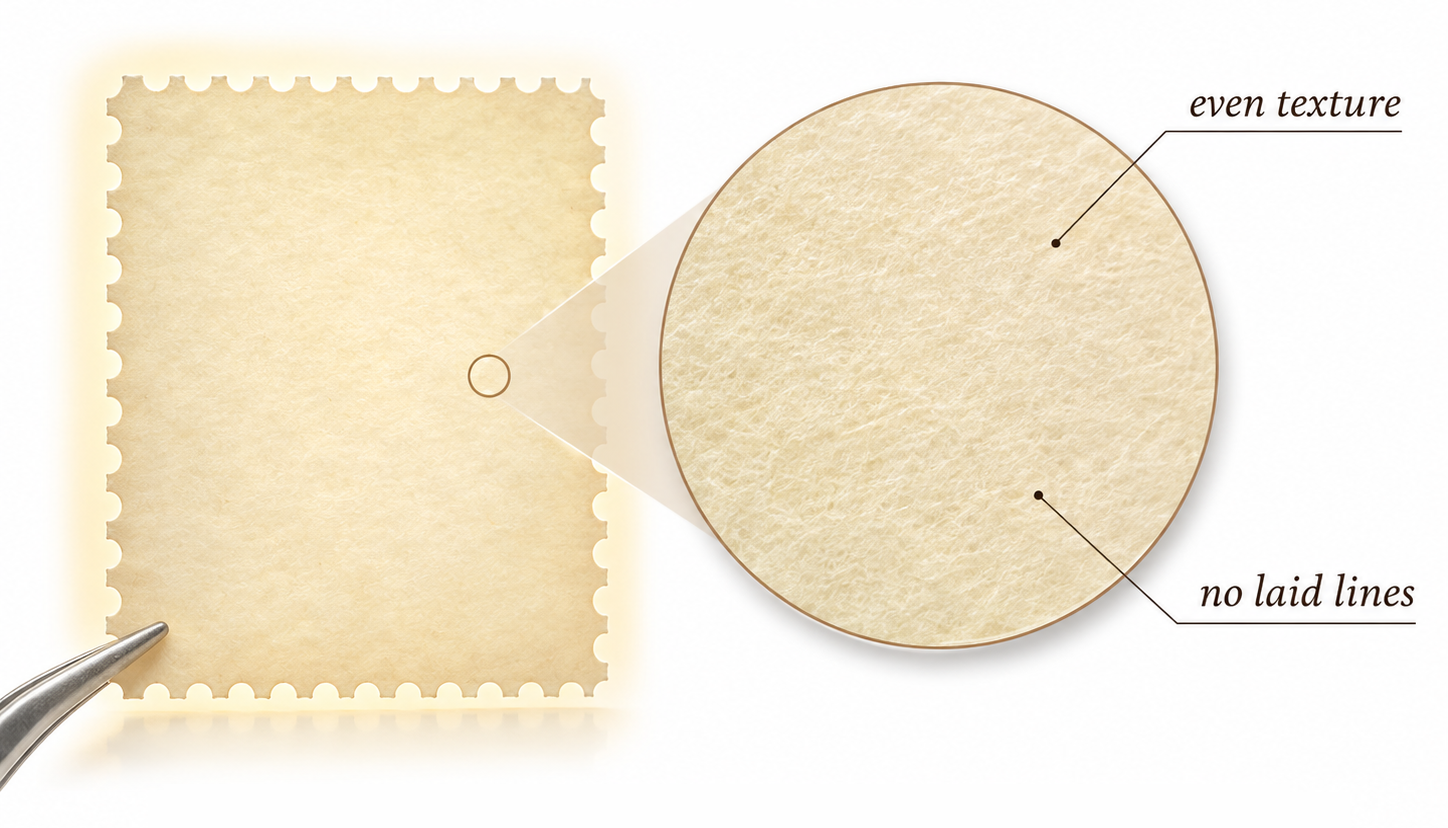
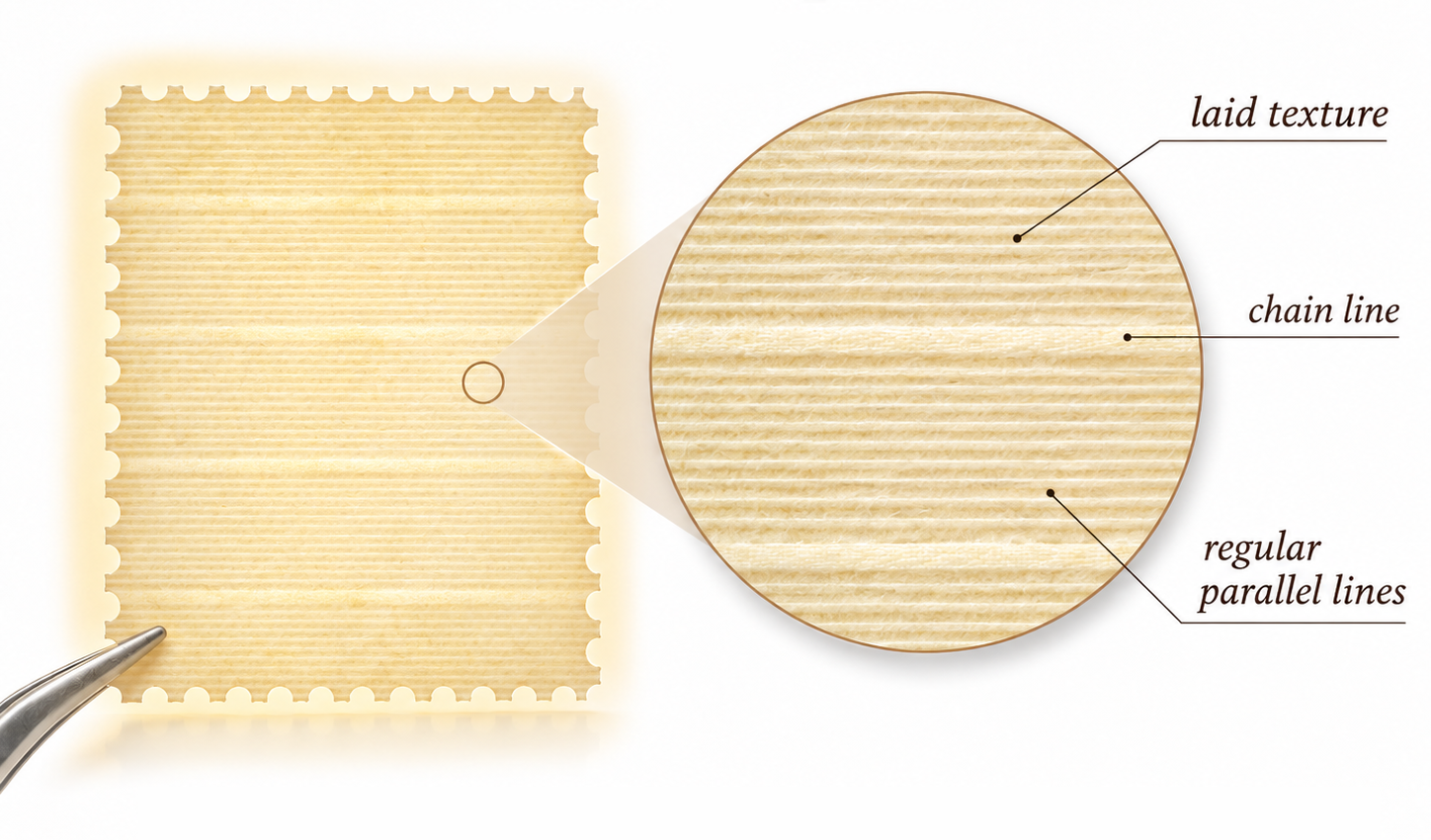
Wove paper has a comparatively even fibre structure, unlike the regular lines characteristic of laid paper. Wove structure, watermark, colour and gum describe separate properties of a sheet.
Both the Large Anchor stock and the Large Crown stock used here were machine-made. The watermark was formed while the fibres were wet, before the sheet was gummed and printed. The comparison illustrations explain wove and laid structures; they are not photographs of these original high-value papers.
The printed face alone cannot establish thickness, watermark orientation or the condition of the reverse. Read the individual note for the documented issue paper, rather than inferring those properties from the reconstruction’s smooth surface.
Wove paper: even texture without laid lines.Image information
Click image to magnify
Diagram of wove paper with a magnified inset showing an even texture without laid lines.
Credit
Stunning Stamps · 2026
Notes
Digitally constructed
Laid paper: regular parallel lines, shown for comparison.Image information
Click image to magnify
Diagram of laid paper with a magnified inset showing regular parallel lines.
Credit
Stunning Stamps · 2026
Notes
Digitally constructed
On this stamp
The 5s uses machine-made Large Anchor fiscal paper. Wove describes its structure, separately from watermark and colour. The two comparison illustrations explain the paper terms rather than showing an original sheet.
Bluing belongs to the paper, not to a second printed colour. The Large Anchor stock originated in fiscal-stamp production. Wright and Creeke describe its chemical preparation and note that the blue tint could vary greatly.
The 2s 6d, 5s and 10s occur on blued and white paper. Their illustrations here target the white-paper catalogue categories. Faint bluing is difficult to judge in a front photograph, and age or a coloured backing can be misleading.
The long pounds normally use white Crown paper; the brown-lilac Orb printing is a change of watermark, not an Anchor-paper issue. Do not import later Edwardian chalk-paper distinctions into these Victorian descriptions.
On this stamp
SG180 is represented on white Large Anchor paper. The blued-paper issue is a separate paper category; no bluing is inferred from the colour of this screen image.
Fugitive ink is designed to react when someone tries to remove a cancellation. Doubly fugitive describes sensitivity to water and chemical treatment; it does not mean two colours or two printing passes.
Wright and Creeke explicitly describe the half-crown’s purple as doubly fugitive. Their accounts name the other colours without supplying the same chemical description for every ink. A security claim for purple should not automatically be transferred to rose, blue or green.
For the pound’s change to green they suggest fear of photographic imitation, while making clear that this is their interpretation. Preventing reproduction and preventing the cleaning of used stamps are related security aims, but involve different mechanisms.
On this stamp
The 5s uses rose ink. The half-crown’s specific doubly-fugitive description is not automatically assigned to this colour; ink and paper differences are considered separately.
A watermark is a thinner pattern formed within the paper, rather than an inked emblem. Its shape and spacing can distinguish stamps whose printed faces are almost identical. The reverse of an original is needed to establish orientation or a partial device.
The upright 2s 6d, 5s and 10s each cover one Large Anchor. This is the large fiscal-paper anchor, not the Small Anchor of the earlier 2½d. The long pound spans three Large (1880) Crowns across its width.
A November 1887 paper requisition for the brown-lilac pound was entered in the Orb column by mistake. The resulting printing has three Orbs instead of three Crowns. The green pound retained Crown paper. Neither paper change altered the printed portrait.
On this stamp
Each 5s impression covers one Large Anchor. This is the large fiscal-paper device, not the Small Anchor of the earlier 2½d. Orientation cannot be certified from the illustrated face.
A perforation gauge measures the spacing of holes over two centimetres, not the total number of teeth on an edge. Two numbers give the horizontal gauge first and the vertical gauge second.
All five ordinary issues here gauge 14 in both directions. The long pound naturally has more holes along its horizontal edges than an upright high value; differing endpoint counts do not create another gauge.
A five-shilling SPECIMEN example perforated 12 is documented separately. It is not an ordinary public-sale alternative in this set. Imperforate proofs and trimmed perforated stamps also need to be distinguished through margins, paper and provenance.
Enlarged spacing diagram, not to scale. Match the spacing with a perforation gauge.Image information
Enlarged perforation spacing: fourteen equal intervals between hole centres span 20 millimetres. This is a schematic, not a ruler.
Credit
Stunning Stamps · 2026
On this stamp
The ordinary 5s gauges 14 horizontally and vertically. Total teeth at the endpoints can vary without changing the gauge. No grouped perforation alternative is added.
De La Rue used white gum arabic, applied to the paper before the stamp impression was printed. The adhesive coating is different from both a watermark within the sheet and ink on its face.
Original gum, disturbed gum, hinge traces and later regumming describe condition. A clean-looking printed face cannot establish an untouched reverse. Used stamps may have lost their gum during removal from a document.
These illustrations show the design rather than a certified surviving item. Their clean paper does not make an assertion about original gum or the treatment of the specimens used as drawing references.
On this stamp
De La Rue gummed the paper before printing this 5s. The illustration depicts the face only and makes no claim about original gum, hinging or regumming of a surviving specimen.
A pane is a block of impressions within a printing sheet. A gutter separates panes, and selvedge is the outside margin. The larger sheet supplied by the papermill is a different unit again.
The 2s 6d, 5s and 10s plates held 112 stamps in two panes of 56, one above the other. Each pane had seven rows of eight. Large Anchor paper was manufactured with 224 devices; a half mill-sheet accommodated this 112-subject printing arrangement.
The long pound plate held 80 stamps in two vertically arranged panes of 40, each ten rows of four. Each wide impression covered three Crown devices. A registration sheet with examples subsequently removed still records the original layout; count the missing spaces as well as the surviving stamps.
The diagram explains pane and gutter terminology rather than reproducing either high-value layout. Do not substitute the earlier upright high values’ single-pane Anchor arrangement for these new two-pane plates.
Sheet, panes and margins: a simplified example.Image information
A schematic printing sheet contains two panes separated by an unprinted gutter and surrounded by a margin.
Credit
Stunning Stamps · 2026
On this stamp
The 5s plate has two panes, one above the other, each seven rows of eight. The complete printing unit fits a half mill-sheet of Large Anchor paper. The generic diagram explains terms, not this exact layout.
Multiply the number of stamps by the denomination to obtain the face value of a pane or printing sheet. This was an accounting amount, not a modern collecting value or a postal rate.
A 56-stamp pane of half-crowns totals £7, of five-shillings £14, and of ten-shillings £28. The full two-pane printing sheets total £14, £28 and £56 respectively.
A pane of 40 one-pound stamps totals £40, and the complete 80-subject sheet £80. These calculations describe the documented printing units; they do not by themselves prove how every post office divided its stocks for counter use.
On this stamp
For the 5s, 56 stamps make £14 and 112 make £28. These are calculated printing-unit totals, not a claim about a particular counter subdivision.
The lower-left letter gives the row and the lower-right letter the column. The upper letters repeat the pair in reverse order. On the upright high values the full grid runs through fourteen rows, A–N, and eight columns, A–H, with a gutter between the two panes.
The long pound uses twenty rows, A–T, and four columns, A–D. Its white letters stand against coloured corner blocks, whereas the upright designs have coloured letters on white. These are different arrangements from the five-pound’s column-first telegraph convention.
Letters locate an impression, not an engraver, post office or printing plate. Repeated flaws can make a position useful when studying a plate; the same letters alone cannot distinguish two plates. The reverse-order upper pair also helped reveal fraudulent assemblies made from uncancelled pieces.
On this stamp
The lower B–H pair locates row 2, column 8 in the full fourteen-row, eight-column grid. The upper pair is reversed. Coloured letters occupy white squares. The pair alone does not establish the printing plate.
A die carries the original design; a printing plate carries the repeated subjects needed for production. These high values do not show a plate number in the individual stamp design. Corner letters identify a position, not a plate.
The half-crown used plates 1 and 2, the five-shilling 5 and 6, the ten-shilling 2 and 3, and the long pound 2 and 3. The last three denominations continued earlier numbering rather than starting again when their designs changed.
Official registration records, marginal annotations and established plate characteristics can supply further identification. Without that evidence, an illustration should not be assigned to a particular plate merely from its colour or corner pair. The pound’s documented JC/TA breaks illustrate how additional evidence can matter.
On this stamp
Plates 5 and 6 continued the sequence after the earlier five-shilling plate 4. Both began work on 16 October 1883. The B–H pair does not identify which plate produced an original.
A complete sheet preserves information that is lost when stamps are separated. The later high-value plates had relatively plain printed margins, with a line-and-dot guide at the top and bottom to assist perforating.
Plate and current numbers were written by hand on the registration sheets described by Wright and Creeke. These annotations are different from a numeral printed in every stamp, and different again from lettering formed as a watermark.
Large Anchor paper had marginal Inland Revenue wording; Crown paper had POSTAGE wording and other watermark elements. A watermarked word in selvedge does not change the inscription printed on the stamp. Retained margins can therefore help explain both manufacture and paper identity.
On this stamp
The 5s layout used guides at the top and bottom. Plate and current numbers were written on the registration sheets rather than printed on the stamp face. This detached illustration has no selvedge establishing marginal details.
A familiar royal likeness can be carried into a new frame. The earlier surface-printed head derived from Joubert’s engraving after Corbould’s drawing, with Wyon’s medal as an earlier artistic source. Those credits do not identify the engraver of every later die.
De La Rue made the new half-crown setting, revised the five-shilling and gave the ten-shilling an octagonal frame. The five-shilling’s Greek-key ornament recalls Owen Jones’s 1867 design; the later revision is not a new commission to Jones.
The long pound adapted the company’s 1877 telegraph design for postage. The 1891 green retained its existing engraving. A colour registration therefore need not imply a replacement die, and a repeated portrait need not imply an unchanged surrounding design.
On this stamp
The revised 1884 five-shilling retained a Greek-key connection to Owen Jones’s earlier design. His inherited ornament and Joubert’s earlier portrait are distinguished from De La Rue’s later frame and die.
A die proof tests the original engraving; a plate proof shows impressions from a printing plate. An imprimatur is an approved registration impression. These terms explain why an object was made, not simply whether its edges are perforated.
Black impressions on glazed card can bear dates and workshop endorsements such as BEFORE HARDENING. Empty corner spaces show that the permanent design was prepared separately from the identifying letters used in production. Such proofs are not evidence of black stamps sold at the counter.
The green pound’s registration concerns colour rather than a new design. The current Postal Museum inventory identifies POST 150/786 as plate 2; Wright and Creeke describe plate 3 as registered in green on the same date. Keep these source descriptions distinct when citing the object.
On this stamp
The five-shilling proof dated 11 July 1883 is marked BEFORE HARDENING. A later proof or specimen is distinct from the ordinary rose printing represented by SG180.
An ordinary issued stamp, a specimen, a colour trial and an imperforate proof are different kinds of object. The same design can occur in several categories without every combination becoming a normal public issue.
Grosvenor records a white-paper five-shilling rose, letters DC, perforated 12 and marked SPECIMEN Type 9. That provides specific evidence for this exceptional object; it does not establish ordinary perforation-12 alternatives for all the high values.
All five illustrations represent normal perforation 14. No grouped perforation alternatives are present in this set. A claimed exceptional example needs its own gauge, marking, paper and provenance checked; cutting away the teeth cannot establish an imperforate issue.
On this stamp
A documented white-paper 5s rose DC is perforated 12 and marked SPECIMEN Type 9. It is exceptional reference material; the B–H SG180 illustration remains ordinary perforation 14, with no grouped alternative.
SPECIMEN and administrative CANCELLED markings identify material prepared for reference or official handling. They are separate from a postmark applied when a stamp paid for a service, and from the printing of the underlying design.
Surviving high-value examples include several specimen and cancellation types. The marked perforation-12 five-shilling is one specific combination. An unusual overprint needs independent authentication; its presence alone does not explain when or why a sheet was prepared.
An official-service overprint is a further category. Wright and Creeke note that some Orb-paper pounds were overprinted for official use. An official marking, a fiscal cancellation and the unoverprinted public-sale stamp should not be treated as interchangeable evidence.
On this stamp
The illustrated 5s has no SPECIMEN, CANCELLED or official-service overprint. Surviving officially marked examples do not change the status of this unoverprinted public-sale design.
A repeatable plate flaw belongs to the printing surface and can appear on successive impressions. A single blurred area, scratch or cancellation is weaker evidence: it may have arisen in printing, later handling or photography.
On plate 2 of the long pound, the JC and TA positions are associated with broken-frame varieties. Comparing a documented flaw with the same position in another printing can link plate history across a change of colour.
The two pound illustrations here show EC and HA, not the named broken-frame positions. No specialised flaw is claimed for them or for the upright high-value reconstructions. Use authenticated original comparisons when assigning a plate or variety.
On this stamp
The B–H illustration is not attributed to a named plate flaw. A recurring mark needs corroboration at the same position; an isolated printing weakness or digital artefact does not establish a variety.
The upright high values occur on both blued and white Large Anchor paper. The paper category and printed shade need to be considered together, but neither is automatically a different design or perforation gauge.
The brown-lilac pound’s accidental Orb printing followed a wrongly completed paper requisition in November 1887. Wright and Creeke record 80,800 stamps and place public availability from early October 1888 into May 1889. The printed design remained unchanged.
The later green pound retained Crown paper and the established plates. Its colour change is separate from the earlier Orb mistake. Likewise the ten-shilling’s cobalt and ultramarine distinctions concern ink and paper, rather than a new octagonal engraving.
On this stamp
The design occurs on blued and white Large Anchor paper, with rose-to-carmine ink differences. This illustration is white-paper SG180 rose, not a representation of every paper and shade category.
High denominations reduced the number of smaller stamps needed for large payments. A half-crown or pound does not by itself identify one universal letter rate: date, destination, weight and service all matter.
A complete cover, parcel document, telegraph form or accounting record can explain a high-value use. A detached stamp with a town and date often cannot establish the original charge or show whether it travelled on an ordinary letter.
Read the whole item, including the total franking and other endorsements. A stamp originally designed for telegraphs may later have a postal design descendant, but those two issues and their evidence remain separate.
On this stamp
At 60 old pence, this 5s could reduce the number of smaller stamps needed for a large charge. Its denomination alone cannot identify a route, weight or service; a complete dated document is needed.
From 1 January 1883, the combined-duty rules covered eligible general adhesive duties up to two shillings and sixpence. Specially appropriated fiscal stamps were excluded. This limit matters when comparing the half-crown with the larger denominations.
The half-crown explicitly reads POSTAGE & REVENUE, and its 1883 notice also mentions telegraph use. The five-shilling, ten-shilling and pound designs read POSTAGE. Their higher values should not automatically inherit the half-crown’s dual-purpose authorisation.
A fiscal-looking cancellation, an official overprint and a postal marking describe different uses or treatments. Establish the applicable rule and the surviving document before assigning a revenue use; an ink colour or an inherited telegraph layout is insufficient.
On this stamp
This 5s exceeds the 2s 6d combined-duty ceiling and reads POSTAGE. The half-crown’s revenue authorisation is not automatically transferred to it. An original document and the applicable rules are needed to interpret a particular non-letter use.
The stamp design and corner letters were printed before issue. A cancellation was applied later to prevent reuse or record a payment. Specimen markings and registration annotations belong to different stages of the stamp’s history.
For high values, the surrounding document is particularly valuable evidence. A date or office name on a loose stamp does not alone distinguish postal carriage, telegraph work or internal accounting.
Cleaning can weaken both the cancellation and the printed colour. Treat a pale or apparently unused example as a condition and identification question before naming a new shade. These reconstructions show the designs without a cancellation.
On this stamp
The illustration shows the 5s design without a cancellation. A dated or pen-cancelled original needs its surrounding document to establish use; a clean face alone cannot certify that a stamp was never used.