
The design of the 2s 6d lilac
Queen Victoria · Great Britain · Thomas De La Rue & Co. · 1883
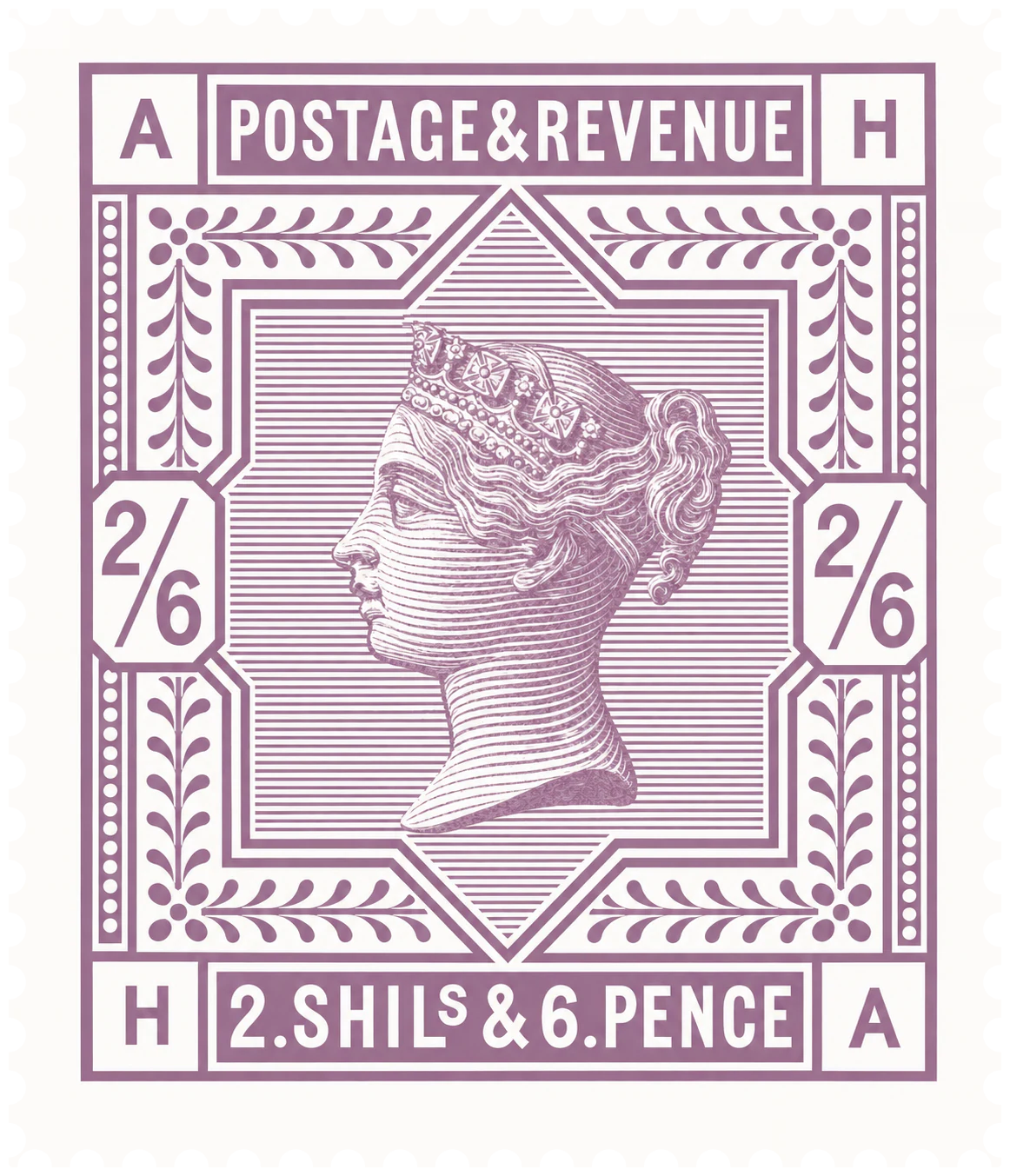
The Queen inside an indented square
The half-crown has an unusual frame around Victoria's portrait.
Her head sits against fine horizontal shading, enclosed within a rectangular design whose inner sides form a series of angular indentations.
Narrow rows of pearl-like dots run beside the portrait.
POSTAGE & REVENUE appears above, while the lower panel reads 2. SHILS & 6. PENCE. [1, 2]
The arrangement gives the stamp a more angular appearance than the circles and ovals of many earlier Victorian issues.
It was created specifically for the new unified postage-and-revenue series.
The earlier surface-printed likeness traces back through Joubert’s engraving and Corbould’s drawing to Wyon’s medal. These inherited portrait sources are distinct from De La Rue’s new half-crown frame and die; no individual engraver of that later design is established here. [3, 4, 5, 1]
The unusual way of spelling half a crown
The stamp expresses its denomination in two ways.
The lower inscription reads 2. SHILS & 6. PENCE, abbreviating the word SHILLINGS. A large 2/6 appears in a white tablet on each side of Victoria. [2]
The arrangement made the value prominent without crowding the central portrait.
The engraver had to accommodate a relatively long denomination within a narrow rectangular design.
The result combines words, punctuation and figures in an unusually conspicuous manner.
The proofs with empty corners
The issued half-crown has letters in all four corners, but the original master die did not contain them.
A surviving proof dated 11 April 1883 shows blank corner panels. The impression is marked BEFORE HARDENING. [6]
The letters were supplied later through interchangeable metal plugs during the preparation of the printing plates.
This allowed the same portrait and ornament to be reproduced repeatedly, while giving each stamp position its own identifying characters.
The proof shows the design before the individual details required for mass production were added.
Four letters, reversed in pairs
The half-crown has coloured letters against white square backgrounds in all four corners.
The lower pair identifies the stamp's position within the printing sheet. The upper letters repeat the pair in reverse order.
The arrangement helped expose attempts to construct fraudulent stamps from uncancelled pieces of used examples. [1]
A complete printing plate contained 112 stamps, arranged in two panes of fifty-six.
Unlike the 240-position sheets used for many ordinary denominations, the larger high-value format required its own arrangement of letters.
The anchor concealed beneath the portrait
The half-crown was printed on paper carrying the Large Anchor watermark.
The anchor was formed within the paper during manufacture rather than printed in ink. It helped make the stamp more difficult to imitate.
The original paper was frequently blue-tinted, though later supplies could be almost white. [1]
The paper had been developed for government revenue stamps and was now used for postage as well.
The visible design therefore sat on a material with its own hidden security emblem.
The purple ink designed to be damaged
The half-crown was printed in purple, including shades of lilac and deep violet.
The ink was described as doubly fugitive. It was intended to be damaged by water or chemical solvents used to remove cancellations. [1]
The colour varied between printings, and the blue tint of some papers further affected its appearance.
The stamp's colour was therefore not simply an artistic choice. It formed part of the security system developed for stamps that could serve both postal and revenue purposes.
The diamond diadem made for a king
The ornament in Victoria's hair was commissioned for George IV's coronation in 1821. [7]
It contains 1,333 diamonds, with crosses and the national emblems of the rose, thistle and shamrock.
Victoria later wore the diadem in portraits, and it became a familiar feature of British postage stamps.
On the half-crown lilac, its elaborate jewels are reduced to tiny printed lines. A magnificent royal ornament had become part of a stamp worth two shillings and sixpence.
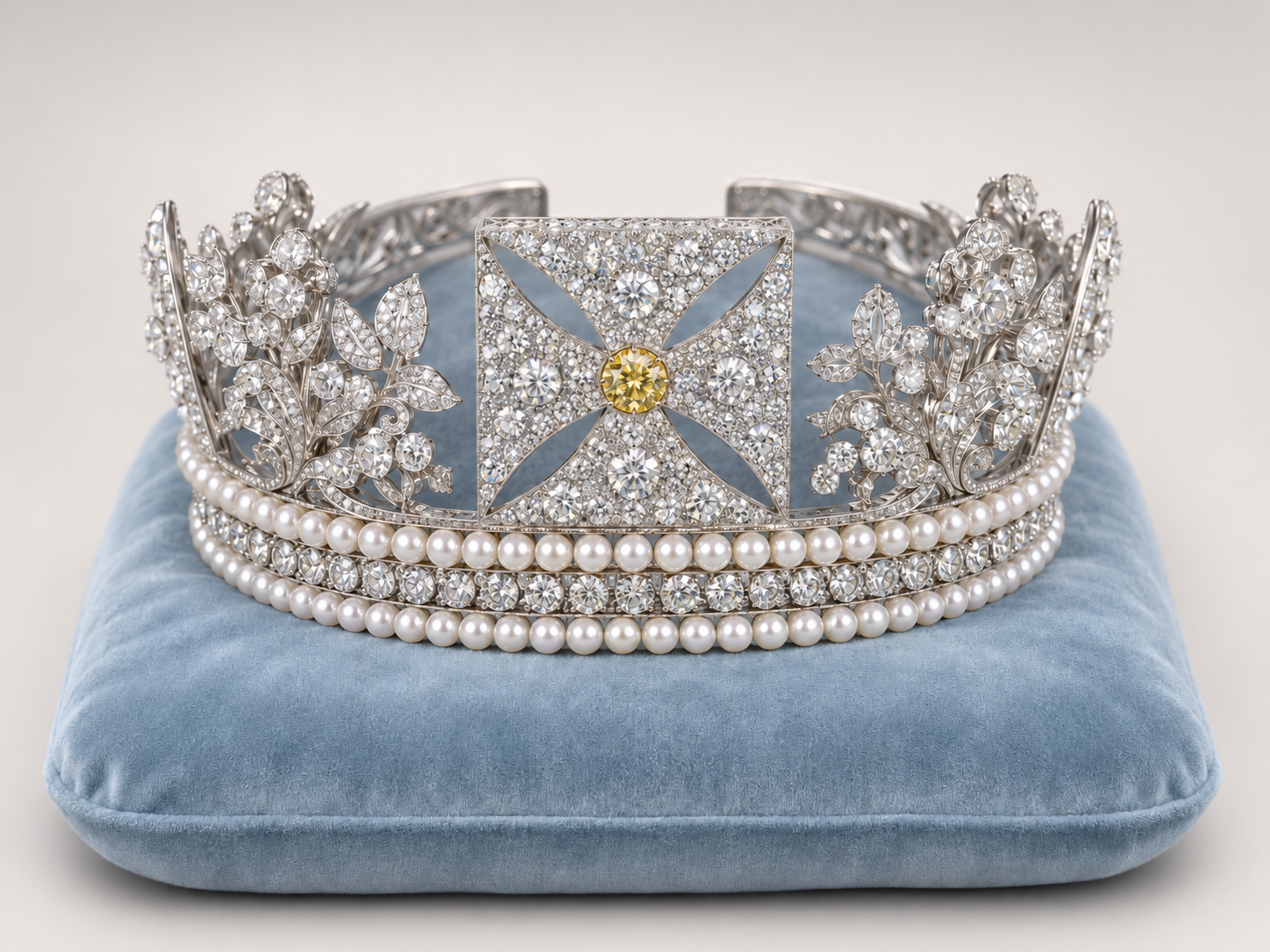
Image information
Click image to magnify
Digitally created illustration of the diamond diadem, with crosses, floral emblems and rows of pearls, resting on a blue cushion.
- Credit
- Stunning Stamps.
- Notes
- Digitally created.
Sources
- Hastings E. Wright and A. B. Creeke: A History of the Adhesive Stamps of the British Isles (1899), pp. 160–161
- Fred J. Melville: Postage Stamps of Great Britain, p. 31: 2s 6d denomination inscription
- Robert B. Galland, The First Low Value Surface Printed Postage Stamps of Great Britain (RPSL, 2014), p. 3: earlier Joubert portrait engraving after Corbould
- Douglas N. Muir, William Wyon & the Penny Black, Royal Mint Museum
- Wright and Creeke, A History of the Adhesive Stamps of the British Isles (1899), pp. 69 and 160–163: De La Rue manufacture and the 1883–1884 high values
- David Feldman: De La Rue half-crown die proofs, April 1883
- Royal Collection Trust: George IV's Diamond Diadem