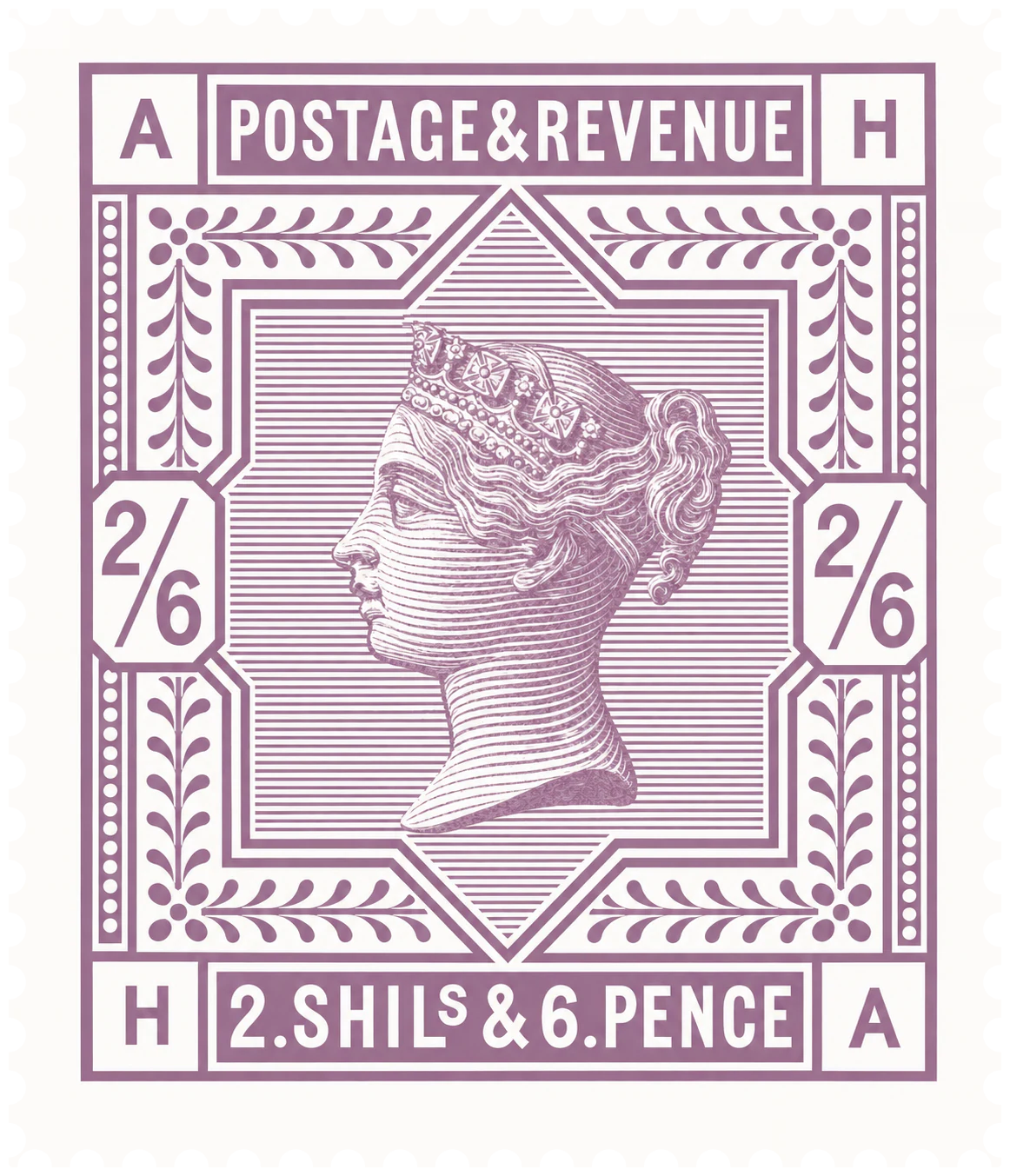
The half-crown lilac appeared in July 1883, becoming the first high-value stamp in Britain's new unified postage-and-revenue series. De La Rue designed a rectangular stamp with Victoria's portrait, large value figures and four corner letters. Its introduction was complicated by stocks of older embossed revenue stamps, while its new printing plates entered production in an unexpected order. The first impressions were made on distinctive blue-tinted security paper.
Stories
The stamp that arrived before its companions
The stamp that arrived before its companions
The two-shillings-and-sixpence appeared on 2 July 1883, nine months before most of Britain's new unified postage-and-revenue series.
De La Rue had been preparing designs suitable for both purposes, using inks intended to prevent the fraudulent removal of cancellations.
The half-crown was the first of the new higher-value designs to enter production. A Post Office circular dated 3 July announced that the stamp was ready. [14]
The printers had completed their work well ahead of the other denominations.
The stamp's early appearance illustrates how a large coordinated design project could reach the public in stages rather than all at once.
The printing plates used in the wrong order
De La Rue prepared two printing plates for the new half-crown.
Plate 2 was registered on 19 June 1883; plate 1 followed on 19 July. Plate 2 began work on 25 June, while plate 1 was not brought to press until 27 September. [14, 15]
The records do not explain why the second plate was used first.
Each plate contained 112 impressions, arranged in two panes of fifty-six.
The numbering suggests a straightforward sequence, but the actual printing history tells a different story. A completed plate could remain unused while its companion was already producing stamps.
The engraver's proof dated 11 April
Surviving De La Rue proofs reveal the development of the half-crown before its printing plates were prepared.
One proof, printed in black on glazed white card, is dated 11 April 1883 and endorsed BEFORE HARDENING. The corner-letter spaces are still empty. [16]
Another proof dated 13 April records a further stage before the die was used for striking impressions.
The engravers had to complete and harden the original steel tool before it could be reproduced for mass printing.
These dated proofs preserve two moments in the workshop, showing that the finished stamp was the result of successive operations rather than one act of engraving.
The old stamps that confused historians
The introduction of the new half-crown puzzled Hastings Wright and A. B. Creeke when they examined government records in the 1890s.
They found that stamps of this value had been supplied during the first half of 1883, apparently before the new printing plates were ready. [14]
The explanation emerged from the stock books. The stamps were remnants of an older embossed Inland Revenue issue, which had been retained temporarily while the new adhesive stamp was being prepared.
Early in January, 4,540 of the old embossed stamps had entered the accounts. The new surface-printed half-crown was not issued until July.
The discovery resolved a mystery about the timing of manufacture, using records that had survived for more than a decade.
The paper that looked blue before printing
The half-crown was printed on Large Anchor watermarked paper, originally associated with revenue stamps.
Some sheets had a pronounced bluish tint, while others were almost white. The colour came from the paper rather than Victoria's printed portrait. [14]
The purple printing ink was specially prepared to react to attempts to remove cancellations.
Together, the coloured paper, hidden watermark and chemically sensitive ink formed part of the stamp's security.
The printers were bringing together several different materials, each intended to make the finished object more difficult to imitate or reuse.
Why do some stories appear on several pages?
Every page is written to make sense on its own. Visitors often arrive directly at a particular stamp or subject, without having explored the rest of the site.
Some stories are relevant to several stamps, so they are repeated where they help explain what you're looking at. For those exploring a series, the details specific to each stamp generally come first, with the more familiar stories further down the page.
This way, you can explore the site in any order without missing interesting background.
An indented frame surrounds Victoria, with bold 2/6 figures at either side. Explore the proof with empty corners, the hidden anchor and lilac ink designed to reveal attempts at reuse. [17, 18]
De La Rue grew from a playing-card business into a major security printer. It supplied British postage stamps from the Victorian period and printed the Edward VII issues before the contract changed in 1911.
On this stamp
Thomas De La Rue & Co. designed and surface-printed the half-crown lilac issued on 2 July 1883. Two plates were prepared, with plate 2 brought to press before plate 1. The inherited portrait sources are credited separately from the new frame and die.
Jean Ferdinand Joubert de la Ferté was a French engraver and photographer. He trained in Paris and later worked in London, where his engraving helped establish De La Rue’s surface-printed postage stamps.
On this stamp
Joubert engraved the earlier surface-printed Queen’s head after Corbould’s drawing. On the 1883 half-crown lilac, this identifies an inherited portrait model, not a documented commission to engrave its later die or frame.
William Wyon was a medallist and engraver at the Royal Mint. His models of royal heads were made for coins and medals and also became sources for stamp portraits.
On this stamp
Wyon’s City of London medal supplied the youthful likeness inherited on the 1883 half-crown lilac. He is credited as an earlier artistic source, separate from De La Rue’s later stamp design.
Henry Corbould was a draughtsman and book illustrator. He trained with his father and at the Royal Academy Schools, where he received a silver medal for a life study.
On this stamp
Corbould’s drawing after Wyon’s medal supplied the model for the earlier surface-printed Queen’s head. His connection to the 1883 half-crown lilac is that inherited portrait source, not the preparation of its later frame or die.
The country identifies the postal authority that issued the stamp. The monarch identifies the ruler whose portrait it carries. A definitive is an everyday stamp intended for regular postal use.
On this stamp
This 2s 6d belongs to the Later High Values of Victoria’s reign. The youthful head is inherited from earlier artistic models; it is not a new portrait of the Queen at the issue date.
The denomination is the stamp’s face value: the amount of postage it represents. Its price to a collector can be quite different.
In Britain’s old currency, 12 pence made one shilling and 20 shillings made one pound: 240 pence altogether. The abbreviations were d for pence, s for shillings and £ for pounds. The d comes from the Latin denarius. A halfpenny, written ½d, was half an old penny.
On this stamp
This stamp represents 30 old pence. A 56-stamp pane totals £7 and the complete two-pane printing sheet £14.
The design can look different when either its ink or its paper changes. Rose on bluish paper, for example, should not be assessed in the same way as rose on white paper. Inspect the unprinted areas as well as the portrait.
Period descriptions include purple for the half-crown, carmine for the five-shilling, blue and cobalt for the ten-shilling, and brown-violet for the first long pound. Modern catalogue names make further distinctions. These names describe families of impressions, not calibrated screen colours.
Fading, cleaning, staining and lighting can also alter appearance. Compare appropriate original material and its condition before treating a colour difference as an issued shade. The reconstructions illustrate the intended colour families.
On this stamp
The illustration represents lilac as catalogued for SG178. It targets the white-paper category, whose appearance should not be confused with the same ink on bluish paper. No calibrated shade or condition is certified.
These dates describe different events. A die proof records work on the original tool; a registration sheet records approval; the press date records manufacture; the issue date concerns public availability. Their order and spacing can explain apparent contradictions.
The half-crown was issued on 2 July 1883. The redesigned 5s, 10s and brown-lilac pound followed on 1 April 1884, after months of preparation. The half-crown’s second plate was used before its first, so a plate number is not a chronological guarantee.
For the green pound, the circular is dated 27 January 1891. Wright and Creeke say it was in use by the end of that month, possibly on the circular date. This is narrower evidence than a securely demonstrated first-day cover.
On this stamp
Wright and Creeke date the design’s issue to 2 July 1883, a day before the circular announcing availability. The illustration targets white-paper SG178 rather than asserting that this paper category was the first supply.
This family brings together the half-crown of 1883, the redesigned five-shilling, ten-shilling and pound of 1884, and the pound’s green printing of 1891. It is a useful design grouping, not a claim that all five appeared together.
The first three have upright designs on Large Anchor paper. The unusually long pound was adapted from a telegraph design and covers three Crown watermarks. Its change to green retained the established engraving.
Earlier upright high values and the five-pound orange belong to separate groups. Blued paper, the pound’s Orb-paper error and officially marked examples need to be identified within their own histories rather than treated as additional denominations.
On this stamp
This 2s 6d is one of five articles in the family. The half-crown preceded the redesigned 1884 values.
A catalogue reference identifies a combination of design, colour, paper and other features. It does not identify every printing plate or certify the condition of a particular stamp. Similar printed faces can conceal different watermarks or paper colours.
These illustrations represent the white-paper 2s 6d, 5s and 10s, the Crown-watermarked brown-lilac pound and the green pound. The first-appearance date may describe the design’s introduction before the particular paper category illustrated.
Read the reference with the individual note and the recorded original specimens. A digital reconstruction is useful for studying the design, but cannot prove an unseen watermark, original gum or a calibrated shade.
On this stamp
The recorded specimen references identify SG178 with H–A below and A–H above. The paper category is white Large Anchor. The reconstruction does not authenticate the reverse of an original.
Typography, also called surface printing, transfers ink from the raised parts of a printing surface. The recessed areas leave the paper unprinted. White lettering therefore need not be a second impression in white ink.
De La Rue engraved steel dies and used moulding and electrotyping to multiply their designs into printing plates. By this period the company used steam presses. Gumming, printing and perforating were distinct stages.
Each of these stamps was printed in one colour. The long pound’s adaptation does not imply the separate POSTAGE printing used for the five-pound orange. The diagram explains the printing principle, not the precise construction of a particular press.
Surface printing, shown from the side. The paper is pressed onto the inked surface.Image information
Side view of surface printing. Paper is pressed down onto ink on the raised parts of a printing plate; the lower spaces do not touch the paper.
Credit
Stunning Stamps · 2026
On this stamp
De La Rue printed this 2s 6d from raised surfaces in one ink. White details are unprinted paper. The upright design does not require a separate white or inscription impression.
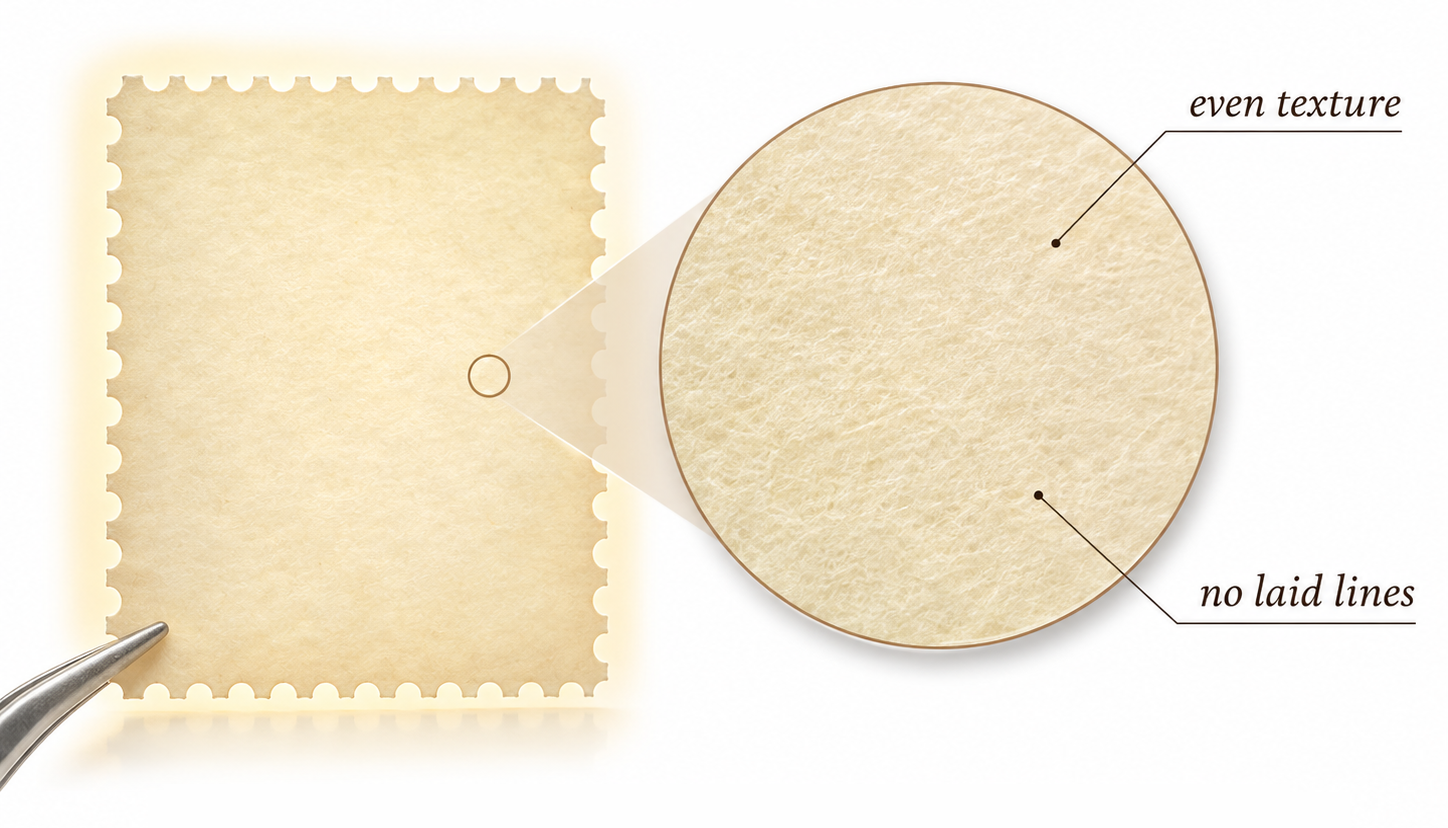
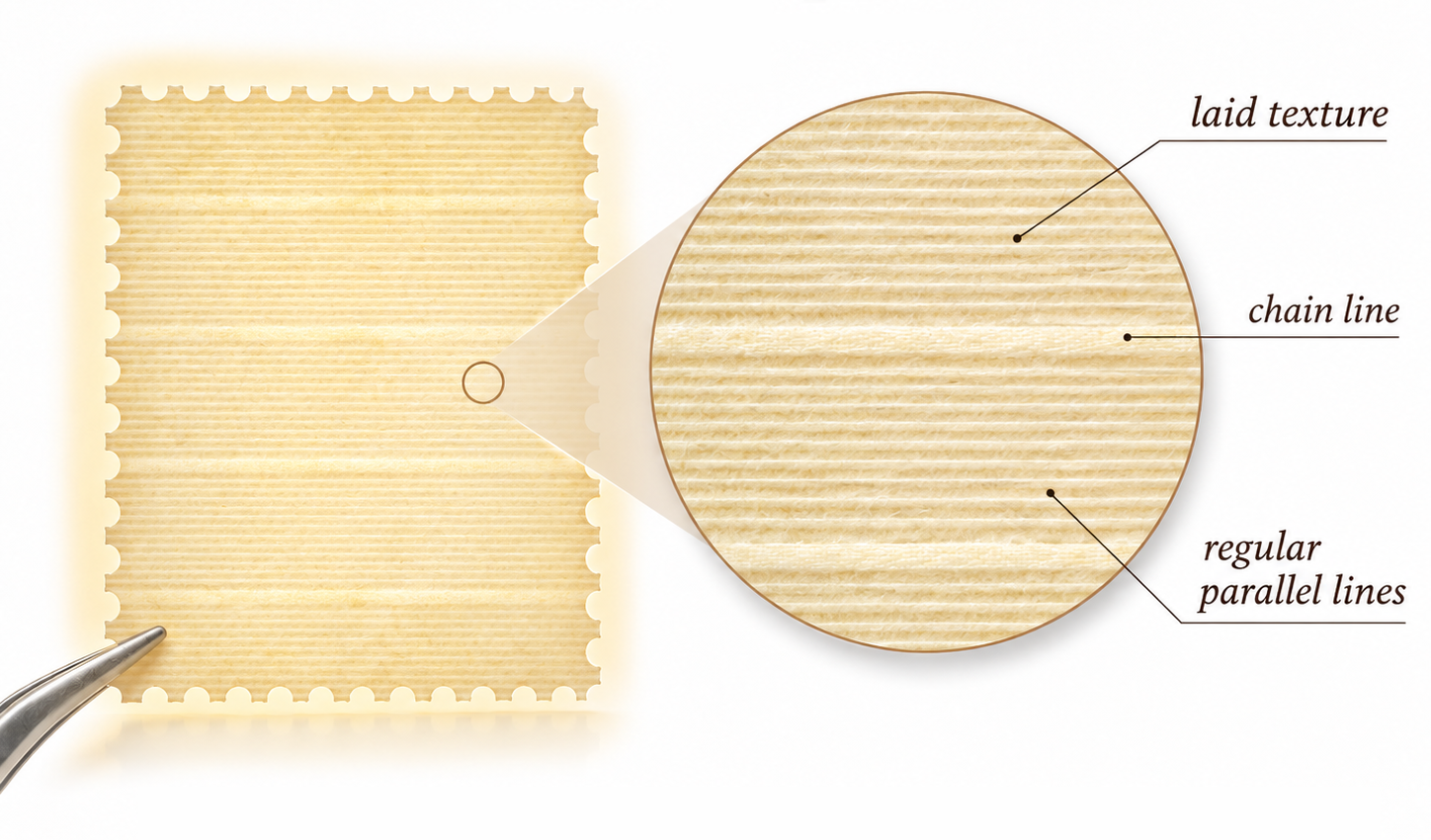
Wove paper has a comparatively even fibre structure, unlike the regular lines characteristic of laid paper. Wove structure, watermark, colour and gum describe separate properties of a sheet.
Both the Large Anchor stock and the Large Crown stock used here were machine-made. The watermark was formed while the fibres were wet, before the sheet was gummed and printed. The comparison illustrations explain wove and laid structures; they are not photographs of these original high-value papers.
The printed face alone cannot establish thickness, watermark orientation or the condition of the reverse. Read the individual note for the documented issue paper, rather than inferring those properties from the reconstruction’s smooth surface.
Wove paper: even texture without laid lines.Image information
Click image to magnify
Diagram of wove paper with a magnified inset showing an even texture without laid lines.
Credit
Stunning Stamps · 2026
Notes
Digitally constructed
Laid paper: regular parallel lines, shown for comparison.Image information
Click image to magnify
Diagram of laid paper with a magnified inset showing regular parallel lines.
Credit
Stunning Stamps · 2026
Notes
Digitally constructed
On this stamp
The 2s 6d uses machine-made Large Anchor fiscal paper. Wove describes its structure, separately from watermark and colour. The two comparison illustrations explain the paper terms rather than showing an original sheet.
Bluing belongs to the paper, not to a second printed colour. The Large Anchor stock originated in fiscal-stamp production. Wright and Creeke describe its chemical preparation and note that the blue tint could vary greatly.
The 2s 6d, 5s and 10s occur on blued and white paper. Their illustrations here target the white-paper catalogue categories. Faint bluing is difficult to judge in a front photograph, and age or a coloured backing can be misleading.
The long pounds normally use white Crown paper; the brown-lilac Orb printing is a change of watermark, not an Anchor-paper issue. Do not import later Edwardian chalk-paper distinctions into these Victorian descriptions.
On this stamp
SG178 is represented on white Large Anchor paper. The blued-paper issue is a separate paper category; no bluing is inferred from the colour of this screen image.
Fugitive ink is designed to react when someone tries to remove a cancellation. Doubly fugitive describes sensitivity to water and chemical treatment; it does not mean two colours or two printing passes.
Wright and Creeke explicitly describe the half-crown’s purple as doubly fugitive. Their accounts name the other colours without supplying the same chemical description for every ink. A security claim for purple should not automatically be transferred to rose, blue or green.
For the pound’s change to green they suggest fear of photographic imitation, while making clear that this is their interpretation. Preventing reproduction and preventing the cleaning of used stamps are related security aims, but involve different mechanisms.
On this stamp
Wright and Creeke explicitly call the half-crown purple doubly fugitive. It was intended to react to attempts to clean away cancellations; this describes ink behaviour, not a second printing.
A watermark is a thinner pattern formed within the paper, rather than an inked emblem. Its shape and spacing can distinguish stamps whose printed faces are almost identical. The reverse of an original is needed to establish orientation or a partial device.
The upright 2s 6d, 5s and 10s each cover one Large Anchor. This is the large fiscal-paper anchor, not the Small Anchor of the earlier 2½d. The long pound spans three Large (1880) Crowns across its width.
A November 1887 paper requisition for the brown-lilac pound was entered in the Orb column by mistake. The resulting printing has three Orbs instead of three Crowns. The green pound retained Crown paper. Neither paper change altered the printed portrait.
On this stamp
Each 2s 6d impression covers one Large Anchor. This is the large fiscal-paper device, not the Small Anchor of the earlier 2½d. Orientation cannot be certified from the illustrated face.
A perforation gauge measures the spacing of holes over two centimetres, not the total number of teeth on an edge. Two numbers give the horizontal gauge first and the vertical gauge second.
All five ordinary issues here gauge 14 in both directions. The long pound naturally has more holes along its horizontal edges than an upright high value; differing endpoint counts do not create another gauge.
A five-shilling SPECIMEN example perforated 12 is documented separately. It is not an ordinary public-sale alternative in this set. Imperforate proofs and trimmed perforated stamps also need to be distinguished through margins, paper and provenance.
Enlarged spacing diagram, not to scale. Match the spacing with a perforation gauge.Image information
Enlarged perforation spacing: fourteen equal intervals between hole centres span 20 millimetres. This is a schematic, not a ruler.
Credit
Stunning Stamps · 2026
On this stamp
The ordinary 2s 6d gauges 14 horizontally and vertically. Total teeth at the endpoints can vary without changing the gauge. No grouped perforation alternative is added.
De La Rue used white gum arabic, applied to the paper before the stamp impression was printed. The adhesive coating is different from both a watermark within the sheet and ink on its face.
Original gum, disturbed gum, hinge traces and later regumming describe condition. A clean-looking printed face cannot establish an untouched reverse. Used stamps may have lost their gum during removal from a document.
These illustrations show the design rather than a certified surviving item. Their clean paper does not make an assertion about original gum or the treatment of the specimens used as drawing references.
On this stamp
De La Rue gummed the paper before printing this 2s 6d. The illustration depicts the face only and makes no claim about original gum, hinging or regumming of a surviving specimen.
A pane is a block of impressions within a printing sheet. A gutter separates panes, and selvedge is the outside margin. The larger sheet supplied by the papermill is a different unit again.
The 2s 6d, 5s and 10s plates held 112 stamps in two panes of 56, one above the other. Each pane had seven rows of eight. Large Anchor paper was manufactured with 224 devices; a half mill-sheet accommodated this 112-subject printing arrangement.
The long pound plate held 80 stamps in two vertically arranged panes of 40, each ten rows of four. Each wide impression covered three Crown devices. A registration sheet with examples subsequently removed still records the original layout; count the missing spaces as well as the surviving stamps.
The diagram explains pane and gutter terminology rather than reproducing either high-value layout. Do not substitute the earlier upright high values’ single-pane Anchor arrangement for these new two-pane plates.
Sheet, panes and margins: a simplified example.Image information
A schematic printing sheet contains two panes separated by an unprinted gutter and surrounded by a margin.
Credit
Stunning Stamps · 2026
On this stamp
The 2s 6d plate has two panes, one above the other, each seven rows of eight. The complete printing unit fits a half mill-sheet of Large Anchor paper. The generic diagram explains terms, not this exact layout.
Multiply the number of stamps by the denomination to obtain the face value of a pane or printing sheet. This was an accounting amount, not a modern collecting value or a postal rate.
A 56-stamp pane of half-crowns totals £7, of five-shillings £14, and of ten-shillings £28. The full two-pane printing sheets total £14, £28 and £56 respectively.
A pane of 40 one-pound stamps totals £40, and the complete 80-subject sheet £80. These calculations describe the documented printing units; they do not by themselves prove how every post office divided its stocks for counter use.
On this stamp
For the 2s 6d, 56 stamps make £7 and 112 make £14. These are calculated printing-unit totals, not a claim about a particular counter subdivision.
The lower-left letter gives the row and the lower-right letter the column. The upper letters repeat the pair in reverse order. On the upright high values the full grid runs through fourteen rows, A–N, and eight columns, A–H, with a gutter between the two panes.
The long pound uses twenty rows, A–T, and four columns, A–D. Its white letters stand against coloured corner blocks, whereas the upright designs have coloured letters on white. These are different arrangements from the five-pound’s column-first telegraph convention.
Letters locate an impression, not an engraver, post office or printing plate. Repeated flaws can make a position useful when studying a plate; the same letters alone cannot distinguish two plates. The reverse-order upper pair also helped reveal fraudulent assemblies made from uncancelled pieces.
On this stamp
The lower H–A pair locates row 8, column 1 in the full fourteen-row, eight-column grid. The upper pair is reversed. Coloured letters occupy white squares. The pair alone does not establish the printing plate.
A die carries the original design; a printing plate carries the repeated subjects needed for production. These high values do not show a plate number in the individual stamp design. Corner letters identify a position, not a plate.
The half-crown used plates 1 and 2, the five-shilling 5 and 6, the ten-shilling 2 and 3, and the long pound 2 and 3. The last three denominations continued earlier numbering rather than starting again when their designs changed.
Official registration records, marginal annotations and established plate characteristics can supply further identification. Without that evidence, an illustration should not be assigned to a particular plate merely from its colour or corner pair. The pound’s documented JC/TA breaks illustrate how additional evidence can matter.
On this stamp
Plate 2 was registered on 19 June 1883 and plate 1 on 19 July. Plate 2 entered use on 25 June; plate 1 followed on 27 September. No particular plate is assigned to the illustrated H–A.
A complete sheet preserves information that is lost when stamps are separated. The later high-value plates had relatively plain printed margins, with a line-and-dot guide at the top and bottom to assist perforating.
Plate and current numbers were written by hand on the registration sheets described by Wright and Creeke. These annotations are different from a numeral printed in every stamp, and different again from lettering formed as a watermark.
Large Anchor paper had marginal Inland Revenue wording; Crown paper had POSTAGE wording and other watermark elements. A watermarked word in selvedge does not change the inscription printed on the stamp. Retained margins can therefore help explain both manufacture and paper identity.
On this stamp
The 2s 6d layout used guides at the top and bottom. Plate and current numbers were written on the registration sheets rather than printed on the stamp face. This detached illustration has no selvedge establishing marginal details.
A familiar royal likeness can be carried into a new frame. The earlier surface-printed head derived from Joubert’s engraving after Corbould’s drawing, with Wyon’s medal as an earlier artistic source. Those credits do not identify the engraver of every later die.
De La Rue made the new half-crown setting, revised the five-shilling and gave the ten-shilling an octagonal frame. The five-shilling’s Greek-key ornament recalls Owen Jones’s 1867 design; the later revision is not a new commission to Jones.
The long pound adapted the company’s 1877 telegraph design for postage. The 1891 green retained its existing engraving. A colour registration therefore need not imply a replacement die, and a repeated portrait need not imply an unchanged surrounding design.
On this stamp
The 2s 6d received its own indented square setting around the inherited portrait. The established portrait credits do not identify an individual engraver of this later die.
A die proof tests the original engraving; a plate proof shows impressions from a printing plate. An imprimatur is an approved registration impression. These terms explain why an object was made, not simply whether its edges are perforated.
Black impressions on glazed card can bear dates and workshop endorsements such as BEFORE HARDENING. Empty corner spaces show that the permanent design was prepared separately from the identifying letters used in production. Such proofs are not evidence of black stamps sold at the counter.
The green pound’s registration concerns colour rather than a new design. The current Postal Museum inventory identifies POST 150/786 as plate 2; Wright and Creeke describe plate 3 as registered in green on the same date. Keep these source descriptions distinct when citing the object.
On this stamp
A black die proof dated 11 April 1883 is marked BEFORE HARDENING. It records preparation, not issue. The later registration sheets identify the 112-subject plate arrangement.
An ordinary issued stamp, a specimen, a colour trial and an imperforate proof are different kinds of object. The same design can occur in several categories without every combination becoming a normal public issue.
Grosvenor records a white-paper five-shilling rose, letters DC, perforated 12 and marked SPECIMEN Type 9. That provides specific evidence for this exceptional object; it does not establish ordinary perforation-12 alternatives for all the high values.
All five illustrations represent normal perforation 14. No grouped perforation alternatives are present in this set. A claimed exceptional example needs its own gauge, marking, paper and provenance checked; cutting away the teeth cannot establish an imperforate issue.
On this stamp
This 2s 6d represents the ordinary perforation-14 issue. The specifically documented five-shilling perf. 12 specimen is not evidence for assigning a perf. 12 alternative to this stamp. Proofs require their own identification.
SPECIMEN and administrative CANCELLED markings identify material prepared for reference or official handling. They are separate from a postmark applied when a stamp paid for a service, and from the printing of the underlying design.
Surviving high-value examples include several specimen and cancellation types. The marked perforation-12 five-shilling is one specific combination. An unusual overprint needs independent authentication; its presence alone does not explain when or why a sheet was prepared.
An official-service overprint is a further category. Wright and Creeke note that some Orb-paper pounds were overprinted for official use. An official marking, a fiscal cancellation and the unoverprinted public-sale stamp should not be treated as interchangeable evidence.
On this stamp
The illustrated 2s 6d has no SPECIMEN, CANCELLED or official-service overprint. Surviving officially marked examples do not change the status of this unoverprinted public-sale design.
A repeatable plate flaw belongs to the printing surface and can appear on successive impressions. A single blurred area, scratch or cancellation is weaker evidence: it may have arisen in printing, later handling or photography.
On plate 2 of the long pound, the JC and TA positions are associated with broken-frame varieties. Comparing a documented flaw with the same position in another printing can link plate history across a change of colour.
The two pound illustrations here show EC and HA, not the named broken-frame positions. No specialised flaw is claimed for them or for the upright high-value reconstructions. Use authenticated original comparisons when assigning a plate or variety.
On this stamp
The H–A illustration is not attributed to a named plate flaw. A recurring mark needs corroboration at the same position; an isolated printing weakness or digital artefact does not establish a variety.
The upright high values occur on both blued and white Large Anchor paper. The paper category and printed shade need to be considered together, but neither is automatically a different design or perforation gauge.
The brown-lilac pound’s accidental Orb printing followed a wrongly completed paper requisition in November 1887. Wright and Creeke record 80,800 stamps and place public availability from early October 1888 into May 1889. The printed design remained unchanged.
The later green pound retained Crown paper and the established plates. Its colour change is separate from the earlier Orb mistake. Likewise the ten-shilling’s cobalt and ultramarine distinctions concern ink and paper, rather than a new octagonal engraving.
On this stamp
Early supplies used blued Large Anchor paper; white paper and variations in purple ink followed. The SG178 illustration represents the white-paper lilac category. Paper colour does not alter the normal gauge of 14.
High denominations reduced the number of smaller stamps needed for large payments. A half-crown or pound does not by itself identify one universal letter rate: date, destination, weight and service all matter.
A complete cover, parcel document, telegraph form or accounting record can explain a high-value use. A detached stamp with a town and date often cannot establish the original charge or show whether it travelled on an ordinary letter.
Read the whole item, including the total franking and other endorsements. A stamp originally designed for telegraphs may later have a postal design descendant, but those two issues and their evidence remain separate.
On this stamp
At 30 old pence, this 2s 6d could reduce the number of smaller stamps needed for a large charge. Its denomination alone cannot identify a route, weight or service; a complete dated document is needed.
From 1 January 1883, the combined-duty rules covered eligible general adhesive duties up to two shillings and sixpence. Specially appropriated fiscal stamps were excluded. This limit matters when comparing the half-crown with the larger denominations.
The half-crown explicitly reads POSTAGE & REVENUE, and its 1883 notice also mentions telegraph use. The five-shilling, ten-shilling and pound designs read POSTAGE. Their higher values should not automatically inherit the half-crown’s dual-purpose authorisation.
A fiscal-looking cancellation, an official overprint and a postal marking describe different uses or treatments. Establish the applicable rule and the surviving document before assigning a revenue use; an ink colour or an inherited telegraph layout is insufficient.
On this stamp
The July 1883 half-crown notice explicitly permits postal, telegraph and Inland Revenue purposes. Its value falls within the 2s 6d ceiling for the combined general adhesive duties introduced that year.
The stamp design and corner letters were printed before issue. A cancellation was applied later to prevent reuse or record a payment. Specimen markings and registration annotations belong to different stages of the stamp’s history.
For high values, the surrounding document is particularly valuable evidence. A date or office name on a loose stamp does not alone distinguish postal carriage, telegraph work or internal accounting.
Cleaning can weaken both the cancellation and the printed colour. Treat a pale or apparently unused example as a condition and identification question before naming a new shade. These reconstructions show the designs without a cancellation.
On this stamp
The illustration shows the 2s 6d design without a cancellation. A dated or pen-cancelled original needs its surrounding document to establish use; a clean face alone cannot certify that a stamp was never used.