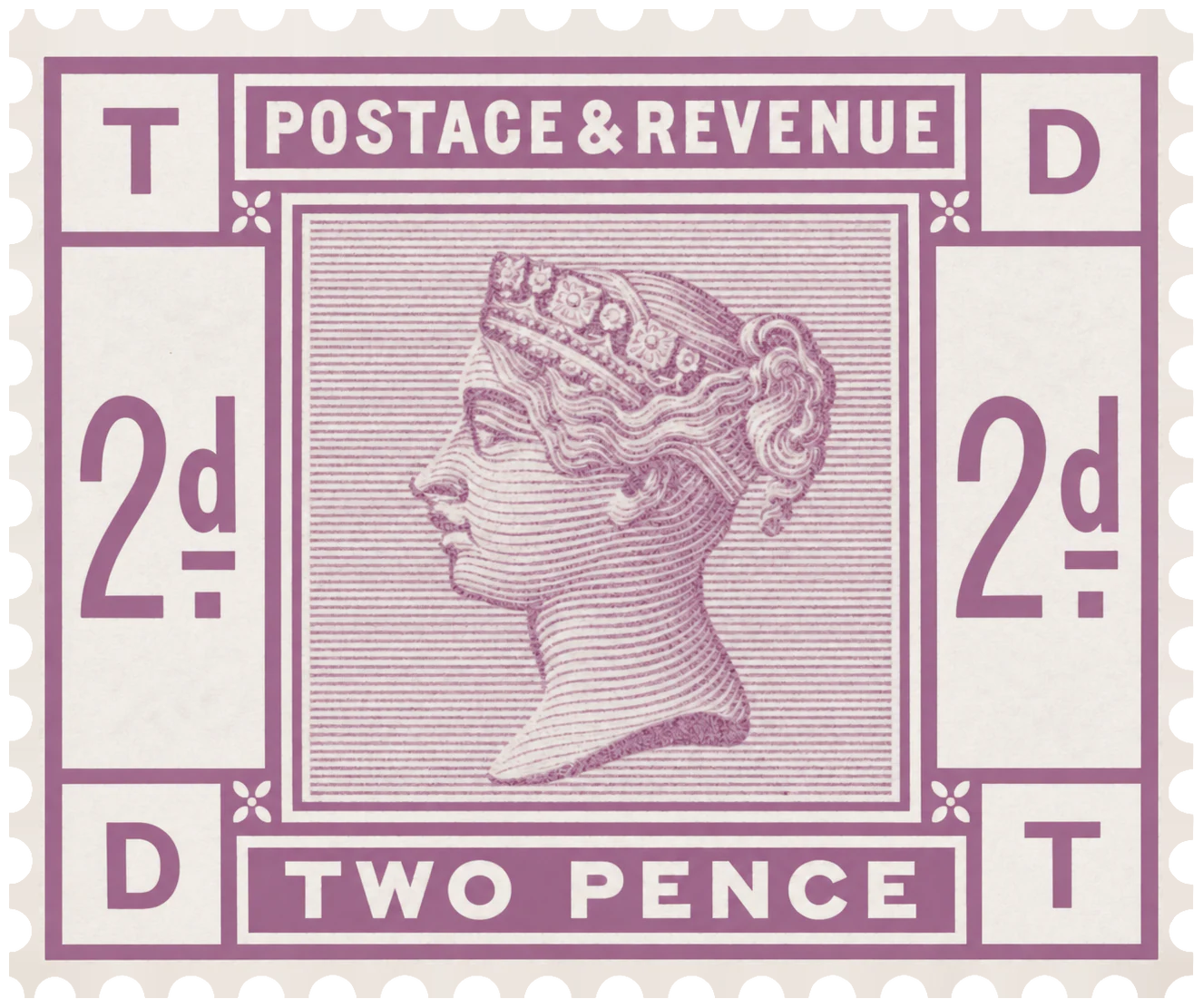
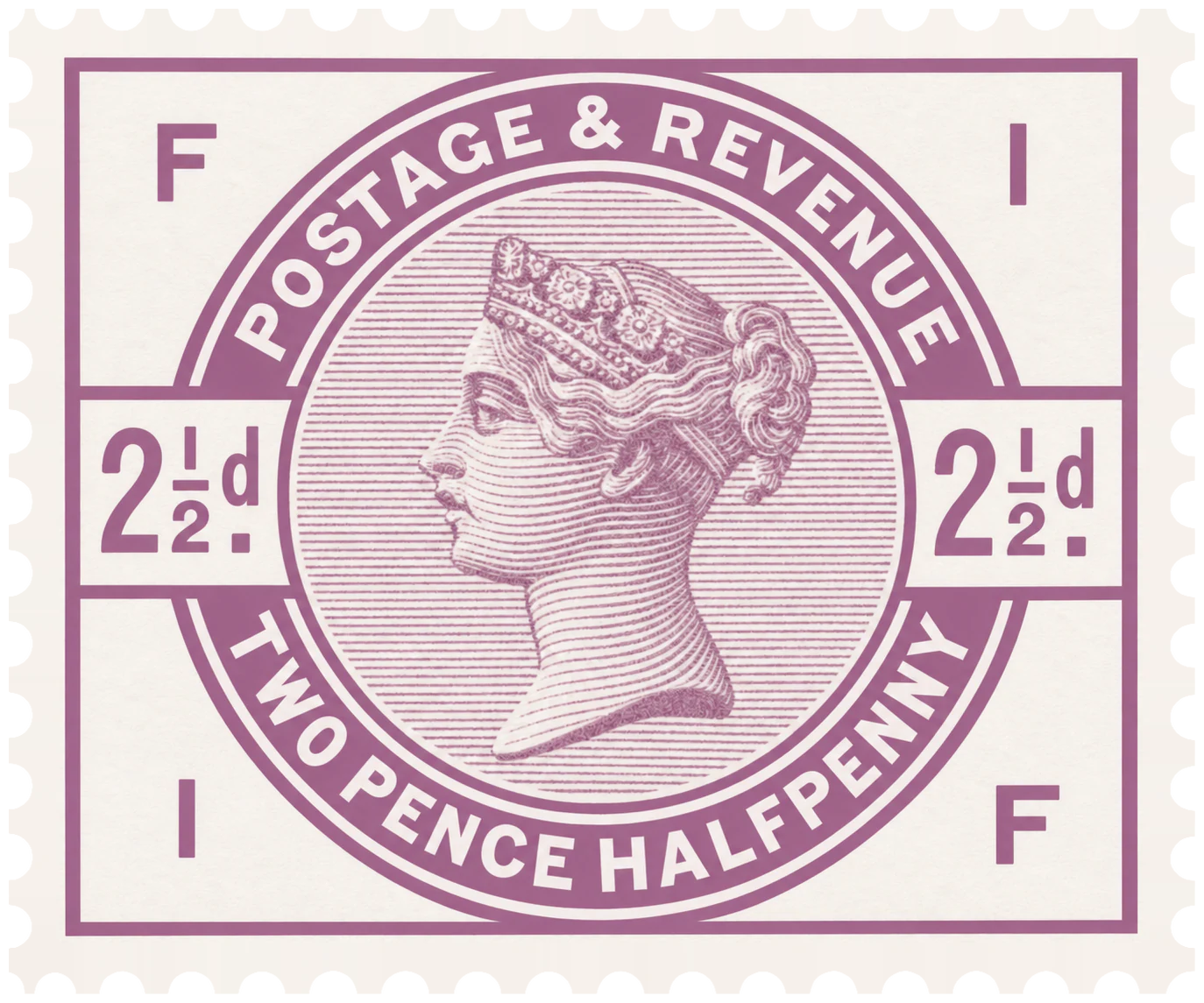
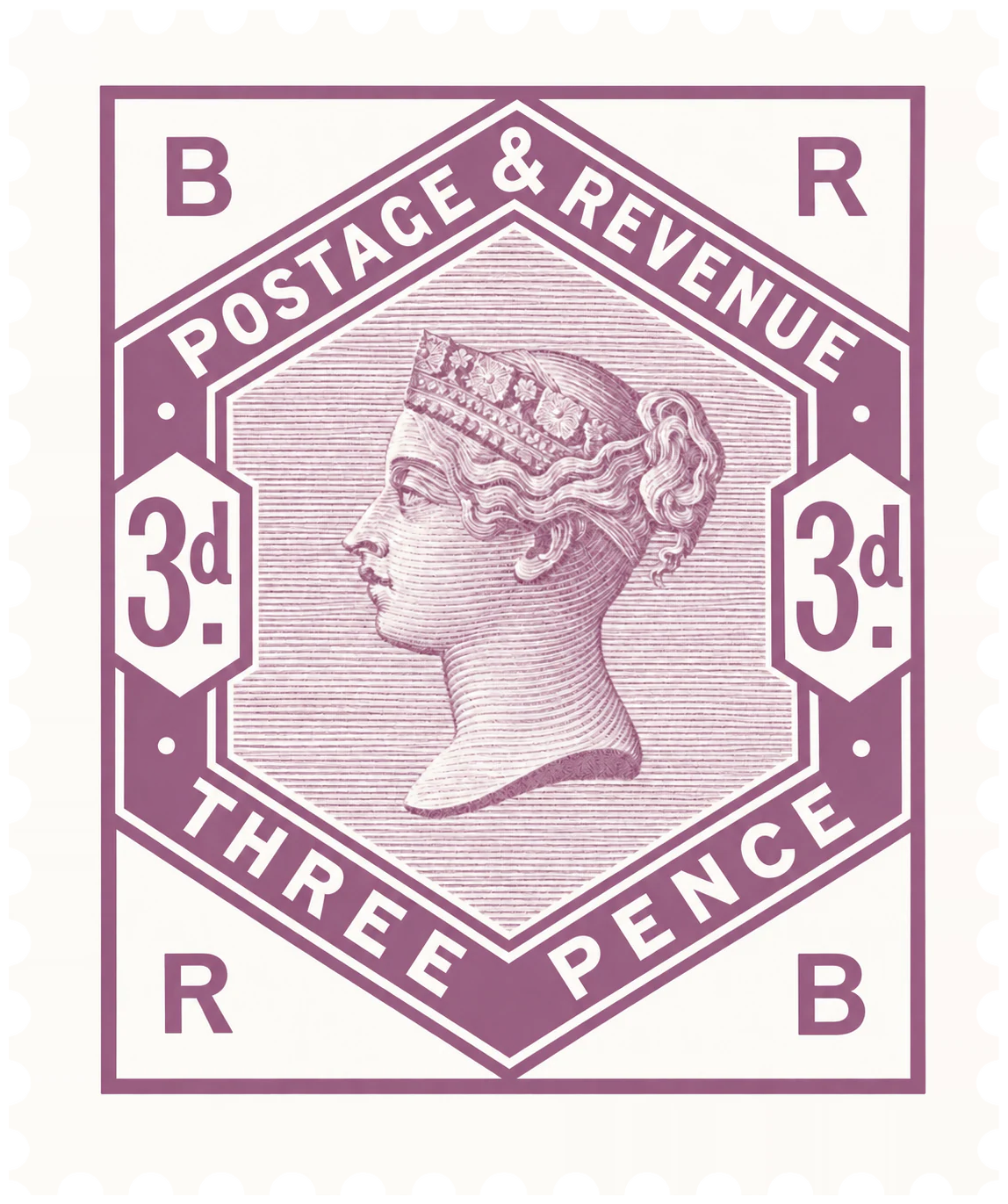
The twopenny lilac introduced a new design in April 1884, with large value figures on either side of Victoria's portrait and four coloured corner letters. De La Rue had prepared its printing plates months earlier. The issue's similar lilac colours soon drew criticism, prompting experiments with coloured paper and alternative inks. One official registration sheet preserves an unusual detail: ten stamps were cut from it in 1885 and replaced on the same day.
Stories
Ten stamps removed — then put back
Ten stamps removed — then put back
When De La Rue prepared the new twopenny, a complete printing sheet was retained as an official record of the approved plate.
The registration sheet for plate 2 survives in the Postal Museum's collection. But it has an unusual feature.
Ten stamps, lettered LA to LJ, were cut from the sheet and later reattached. A handwritten note on the reverse records that the row was taken on 28 January 1885 and replaced that same day. [14]
The records do not explain who removed the stamps or why.
The little operation has nevertheless survived as part of the sheet's history. A document originally prepared for official approval now preserves evidence of someone handling and altering it more than a century ago.
A design finished before anyone could buy it
The twopenny lilac appeared on 1 April 1884, but its printing plates had been completed months earlier.
Plate 1 was registered on 30 October 1883, followed by plate 2 the next day. Both were brought to press on 3 November. [15]
The printers therefore had several months in which to prepare supplies.
Only two plates were required during the stamp's production life. Allan Oliver's study gives a combined total of 113,500 sheets, equivalent to more than 27 million impressions.
The finished stamps looked identical, but behind them were months of preparation and the repeated work of the printing machinery.
A hundred and twenty experiments on squared paper
The Lilac and Green stamps attracted criticism soon after their introduction. Several values were difficult to distinguish because their colours were so similar.
De La Rue began experimenting with alternative combinations of ink and paper.
Two large pieces of squared paper once held 120 trial impressions of the twopenny and two-and-a-halfpenny, arranged in neat columns. The impressions used different inks and coloured papers. [16]
The trials were subsequently separated, but their original arrangement was recorded.
The experiment gives a glimpse of a Victorian design workshop. Before choosing a new appearance, the printers laid out dozens of alternatives for comparison, much as a designer might arrange colour samples today.
The purple stamp printed on yellow paper
One of the experiments produced a particularly striking version of the twopenny.
On 13 June 1884, De La Rue prepared a formal scheme showing how existing stamps might be improved by printing them on coloured papers.
The twopenny appeared in purple on yellow paper. Another impression, also using the twopenny design, was printed in purple on pink paper to demonstrate a possible sixpenny colour combination. [16]
The proposed combinations were shown to postal officials.
On 25 June, the authorities decided to send additional examples for opinions and experiments.
The colours were not adopted for ordinary production, but the trials preserve an attempt to rescue the unpopular designs without starting again.
The printing ink that created another problem
The lilac ink was chosen because the government wanted stamps that would resist fraudulent reuse.
The ink was intended to be damaged by chemicals or washing, making it difficult to remove a cancellation while leaving the stamp intact.
But the similarity of the new lilac and green values created a different difficulty. Once cancelled, the denominations could be hard to recognise. [17]
Postal officials warned that mistakes might affect government revenue.
Warren William De La Rue was asked to investigate improvements, beginning with colour trials on different papers.
The experiments eventually led to a more extensive redesign, considered by the Stamp Committee appointed later in 1884.
A security measure intended to protect the stamps had helped create the problem that brought about their replacement.
Three issued designs from the series. Compare their frames and value figures; the cancelled examples and experimental papers are not shown. Shown at different enlargements.
Click a stamp to magnify
Why do some stories appear on several pages?
Every page is written to make sense on its own. Visitors often arrive directly at a particular stamp or subject, without having explored the rest of the site.
Some stories are relevant to several stamps, so they are repeated where they help explain what you're looking at. For those exploring a series, the details specific to each stamp generally come first, with the more familiar stories further down the page.
This way, you can explore the site in any order without missing interesting background.
Two large 2d figures flank Victoria in a broad rectangular design. Explore the four corner letters, the sideways watermark and the coloured-paper trials that gave the same engraving a different appearance. [18, 19, 20]
De La Rue grew from a playing-card business into a major security printer. It supplied British postage stamps from the Victorian period and printed the Edward VII issues before the contract changed in 1911.
On this stamp
Thomas De La Rue & Co. designed and surface-printed the twopenny lilac issued on 1 April 1884. The horizontal design places a large value on either side of the portrait. Two plates were used, each arranged as two panes of 120. Its inherited portrait sources are distinct from the preparation of this new design.
Jean Ferdinand Joubert de la Ferté was a French engraver and photographer. He trained in Paris and later worked in London, where his engraving helped establish De La Rue’s surface-printed postage stamps.
On this stamp
Joubert engraved the earlier surface-printed Queen’s head after Corbould’s drawing. On the 1884 twopenny lilac, this identifies an inherited portrait model, not a documented commission to engrave its later die or frame.
William Wyon was a medallist and engraver at the Royal Mint. His models of royal heads were made for coins and medals and also became sources for stamp portraits.
On this stamp
Wyon’s City of London medal supplied the youthful likeness inherited on the 1884 twopenny lilac. He is credited as an earlier artistic source, separate from De La Rue’s later stamp design.
Henry Corbould was a draughtsman and book illustrator. He trained with his father and at the Royal Academy Schools, where he received a silver medal for a life study.
On this stamp
Corbould’s drawing after Wyon’s medal supplied the model for the earlier surface-printed Queen’s head. His connection to the 1884 twopenny lilac is that inherited portrait source, not the preparation of its later frame or die.
The country identifies the postal authority that issued the stamp. The monarch identifies the ruler whose portrait it carries. A definitive is an everyday stamp intended for regular postal use.
On this stamp
This 2d belongs to Victoria’s Lilac and Green family. Its youthful portrait is inherited from earlier artistic sources, rather than a new likeness of the Queen in 1884.
The denomination is the stamp’s face value: the amount of postage it represents. Its price to a collector can be quite different.
In Britain’s old currency, 12 pence made one shilling and 20 shillings made one pound: 240 pence altogether. The abbreviations were d for pence, s for shillings and £ for pounds. The d comes from the Latin denarius. A halfpenny, written ½d, was half an old penny.
On this stamp
This stamp represents 2 old pence. There were twelve pence to a shilling and twenty shillings to a pound; its 240-stamp counter sheet was worth £2.
This set uses slate-blue for the halfpenny, lilac for the four values from 1½d to 3d, and dull green for the five values from 4d to 1s. Period descriptions commonly call the latter groups purple and sea-green.
A colour name covers a range of impressions. Ink strength, printing, paper and later exposure can all affect appearance. A weak impression is not automatically a separately issued shade, and water or chemical treatment can alter the security inks.
The illustrations give a consistent impression of the colour families. They are not calibrated standards for authenticating a shade. Compare original material and its condition before treating a colour difference as evidence of another printing.
On this stamp
The 2d is illustrated in lilac. The illustration represents the ordinary colour family, without authenticating a specialised shade or faded original.
A die proof records work on an engraving. Registration approves a printing plate or state; the start of printing is another event. The public issue date records when the stamp became available, and may be months later.
The ninepenny went to press on 18 July 1883 and the first supply arrived late that month. Wright and Creeke corrected the older July issue attribution to 1 August. For the 1884 group, the Post Office notice of 18 March announced issue on 1 April.
A dated proof or early plate registration is therefore not an earlier issue date. A cover can provide evidence of actual use, but its date must be read alongside production records and the official announcement.
On this stamp
The 2d was included in the March announcement for issue on 1 April 1884. Earlier proofs and plate work record preparation, not an earlier public sale.
This group brings together ten low-value stamps introduced in 1883–1884. Most share conspicuous value figures, corner letters and inscriptions covering postage and revenue. The name is convenient rather than literally complete: its halfpenny is slate-blue.
The ninepenny appeared in August 1883; the other nine followed in April 1884. There is no new penny here, because the Penny Lilac introduced in 1881 continued in use. The existing halfpenny design was retained in a new colour.
A set groups related issues, not every object made during their preparation. Essays, unissued dies, specimens and unusual perforations need separate descriptions; their existence does not create another ordinary stamp article.
On this stamp
This 2d is one of ten ordinary stamps in the group. The penny denomination continued separately as the Penny Lilac.
A stamp catalogue gives each listed issue a reference number. SG means Stanley Gibbons, the publisher of the catalogue used here. These numbers help collectors refer to the same issue; they are not serial numbers printed on individual stamps.
A range of numbers groups related entries. Colour, paper or perforation differences may account for separate listings within that range.
On this stamp
The existing reconstruction targets SG189, with D–T below and T–D above. Its identity follows the recorded specimen references; the drawing is not a microscopic authentication standard.
Typography transfers ink from the raised parts of a printing surface. Recessed parts do not touch the paper, leaving the white lettering, fine lines and openings within the design. It differs from recess printing, where ink comes from engraved grooves.
De La Rue multiplied the design through moulding and electrotyping to assemble plates of many subjects. Printing, gumming and perforating were distinct manufacturing operations; the paper was gummed before printing.
These stamps were printed in a single colour, without the separate carmine value impression used for the 1883 Value Overprints. The illustration explains the printing principle, not an exact view of the nineteenth-century press.
Surface printing, shown from the side. The paper is pressed onto the inked surface.Image information
Side view of surface printing. Paper is pressed down onto ink on the raised parts of a printing plate; the lower spaces do not touch the paper.
Credit
Stunning Stamps · 2026
On this stamp
De La Rue printed this 2d in one colour from raised printing surfaces. The white lettering and spaces are unprinted paper, not a second white impression.
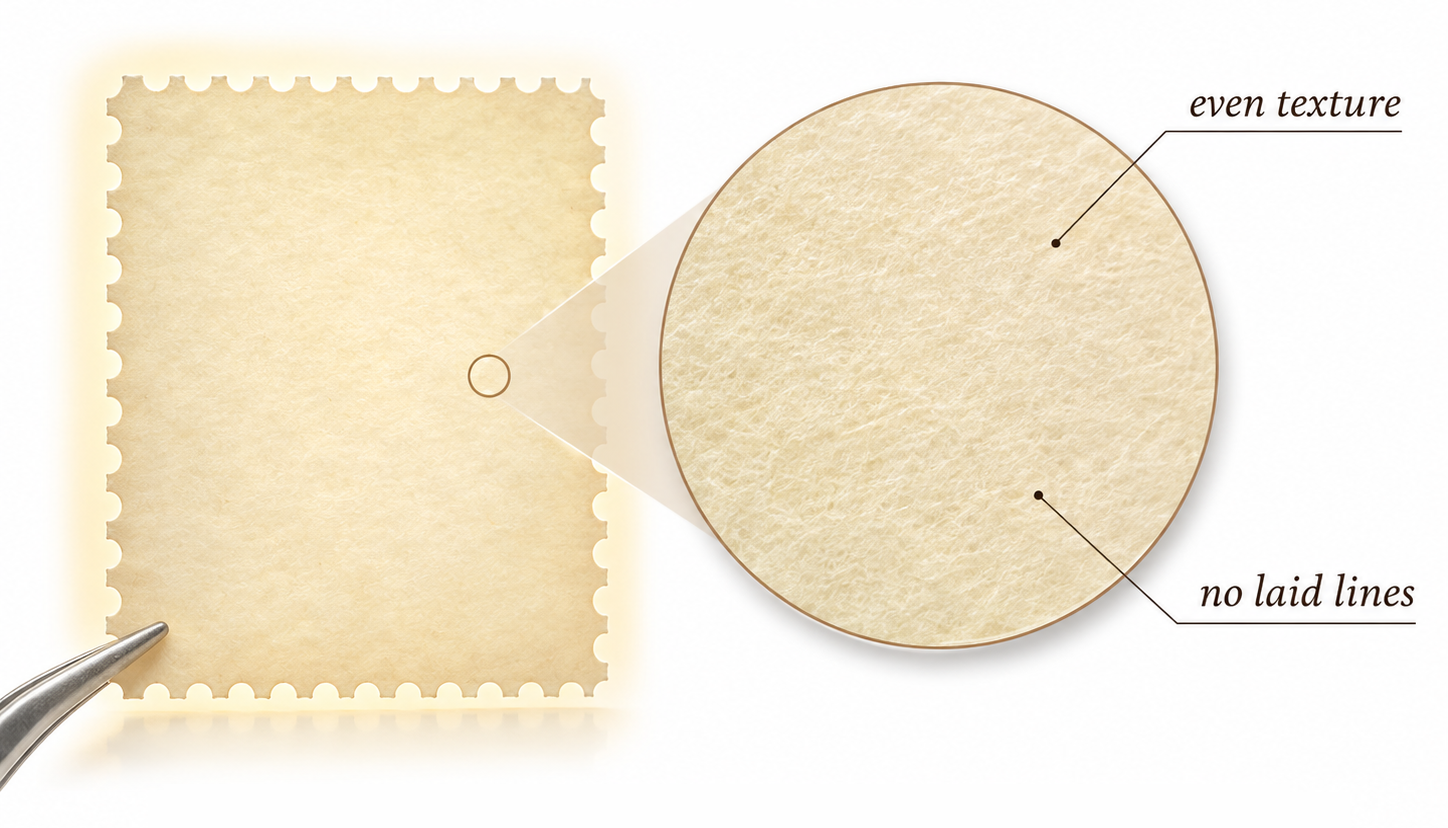
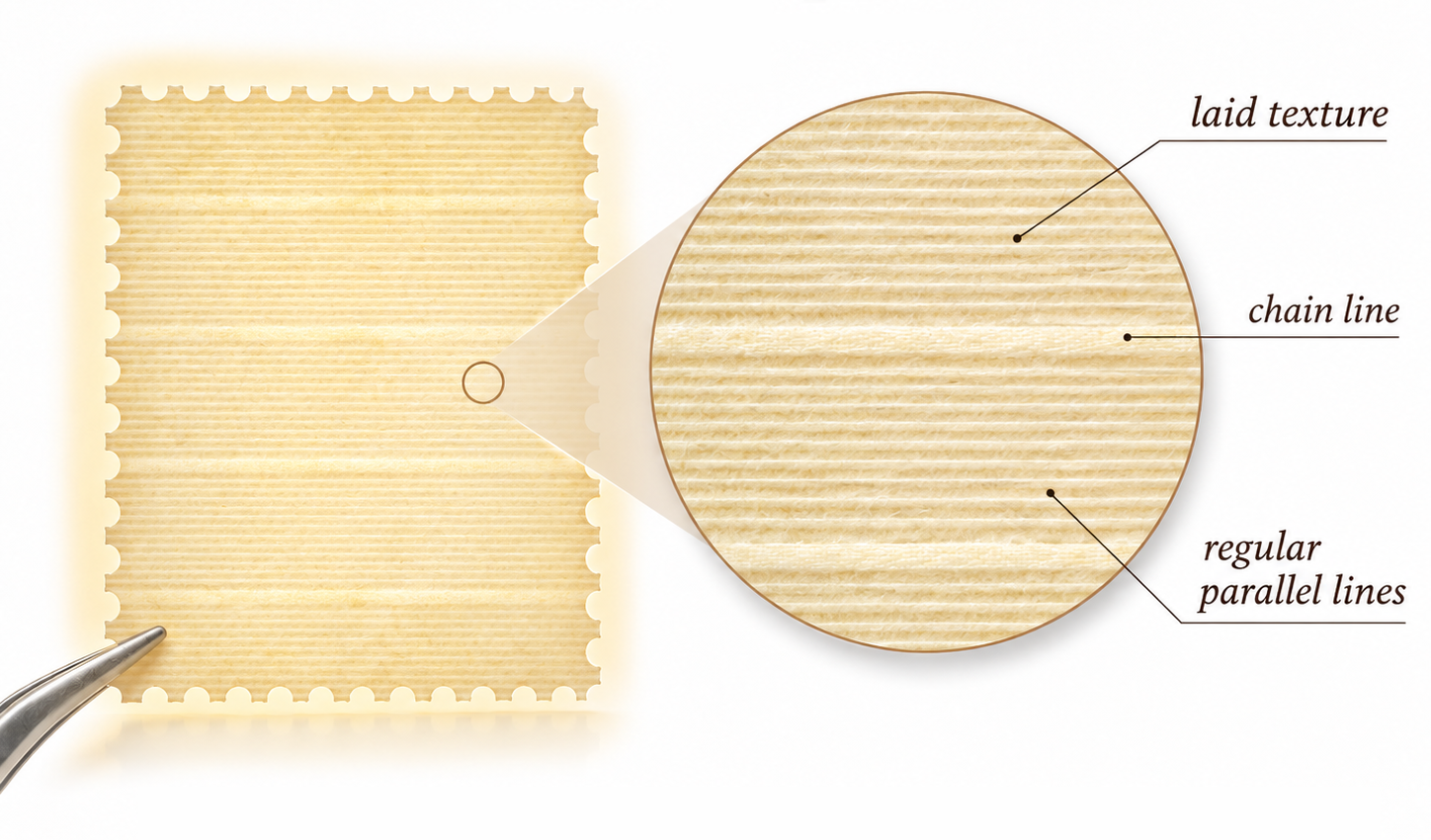
Wove paper has an even fibre structure rather than the parallel lines associated with laid paper. The two illustrations explain that structural difference; neither is a photograph of an original Lilac and Green sheet.
These stamps used machine-made white paper carrying the Large Crown watermark. The papermaking process produced the watermark before the sheet was gummed and printed. Paper structure, watermark and surface finish describe different features.
An illustration of the face cannot establish the condition of the reverse, paper thickness or watermark orientation on a particular original. The accompanying stamp note identifies the normal issue paper, without claiming those unseen details for the reconstruction.
Wove paper: even texture without laid lines.Image information
Click image to magnify
Diagram of wove paper with a magnified inset showing an even texture without laid lines.
Credit
Stunning Stamps · 2026
Notes
Digitally constructed
Laid paper: regular parallel lines, shown for comparison.Image information
Click image to magnify
Diagram of laid paper with a magnified inset showing regular parallel lines.
Credit
Stunning Stamps · 2026
Notes
Digitally constructed
On this stamp
The 2d uses machine-made Crown paper. The comparison illustrations explain wove and laid structures; no laid-paper alternative is assigned here.
Wove describes the structure of paper, not a coating. Surface finish concerns the face presented to the printer; gum is a separate coating on the reverse.
The ordinary issues in this group used Crown paper. No Edwardian chalk-surfaced alternative is assigned to these Victorian stamps. Smoothness or shine in a scan is not enough to identify a paper treatment.
Colour changes caused by ageing, backing paper or scanning should also be kept separate from original paper varieties. A physical examination and a relevant reference are needed before naming an exceptional paper.
On this stamp
This 2d belongs on ordinary Crown paper. A chalk-surfaced alternative is not part of the issue; the front illustration does not establish thickness or the condition of the reverse.
Fugitive ink is intended to change when someone tries to remove a cancellation. Doubly fugitive refers to sensitivity to water and chemical treatment, not to two printings or two colours.
The purple and sea-green inks of the new postage-and-revenue designs were chosen for this protective purpose. Their vulnerability also means that washing can change a genuine stamp’s appearance. The retained halfpenny in slate-blue should not automatically inherit every chemical description of those new designs.
Security and colour recognition were different demands. Even when an ink discouraged cleaning, similar-looking values could be inconvenient in use. Preserve the cover or document where possible: it can help distinguish original colour from later alteration.
On this stamp
The 2d used a security ink intended to react to cleaning. Doubly fugitive refers to water and chemical sensitivity, not two colours or two printing operations.
A watermark is a thinner area formed within the paper, rather than an additional printed emblem. Patterns on the papermaking roll displace fibres while the sheet is still wet.
The Large (1880) Crown paper supplied a crown position for each stamp. Margins carried further watermark elements, including the word POSTAGE. A marginal watermark fragment is therefore different from a variety of the printed inscription.
The name is also encountered as Imperial Crown. It must not be confused with earlier small and large Crowns used for the line-engraved stamps. Read the watermark with the issue, format and orientation, rather than treating any crown as sufficient identification.
On this stamp
This 2d uses Large Crown paper. The watermark was formed during papermaking, before gumming and printing; its presence cannot be established by the printed face alone.
The relationship between printing and paper determines watermark orientation. Turning the design across the Crown paper produces a sideways crown; it does not require a different watermark design.
The upright designs normally have upright crowns. The four horizontal values—2d, 2½d, 6d and 9d—normally have sideways crowns. Viewed from the back, the normal sideways crown points right; viewed through the front, it points left.
State the viewing side when describing direction. An inverted or sideways-inverted example requires evidence from the original reverse; a front-only illustration cannot establish it. An abnormal orientation does not by itself identify a different printing plate.
On this stamp
With the 2d design upright to the reader, the normal Crown is sideways: its top points right when viewed from the back, or left through the front. The reconstruction does not assign an inverted-watermark variety to the illustrated stamp.
A perforation gauge describes the spacing of holes over two centimetres. It is not the total number of holes or teeth on an edge. In a two-number description the horizontal measurement comes first.
All ten ordinary stamps in this group gauge 14 horizontally and vertically. A horizontal design naturally has more holes along its long edge than an upright one, although both use the same gauge.
Perforation-12 material belongs to a separate official or experimental category discussed in its own drawer. It is not an ordinary grouped alternative here. A straight edge alone also cannot distinguish an imperforate proof from a trimmed stamp.
Enlarged spacing diagram, not to scale. Match the spacing with a perforation gauge.Image information
Enlarged perforation spacing: fourteen equal intervals between hole centres span 20 millimetres. This is a schematic, not a ruler.
Credit
Stunning Stamps · 2026
On this stamp
The ordinary 2d gauges 14 horizontally and vertically. The horizontal shape changes the number of holes along each edge, not the gauge. No ordinary grouped perforation alternative is assigned.
De La Rue used gum arabic on the paper before the stamp impression was printed. Perforation followed printing. The adhesive coating and the watermark are different features, made at different stages.
Original gum, disturbed gum, hinge traces and later regumming describe condition rather than face value or design. The appearance of an unused face does not establish the state of the reverse.
These reconstructions show the printed face only. They do not certify original gum on a surviving specimen, and the word unused should not be taken as a guarantee of an untouched reverse.
On this stamp
The paper for this 2d was gummed before printing. The face illustration cannot establish original gum, hinge traces or later regumming.
A pane is a block of stamps within a sheet; a gutter separates panes and selvedge is the outside margin. Each printing plate in this group held 240 subjects in two panes of 120.
For upright stamps the panes were one above the other, each ten rows of twelve. For horizontal stamps they were side by side, each twelve rows of ten. The direction is described with the stamp design upright to the reader.
The Crown paper came from the mill in double sheets, and pairs of plates printed the two 240-subject units. Thus a mill sheet, a printing plate, a pane and a post-office counter sheet are not interchangeable quantities. The diagram explains the terms rather than the exact layout of this issue.
Sheet, panes and margins: a simplified example.Image information
A schematic printing sheet contains two panes separated by an unprinted gutter and surrounded by a margin.
Credit
Stunning Stamps · 2026
On this stamp
For the 2d, the panes contain twelve rows of ten, side by side. Two 240-subject plate impressions filled a double mill sheet of Crown paper.
A printing unit did not always reach the counter intact. Dividing sheets into convenient monetary amounts simplified stock handling and accounting. Different denominations therefore used different counter-sheet sizes despite sharing a 240-subject printing arrangement.
The halfpenny, three-halfpenny and twopenny were supplied in complete units of 240. The 2½d used a pane of 120. The 3d and 6d used forty, the 4d and 5d sixty, the 9d thirty and the 1s twenty.
Multiply the number of stamps by their face value to find the counter-sheet value. This is an accounting total, not a postal rate or the value of the paper to a collector. A detached single cannot show the original counter-sheet boundaries.
On this stamp
The 2d counter sheet contained 240 stamps, worth £2. Here the counter sheet and the 240-subject printing unit coincide.
Except for the halfpenny, these stamps have coloured identifying letters at all four corners. The lower pair gives a position in the printing unit; the upper pair repeats those letters in reverse order.
In upright format the full grid spans twenty rows and twelve columns; in horizontal format it spans twelve rows and twenty columns. The gutter interrupts the grid but does not start the lettering again. Read positions relative to the printed design.
Letters help reconstruct sheets and identify recurring flaws. They do not identify a plate on their own, since successive plates can carry the same sequence. The unlettered halfpenny must be studied through other evidence, including margins and provenanced multiples.
On this stamp
The lower D–T gives row 4, column 20 in the twelve-row, twenty-column printing grid. The upper pair is reversed. This position can recur on different plates.
A die carries the original design; a printing plate carries many copies arranged for production. A die number, a plate number and a corner-letter position describe different things.
Unlike earlier Victorian surface-printed designs, the stamps here do not show a plate number in the printed face. Production records identify which plates were prepared and used, but an ordinary detached illustration need not be assignable to one of them.
A prepared plate was not necessarily issued. The first two ninepenny plates were rejected for misplaced letters; the fourpenny’s third plate was unused. The fivepenny’s first two belonged to its abandoned die. Registered material, plate characteristics and provenance matter when making a specific attribution.
On this stamp
Two plates were made and used. Their 240 subjects were arranged as two horizontal-format panes; no printed plate figure identifies this D–T example.
Margins can carry perforating guides and marks showing where a sheet should be divided. They served the printer and the people handling stocks, rather than forming part of the individual stamp design.
The reused halfpenny arrangement had a T-shaped perforating guide and otherwise plain printed margins. Some of the higher values added small hexagonal division marks. These vary with the denomination and sometimes with the plate state.
A printed marginal mark is different from a word or symbol formed as a watermark in the paper. Retain selvedge with a stamp when studying these features: separating it removes evidence that a face-only illustration cannot recover.
On this stamp
The full 240-subject unit served as the post-office sheet. Its vertical gutter is not a division into a different denomination.
A shared likeness does not mean every stamp was printed from one unchanged die. De La Rue adapted the portrait to several frames and formats, while the halfpenny retained its 1880 design in another colour.
The fourpenny has a larger portrait than its new companions. The fivepenny required a replacement die after the first cracked. Its issued Die II has a plainer d with a dot beneath it, replacing the earlier serifed d and line. Die II is not another name for plate 2: the issued fivepenny plates were 3 and 4.
Earlier artistic sources are credited separately from these later engravings. A workshop die or punch number describes a production tool; it is not a number printed on the issued stamp and does not establish the individual engraver’s identity.
On this stamp
Horizontal rectangular arrangement with a large 2d at each side.
A die proof tests the engraved design. A plate proof shows an impression from a printing plate, while an imprimatur records approval. These categories tell us why an object was made, not merely whether it has perforations.
Black proofs on glazed card can preserve dates, workshop instructions and empty corner-letter spaces. The ninepenny proof with a June date corrected by hand is one example. Such a proof does not demonstrate that black stamps were sold for postage.
Identify the object from its paper, inscriptions, margins and documented history. An imperforate single removed from an approval sheet needs its provenance; wide margins alone do not establish what kind of proof it is.
On this stamp
For the 2d, a proof, registration impression and ordinary issued stamp are different kinds of object. Evidence of plate approval or an unperforated edge must be interpreted with the object’s provenance.
Perforation 12 is recorded for material associated with this series, but it was not the ordinary public issue. The period and modern accounts differ in their description of its purpose.
Wright and Creeke describe parts of waste sheets sent to Somerset House for official purposes and perforated on a treadle machine because the usual machines needed whole sheets. John F. Roe describes official perforation trials and records examples with and without SPECIMEN overprints.
Those accounts should not be collapsed into an ordinary alternative gauge. The shared conclusion is that this material was not intended for normal counter sale. Any claimed example needs specialist identification of its gauge, overprint, paper and provenance; the illustrations here represent the ordinary perforation-14 stamps.
On this stamp
The ordinary 2d on this page is perforated 14. The separate perforation-12 material requires the qualifications in this drawer and does not create a grouped public-issue alternative.
A specimen is a reference example supplied for recognition or official purposes. An administrative cancellation can also prevent an example from being used to pay a charge. Neither is the same as a postmark applied after a postal journey.
Roe records SPECIMEN Type 9 and CANCELLED Type 14 overprints across this group. These labels identify the overprint, not a new denomination or a separate colour of the underlying stamp.
The original stamp and the added marking require separate examination. Position or intensity may vary, and an unusual marking needs evidence of authenticity. Do not infer a specimen merely because a stamp is unused, or mistake an ordinary pen cancellation for a standard reference overprint.
On this stamp
The illustrated 2d has no reference overprint. Added SPECIMEN or CANCELLED markings must be described separately from the underlying stamp, its perforation and any later postal use.
The identifying corner letters were separate from the permanent master design. This made it possible to give each position its own characters, but it also introduced opportunities for errors in preparing the printing plates.
A badly fitted letter plug can leave an inked arc or mark beside a letter. Repeated examples at the same position are stronger evidence than a single blurred impression. The ninepenny’s rejected plates show a different problem: incorrectly positioned letters before normal production began.
Separate a recurring plate feature from an inking accident, damage, a cancellation or a flaw introduced by scanning. No specialised plug flaw is assigned to these digital illustrations. The halfpenny has no check-letter plugs to which that explanation could apply.
On this stamp
No plug flaw is assigned to the illustrated D–T 2d. Use repeated original impressions and their sheet positions to distinguish a plate feature from an inking accident or later damage.
A denomination can pay a charge on its own or contribute to a larger franking. Weight, destination, date and extra services determine the amount; a face value does not identify one universal postal rate.
The official issue notice made these stamps available for postal and telegraph use. Revenue use was also permitted under the combined-duty arrangements. The same design can therefore survive on very different kinds of item.
A complete cover, wrapper or form preserves the evidence needed to identify a service. Record the total franking and relevant dates before interpreting the charge. A loose stamp with a town cancellation cannot usually supply that full account.
On this stamp
This 2d could pay all or part of a postal charge. A complete dated item is needed to identify the destination, weight and any extra service; the face value alone does not establish its journey.
The combined-duty arrangements allowed eligible general adhesive duties up to 2s 6d to be paid with stamps also valid for postage. Duties requiring a specially appropriated adhesive were excluded. Telegraph charges were a further use, distinct from a tax or postal charge.
POSTAGE & REVENUE—or POSTAGE AND REVENUE—makes the dual purpose visible on the new designs. The halfpenny retained its earlier POSTAGE-only inscription; an inherited inscription should not be mistaken for a complete statement of all contemporary rules.
A fiscal signature, telegraph marking or postal cancellation must be interpreted with the original document where possible. These differences help explain the emphasis on inks that reacted to attempts to clean away evidence of previous use.
On this stamp
The 2d belongs to the contemporary combined-duty arrangements. Its postage-and-revenue inscription makes the dual purpose explicit. A telegraph charge is distinct from either a postal charge or a revenue duty.
The stamp design was printed before issue. A dated postal strike, handwritten cancellation or mark on a telegraph form was applied later in use. Official specimen markings belong to another stage and purpose.
A pen stroke or numeral on a detached stamp can be ambiguous. The surrounding document, other stamps and the sequence of marks may establish what happened more securely than the mark alone.
Cleaning can remove or weaken both cancellation and stamp colour. A faint impression should first be considered as a condition question, rather than automatically being promoted to a new shade or printing variety.
On this stamp
This 2d reconstruction is shown unused. A later postal strike, signature or administrative marking must be identified separately; a faint colour alone cannot establish a special shade or a particular use.