
Understanding the stamp details
½d rose-red · Perkins, Bacon & Co.
Printer
Perkins Bacon was a London security printer. Its engraved stamp production combined the preparation of steel plates with the repeated inking, wiping and pressing of sheets.
On this stamp
Perkins, Bacon & Co. printed the halfpenny Bantam from engraved steel plates of 480 impressions. The illustration represents plate 14, used from 1876, retaining the design introduced in 1870.
Sources
- R. C. A. Payne, The Perkins Bacon Story (RPSL, 9 May 1996), company styles, PDF p. 2
- Wright and Creeke, A History of the Adhesive Stamps of the British Isles (1899), pp. 11, 34–35
- Royal Mail, British Philatelic Bulletin, January 2020, pp. 150–154: The Birth of the Bantam, including Frederick Heath’s miniature portrait
- Wright and Creeke, A History of the Adhesive Stamps of the British Isles (1899), pp. 13–16, 34–35 and 42–44: halfpenny plates, Die II and three-halfpenny adaptation
The Bantam’s portrait engraving
Frederick Heath, Charles Heath’s son, was an engraver working in the family’s illustrated-book business. His surviving prints include engraved interpretations of other artists’ paintings.
On this stamp
Frederick Heath engraved the reduced portrait for the 1870 halfpenny Bantam. Surviving May 1870 proofs show the miniature head being completed and strengthened; this is a new engraving, distinct from the debated attribution of the original 1840 portrait.
Portrait source
William Wyon was a medallist and engraver at the Royal Mint. His models of royal heads were made for coins and medals and also became sources for stamp portraits.
On this stamp
William Wyon’s City of London medal supplied the youthful likeness behind the Bantam’s portrait. Frederick Heath adapted that established likeness to the miniature format in 1870; Wyon was not commissioned to design this later stamp.
Country and monarch
The country identifies the postal authority that issued the stamp. The monarch identifies the ruler whose portrait it carries. A definitive is an everyday stamp intended for regular postal use.
On this stamp
This ½d rose-red belongs to Great Britain’s everyday stamps bearing Queen Victoria’s portrait. The design appeared in 1870; the illustration represents the later plate 14 printing identified separately below.
Denomination
The denomination is the stamp’s face value: the amount of postage it represents. Its price to a collector can be quite different.
In Britain’s old currency, 12 pence made one shilling and 20 shillings made one pound: 240 pence altogether. The abbreviations were d for pence, s for shillings and £ for pounds. The d comes from the Latin denarius. A halfpenny, written ½d, was half an old penny.
On this stamp
Half a penny was one twenty-fourth of a shilling. The large ½ figures identify the value on both sides of the miniature portrait. Twenty-four stamps made one shilling and the complete 480-stamp sheet one pound.
Stamp shades
A shade is a variation within a stamp’s colour. Some variations receive their own catalogue numbers even though the design and denomination stay the same.
Compare known examples under consistent lighting. Fading can change a stamp’s appearance, and photographs or screens can alter how colours look. A catalogue colour name helps describe a shade; it is not a colour test by itself.
On this stamp
The reconstruction represents the rose-red colour family of SG48. Issued Bantams vary towards lake-red and in strength of colour. The experimental green and other trial inks were not ordinary alternative colours of this issued stamp.
Issue dates and recorded use
A stamp can be printed, sent to post offices, put on sale and made valid for postage on different dates. An official notice or instruction can establish when it was intended to be used; a dated letter shows that a particular example was actually used.
An early surviving cover is evidence of use by that day. It does not necessarily identify the first day of sale. A year in the heading may also cover later printings of the same design.
On this stamp
The announced public issue date was 1 October 1870, when the new reduced rates took effect. Supplies had reached the General Post Office in August, but that distribution date was not the date of public sale. The illustrated plate 14 was used later, in 1876.
The two new line-engraved values of 1870
The halfpenny and three-halfpenny were issued together on 1 October 1870 as postal charges for newspapers, printed matter and samples were reduced. They extended the line-engraved family long associated with the Penny Red and Two Pence Blue.
The halfpenny was a new miniature design. The three-halfpenny revived an engraving prepared in 1860 for a proposed rate change that did not proceed. A shared issue date therefore conceals two quite different beginnings.
Both were printed by Perkins Bacon, but their paper layouts differ. The halfpenny has a script watermark and 480 stamps per sheet; the three-halfpenny has Large Crown paper and 240. The individual note identifies the later plate represented by each illustration.
On this stamp
The Bantam is the miniature member of the two-value 1870 group. Its new engraving, script watermark and doubled sheet capacity distinguish it from the three-halfpenny, despite their shared release date.
Catalogue references
A stamp catalogue gives each listed issue a reference number. SG means Stanley Gibbons, the publisher of the catalogue used here. These numbers help collectors refer to the same issue; they are not serial numbers printed on individual stamps.
A range of numbers groups related entries. Colour, paper or perforation differences may account for separate listings within that range.
On this stamp
SG48 is the recorded identity of this rose-red reconstruction. It represents plate 14 with K–U in the lower corners. Those letters identify this one sheet position. Watermark orientation, original gum and paper condition cannot be authenticated from the front illustration.
Sources
- Stanley Gibbons: Philatelic terms for beginners
- Recorded illustration reference for Great Britain Queen Victoria halfpenny rose-red Bantam design introduced1870, SG48; representative plate14, sheet position K/U: primary issued plate14 K/U design, lettering, profile and perforations
- Recorded illustration reference for Great Britain Queen Victoria halfpenny rose-red Bantam design introduced1870, SG48; representative plate14, sheet position K/U: independent issued plate14 block, denomination forms, engraving and colour
Printing from engraved lines
Line engraving is a form of recess, or intaglio, printing. The lines that carry ink are cut below the surface of a metal plate. After inking the plate, the printer wipes the flat surface clean, leaving ink in the engraved grooves.
Damp paper is pressed firmly against the plate and takes up the ink from those grooves. The fine coloured lines form the image; the spaces between them leave the paper visible. This differs from surface printing, where the raised parts of the printing surface carry the ink.
A transfer roller repeated the design from the die across a steel plate. The corner letters were added separately to each position. Printing, gumming and drying preceded perforation: punching the holes was a separate operation from making the coloured image.
Image information
Side view of recess printing: ink remains in grooves below the plate surface and pressure brings paper into contact with it.
- Credit
- Stunning Stamps · 2026
On this stamp
Perkins Bacon printed the ½d from ink held in engraved lines below the steel plate’s surface. Damp paper took up that ink under pressure. The complete design was printed in rose-red; its white details are unprinted paper, not a separate white-ink impression.
Wove paper
Wove describes the structure of the paper. Viewed against the light, it has a fairly even appearance. Laid paper instead shows a regular pattern of lines left by its manufacture.
Paper structure and watermark are separate characteristics: wove paper can carry a watermark. Both can help distinguish stamps with similar printed designs.
These late line-engraved stamps used handmade wove paper. The watermark was formed by a pattern attached to the papermaking mould; it was not printed on the finished sheet. The even texture of wove paper does not mean that it was machine-made.
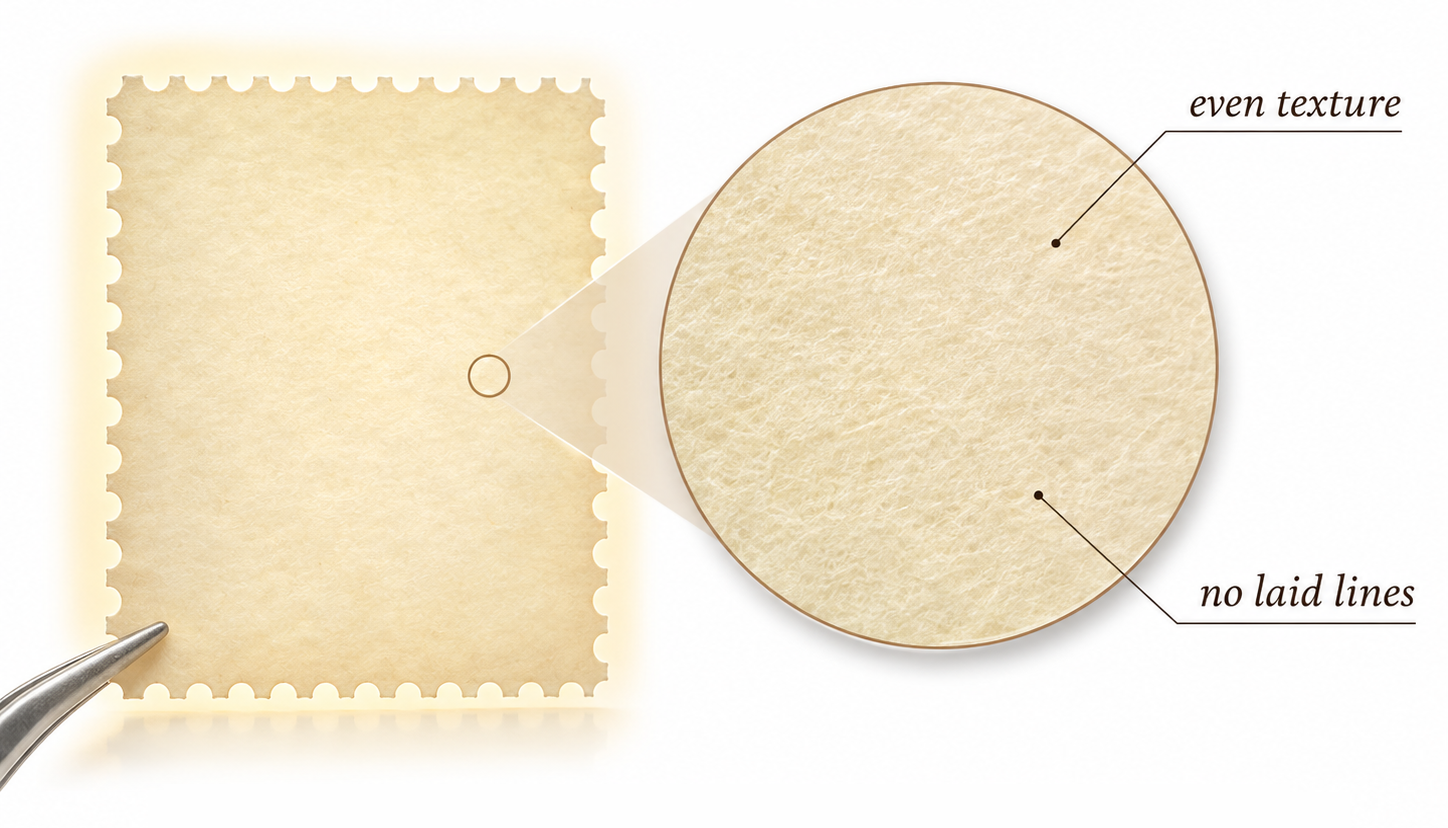
Image information
Click image to magnify
Diagram of wove paper with a magnified inset showing an even texture without laid lines.
- Credit
- Stunning Stamps · 2026
- Notes
- Digitally constructed
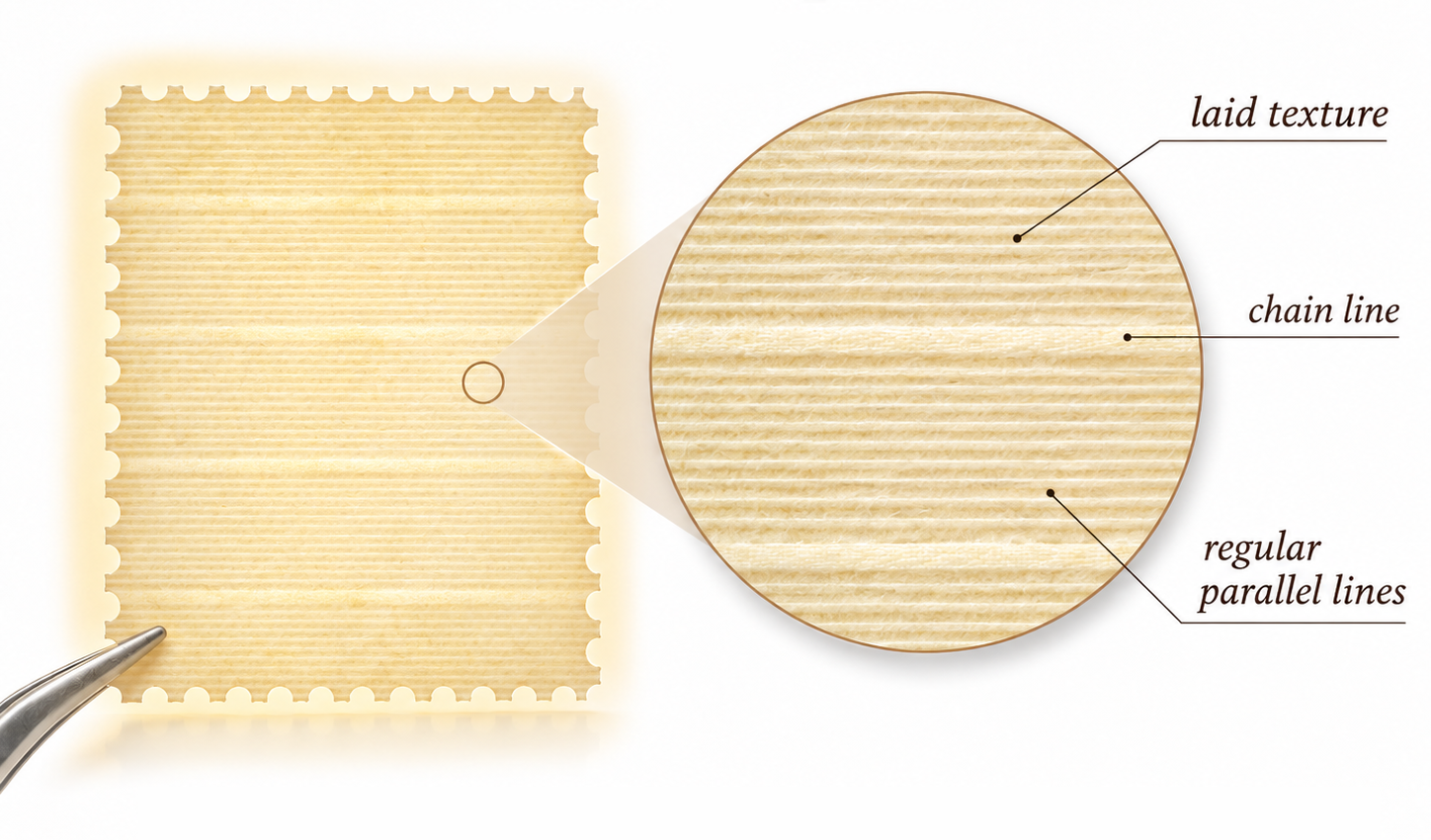
Image information
Click image to magnify
Diagram of laid paper with a magnified inset showing regular parallel lines.
- Credit
- Stunning Stamps · 2026
- Notes
- Digitally constructed
On this stamp
The Bantam used handmade wove paper, described by Wright and Creeke as thinner than the average paper of the other line-engraved values. Its mould carried the script half penny watermark. The texture diagrams compare wove with laid paper; they are not photographs of this stamp.
Sources
- Fitzwilliam Museum: Wove paper
- American Philatelic Society: Watermarks — A Philatelic Introduction
- Wright and Creeke, A History of the Adhesive Stamps of the British Isles (1899), pp. 11–13: line engraving, handmade paper, watermarks and gum
- Wright and Creeke (1899), pp. 13–16: halfpenny issue, plates, sheets, script watermark and perforation
- Wright and Creeke (1899), pp. 42–44: three-halfpenny design, plates 1 and 3, paper, sheets and unissued 1860 printing
Script half penny and Large Crown
A watermark is a pattern of thinner paper formed during manufacture. Light passes through it differently from the surrounding fibres. It belongs to the paper, so it can distinguish stamps with very similar printed faces.
The Bantam uses the words half penny in flowing script. One complete inscription stretches across three neighbouring stamp positions. There are eight inscriptions across each row of twenty-four stamps and twenty rows, making 160 inscriptions in a full sheet.
The three-halfpenny instead uses the Large Crown paper of the contemporary Penny Red, with one crown intended for each stamp position. This is a different watermark from the Imperial Crown of the Edward VII issues.
An individual Bantam normally contains only part of the words. An incomplete mark is not automatically a missing watermark. Orientation and displacement must be established from the actual paper; neither can be assigned from a front-view reconstruction.
On this stamp
The words half penny extend across three adjacent stamps. A full sheet has 160 repetitions, eight per row in twenty rows. An individual K–U stamp contains only part of the pattern. Upright, inverted or reversed orientation requires examination of the original paper and is not assigned to this reconstruction.
Sources
- Wright and Creeke, A History of the Adhesive Stamps of the British Isles (1899), pp. 11–13: line engraving, handmade paper, watermarks and gum
- Wright and Creeke (1899), pp. 13–16: halfpenny issue, plates, sheets, script watermark and perforation
- Wright and Creeke (1899), pp. 42–44: three-halfpenny design, plates 1 and 3, paper, sheets and unissued 1860 printing
- Royal Mail, British Philatelic Bulletin, January 2020, pp. 150–156: The Birth of the Bantam, proofs, printing and watermark
Gauge 14 and the direction of perforating
Perforation gauge measures the number of holes over two centimetres, not the total number of teeth along an edge. Gauge 14 applies both horizontally and vertically to the normal issued stamps in this set.
Punching the holes was a separate operation at Somerset House after printing, gumming and drying. The dampened printing paper could shrink as it dried, so the perforations did not always align neatly with the engraved designs.
For the small halfpenny the sheets were fed sideways and perforated in successive vertical columns. An outer side could remain unperforated. The three-halfpenny used the usual succession of horizontal rows.
A straight edge, an imperforate proof and a genuinely issued imperforate variety are different possibilities. They do not establish another gauge. The note for each stamp distinguishes the ordinary issue from exceptional material.
On this stamp
The normal Bantam has gauge 14 on both axes. Perforating proceeded through vertical columns after the sheet was turned sideways, sometimes leaving a straight outside edge. The illustrated K–U position is inside the sheet and has perforations on all four sides. No second gauge is grouped into this article.
Sources
- Wright and Creeke, A History of the Adhesive Stamps of the British Isles (1899), pp. 11–13: line engraving, handmade paper, watermarks and gum
- Wright and Creeke (1899), pp. 13–16: halfpenny issue, plates, sheets, script watermark and perforation
- Wright and Creeke (1899), pp. 42–44: three-halfpenny design, plates 1 and 3, paper, sheets and unissued 1860 printing
- Royal Mail, British Philatelic Bulletin, January 2020, pp. 150–156: The Birth of the Bantam, proofs, printing and watermark
Gumming after recess printing
The gum was the adhesive coating on the back. Perkins Bacon printed on damp paper, then gummed and dried the sheets. This sequence differs from the pre-gummed paper used for De La Rue’s surface-printed stamps.
The adhesive was known as British Gum: a starch preparation with gelatine added from the mid-1850s. Two coats were applied from 1864 to improve adhesion. Its appearance could range from pale to brownish.
A front image cannot establish whether an original retains its gum, has been hinged or has been regummed. Gum condition is separate from the design, watermark and cancellation.
On this stamp
The ½d was gummed after recess printing, using the established British Gum preparation. Two coats were then standard. No surviving-gum condition, hinge status or regumming judgement is implied by this uncancelled front illustration.
Sources
- Wright and Creeke, A History of the Adhesive Stamps of the British Isles (1899), pp. 11–13: line engraving, handmade paper, watermarks and gum
- Wright and Creeke (1899), pp. 13–16: halfpenny issue, plates, sheets, script watermark and perforation
- Wright and Creeke (1899), pp. 42–44: three-halfpenny design, plates 1 and 3, paper, sheets and unissued 1860 printing
One pane, two sheet sizes
A printing sheet contains the repeated impressions made from one plate. A pane is an uninterrupted block of stamp positions, usually separated from another pane by a wider blank gutter. Both these line-engraved values were printed in a single pane.
The Bantam plate held twenty rows of twenty-four stamps: 480 impressions. The three-halfpenny plate held twenty rows of twelve: 240. Multiplying rows by columns gives the number of stamps, while multiplying by the denomination gives the sheet’s face value.
The wider halfpenny layout also determined the spacing of its watermark inscriptions and the range of its corner letters. These arrangements cannot be transferred unchanged from the larger three-halfpenny.
On this stamp
Twenty rows of twenty-four made one uninterrupted pane of 480 halfpenny stamps. The larger number reflects the miniature design; it is twice the number of impressions on the ordinary Penny Red and three-halfpenny sheets.
Reading the value of a row and sheet
Victorian money used twelve pence to the shilling and twenty shillings to the pound. A halfpenny was half of one old penny; three-halfpence was one and a half old pence.
A row of twenty-four halfpennies was worth one shilling. Twenty such rows made a sheet worth £1. A row of twelve three-halfpenny stamps was worth one shilling and sixpence, and its twenty-row sheet £1 10s.
These totals describe the original face value printed in the sheet margins. They are not present-day collecting prices or evidence that every customer bought complete sheets.
On this stamp
Twenty-four halfpennies made 12d, or 1s. Twenty such rows made 240d, or £1. The marginal inscription stated the price per stamp, row and sheet.
Four corner letters and a sheet position
Read the lower pair from left to right: the first letter gives the row, the second the column. The upper corners repeat that pair in reverse. This helped expose attempts to assemble an apparently unused stamp from uncancelled pieces.
Both sheets have twenty rows, lettered A to T. The halfpenny has twenty-four columns, A to X; the three-halfpenny twelve, A to L. Thus the complete lower-pair ranges are AA–TX and AA–TL respectively.
The letters were punched into each plate position separately. They are neither an engraver’s initials nor a place of posting. The same pair recurs on different plates, so the letters alone cannot identify a printing plate.
Small differences of position or a recorded wrong letter can help specialists identify a particular impression. The individual note reads the letters on the illustration, rather than attributing one position to every stamp of the issue.
On this stamp
The lower K–U pair identifies row 11, column 21 in the twenty-by-twenty-four halfpenny sheet. The upper pair reverses it to U–K. Another stamp from plate 14 would carry a different pair for its own position.
Sources
- Wright and Creeke, A History of the Adhesive Stamps of the British Isles (1899), pp. 11–13: line engraving, handmade paper, watermarks and gum
- Wright and Creeke (1899), pp. 13–16: halfpenny issue, plates, sheets, script watermark and perforation
- Wright and Creeke (1899), pp. 42–44: three-halfpenny design, plates 1 and 3, paper, sheets and unissued 1860 printing
Information around a complete sheet
Sheet margins carried instructions for attaching stamps, the value of a label, row and sheet, plate numbers and marks used to guide production. These features normally disappear when a single stamp is separated.
A plate number identifies a plate within a denomination’s sequence. A current number was a separate workshop reference. Both could appear in the margins even when a number was also visible inside each stamp.
Crosses, lines and other guide marks helped align or divide the sheet. They are separate from the corner letters within the stamps and from watermarked words in the paper margins. A single stamp need not preserve any of them.
On this stamp
The halfpenny sheet’s margins gave the price per label, row and sheet, and instructions for applying the stamps. Plate and current numbers and guide marks lay outside the designs. Watermarked Postage Stamps inscriptions also appeared in the paper margins; none is part of this separated K–U stamp.
Sources
- Wright and Creeke, A History of the Adhesive Stamps of the British Isles (1899), pp. 11–13: line engraving, handmade paper, watermarks and gum
- Wright and Creeke (1899), pp. 13–16: halfpenny issue, plates, sheets, script watermark and perforation
- Wright and Creeke (1899), pp. 42–44: three-halfpenny design, plates 1 and 3, paper, sheets and unissued 1860 printing
From engraved die to numbered plate
The original die carried a single design cut into softened steel. After hardening, it impressed a raised copy onto a steel transfer roller. The roller then pressed the design repeatedly into a softened printing plate, which was finished and hardened for use.
On the halfpenny, tiny white numerals occur beside the portrait. The first three-halfpenny plate has no numeral inside the stamp; plate 3 added white figures to the side borders. A missing number therefore needs to be interpreted for the particular design.
Registration preserved an approved impression, commonly called an imprimatur. Approval, first printing and first public sale can fall on different dates. Plate numbers run through manufacturing sequences that can include rejected or unused plates.
On this stamp
Tiny white 14 numerals lie immediately beside the portrait in the engraved background. They identify the plate, while K–U identifies the position. The registered plate was prepared in 1875 and used for printing in 1876, later than the design’s 1870 debut.
Sources
- Wright and Creeke, A History of the Adhesive Stamps of the British Isles (1899), pp. 11–13: line engraving, handmade paper, watermarks and gum
- Wright and Creeke (1899), pp. 13–16: halfpenny issue, plates, sheets, script watermark and perforation
- Wright and Creeke (1899), pp. 42–44: three-halfpenny design, plates 1 and 3, paper, sheets and unissued 1860 printing
Used plates, rejected plates and old designs
Not every plate number represents stamps sold to the public. A plate could be abandoned during transfer, rejected because its spacing did not match the perforator, or completed but never brought into use.
Fifteen halfpenny plates were used: 1, 3–6, 8–15, 19 and 20. Later numbered plates retained the 1870 design. Plate 9 saw limited use, whereas some other numbers belong to failed or unused production work.
The three-halfpenny used plates 1 and 3. Plate 1 was first printed in lilac-rose in 1860 but that stock was not issued for ordinary postage. It returned to press in red in 1870. Plate 2 was rejected; plate 3 entered production in 1874 with numerals added inside the design.
A later plate does not change the design’s first-appearance year. The portrait, paper, internal numeral and documentary record together establish which printing an illustration represents.
On this stamp
The illustrated plate 14 belongs to the fifteen halfpenny plates used for issue. Several other numbered plates failed or were never used: rollers broke or cracked during preparation of plates 16–18, and plates 21–22 were not brought to press. A gap in the used sequence does not indicate a missing issued stamp.
Straight edges and recorded varieties
A stamp with no holes on one edge is not necessarily an imperforate stamp. It may come from a sheet edge deliberately left without perforations. An entirely imperforate stamp lacks the normal perforations on every side; adequate margins and comparison material are needed to distinguish it from a trimmed stamp.
Sideways perforating left an outer column of some halfpenny sheets with a straight edge. The catalogue record also includes completely imperforate examples from certain plates. Those are separate categories, not alternative normal gauges.
For the three-halfpenny, imperforate examples are recorded from plate 1. Plate 1 also has the known error in which O replaces C in an upper corner. That error belongs to a particular plate position, not to the plate-3 illustration here.
Neither article groups a second perforation illustration. Normal issued examples of both values use gauge 14; proofs, sheet-edge effects and documented errors remain distinct specialist subjects.
On this stamp
A straight outer edge can result from the normal sideways perforating sequence; the illustration’s interior K–U position does not represent that sheet-edge feature. Fully imperforate Bantams are also documented from particular plates. Neither category warrants a second normal gauge or an extra grouped illustration here.
Essays, proofs and unissued stamps
An essay proposes a design; a die proof tests the single engraving; a plate proof tests the repeated impressions. A colour trial explores an ink choice. A registration impression records official approval, while a SPECIMEN marking identifies reference material.
The Bantam’s development left proposed designs, incomplete and strengthened portrait proofs, and experiments with different colours and backgrounds. These do not mean that the normal 1870 adhesive was issued in all the trial colours.
The three-halfpenny’s lilac-rose stamps of 1860 were a substantial printing for a planned rate change, rather than merely a colour trial. Most were destroyed in 1867, although examples had already been supplied for reference. They must be distinguished from the red stamps issued in 1870.
Absence of a postmark or of perforations alone does not establish any of these categories. Provenance, paper, plate features and official records explain what a surviving item represents.
On this stamp
Surviving Bantam essays, incomplete and strengthened portrait proofs and colour trials document the work leading to the 1870 stamp. Green trial impressions and trial background patterns should not be mistaken for ordinary issued colour varieties of this rose-red plate-14 illustration.
Sources
- Wright and Creeke (1899), pp. 13–16: halfpenny issue, plates, sheets, script watermark and perforation
- Wright and Creeke (1899), pp. 42–44: three-halfpenny design, plates 1 and 3, paper, sheets and unissued 1860 printing
- Royal Mail, British Philatelic Bulletin, January 2020, pp. 150–156: The Birth of the Bantam, proofs, printing and watermark
The cheaper printed-paper post
From 1 October 1870 the inland printed-matter scale began at a halfpenny for a packet up to two ounces. Further two-ounce steps added another halfpenny: one penny up to four ounces and three-halfpence up to six ounces. These were conditional rates for qualifying material, not the ordinary letter rate.
Registered newspapers also had a special halfpenny-per-copy rate. The two new adhesive values made these low and fractional charges easier to pay, and could be combined with other stamps when a larger total was required.
The halfpenny postcard rate began on the same day, but initially applied to official pre-stamped cards. Ordinary private cards franked with adhesive stamps were not admitted to that service until 1894. A Bantam should therefore not be described simply as the stamp introduced for private postcards.
To interpret a surviving use, consider the date, contents, weight and postal service together. The denomination by itself does not establish the rate that a particular item paid.
On this stamp
One Bantam could pay the new inland printed-matter rate for a qualifying packet up to 2oz or the special rate for one registered newspaper. The simultaneous official postcard service used pre-stamped stationery; this adhesive was not an authorisation to send any private card for a halfpenny.
Sources
- Great Britain Philatelic Society: Inland printed matter rates, 1 October 1870
- Great Britain Philatelic Society: Inland newspaper rates, 1 October 1870
- Great Britain Philatelic Society: Postcard rates and restrictions on adhesive stamps
- Wright and Creeke (1899), pp. 13–16: halfpenny issue, plates, sheets, script watermark and perforation
- Wright and Creeke (1899), pp. 42–44: three-halfpenny design, plates 1 and 3, paper, sheets and unissued 1860 printing
Printed design and postal marking
The cancellation was applied after manufacture to show that the stamp had been used. Its date or office number belongs to the postal marking, whereas the small plate numerals and corner letters belong to the printed design.
A surviving wrapper or complete postal item can explain the charge and route more reliably than a loose stamp. A heavy cancellation can obscure the tiny halfpenny plate number or the side figures of the three-halfpenny without changing their identity.
The illustrations show uncancelled designs. They make no claim about a particular original’s gum, first-day use or postal journey. A SPECIMEN marking on reference material is also distinct from ordinary postal cancellation.
On this stamp
This reconstruction shows the ½d without a postal cancellation. The printed 14 numerals and K–U letters identify manufacture, not a post office. A used original’s marking, wrapper or cover supplies the evidence for its actual postal use.
Sources
- Wright and Creeke (1899), pp. 13–16: halfpenny issue, plates, sheets, script watermark and perforation
- Wright and Creeke (1899), pp. 42–44: three-halfpenny design, plates 1 and 3, paper, sheets and unissued 1860 printing
- Royal Mail, British Philatelic Bulletin, January 2020, pp. 150–156: The Birth of the Bantam, proofs, printing and watermark