
Understanding the stamp details
1½d rose-red · Perkins, Bacon & Co.
Printer
Perkins Bacon was a London security printer. Its engraved stamp production combined the preparation of steel plates with the repeated inking, wiping and pressing of sheets.
On this stamp
Perkins, Bacon & Co. adapted the Penny Red’s Die II into the three-halfpenny design in 1860 and printed the issued rose-red stamps from 1870. The illustration represents plate 3, first used in 1874, with small plate numbers in the side borders.
Sources
- R. C. A. Payne, The Perkins Bacon Story (RPSL, 9 May 1996), company styles, PDF p. 2
- Wright and Creeke, A History of the Adhesive Stamps of the British Isles (1899), pp. 11, 34–35
- Wright and Creeke, A History of the Adhesive Stamps of the British Isles (1899), pp. 13–16, 34–35 and 42–44: halfpenny plates, Die II and three-halfpenny adaptation
Die II re-engraving
William Humphrys trained in Philadelphia and engraved banknotes before working in London. His career included book illustration and the fine steel engraving used for security printing.
On this stamp
The 1870 three-halfpenny inherited the Penny Red’s Die II portrait, revised earlier by William Humphrys. Perkins Bacon adapted that die in 1860, shortening the bust to fit a new frame; no separate three-halfpenny portrait commission to Humphrys is established.
Sources
- Wright and Creeke, A History of the Adhesive Stamps of the British Isles (1899), pp. 11, 34–35
- Rebecca Minch, William Humphrys, Dictionary of Irish Biography
- Wright and Creeke, A History of the Adhesive Stamps of the British Isles (1899), pp. 13–16, 34–35 and 42–44: halfpenny plates, Die II and three-halfpenny adaptation
Portrait source
William Wyon was a medallist and engraver at the Royal Mint. His models of royal heads were made for coins and medals and also became sources for stamp portraits.
On this stamp
Wyon’s City of London medal supplied the youthful likeness inherited by the three-halfpenny through Corbould’s drawing and the Penny Red portrait. This credits the earlier medal, not the later shield-shaped frame.
Original portrait drawing
Henry Corbould was a draughtsman and book illustrator. He trained with his father and at the Royal Academy Schools, where he received a silver medal for a life study.
On this stamp
Corbould’s drawing after Wyon’s medal supplied the model for the original stamp portrait inherited by the three-halfpenny through the Penny Red’s Die II. It was not a fresh drawing for the 1860 adaptation or 1870 issue.
Original portrait engraving
Charles Heath was an engraver and publisher of illustrated books. Work from his workshop could carry his signature even when assistants had contributed to the engraving.
Frederick Heath, Charles Heath’s son, was an engraver working in the family’s illustrated-book business. His surviving prints include engraved interpretations of other artists’ paintings.
On this stamp
The three-halfpenny retains an inherited portrait engraving attributed to Charles Heath or Frederick Heath; their individual roles remain unresolved. Humphrys’s later Die II revision and Perkins Bacon’s adaptation of the frame are separate contributions.
Sources
- Douglas N. Muir, William Wyon & the Penny Black, Royal Mint Museum
- Wright and Creeke, A History of the Adhesive Stamps of the British Isles (1899), pp. 11, 34–35
- University of Edinburgh, Walter Scott Digital Archive: Charles Heath
- Wellcome Collection: A young bride in Naples, engraved by Frederick A. Heath after Thomas Uwins (1847), 28393i
Country and monarch
The country identifies the postal authority that issued the stamp. The monarch identifies the ruler whose portrait it carries. A definitive is an everyday stamp intended for regular postal use.
On this stamp
This 1½d rose-red belongs to Great Britain’s everyday stamps bearing Queen Victoria’s portrait. The design appeared in 1870; the illustration represents the later plate 3 printing identified separately below.
Denomination
The denomination is the stamp’s face value: the amount of postage it represents. Its price to a collector can be quite different.
In Britain’s old currency, 12 pence made one shilling and 20 shillings made one pound: 240 pence altogether. The abbreviations were d for pence, s for shillings and £ for pounds. The d comes from the Latin denarius. A halfpenny, written ½d, was half an old penny.
On this stamp
Three-halfpence means one and a half old pence. The words THREE HALFPENCE identify the value around the portrait. Twelve stamps made one shilling and sixpence; the full sheet of 240 was worth one pound ten shillings.
Stamp shades
A shade is a variation within a stamp’s colour. Some variations receive their own catalogue numbers even though the design and denomination stay the same.
Compare known examples under consistent lighting. Fading can change a stamp’s appearance, and photographs or screens can alter how colours look. A catalogue colour name helps describe a shade; it is not a colour test by itself.
On this stamp
The illustration represents the issued rose-red colour family of SG51. Wright and Creeke describe the 1870 printing as lake-red with varying shades. The earlier lilac-rose stamps made in 1860 were not released for ordinary postage; they are a distinct unissued printing.
Issue dates and recorded use
A stamp can be printed, sent to post offices, put on sale and made valid for postage on different dates. An official notice or instruction can establish when it was intended to be used; a dated letter shows that a particular example was actually used.
An early surviving cover is evidence of use by that day. It does not necessarily identify the first day of sale. A year in the heading may also cover later printings of the same design.
On this stamp
The public issue date was 1 October 1870. Plate 1 had already been made and printed in 1860, then returned to press on 6 June 1870. The illustrated plate 3 did not begin printing until 10 August 1874, although it retained the earlier design.
The two new line-engraved values of 1870
The halfpenny and three-halfpenny were issued together on 1 October 1870 as postal charges for newspapers, printed matter and samples were reduced. They extended the line-engraved family long associated with the Penny Red and Two Pence Blue.
The halfpenny was a new miniature design. The three-halfpenny revived an engraving prepared in 1860 for a proposed rate change that did not proceed. A shared issue date therefore conceals two quite different beginnings.
Both were printed by Perkins Bacon, but their paper layouts differ. The halfpenny has a script watermark and 480 stamps per sheet; the three-halfpenny has Large Crown paper and 240. The individual note identifies the later plate represented by each illustration.
On this stamp
The three-halfpenny is the upright member of this 1870 group. Its shield-shaped frame was adapted from the Penny Red’s Die II in 1860, whereas the halfpenny’s miniature portrait was newly engraved for 1870.
Catalogue references
A stamp catalogue gives each listed issue a reference number. SG means Stanley Gibbons, the publisher of the catalogue used here. These numbers help collectors refer to the same issue; they are not serial numbers printed on individual stamps.
A range of numbers groups related entries. Colour, paper or perforation differences may account for separate listings within that range.
On this stamp
SG51 is the recorded identity of this rose-red reconstruction. It represents plate 3 with Q–F in the lower corners. Those letters identify this one sheet position. Watermark orientation, original gum and paper condition cannot be authenticated from the front illustration.
Sources
- Stanley Gibbons: Philatelic terms for beginners
- Recorded illustration reference for Great Britain Queen Victoria 1870 three-halfpence rose-red, SG51, plate3, sheet position Q/F: Issued layout, exact letters, complete outline and side plate marks
- Recorded illustration reference for Great Britain Queen Victoria 1870 three-halfpence rose-red, SG51, plate3, sheet position Q/F: Independent issued plate3 engraving, curved inscriptions, ornament, colour family
Printing from engraved lines
Line engraving is a form of recess, or intaglio, printing. The lines that carry ink are cut below the surface of a metal plate. After inking the plate, the printer wipes the flat surface clean, leaving ink in the engraved grooves.
Damp paper is pressed firmly against the plate and takes up the ink from those grooves. The fine coloured lines form the image; the spaces between them leave the paper visible. This differs from surface printing, where the raised parts of the printing surface carry the ink.
A transfer roller repeated the design from the die across a steel plate. The corner letters were added separately to each position. Printing, gumming and drying preceded perforation: punching the holes was a separate operation from making the coloured image.
Image information
Side view of recess printing: ink remains in grooves below the plate surface and pressure brings paper into contact with it.
- Credit
- Stunning Stamps · 2026
On this stamp
Perkins Bacon printed the 1½d from ink held in engraved lines below the steel plate’s surface. Damp paper took up that ink under pressure. The complete design was printed in rose-red; its white details are unprinted paper, not a separate white-ink impression.
Wove paper
Wove describes the structure of the paper. Viewed against the light, it has a fairly even appearance. Laid paper instead shows a regular pattern of lines left by its manufacture.
Paper structure and watermark are separate characteristics: wove paper can carry a watermark. Both can help distinguish stamps with similar printed designs.
These late line-engraved stamps used handmade wove paper. The watermark was formed by a pattern attached to the papermaking mould; it was not printed on the finished sheet. The even texture of wove paper does not mean that it was machine-made.
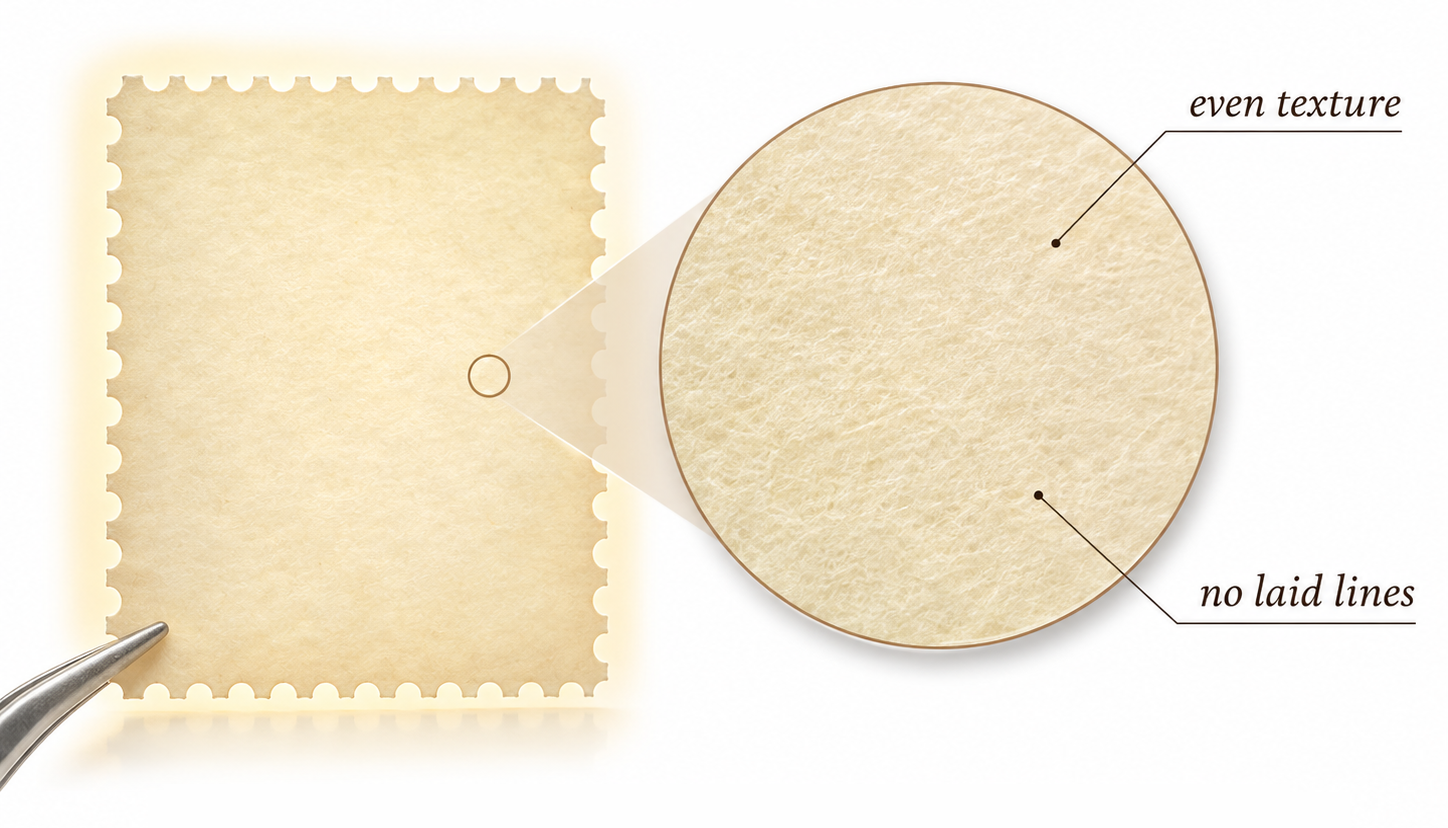
Image information
Click image to magnify
Diagram of wove paper with a magnified inset showing an even texture without laid lines.
- Credit
- Stunning Stamps · 2026
- Notes
- Digitally constructed
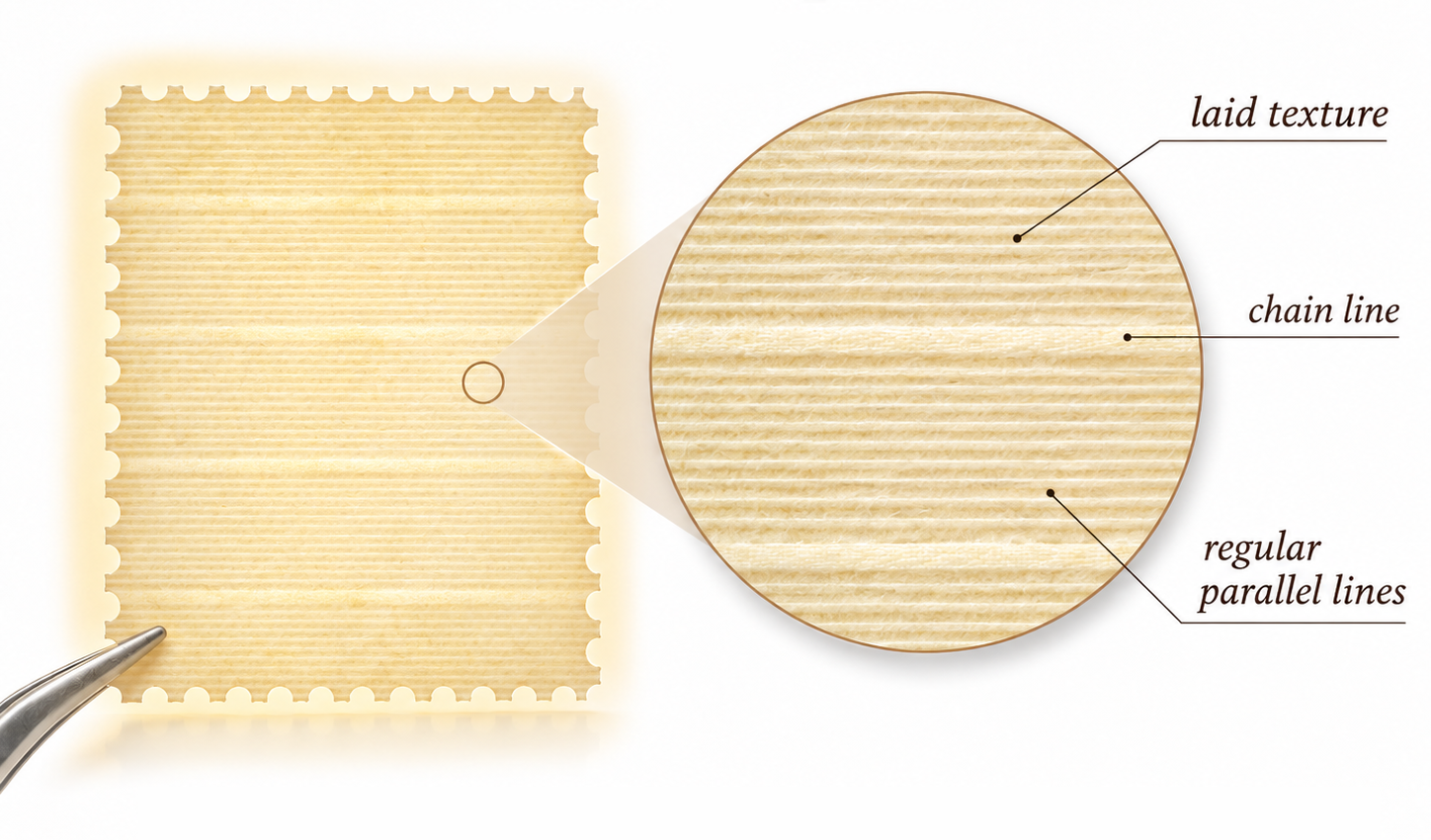
Image information
Click image to magnify
Diagram of laid paper with a magnified inset showing regular parallel lines.
- Credit
- Stunning Stamps · 2026
- Notes
- Digitally constructed
On this stamp
The issued three-halfpenny used the handmade Large Crown wove paper of the contemporary Penny Red. The issued red stamps are normally unblued; the registration sheet of the unissued 1860 lilac-rose printing is strongly blued. Paper colour and watermark are separate properties.
Sources
- Fitzwilliam Museum: Wove paper
- American Philatelic Society: Watermarks — A Philatelic Introduction
- Wright and Creeke, A History of the Adhesive Stamps of the British Isles (1899), pp. 11–13: line engraving, handmade paper, watermarks and gum
- Wright and Creeke (1899), pp. 13–16: halfpenny issue, plates, sheets, script watermark and perforation
- Wright and Creeke (1899), pp. 42–44: three-halfpenny design, plates 1 and 3, paper, sheets and unissued 1860 printing
Script half penny and Large Crown
A watermark is a pattern of thinner paper formed during manufacture. Light passes through it differently from the surrounding fibres. It belongs to the paper, so it can distinguish stamps with very similar printed faces.
The Bantam uses the words half penny in flowing script. One complete inscription stretches across three neighbouring stamp positions. There are eight inscriptions across each row of twenty-four stamps and twenty rows, making 160 inscriptions in a full sheet.
The three-halfpenny instead uses the Large Crown paper of the contemporary Penny Red, with one crown intended for each stamp position. This is a different watermark from the Imperial Crown of the Edward VII issues.
An individual Bantam normally contains only part of the words. An incomplete mark is not automatically a missing watermark. Orientation and displacement must be established from the actual paper; neither can be assigned from a front-view reconstruction.
On this stamp
One Large Crown was intended beneath each three-halfpenny stamp. The same paper family served the contemporary Penny Red. The plate-3 face illustration cannot establish whether the crown on an original is upright, inverted or displaced.
Sources
- Wright and Creeke, A History of the Adhesive Stamps of the British Isles (1899), pp. 11–13: line engraving, handmade paper, watermarks and gum
- Wright and Creeke (1899), pp. 13–16: halfpenny issue, plates, sheets, script watermark and perforation
- Wright and Creeke (1899), pp. 42–44: three-halfpenny design, plates 1 and 3, paper, sheets and unissued 1860 printing
- Royal Mail, British Philatelic Bulletin, January 2020, pp. 150–156: The Birth of the Bantam, proofs, printing and watermark
Gauge 14 and the direction of perforating
Perforation gauge measures the number of holes over two centimetres, not the total number of teeth along an edge. Gauge 14 applies both horizontally and vertically to the normal issued stamps in this set.
Punching the holes was a separate operation at Somerset House after printing, gumming and drying. The dampened printing paper could shrink as it dried, so the perforations did not always align neatly with the engraved designs.
For the small halfpenny the sheets were fed sideways and perforated in successive vertical columns. An outer side could remain unperforated. The three-halfpenny used the usual succession of horizontal rows.
A straight edge, an imperforate proof and a genuinely issued imperforate variety are different possibilities. They do not establish another gauge. The note for each stamp distinguishes the ordinary issue from exceptional material.
On this stamp
The normal three-halfpenny is perforated 14 horizontally and vertically. Plate 1 and plate 3 share that gauge. The illustrated Q–F plate-3 stamp is fully perforated; plate-1 imperforate material is a separate specialist category, not a grouped perforation alternative.
Sources
- Wright and Creeke, A History of the Adhesive Stamps of the British Isles (1899), pp. 11–13: line engraving, handmade paper, watermarks and gum
- Wright and Creeke (1899), pp. 13–16: halfpenny issue, plates, sheets, script watermark and perforation
- Wright and Creeke (1899), pp. 42–44: three-halfpenny design, plates 1 and 3, paper, sheets and unissued 1860 printing
- Royal Mail, British Philatelic Bulletin, January 2020, pp. 150–156: The Birth of the Bantam, proofs, printing and watermark
Gumming after recess printing
The gum was the adhesive coating on the back. Perkins Bacon printed on damp paper, then gummed and dried the sheets. This sequence differs from the pre-gummed paper used for De La Rue’s surface-printed stamps.
The adhesive was known as British Gum: a starch preparation with gelatine added from the mid-1850s. Two coats were applied from 1864 to improve adhesion. Its appearance could range from pale to brownish.
A front image cannot establish whether an original retains its gum, has been hinged or has been regummed. Gum condition is separate from the design, watermark and cancellation.
On this stamp
The 1½d was gummed after recess printing, using the established British Gum preparation. Two coats were then standard. No surviving-gum condition, hinge status or regumming judgement is implied by this uncancelled front illustration.
Sources
- Wright and Creeke, A History of the Adhesive Stamps of the British Isles (1899), pp. 11–13: line engraving, handmade paper, watermarks and gum
- Wright and Creeke (1899), pp. 13–16: halfpenny issue, plates, sheets, script watermark and perforation
- Wright and Creeke (1899), pp. 42–44: three-halfpenny design, plates 1 and 3, paper, sheets and unissued 1860 printing
One pane, two sheet sizes
A printing sheet contains the repeated impressions made from one plate. A pane is an uninterrupted block of stamp positions, usually separated from another pane by a wider blank gutter. Both these line-engraved values were printed in a single pane.
The Bantam plate held twenty rows of twenty-four stamps: 480 impressions. The three-halfpenny plate held twenty rows of twelve: 240. Multiplying rows by columns gives the number of stamps, while multiplying by the denomination gives the sheet’s face value.
The wider halfpenny layout also determined the spacing of its watermark inscriptions and the range of its corner letters. These arrangements cannot be transferred unchanged from the larger three-halfpenny.
On this stamp
Twenty rows of twelve made one pane of 240 three-halfpenny stamps. Plates 1 and 3 used the same basic arrangement. There is no intermediate gutter dividing the printing sheet into separate panes.
Reading the value of a row and sheet
Victorian money used twelve pence to the shilling and twenty shillings to the pound. A halfpenny was half of one old penny; three-halfpence was one and a half old pence.
A row of twenty-four halfpennies was worth one shilling. Twenty such rows made a sheet worth £1. A row of twelve three-halfpenny stamps was worth one shilling and sixpence, and its twenty-row sheet £1 10s.
These totals describe the original face value printed in the sheet margins. They are not present-day collecting prices or evidence that every customer bought complete sheets.
On this stamp
Twelve three-halfpenny stamps made 18d, or 1s 6d. Twenty such rows made 360d, or £1 10s. These totals explain the original sheet inscriptions.
Four corner letters and a sheet position
Read the lower pair from left to right: the first letter gives the row, the second the column. The upper corners repeat that pair in reverse. This helped expose attempts to assemble an apparently unused stamp from uncancelled pieces.
Both sheets have twenty rows, lettered A to T. The halfpenny has twenty-four columns, A to X; the three-halfpenny twelve, A to L. Thus the complete lower-pair ranges are AA–TX and AA–TL respectively.
The letters were punched into each plate position separately. They are neither an engraver’s initials nor a place of posting. The same pair recurs on different plates, so the letters alone cannot identify a printing plate.
Small differences of position or a recorded wrong letter can help specialists identify a particular impression. The individual note reads the letters on the illustration, rather than attributing one position to every stamp of the issue.
On this stamp
The lower Q–F pair identifies row 17, column 6 in the twenty-by-twelve three-halfpenny sheet. The upper pair reverses it to F–Q. The recorded plate-1 letter error does not apply to this plate-3 position.
Sources
- Wright and Creeke, A History of the Adhesive Stamps of the British Isles (1899), pp. 11–13: line engraving, handmade paper, watermarks and gum
- Wright and Creeke (1899), pp. 13–16: halfpenny issue, plates, sheets, script watermark and perforation
- Wright and Creeke (1899), pp. 42–44: three-halfpenny design, plates 1 and 3, paper, sheets and unissued 1860 printing
Information around a complete sheet
Sheet margins carried instructions for attaching stamps, the value of a label, row and sheet, plate numbers and marks used to guide production. These features normally disappear when a single stamp is separated.
A plate number identifies a plate within a denomination’s sequence. A current number was a separate workshop reference. Both could appear in the margins even when a number was also visible inside each stamp.
Crosses, lines and other guide marks helped align or divide the sheet. They are separate from the corner letters within the stamps and from watermarked words in the paper margins. A single stamp need not preserve any of them.
On this stamp
The three-halfpenny sheet carried price and application instructions, marginal plate numbers and guide marks. Plate 3’s later arrangement also had current numbers and circled marginal plate numbers. These are separate from the small white 3 figures inside the illustrated Q–F stamp.
Sources
- Wright and Creeke, A History of the Adhesive Stamps of the British Isles (1899), pp. 11–13: line engraving, handmade paper, watermarks and gum
- Wright and Creeke (1899), pp. 13–16: halfpenny issue, plates, sheets, script watermark and perforation
- Wright and Creeke (1899), pp. 42–44: three-halfpenny design, plates 1 and 3, paper, sheets and unissued 1860 printing
From engraved die to numbered plate
The original die carried a single design cut into softened steel. After hardening, it impressed a raised copy onto a steel transfer roller. The roller then pressed the design repeatedly into a softened printing plate, which was finished and hardened for use.
On the halfpenny, tiny white numerals occur beside the portrait. The first three-halfpenny plate has no numeral inside the stamp; plate 3 added white figures to the side borders. A missing number therefore needs to be interpreted for the particular design.
Registration preserved an approved impression, commonly called an imprimatur. Approval, first printing and first public sale can fall on different dates. Plate numbers run through manufacturing sequences that can include rejected or unused plates.
On this stamp
The white 3 appears in both side borders. Plate 3 was registered on 30 April 1874 and first put to press on 10 August. The earlier plate 1 has no number inside the stamp, so a numeral-free original is not automatically a damaged plate-3 impression.
Sources
- Wright and Creeke, A History of the Adhesive Stamps of the British Isles (1899), pp. 11–13: line engraving, handmade paper, watermarks and gum
- Wright and Creeke (1899), pp. 13–16: halfpenny issue, plates, sheets, script watermark and perforation
- Wright and Creeke (1899), pp. 42–44: three-halfpenny design, plates 1 and 3, paper, sheets and unissued 1860 printing
Used plates, rejected plates and old designs
Not every plate number represents stamps sold to the public. A plate could be abandoned during transfer, rejected because its spacing did not match the perforator, or completed but never brought into use.
Fifteen halfpenny plates were used: 1, 3–6, 8–15, 19 and 20. Later numbered plates retained the 1870 design. Plate 9 saw limited use, whereas some other numbers belong to failed or unused production work.
The three-halfpenny used plates 1 and 3. Plate 1 was first printed in lilac-rose in 1860 but that stock was not issued for ordinary postage. It returned to press in red in 1870. Plate 2 was rejected; plate 3 entered production in 1874 with numerals added inside the design.
A later plate does not change the design’s first-appearance year. The portrait, paper, internal numeral and documentary record together establish which printing an illustration represents.
On this stamp
Plate 1 supplied the unissued lilac-rose stamps of 1860 and the first red stamps issued in 1870. Plate 2 was rejected because its impressions were inaccurately spaced. Plate 3, illustrated here, replaced it in 1874 and remained at press until July 1880.
Straight edges and recorded varieties
A stamp with no holes on one edge is not necessarily an imperforate stamp. It may come from a sheet edge deliberately left without perforations. An entirely imperforate stamp lacks the normal perforations on every side; adequate margins and comparison material are needed to distinguish it from a trimmed stamp.
Sideways perforating left an outer column of some halfpenny sheets with a straight edge. The catalogue record also includes completely imperforate examples from certain plates. Those are separate categories, not alternative normal gauges.
For the three-halfpenny, imperforate examples are recorded from plate 1. Plate 1 also has the known error in which O replaces C in an upper corner. That error belongs to a particular plate position, not to the plate-3 illustration here.
Neither article groups a second perforation illustration. Normal issued examples of both values use gauge 14; proofs, sheet-edge effects and documented errors remain distinct specialist subjects.
On this stamp
Imperforate examples and the O-for-C upper-corner error are recorded from plate 1, including material from the unissued 1860 printing. This article illustrates normal plate 3, Q–F. The error is a feature of a different plate, not of all three-halfpenny stamps.
Essays, proofs and unissued stamps
An essay proposes a design; a die proof tests the single engraving; a plate proof tests the repeated impressions. A colour trial explores an ink choice. A registration impression records official approval, while a SPECIMEN marking identifies reference material.
The Bantam’s development left proposed designs, incomplete and strengthened portrait proofs, and experiments with different colours and backgrounds. These do not mean that the normal 1870 adhesive was issued in all the trial colours.
The three-halfpenny’s lilac-rose stamps of 1860 were a substantial printing for a planned rate change, rather than merely a colour trial. Most were destroyed in 1867, although examples had already been supplied for reference. They must be distinguished from the red stamps issued in 1870.
Absence of a postmark or of perforations alone does not establish any of these categories. Provenance, paper, plate features and official records explain what a surviving item represents.
On this stamp
The 1860 lilac-rose stock amounted to 10,000 sheets. Records account for 8,962 destroyed in 1867, 1,036 distributed as specimens and one sheet each retained for registration and sent to the Paris Exhibition. The rose-red plate-3 illustration belongs to the later issued series, not that unissued stock.
Sources
- Wright and Creeke (1899), pp. 13–16: halfpenny issue, plates, sheets, script watermark and perforation
- Wright and Creeke (1899), pp. 42–44: three-halfpenny design, plates 1 and 3, paper, sheets and unissued 1860 printing
- Royal Mail, British Philatelic Bulletin, January 2020, pp. 150–156: The Birth of the Bantam, proofs, printing and watermark
The cheaper printed-paper post
From 1 October 1870 the inland printed-matter scale began at a halfpenny for a packet up to two ounces. Further two-ounce steps added another halfpenny: one penny up to four ounces and three-halfpence up to six ounces. These were conditional rates for qualifying material, not the ordinary letter rate.
Registered newspapers also had a special halfpenny-per-copy rate. The two new adhesive values made these low and fractional charges easier to pay, and could be combined with other stamps when a larger total was required.
The halfpenny postcard rate began on the same day, but initially applied to official pre-stamped cards. Ordinary private cards franked with adhesive stamps were not admitted to that service until 1894. A Bantam should therefore not be described simply as the stamp introduced for private postcards.
To interpret a surviving use, consider the date, contents, weight and postal service together. The denomination by itself does not establish the rate that a particular item paid.
On this stamp
One three-halfpenny could pay the third step of the October 1870 inland printed-matter scale: a qualifying packet over 4oz and up to 6oz. It could also contribute to other required totals. A complete item is needed to determine which service and weight step a particular use represents.
Sources
- Great Britain Philatelic Society: Inland printed matter rates, 1 October 1870
- Great Britain Philatelic Society: Inland newspaper rates, 1 October 1870
- Great Britain Philatelic Society: Postcard rates and restrictions on adhesive stamps
- Wright and Creeke (1899), pp. 13–16: halfpenny issue, plates, sheets, script watermark and perforation
- Wright and Creeke (1899), pp. 42–44: three-halfpenny design, plates 1 and 3, paper, sheets and unissued 1860 printing
Printed design and postal marking
The cancellation was applied after manufacture to show that the stamp had been used. Its date or office number belongs to the postal marking, whereas the small plate numerals and corner letters belong to the printed design.
A surviving wrapper or complete postal item can explain the charge and route more reliably than a loose stamp. A heavy cancellation can obscure the tiny halfpenny plate number or the side figures of the three-halfpenny without changing their identity.
The illustrations show uncancelled designs. They make no claim about a particular original’s gum, first-day use or postal journey. A SPECIMEN marking on reference material is also distinct from ordinary postal cancellation.
On this stamp
This reconstruction shows the 1½d without a postal cancellation. The printed 3 numerals and Q–F letters identify manufacture, not a post office. A used original’s marking, wrapper or cover supplies the evidence for its actual postal use.
Sources
- Wright and Creeke (1899), pp. 13–16: halfpenny issue, plates, sheets, script watermark and perforation
- Wright and Creeke (1899), pp. 42–44: three-halfpenny design, plates 1 and 3, paper, sheets and unissued 1860 printing
- Royal Mail, British Philatelic Bulletin, January 2020, pp. 150–156: The Birth of the Bantam, proofs, printing and watermark