
Understanding the stamp details
1d rose-red · Perkins, Bacon & Co.
Printer
Perkins Bacon was a London security printer. Its engraved stamp production combined the preparation of steel plates with the repeated inking, wiping and pressing of sheets.
On this stamp
Perkins, Bacon & Co. printed the 1864 four-letter Penny Red from engraved steel plates. Its four corner letters and small plate numbers were incorporated into the printed design.
Die II re-engraving
William Humphrys trained in Philadelphia and engraved banknotes before working in London. His career included book illustration and the fine steel engraving used for security printing.
On this stamp
The 1864 four-letter Penny Red retained the Die II portrait revised by William Humphrys for the penny stamp. The new security markings did not represent a fresh portrait commission.
Portrait source
William Wyon was a medallist and engraver at the Royal Mint. His models of royal heads were made for coins and medals and also became sources for stamp portraits.
On this stamp
Wyon’s City of London medal supplied the youthful likeness inherited by the 1864 four-letter Penny Red. His medal portrait is distinct from the later stamp engraving and security markings.
Original portrait drawing
Henry Corbould was a draughtsman and book illustrator. He trained with his father and at the Royal Academy Schools, where he received a silver medal for a life study.
On this stamp
Corbould’s drawing after Wyon’s medal helped prepare the original stamp portrait inherited by the 1864 four-letter Penny Red; it was not a new drawing commissioned for this issue.
Original portrait engraving
Charles Heath was an engraver and publisher of illustrated books. Work from his workshop could carry his signature even when assistants had contributed to the engraving.
Frederick Heath, Charles Heath’s son, was an engraver working in the family’s illustrated-book business. His surviving prints include engraved interpretations of other artists’ paintings.
On this stamp
The 1864 four-letter Penny Red retains an inherited portrait engraving attributed to Charles Heath or Frederick Heath; their individual roles remain unresolved. Humphrys’s documented later revision is distinct from this original work.
Sources
- Douglas N. Muir, William Wyon & the Penny Black, Royal Mint Museum
- Wright and Creeke, A History of the Adhesive Stamps of the British Isles (1899), pp. 11, 34–35
- University of Edinburgh, Walter Scott Digital Archive: Charles Heath
- Wellcome Collection: A young bride in Naples, engraved by Frederick A. Heath after Thomas Uwins (1847), 28393i
Country and monarch
The country identifies the postal authority that issued the stamp. The monarch identifies the ruler whose portrait it carries. A definitive is an everyday stamp intended for regular postal use.
On this stamp
The four-letter Penny Red belongs to Great Britain’s ordinary Victorian postage stamps. It continues the youthful left-facing portrait used in the line-engraved series.
Denomination
The denomination is the stamp’s face value: the amount of postage it represents. Its price to a collector can be quite different.
In Britain’s old currency, 12 pence made one shilling and 20 shillings made one pound: 240 pence altogether. The abbreviations were d for pence, s for shillings and £ for pounds. The d comes from the Latin denarius. A halfpenny, written ½d, was half an old penny.
On this stamp
The ONE PENNY inscription gives a value of one old penny. Twelve such stamps made one shilling.
Stamp shades
A shade is a variation within a stamp’s colour. Some variations receive their own catalogue numbers even though the design and denomination stay the same.
Compare known examples under consistent lighting. Fading can change a stamp’s appearance, and photographs or screens can alter how colours look. A catalogue colour name helps describe a shade; it is not a colour test by itself.
On this stamp
This reconstruction uses the rose-red family recorded for its plate 73 model. The issue includes related carmine and rose shades; the colour name does not identify a plate on its own.
Issue, registration and first printing
Registration approved a printing plate and preserved an official impression. Putting the plate to press began production; public issue followed when stamps reached the counter. A dated cover establishes use by that day, without necessarily giving the first day of sale.
The four-letter twopenny entered general circulation in July 1858. The penny followed on 1 April 1864, although its first usable four-letter plates had been registered in March 1861. Existing stocks of the earlier penny plates delayed the change.
For the thin-line twopenny, Wright and Creeke record plate 13 going to press on 13 April 1869 but could not establish the exact issue date. Their suggestion of an April release is qualified; later accounts place the change in July. The secure common year is 1869.
On this stamp
The four-letter Penny Red was issued on 1 April 1864. Plate 73, represented here, had been registered on 14 March 1861: approval and public introduction were separate events.
Sources
- Wright and Creeke, A History of the Adhesive Stamps of the British Isles (1899), pp. 1–5: plate numbers, check letters, July 1858 circular and registration
- Wright and Creeke (1899), pp. 34–40: Die II, Large Crown paper and the four-letter Penny Red
- Wright and Creeke (1899), pp. 47–56: twopenny sheet arrangements, the 1858 and 1869 designs and their plates
- Great Britain Philatelic Society, A Survey of GB Stamps, GB Journal 28(2), 1990: four-corner-letter issues and Large Crown types
Four letters and a numbered design
The four-corner-letter issues continued the familiar line-engraved penny and twopenny designs. Their new security markings were introduced on the blue twopenny in 1858 and the red penny in 1864. The later blue twopenny, introduced in 1869, retained them while changing the width of its white horizontal rules.
Each stamp has a pair of lower check letters repeated in reverse above, together with a tiny plate number on both sides of the portrait. The letters locate one impression within a sheet; the numbers identify the plate that printed it. A postmaster could compare these marks when a stamp seemed to have been pieced together from used fragments.
These three articles cover design families with many individual printings. Their dates identify the introduction of each type, rather than the printing date of every plate or shade represented by it.
On this stamp
This four-letter Penny Red belongs to the family with reversed corner-letter pairs and a plate number at each side. The set groups the 1858 twopenny, 1864 penny and 1869 twopenny design changes.
Sources
- Wright and Creeke, A History of the Adhesive Stamps of the British Isles (1899), pp. 1–5: plate numbers, check letters, July 1858 circular and registration
- Wright and Creeke (1899), pp. 34–40: Die II, Large Crown paper and the four-letter Penny Red
- Wright and Creeke (1899), pp. 47–56: twopenny sheet arrangements, the 1858 and 1869 designs and their plates
Thick rules, thin rules and the Penny Red
On the blue twopenny, two unprinted horizontal strips separate the portrait area from the POSTAGE tablet above and TWO PENCE below. They appear white because the paper shows through. They were not added in white ink.
The 1858 four-letter twopenny has broad rules and was printed from plates 7, 8, 9 and 12. The later version has narrower rules and comes from plates 13, 14 and 15. The Penny Red has neither of these white strips: its denomination tablets meet the engraved background differently.
Rules need to be read together with the corner design. An earlier thin-rule twopenny from plate 6 still has stars in its upper corners and belongs to the previous series. Thin lines alone do not identify the four-letter issue of 1869.
Ink, wear and the quality of an impression can change how strongly fine details appear. The combined design, plate number, paper and perforation provide a more dependable identification than one small feature on its own.
On this stamp
This Penny Red has four plain block letters and tiny plate 73 numerals. Unlike the blue twopenny designs, it has no white horizontal rules beneath POSTAGE or above its value.
Catalogue references
A stamp catalogue gives each listed issue a reference number. SG means Stanley Gibbons, the publisher of the catalogue used here. These numbers help collectors refer to the same issue; they are not serial numbers printed on individual stamps.
A range of numbers groups related entries. Colour, paper or perforation differences may account for separate listings within that range.
On this stamp
The recorded model for this rose-red illustration is SG 43, plate 73, position ME. The broader four-letter penny family includes SG 43–44; paper, shade and plate require examination of the actual stamp.
Reading gauge 14
Perforation gauge describes the spacing of the holes over two centimetres. In a 14 × 14 measurement, the first number applies across the top and bottom, and the second down the sides. It does not mean that every edge has fourteen holes or teeth.
All three ordinary four-corner-letter issues were perforated 14. The perforations 16 and 14 found on earlier stamps with stars in their upper corners must not be carried forward as alternatives for this set.
Printing, gumming and drying came before the sheets were perforated at Somerset House. Small differences in alignment could leave a design off centre within its perforations. That is different from a new gauge.
An imperforate pair or sheet needs separate evidence: it may be a proof, an experiment or an issued error. Cutting the teeth off a normal stamp also makes straight edges, so a single trimmed example does not establish an imperforate variety.
Image information
Enlarged perforation spacing: fourteen equal intervals between hole centres span 20 millimetres. This is a schematic, not a ruler.
- Credit
- Stunning Stamps · 2026
On this stamp
The ordinary four-letter Penny Red is gauge 14 horizontally and vertically. There is no grouped gauge alternative on this article. The earlier Stars series’ gauge-16 alternatives remain on their own canonical pages.
Sources
- Wright and Creeke (1899), pp. 11–13: steel dies and plates, recess printing, handmade paper, watermarks and gum
- Wright and Creeke (1899), pp. 34–40: Die II, Large Crown paper and the four-letter Penny Red
- Wright and Creeke (1899), pp. 47–56: twopenny sheet arrangements, the 1858 and 1869 designs and their plates
Printing from engraved lines
Line engraving is a form of recess, or intaglio, printing. The lines that carry ink are cut below the surface of a metal plate. After inking the plate, the printer wipes the flat surface clean, leaving ink in the engraved grooves.
Damp paper is pressed firmly against the plate and takes up the ink from those grooves. The fine coloured lines form the image; the spaces between them leave the paper visible. This differs from surface printing, where the raised parts of the printing surface carry the ink.
A transfer roller repeated the design from the die across a steel plate. The corner letters were added separately to each position. Printing, gumming and drying preceded perforation: punching the holes was a separate operation from making the coloured image.
Image information
Side view of recess printing: ink remains in grooves below the plate surface and pressure brings paper into contact with it.
- Credit
- Stunning Stamps · 2026
On this stamp
Perkins Bacon printed this penny in one red ink from an engraved steel plate. The pale parts of the design are areas of paper between the inked lines. Printing preceded gumming, drying and perforation.
Wove paper
Wove describes the structure of the paper. Viewed against the light, it has a fairly even appearance. Laid paper instead shows a regular pattern of lines left by its manufacture.
Paper structure and watermark are separate characteristics: wove paper can carry a watermark. Both can help distinguish stamps with similar printed designs.
The line-engraved issues used handmade wove paper from Rush Mills. Its even texture should not be confused with machine manufacture. A watermark pattern attached to the papermaking mould left thinner areas in the sheet as the fibres settled.
Thickness could vary between sheets. The period account explains that thicker or thinner sheets were included to bring a ream to the contracted weight. Paper thickness, a watermark variety and a change of printing ink are separate features.
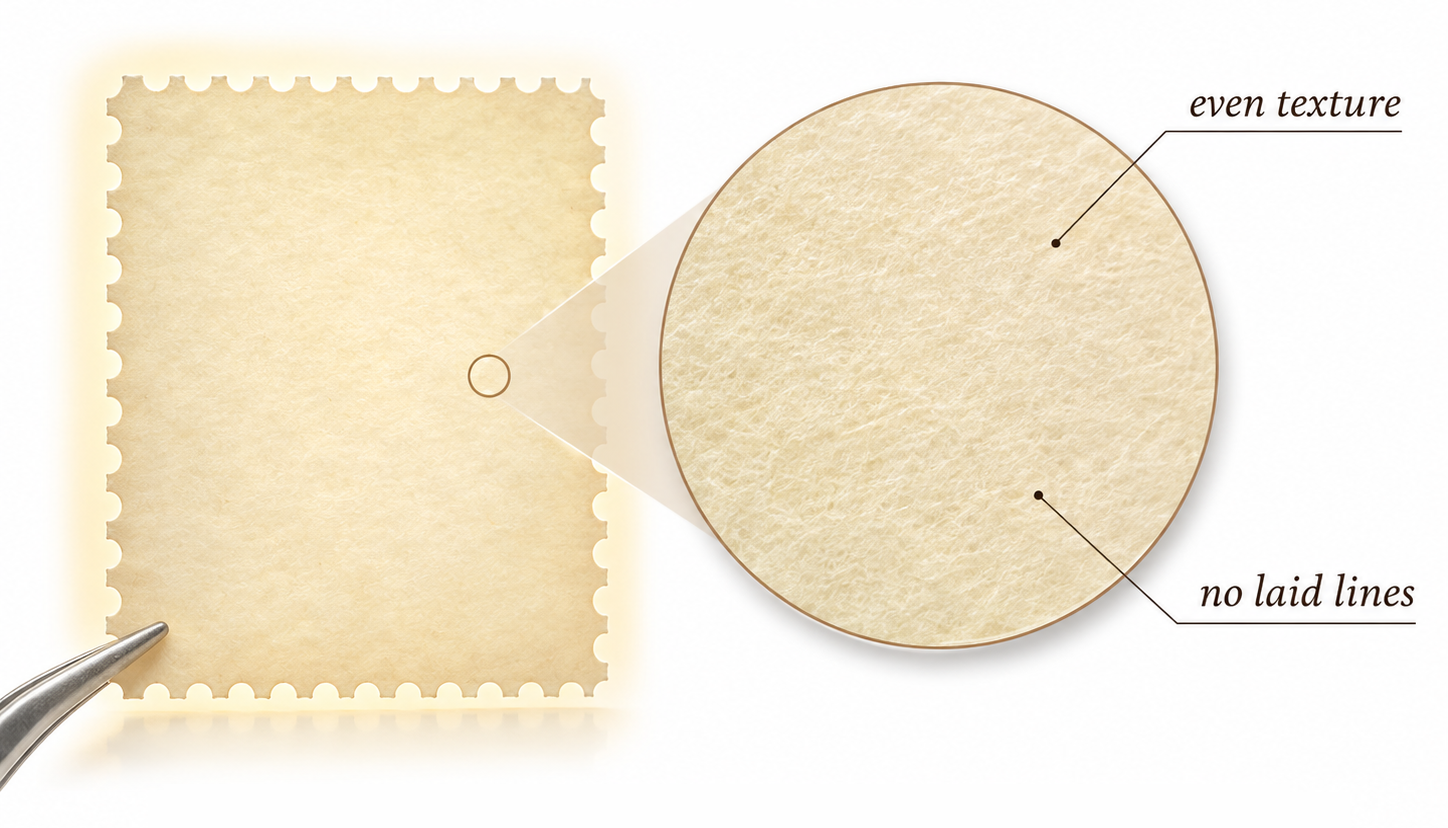
Image information
Click image to magnify
Diagram of wove paper with a magnified inset showing an even texture without laid lines.
- Credit
- Stunning Stamps · 2026
- Notes
- Digitally constructed
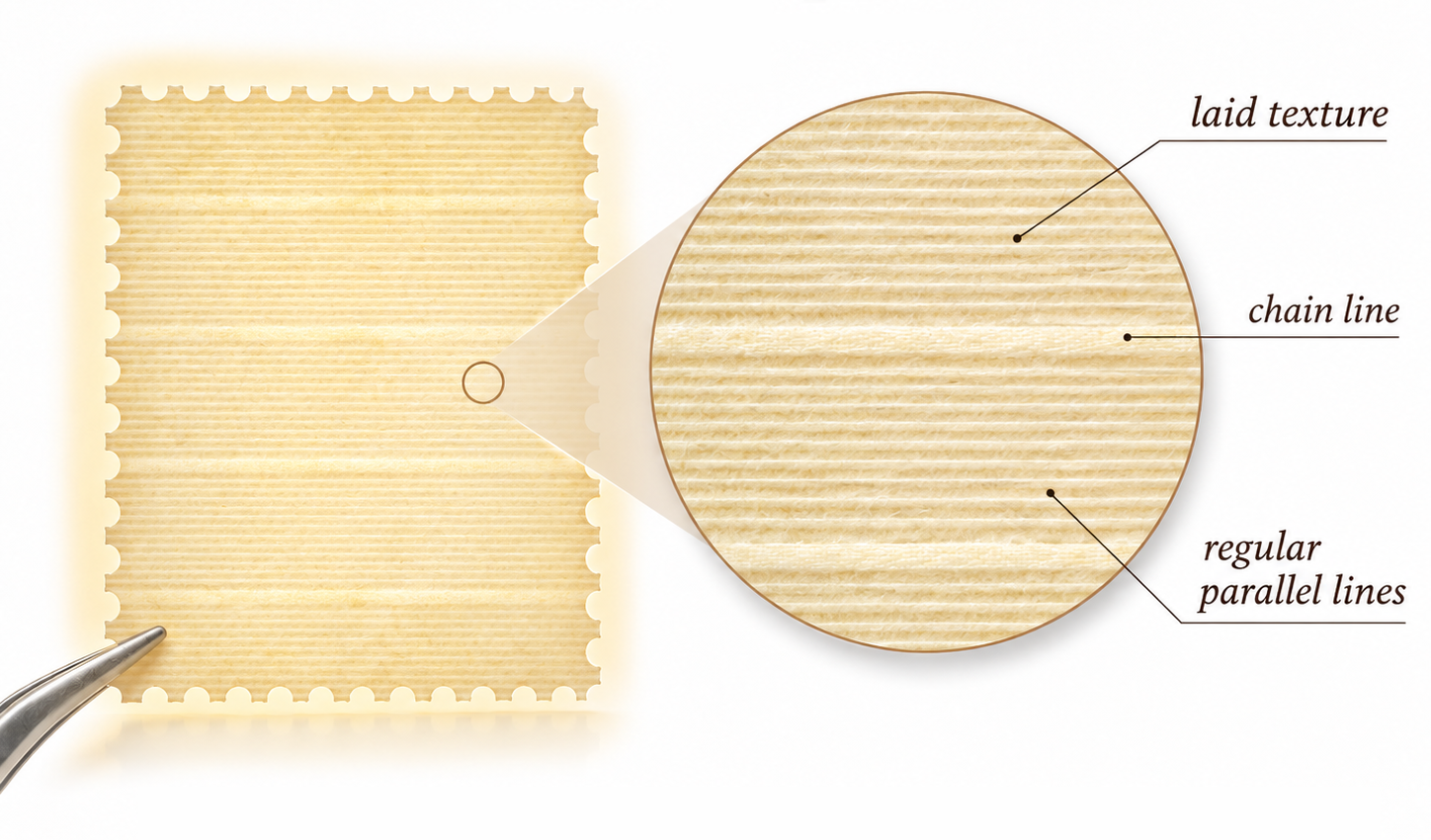
Image information
Click image to magnify
Diagram of laid paper with a magnified inset showing regular parallel lines.
- Credit
- Stunning Stamps · 2026
- Notes
- Digitally constructed
On this stamp
This four-letter Penny Red used the handmade wove paper of the line-engraved series. Its paper structure is distinct from the Large Crown watermark and from the red printing ink.
Sources
- Fitzwilliam Museum: Wove paper
- American Philatelic Society: Watermarks — A Philatelic Introduction
- Wright and Creeke (1899), pp. 11–13: steel dies and plates, recess printing, handmade paper, watermarks and gum
- Wright and Creeke (1899), pp. 34–40: Die II, Large Crown paper and the four-letter Penny Red
Large Crown paper and its later form
A watermark is a pattern within the paper, made by leaving less fibre at selected points. The Large Crown sheet supplied a crown for each stamp position. It is distinct from the Small Crown of earlier issues and from the Imperial Crown used much later for Edward VII.
The Large Crown design was modified in 1862 by omitting two short vertical lines. Collectors distinguish the earlier and later forms as types I and II. That change belongs to the paper, while Die II describes an engraved portrait: the two uses of the word type or die should not be merged.
The thick-rule twopenny spans the change: plates 7 and 8 belong to the earlier paper, plate 9 occurs across the transition and plate 12 uses the later form. The four-letter Penny Red and thin-rule twopenny use the later Large Crown paper.
A crown may be faint, displaced or inverted. Its orientation and exact form require the original paper. The front-view illustration identifies the design represented here, without showing a particular watermark impression.
On this stamp
The four-letter Penny Red uses the later Large Crown form introduced in 1862, omitting two short vertical lines. The illustrated plate 73 is within this series; the watermark is a feature of the original paper.
Sources
- Wright and Creeke (1899), pp. 11–13: steel dies and plates, recess printing, handmade paper, watermarks and gum
- Wright and Creeke (1899), pp. 34–40: Die II, Large Crown paper and the four-letter Penny Red
- Wright and Creeke (1899), pp. 47–56: twopenny sheet arrangements, the 1858 and 1869 designs and their plates
- Great Britain Philatelic Society, A Survey of GB Stamps, GB Journal 28(2), 1990: four-corner-letter issues and Large Crown types
Adhesive applied after printing
The gum was the coating that attached a stamp to the letter. Perkins Bacon printed on damp paper, then gummed and dried the sheets. This sequence differed from De La Rue’s surface printing on paper already coated with gum.
The line-engraved stamps used British Gum, a starch preparation to which gelatine had been added from the middle of 1855. The period account describes gum ranging from pale to brownish; the colour alone is not a new stamp design.
In June 1864 the penny and twopenny began receiving two coats, initially as a one-year trial to improve adhesion. The practice continued. The thick-rule twopenny therefore spans both the earlier and later gumming arrangements.
Original gum, a hinge mark and a later replacement coating concern the back of the surviving object. They cannot be determined from the printed face or from this reconstruction.
On this stamp
The four-letter Penny Red began in April 1864. Double gumming started that June and continued after its trial year; the design alone does not identify which coating arrangement a surviving early stamp retains.
Twenty rows of twelve stamps
The printing plate carried 240 impressions arranged in twenty horizontal rows of twelve. They formed one uninterrupted pane, without a gutter dividing the stamps into smaller blocks. The printed sheet was also the post-office sheet.
The repeated design came from a transfer roller, but the letters were inserted separately into each position. Reading those letters allows a detached stamp to be placed back within the original twenty-by-twelve arrangement.
The margins surrounded the whole pane and carried prices, instructions and production marks. They are additional to the 240 stamp positions. A block of four cut from the sheet is a surviving part of that pane, not evidence of a four-stamp printing unit.
On this stamp
The four-letter Penny Red was printed in a single pane of 240. Its lower-left letters run A–T down twenty rows, and the lower-right letters A–L across twelve columns.
Sources
- Wright and Creeke (1899), pp. 11–13: steel dies and plates, recess printing, handmade paper, watermarks and gum
- Wright and Creeke (1899), pp. 34–40: Die II, Large Crown paper and the four-letter Penny Red
- Wright and Creeke (1899), pp. 47–56: twopenny sheet arrangements, the 1858 and 1869 designs and their plates
- Wright and Creeke, A History of the Adhesive Stamps of the British Isles (1899), pp. 1–5: plate numbers, check letters, July 1858 circular and registration
The value of a row and a sheet
There were twelve old pence in a shilling and twenty shillings in a pound. Twelve penny stamps therefore made a one-shilling row, and twenty rows made a sheet worth £1.
For the twopenny, the same arrangement doubled the totals: two shillings per row and £2 for all 240 stamps. The denomination changed the money represented by the sheet, without changing its number of impressions.
The figures in the sheet margins helped account for stocks and sales. They give the original postal face value, not a collector’s price. Individual stamps and smaller multiples could be separated from the sheet as required.
On this stamp
Twelve penny stamps made a row worth one shilling; twenty rows made £1. These are the postal face values of the original sheet.
Reading the four check letters
Read the lower pair from left to right. The left letter gives the row, from A to T; the right gives the column, from A to L. The sheet begins AA at its upper left and ends TL at its lower right.
The upper corners repeat the lower pair in reverse. For a lower pair RE, the top reads ER: the same letters lie at diagonally opposite corners. This relationship helped expose a stamp assembled from mismatched pieces.
The letters were punched into the plate positions individually, using bold sans-serif capitals. They are neither the engraver’s initials nor an abbreviation for a town. Each plate repeats the same range of positions, so the letter pair needs the small side number to identify a particular plate position.
The individual note reads the reconstruction’s chosen letters. Other stamps of the same issue have other pairs, and a misplaced or altered letter on an original needs specialist comparison with the relevant plate.
On this stamp
The illustration has ME in its lower corners and EM above. M identifies row 13, and E column 5. These are this model’s letters; the issue contains the other positions of the 240-stamp sheet.
Sources
- Wright and Creeke, A History of the Adhesive Stamps of the British Isles (1899), pp. 1–5: plate numbers, check letters, July 1858 circular and registration
- Wright and Creeke (1899), pp. 11–13: steel dies and plates, recess printing, handmade paper, watermarks and gum
- Wright and Creeke (1899), pp. 34–40: Die II, Large Crown paper and the four-letter Penny Red
- Wright and Creeke (1899), pp. 47–56: twopenny sheet arrangements, the 1858 and 1869 designs and their plates
- Recorded illustration reference: primary issued plate73 design, four letters and tiny plate numerals
- Recorded illustration reference: independent SG43 portrait, block check-letter forms and outline
A small number on each side
Each side border contains the number of the printing plate in tiny white figures. The number was added to the transfer roller before the design was repeated across the steel plate. The two numbers on one stamp were intended to agree.
A plate number and a check-letter pair answer different questions. The number identifies which plate printed the stamp; the lower letters locate its row and column. Together they let a collector compare the same position in different impressions.
Penny and twopenny plates had separate numbering sequences. A high number is not a year, and plate 13 of one denomination does not identify plate 13 of another.
Heavy ink, wear, a cancellation or a perforation cutting into the design can obscure a figure. Read both sides and compare their shapes before concluding that the number is unusual. The illustrated number represents the selected model, rather than every printing covered by this page.
On this stamp
The reconstruction shows plate 73 in both side borders, with lower letters ME. Together they identify its chosen plate position. The number is separate from the denomination and from any postmark.
Sources
- Wright and Creeke, A History of the Adhesive Stamps of the British Isles (1899), pp. 1–5: plate numbers, check letters, July 1858 circular and registration
- Wright and Creeke (1899), pp. 11–13: steel dies and plates, recess printing, handmade paper, watermarks and gum
- Wright and Creeke (1899), pp. 34–40: Die II, Large Crown paper and the four-letter Penny Red
- Wright and Creeke (1899), pp. 47–56: twopenny sheet arrangements, the 1858 and 1869 designs and their plates
- Recorded illustration reference: primary issued plate73 design, four letters and tiny plate numerals
- Recorded illustration reference: independent SG43 portrait, block check-letter forms and outline
Plates used, rejected and left unused
Making a plate did not guarantee that it would print issued stamps. It had to be sound, its repeated impressions had to align with the perforating machinery, and it had to be needed for production.
The thick-rule twopenny used plates 7, 8, 9 and 12. Plates 10 and 11 were irregularly laid down and were defaced without registration. Thin-rule production used plates 13, 14 and 15; the first of these began printing in April 1869.
The ordinary four-letter Penny Red sequence runs from 71 to 225 with gaps. Plates 75, 77 and 128 were rejected; 126 was not made because its roller was defective. Plate 77 has exceptional surviving stamps despite its rejection, so it must not be described as an ordinary approved printing. Plates 226–228 were prepared but never put to press.
Registration and press dates also explain why a design’s introduction cannot date every example. The first penny plates waited years after approval, while later plates supplied the same broad design over a long production life.
On this stamp
The ordinary sequence is 71–74, 76, 78–125, 127 and 129–225. Rejected plate 77 has exceptional surviving stamps and is treated separately. The illustration uses ordinary plate 73; numbers 226–228 never entered production.
Instructions and workshop numbers
A complete sheet has a border outside the stamps. Its printed inscriptions gave the price per label, row and sheet, told the sender where to place a stamp, and warned against removing the adhesive when wetting it.
Plate numbers also appeared in the margins. Later plates carried a separate current number, a workshop sequence covering more than one denomination. A current number is therefore not a second reading of the tiny plate figures inside the design.
Guide marks helped with production and division of the sheet. Their arrangement changed as new plates were made: the early four-letter Penny Reds and later plates do not have identical marginal layouts.
These markings normally disappear when a single stamp is detached. The absence of a margin on an example leaves the plate number within the design and the corner letters as the more accessible position clues.
On this stamp
Plate 73 belongs to the earlier marginal arrangement of the four-letter penny plates. Current numbers were added on later plates after 97; they should not be assigned to this illustration merely because they occur elsewhere in the series.
Sources
- Wright and Creeke, A History of the Adhesive Stamps of the British Isles (1899), pp. 1–5: plate numbers, check letters, July 1858 circular and registration
- Wright and Creeke (1899), pp. 34–40: Die II, Large Crown paper and the four-letter Penny Red
- Wright and Creeke (1899), pp. 47–56: twopenny sheet arrangements, the 1858 and 1869 designs and their plates
Die II and the inherited portrait
A die is the original single engraving from which printing plates can be made. A new plate number does not necessarily mean that the portrait has been engraved again: many plates can descend from the same die.
The four-letter Penny Red retained the strengthened Die II portrait introduced in the earlier penny series. William Humphrys’s revision belongs to that earlier work. Replacing the top stars with letters and adding plate numbers did not amount to a new portrait commission.
In April 1858 a new twopenny die was made from the penny Die II design with the necessary change of value. Both the thick-rule and thin-rule four-letter twopence descend from it. Their different white rules distinguish later preparation of the printing design, rather than a documented new artist.
The contributor drawers distinguish the medal likeness, Corbould’s drawing, the unresolved original Heath engraving credit and Humphrys’s revision. These are different stages in the image’s history.
On this stamp
This Penny Red retains the earlier Die II portrait revised by William Humphrys. Four corner letters and plate numbers identify the later plate design, not a fresh portrait engraving.
Sources
- Wright and Creeke (1899), pp. 11–13: steel dies and plates, recess printing, handmade paper, watermarks and gum
- Wright and Creeke (1899), pp. 34–40: Die II, Large Crown paper and the four-letter Penny Red
- Wright and Creeke (1899), pp. 47–56: twopenny sheet arrangements, the 1858 and 1869 designs and their plates
Proofs, registration sheets and reprints
An essay proposes a design. A die proof tests the single engraving; a plate proof tests its repeated impressions. A registration or imprimatur sheet records official approval. These objects served different purposes from stamps sold for letters.
Registration could precede general issue by years. Before 1889 several impressions were normally taken when a plate was approved; one was retained in the official record and spare sheets could enter stock. A registration date should therefore be read as a production record, rather than automatically as the date of public introduction.
The black Royal Reprints made in 1865 came from the earlier penny plate 66, with upper stars and Large Crown paper. They are not black printings of the four-letter Penny Red and are not original Penny Blacks of 1840.
A SPECIMEN marking identifies reference material rather than ordinary postal use. Paper, plate, marking and provenance must be considered together. An unusual colour or a straight edge alone does not establish the purpose of an impression.
On this stamp
The four-letter penny has registration and proof material. The black Royal Reprints made from plate 66 in 1865 belong to the earlier Stars design, not this plate 73 family. A reference marking or special paper needs its own identification.
Sources
- Wright and Creeke, A History of the Adhesive Stamps of the British Isles (1899), pp. 1–5: plate numbers, check letters, July 1858 circular and registration
- Wright and Creeke (1899), pp. 34–40: Die II, Large Crown paper and the four-letter Penny Red
- Wright and Creeke (1899), pp. 47–56: twopenny sheet arrangements, the 1858 and 1869 designs and their plates
- The Postal Museum, Universal Postal Union stamps: reference examples and SPECIMEN markings
- National Postal Museum, Philatelic Bulletin, June 1976, p. 3: Ormond Hill’s order and the uncertain purpose of the black reprints
- Heinrich Köhler, sale 386, lots 370–372: the order of 1 September 1865 for the black reprints
Imperforate errors and experimental paper
An ordinary perforated issue can have an exceptional sheet that missed the perforating machine. That is an error in finishing, not a second routine perforation gauge. An imperforate proof or experimental printing may look similar but has a different origin.
For the Penny Red, an imperforate sheet from plate 116 reached the Cardiff Post Office in January 1870. Wright and Creeke also describe plate 121 impressions on chemically treated paper as experiments, which should be kept separate from the Cardiff issue.
For the later twopenny, their reported imperforate plate 13 impressions came from chemical-paper experiments and were not intended for issue. This evidence does not establish an ordinary imperforate companion to the thin-rule stamp.
A convincing identification needs sufficient margins or adjoining stamps, the correct plate and paper, and provenance. A trimmed perforated stamp cannot demonstrate an imperforate error. None of these exceptional objects changes the normal 14 × 14 gauge of the articles in this set.
On this stamp
The recorded Cardiff Penny consists of plate 116 stamps accidentally issued imperforate in January 1870. Experimental plate 121 paper is a different category. Neither is represented by this normally perforated plate 73 reconstruction.
Sources
- Wright and Creeke (1899), pp. 34–40: Die II, Large Crown paper and the four-letter Penny Red
- Wright and Creeke (1899), pp. 47–56: twopenny sheet arrangements, the 1858 and 1869 designs and their plates
- Bertram W. H. Poole, The British Penny Red (1937), reproduced in Yesterday in Mekeel’s (January 2014), p. 7: Cardiff imperforates in early 1870
- Corinphila, Besançon Collection: Great Britain (2019), p. 48: Walter Scott’s account of the Cardiff imperforates
Matching the corners and the two numbers
A used stamp might have only part of its face covered by the cancellation. Joining clean portions from different stamps could create an apparently unused label. The four letters and repeated plate number gave postmasters specific features to compare when examining a suspected alteration.
The July 1858 circular instructed them to check the reversed arrangement of the corner letters and whether the numbers on the two sides agreed. The twopenny introduced the arrangement first; the penny followed after the old stock of plates could be set aside.
These marks strengthened an existing design rather than adding a new charge. The small plate figures and large check letters were printed with the portrait, while the cancellation was applied later in postal use.
A mismatch on a surviving object needs investigation. It can involve a difficult reading, an alteration or a damaged impression; the circular explains the intended security check, rather than certifying any particular unusual stamp.
On this stamp
For this illustration, ME below is reversed to EM above, and plate 73 appears on both sides. These are the relationships the 1858 circular told postmasters to inspect on a suspected composite stamp.
Sources
- Wright and Creeke, A History of the Adhesive Stamps of the British Isles (1899), pp. 1–5: plate numbers, check letters, July 1858 circular and registration
- Wright and Creeke (1899), pp. 34–40: Die II, Large Crown paper and the four-letter Penny Red
- Wright and Creeke (1899), pp. 47–56: twopenny sheet arrangements, the 1858 and 1869 designs and their plates
- Recorded illustration reference: primary issued plate73 design, four letters and tiny plate numerals
- Recorded illustration reference: independent SG43 portrait, block check-letter forms and outline
The mark added when a stamp was used
The printed design paid postage; a cancellation marked it as used. The check letters and plate numbers were already on the sheet before sale. They should not be read as part of the later postal marking.
A dated envelope can connect a stamp with a place, route and time of use. A loose stamp may retain only part of the postmark, so it provides less evidence about the journey or the charge paid.
The four-letter system addressed attempts to reuse uncancelled pieces. Reading the cancellation alongside the security marks can help distinguish ordinary wear and ink coverage from a suspicious join.
Postal use, an official reference marking and the absence of a cancellation describe different states. The clean face of the reconstruction does not establish original gum or the condition of a surviving unused example.
On this stamp
The check letters ME and plate number 73 are part of the printed four-letter Penny Red. A postal cancellation would be applied later; a dated cover could establish use, but could not by itself date the first printing.
Sources
- Wright and Creeke, A History of the Adhesive Stamps of the British Isles (1899), pp. 1–5: plate numbers, check letters, July 1858 circular and registration
- American Philatelic Society, Stamp Vocabulary: cancellation, postmark, denomination and paper
- Recorded illustration reference: primary issued plate73 design, four letters and tiny plate numerals
- Recorded illustration reference: independent SG43 portrait, block check-letter forms and outline
Face value and the letter rate
A denomination gives the amount of postage purchased. The service, weight and date decide what that amount could pay for. Several stamps could be combined to make a higher charge.
At the introduction of these designs, an ordinary prepaid inland letter cost 1d up to ½oz, or 2d above ½oz and up to 1oz. From 5 October 1871, 1d covered up to 1oz and 2d covered above 2oz up to 4oz.
A cover’s date and contents therefore matter. The same penny or twopenny design could serve a different weight band later in its life. These examples concern inland letters; overseas routes and other services require their own rate evidence.
On this stamp
The four-letter Penny Red initially paid the basic inland letter rate up to ½oz. From 5 October 1871, the penny rate covered up to 1oz.