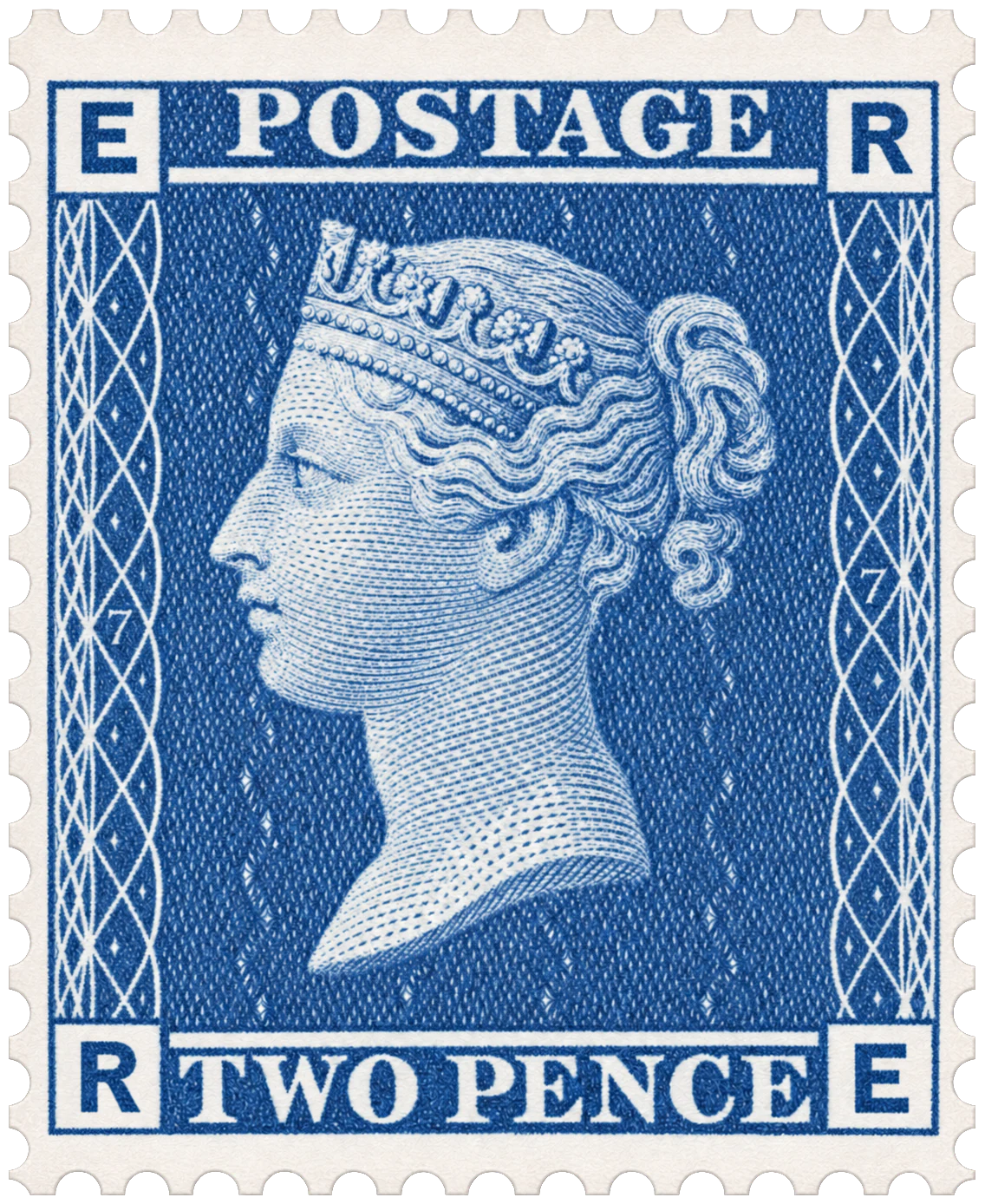
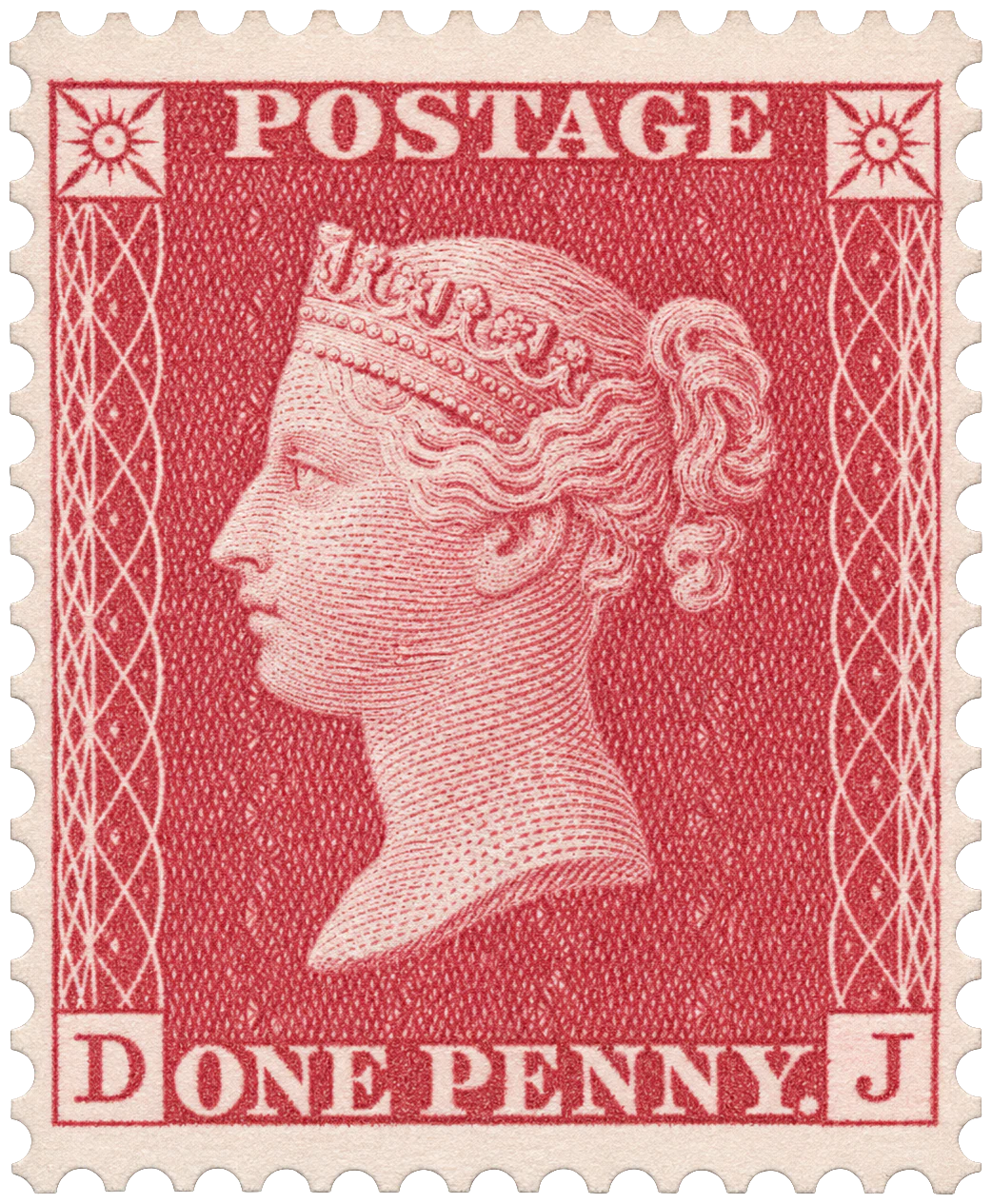
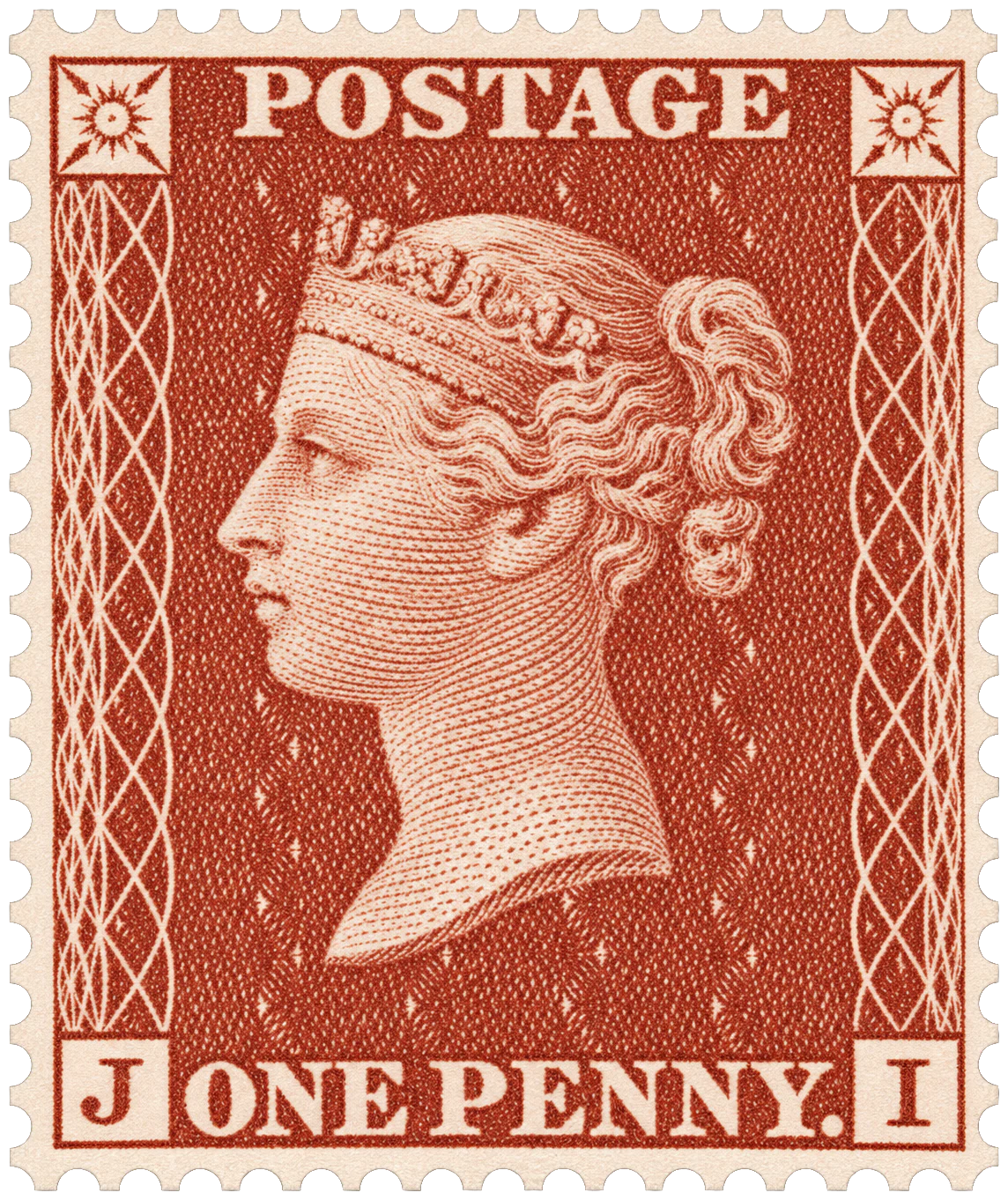
The Two Pence Blue was redesigned in 1858 to combat fraud. Its upper stars gave way to bold corner letters, while tiny numbers identified the printing plate. Victoria's portrait was also strengthened using William Humphrys's revised engraving. The thick white lines remained from the earlier design. This version introduced improvements that the Penny Red would not receive until 1864.
Stories
The blue stamp that led the way
The blue stamp that led the way
In July 1858, the Two Pence Blue appeared with four corner letters and numbers identifying its printing plate.
The change had been prompted by fears that dishonest people were joining uncancelled portions of used stamps to make apparently unused ones. The new markings were designed to expose such alterations. [8]
Rowland Hill announced the change in a circular to postmasters, explaining how to examine the lettering and plate numbers.
The two-penny stamp was the first of the line-engraved values to use the new design. The Penny Red would not follow until 1864.
The delay was practical rather than artistic. The authorities already possessed a large stock of older penny printing plates and were reluctant to discard them.
For six years, the blue stamp carried a security improvement that its more familiar red companion lacked.
The blue stamp carried four letters while the penny retained its upper stars.
Click either stamp to magnify
The new portrait borrowed from the Penny Red
The redesign involved more than replacing the upper stars with letters.
In April 1858, Perkins, Bacon & Co. prepared a new die for the Two Pence Blue, based on the improved Penny Red engraving introduced in 1855.
That earlier revision had been the work of William Humphrys, who strengthened the engraving after years of production had weakened the impressions. [8]
The printers adapted Humphrys's portrait for the two-penny value, retaining the familiar youthful image of Queen Victoria.
The result became known as Die II. The engraving was stronger than its predecessor, with more clearly defined shading around the Queen's face and hair.
An improvement originally made for the Penny Red had now given the blue stamp a second life.
The strengthened penny portrait provided the starting point for the revised blue design.
Click either stamp to magnify
Two printing plates that went wrong
Preparing a printing plate required more than reproducing a beautiful engraving. Every impression had to sit in precisely the right position for the perforating machinery.
Two plates prepared for the redesigned Two Pence Blue, numbered 10 and 11, failed this requirement.
The impressions had been laid down irregularly, making the plates unsuitable for production. Both were defaced on 23 June 1868, without being officially registered. [8]
The printers instead completed plate 12, which was approved in January 1868 and began work that October.
The abandoned plates represent a substantial investment of skilled labour. Hundreds of individual impressions had been transferred to steel, only for faults in their alignment to make the work unusable.
The plate that printed more than ninety million stamps
Plate 9 of the redesigned Two Pence Blue was registered on 14 March 1861 and put to press that same day.
It proved extraordinarily durable. The plate was withdrawn from the press on 28 October 1868, and defaced on 13 October 1869. It produced 383,500 sheets. Each sheet contained 240 stamps, giving a total of more than 92 million impressions. [8, 14]
The plate's long career contrasted with the unsuccessful attempts to manufacture plates 10 and 11.
A single piece of engraved steel had supported more than seven years of production, reproducing Victoria's portrait millions of times. [14]
The postmaster who spotted a clever fraud
In July 1857, J. R. Bettesworth, postmaster of Amersham, wrote to the Post Office with a warning. He believed dishonest people were joining together uncancelled portions cut from used stamps to create apparently unused ones.
Bettesworth suggested putting identifying letters in all four corners, rather than only the lower two. He enclosed a drawing showing how the arrangement might work. [8]
Rowland Hill improved the proposal by reversing the lower letters in the upper corners, giving every stamp in a sheet its own combination.
The new system appeared on the Two Pence Blue in July 1858.
An observant provincial postmaster had helped bring about one of the most recognisable changes to Victoria's postage stamps.
The printer who worried about extra work
The idea of adding four corner letters was not entirely new.
Rowland Hill had consulted Perkins, Bacon & Co. about a similar proposal in August 1852. J. B. Bacon supported the idea, but warned that it would increase the work of preparing each printing plate.
The upper ornaments would have to be removed, and hundreds of additional letters punched individually into the steel. Bacon estimated another two and a half to three days of work per plate, possibly requiring an extra employee. [8]
The proposal was postponed.
By 1858, the security benefits outweighed the inconvenience. The printers adopted the system, turning a suggestion that had once seemed too costly into an established feature of British stamps.
Why do some stories appear on several pages?
Every page is written to make sense on its own. Visitors often arrive directly at a particular stamp or subject, without having explored the rest of the site.
Some stories are relevant to several stamps, so they are repeated where they help explain what you're looking at. For those exploring a series, the details specific to each stamp generally come first, with the more familiar stories further down the page.
This way, you can explore the site in any order without missing interesting background.
Four corner letters and tiny plate numbers gave the Two Pence Blue a new defence against fraud. Explore its thick white rules, bolder lettering and strengthened portrait of Victoria. [15, 16]
Perkins Bacon was a London security printer. Its engraved stamp production combined the preparation of steel plates with the repeated inking, wiping and pressing of sheets.
On this stamp
Perkins, Bacon & Co. printed the 1858 Two Pence Blue with thick white lines from engraved steel plates. Its four corner letters and small plate numbers were incorporated into the printed design.
William Humphrys trained in Philadelphia and engraved banknotes before working in London. His career included book illustration and the fine steel engraving used for security printing.
On this stamp
The 1858 Two Pence Blue with thick white lines inherited the Die II portrait adapted for twopence in 1858 from William Humphrys’s revised penny die. This credits his earlier portrait revision, not a separate commission to engrave this issue.
William Wyon was a medallist and engraver at the Royal Mint. His models of royal heads were made for coins and medals and also became sources for stamp portraits.
On this stamp
Wyon’s City of London medal supplied the youthful likeness inherited by the 1858 Two Pence Blue with thick white lines. His medal portrait is distinct from the later stamp engraving and security markings.
Henry Corbould was a draughtsman and book illustrator. He trained with his father and at the Royal Academy Schools, where he received a silver medal for a life study.
On this stamp
Corbould’s drawing after Wyon’s medal helped prepare the original stamp portrait inherited by the 1858 Two Pence Blue with thick white lines; it was not a new drawing commissioned for this issue.
Charles Heath was an engraver and publisher of illustrated books. Work from his workshop could carry his signature even when assistants had contributed to the engraving.
Frederick Heath, Charles Heath’s son, was an engraver working in the family’s illustrated-book business. His surviving prints include engraved interpretations of other artists’ paintings.
On this stamp
The 1858 Two Pence Blue with thick white lines retains an inherited portrait engraving attributed to Charles Heath or Frederick Heath; their individual roles remain unresolved. Humphrys’s documented later revision is distinct from this original work.
The country identifies the postal authority that issued the stamp. The monarch identifies the ruler whose portrait it carries. A definitive is an everyday stamp intended for regular postal use.
On this stamp
The thick-rule Two Pence Blue belongs to Great Britain’s ordinary Victorian postage stamps. It continues the youthful left-facing portrait used in the line-engraved series.
The denomination is the stamp’s face value: the amount of postage it represents. Its price to a collector can be quite different.
In Britain’s old currency, 12 pence made one shilling and 20 shillings made one pound: 240 pence altogether. The abbreviations were d for pence, s for shillings and £ for pounds. The d comes from the Latin denarius. A halfpenny, written ½d, was half an old penny.
On this stamp
The TWO PENCE inscription gives a value of two old pence. Six such stamps made one shilling.
A shade is a variation within a stamp’s colour. Some variations receive their own catalogue numbers even though the design and denomination stay the same.
Compare known examples under consistent lighting. Fading can change a stamp’s appearance, and photographs or screens can alter how colours look. A catalogue colour name helps describe a shade; it is not a colour test by itself.
On this stamp
This plate 7 reconstruction represents the blue thick-rule issue. The period account describes deep blue shades; its white rules and letters are unprinted paper.
Registration approved a printing plate and preserved an official impression. Putting the plate to press began production; public issue followed when stamps reached the counter. A dated cover establishes use by that day, without necessarily giving the first day of sale.
The four-letter twopenny entered general circulation in July 1858. The penny followed on 1 April 1864, although its first usable four-letter plates had been registered in March 1861. Existing stocks of the earlier penny plates delayed the change.
For the thin-line twopenny, Wright and Creeke record plate 13 going to press on 13 April 1869 but could not establish the exact issue date. Their suggestion of an April release is qualified; later accounts place the change in July. The secure common year is 1869.
On this stamp
The four-letter, thick-rule twopenny entered general circulation in July 1858. Plate 7 had been approved in June and went to press on 19 July; its printing date is not presented as an exact first day of public sale.
The four-corner-letter issues continued the familiar line-engraved penny and twopenny designs. Their new security markings were introduced on the blue twopenny in 1858 and the red penny in 1864. The later blue twopenny, introduced in 1869, retained them while changing the width of its white horizontal rules.
Each stamp has a pair of lower check letters repeated in reverse above, together with a tiny plate number on both sides of the portrait. The letters locate one impression within a sheet; the numbers identify the plate that printed it. A postmaster could compare these marks when a stamp seemed to have been pieced together from used fragments.
These three articles cover design families with many individual printings. Their dates identify the introduction of each type, rather than the printing date of every plate or shade represented by it.
On this stamp
This thick-rule Two Pence Blue belongs to the family with reversed corner-letter pairs and a plate number at each side. The set groups the 1858 twopenny, 1864 penny and 1869 twopenny design changes.
On the blue twopenny, two unprinted horizontal strips separate the portrait area from the POSTAGE tablet above and TWO PENCE below. They appear white because the paper shows through. They were not added in white ink.
The 1858 four-letter twopenny has broad rules and was printed from plates 7, 8, 9 and 12. The later version has narrower rules and comes from plates 13, 14 and 15. The Penny Red has neither of these white strips: its denomination tablets meet the engraved background differently.
Rules need to be read together with the corner design. An earlier thin-rule twopenny from plate 6 still has stars in its upper corners and belongs to the previous series. Thin lines alone do not identify the four-letter issue of 1869.
Ink, wear and the quality of an impression can change how strongly fine details appear. The combined design, plate number, paper and perforation provide a more dependable identification than one small feature on its own.
On this stamp
Plate 7 has the broad white rules below POSTAGE and above TWO PENCE. Its upper corners contain letters, separating it from earlier blue stamps with stars.
A stamp catalogue gives each listed issue a reference number. SG means Stanley Gibbons, the publisher of the catalogue used here. These numbers help collectors refer to the same issue; they are not serial numbers printed on individual stamps.
A range of numbers groups related entries. Colour, paper or perforation differences may account for separate listings within that range.
On this stamp
The recorded model is SG 45, plate 7, position RE. This identifies the thick-rule four-letter design; it is not a classification based solely on the shade of the reconstruction.
Perforation gauge describes the spacing of the holes over two centimetres. In a 14 × 14 measurement, the first number applies across the top and bottom, and the second down the sides. It does not mean that every edge has fourteen holes or teeth.
All three ordinary four-corner-letter issues were perforated 14. The perforations 16 and 14 found on earlier stamps with stars in their upper corners must not be carried forward as alternatives for this set.
Printing, gumming and drying came before the sheets were perforated at Somerset House. Small differences in alignment could leave a design off centre within its perforations. That is different from a new gauge.
An imperforate pair or sheet needs separate evidence: it may be a proof, an experiment or an issued error. Cutting the teeth off a normal stamp also makes straight edges, so a single trimmed example does not establish an imperforate variety.
Enlarged spacing diagram, not to scale. Match the spacing with a perforation gauge.Image information
Enlarged perforation spacing: fourteen equal intervals between hole centres span 20 millimetres. This is a schematic, not a ruler.
Credit
Stunning Stamps · 2026
On this stamp
The ordinary thick-rule Two Pence Blue is gauge 14 horizontally and vertically. There is no grouped gauge alternative on this article. The earlier Stars series’ gauge-16 alternatives remain on their own canonical pages.
Line engraving is a form of recess, or intaglio, printing. The lines that carry ink are cut below the surface of a metal plate. After inking the plate, the printer wipes the flat surface clean, leaving ink in the engraved grooves.
Damp paper is pressed firmly against the plate and takes up the ink from those grooves. The fine coloured lines form the image; the spaces between them leave the paper visible. This differs from surface printing, where the raised parts of the printing surface carry the ink.
A transfer roller repeated the design from the die across a steel plate. The corner letters were added separately to each position. Printing, gumming and drying preceded perforation: punching the holes was a separate operation from making the coloured image.
Enlarged cross-section. Engraved lines hold the ink; the surrounding surface is wiped clean before printing.Image information
Side view of recess printing: ink remains in grooves below the plate surface and pressure brings paper into contact with it.
Credit
Stunning Stamps · 2026
On this stamp
Perkins Bacon printed this twopenny in one blue ink from an engraved steel plate. The pale parts of the design are areas of paper between the inked lines. Printing preceded gumming, drying and perforation.
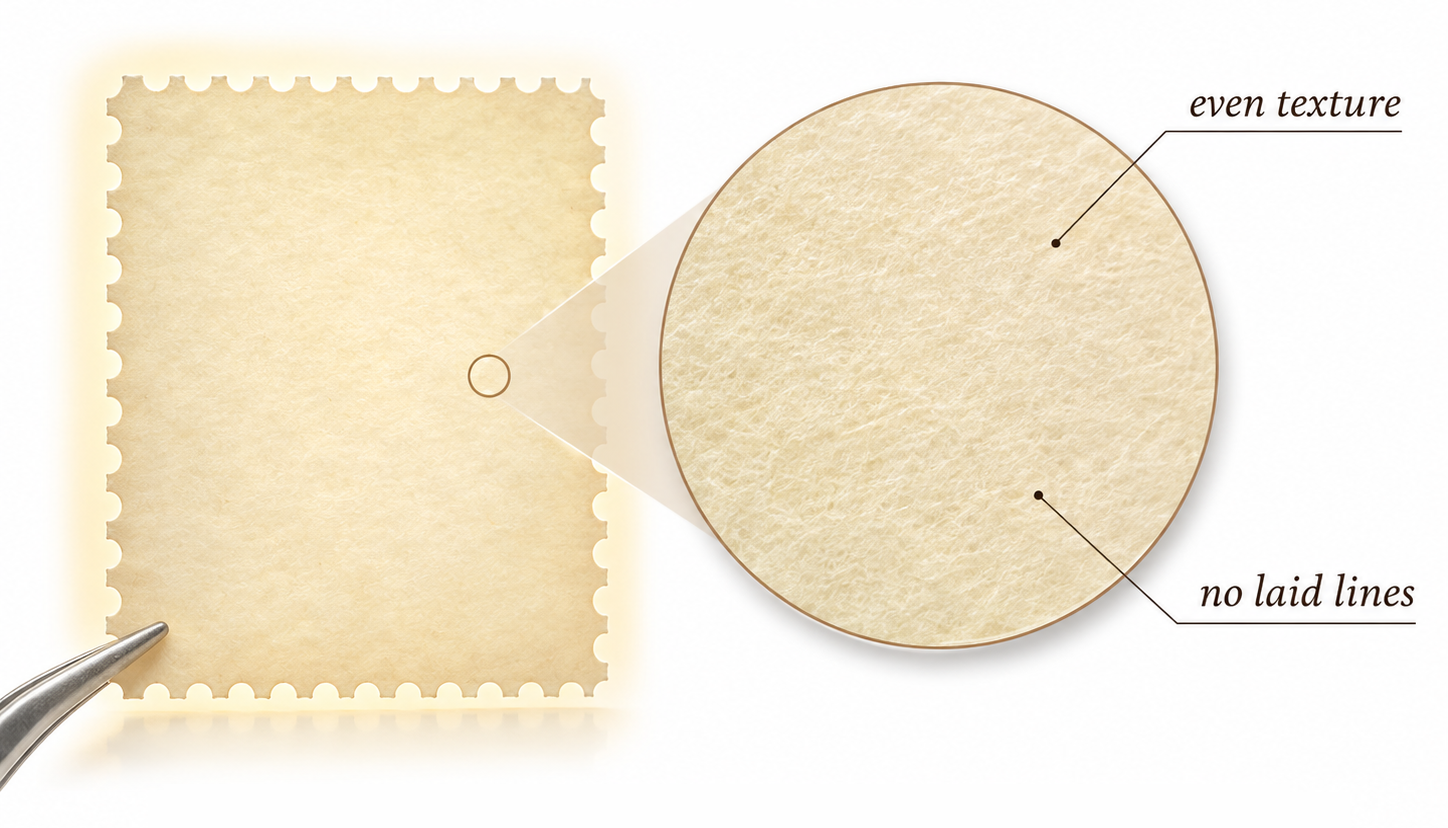
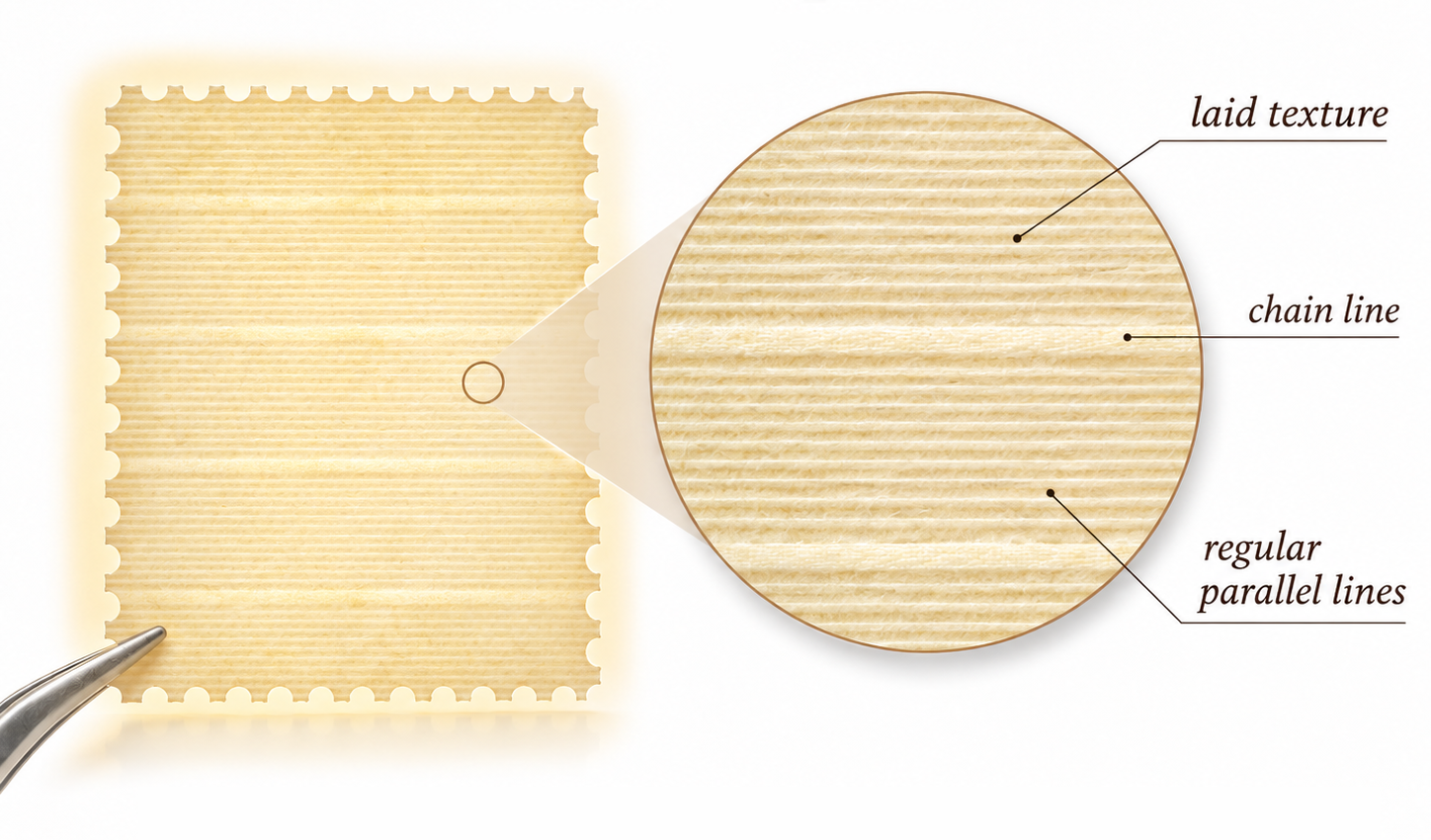
Wove describes the structure of the paper. Viewed against the light, it has a fairly even appearance. Laid paper instead shows a regular pattern of lines left by its manufacture.
Paper structure and watermark are separate characteristics: wove paper can carry a watermark. Both can help distinguish stamps with similar printed designs.
The line-engraved issues used handmade wove paper from Rush Mills. Its even texture should not be confused with machine manufacture. A watermark pattern attached to the papermaking mould left thinner areas in the sheet as the fibres settled.
Thickness could vary between sheets. The period account explains that thicker or thinner sheets were included to bring a ream to the contracted weight. Paper thickness, a watermark variety and a change of printing ink are separate features.
Wove paper: even texture without laid lines.Image information
Click image to magnify
Diagram of wove paper with a magnified inset showing an even texture without laid lines.
Credit
Stunning Stamps · 2026
Notes
Digitally constructed
Laid paper: regular parallel lines, shown for comparison.Image information
Click image to magnify
Diagram of laid paper with a magnified inset showing regular parallel lines.
Credit
Stunning Stamps · 2026
Notes
Digitally constructed
On this stamp
This thick-rule Two Pence Blue used the handmade wove paper of the line-engraved series. Its paper structure is distinct from the Large Crown watermark and from the blue printing ink.
A watermark is a pattern within the paper, made by leaving less fibre at selected points. The Large Crown sheet supplied a crown for each stamp position. It is distinct from the Small Crown of earlier issues and from the Imperial Crown used much later for Edward VII.
The Large Crown design was modified in 1862 by omitting two short vertical lines. Collectors distinguish the earlier and later forms as types I and II. That change belongs to the paper, while Die II describes an engraved portrait: the two uses of the word type or die should not be merged.
The thick-rule twopenny spans the change: plates 7 and 8 belong to the earlier paper, plate 9 occurs across the transition and plate 12 uses the later form. The four-letter Penny Red and thin-rule twopenny use the later Large Crown paper.
A crown may be faint, displaced or inverted. Its orientation and exact form require the original paper. The front-view illustration identifies the design represented here, without showing a particular watermark impression.
On this stamp
Plate 7 belongs to the earlier Large Crown paper. The thick-rule issue continued across the paper change: plate 9 occurs with both forms and plate 12 with the later type. No crown orientation is inferred from the reconstructed face.
The gum was the coating that attached a stamp to the letter. Perkins Bacon printed on damp paper, then gummed and dried the sheets. This sequence differed from De La Rue’s surface printing on paper already coated with gum.
The line-engraved stamps used British Gum, a starch preparation to which gelatine had been added from the middle of 1855. The period account describes gum ranging from pale to brownish; the colour alone is not a new stamp design.
In June 1864 the penny and twopenny began receiving two coats, initially as a one-year trial to improve adhesion. The practice continued. The thick-rule twopenny therefore spans both the earlier and later gumming arrangements.
Original gum, a hinge mark and a later replacement coating concern the back of the surviving object. They cannot be determined from the printed face or from this reconstruction.
On this stamp
The thick-rule issue began before the June 1864 double-gumming change. Its early plate 7 model therefore belongs to the earlier period; the later practice applies to subsequent production within the same design family.
The printing plate carried 240 impressions arranged in twenty horizontal rows of twelve. They formed one uninterrupted pane, without a gutter dividing the stamps into smaller blocks. The printed sheet was also the post-office sheet.
The repeated design came from a transfer roller, but the letters were inserted separately into each position. Reading those letters allows a detached stamp to be placed back within the original twenty-by-twelve arrangement.
The margins surrounded the whole pane and carried prices, instructions and production marks. They are additional to the 240 stamp positions. A block of four cut from the sheet is a surviving part of that pane, not evidence of a four-stamp printing unit.
On this stamp
The thick-rule Two Pence Blue was printed in a single pane of 240. Its lower-left letters run A–T down twenty rows, and the lower-right letters A–L across twelve columns.
There were twelve old pence in a shilling and twenty shillings in a pound. Twelve penny stamps therefore made a one-shilling row, and twenty rows made a sheet worth £1.
For the twopenny, the same arrangement doubled the totals: two shillings per row and £2 for all 240 stamps. The denomination changed the money represented by the sheet, without changing its number of impressions.
The figures in the sheet margins helped account for stocks and sales. They give the original postal face value, not a collector’s price. Individual stamps and smaller multiples could be separated from the sheet as required.
On this stamp
Twelve twopenny stamps made a row worth two shillings; twenty rows made £2. These are the postal face values of the original sheet.
Read the lower pair from left to right. The left letter gives the row, from A to T; the right gives the column, from A to L. The sheet begins AA at its upper left and ends TL at its lower right.
The upper corners repeat the lower pair in reverse. For a lower pair RE, the top reads ER: the same letters lie at diagonally opposite corners. This relationship helped expose a stamp assembled from mismatched pieces.
The letters were punched into the plate positions individually, using bold sans-serif capitals. They are neither the engraver’s initials nor an abbreviation for a town. Each plate repeats the same range of positions, so the letter pair needs the small side number to identify a particular plate position.
The individual note reads the reconstruction’s chosen letters. Other stamps of the same issue have other pairs, and a misplaced or altered letter on an original needs specialist comparison with the relevant plate.
On this stamp
The illustration has RE in its lower corners and ER above. R identifies row 18, and E column 5. These are this model’s letters; the issue contains the other positions of the 240-stamp sheet.
Each side border contains the number of the printing plate in tiny white figures. The number was added to the transfer roller before the design was repeated across the steel plate. The two numbers on one stamp were intended to agree.
A plate number and a check-letter pair answer different questions. The number identifies which plate printed the stamp; the lower letters locate its row and column. Together they let a collector compare the same position in different impressions.
Penny and twopenny plates had separate numbering sequences. A high number is not a year, and plate 13 of one denomination does not identify plate 13 of another.
Heavy ink, wear, a cancellation or a perforation cutting into the design can obscure a figure. Read both sides and compare their shapes before concluding that the number is unusual. The illustrated number represents the selected model, rather than every printing covered by this page.
On this stamp
The reconstruction shows plate 7 in both side borders, with lower letters RE. Together they identify its chosen plate position. The number is separate from the denomination and from any postmark.
Making a plate did not guarantee that it would print issued stamps. It had to be sound, its repeated impressions had to align with the perforating machinery, and it had to be needed for production.
The thick-rule twopenny used plates 7, 8, 9 and 12. Plates 10 and 11 were irregularly laid down and were defaced without registration. Thin-rule production used plates 13, 14 and 15; the first of these began printing in April 1869.
The ordinary four-letter Penny Red sequence runs from 71 to 225 with gaps. Plates 75, 77 and 128 were rejected; 126 was not made because its roller was defective. Plate 77 has exceptional surviving stamps despite its rejection, so it must not be described as an ordinary approved printing. Plates 226–228 were prepared but never put to press.
Registration and press dates also explain why a design’s introduction cannot date every example. The first penny plates waited years after approval, while later plates supplied the same broad design over a long production life.
On this stamp
The thick-rule series used plates 7, 8, 9 and 12. Plates 10 and 11 were rejected because their impressions were irregularly laid down. The reconstruction represents plate 7, not a generic number for all four plates.
A complete sheet has a border outside the stamps. Its printed inscriptions gave the price per label, row and sheet, told the sender where to place a stamp, and warned against removing the adhesive when wetting it.
Plate numbers also appeared in the margins. Later plates carried a separate current number, a workshop sequence covering more than one denomination. A current number is therefore not a second reading of the tiny plate figures inside the design.
Guide marks helped with production and division of the sheet. Their arrangement changed as new plates were made: the early four-letter Penny Reds and later plates do not have identical marginal layouts.
These markings normally disappear when a single stamp is detached. The absence of a margin on an example leaves the plate number within the design and the corner letters as the more accessible position clues.
On this stamp
The early thick-rule plates carried marginal plate numbers in small circles. The later plate 12 arrangement also included a current number. The isolated plate 7 illustration shows no sheet margin.
A die is the original single engraving from which printing plates can be made. A new plate number does not necessarily mean that the portrait has been engraved again: many plates can descend from the same die.
The four-letter Penny Red retained the strengthened Die II portrait introduced in the earlier penny series. William Humphrys’s revision belongs to that earlier work. Replacing the top stars with letters and adding plate numbers did not amount to a new portrait commission.
In April 1858 a new twopenny die was made from the penny Die II design with the necessary change of value. Both the thick-rule and thin-rule four-letter twopence descend from it. Their different white rules distinguish later preparation of the printing design, rather than a documented new artist.
The contributor drawers distinguish the medal likeness, Corbould’s drawing, the unresolved original Heath engraving credit and Humphrys’s revision. These are different stages in the image’s history.
On this stamp
Both four-letter twopenny designs descend from the die prepared in April 1858 using the penny Die II portrait. Humphrys is credited for the inherited revision, not for an undocumented new commission for this particular plate.
An essay proposes a design. A die proof tests the single engraving; a plate proof tests its repeated impressions. A registration or imprimatur sheet records official approval. These objects served different purposes from stamps sold for letters.
Registration could precede general issue by years. Before 1889 several impressions were normally taken when a plate was approved; one was retained in the official record and spare sheets could enter stock. A registration date should therefore be read as a production record, rather than automatically as the date of public introduction.
The black Royal Reprints made in 1865 came from the earlier penny plate 66, with upper stars and Large Crown paper. They are not black printings of the four-letter Penny Red and are not original Penny Blacks of 1840.
A SPECIMEN marking identifies reference material rather than ordinary postal use. Paper, plate, marking and provenance must be considered together. An unusual colour or a straight edge alone does not establish the purpose of an impression.
On this stamp
Plate 7’s registration preceded the July 1858 public introduction. An official registration impression is evidence of approval, rather than an ordinary mint example with a different perforation gauge.
An ordinary perforated issue can have an exceptional sheet that missed the perforating machine. That is an error in finishing, not a second routine perforation gauge. An imperforate proof or experimental printing may look similar but has a different origin.
For the Penny Red, an imperforate sheet from plate 116 reached the Cardiff Post Office in January 1870. Wright and Creeke also describe plate 121 impressions on chemically treated paper as experiments, which should be kept separate from the Cardiff issue.
For the later twopenny, their reported imperforate plate 13 impressions came from chemical-paper experiments and were not intended for issue. This evidence does not establish an ordinary imperforate companion to the thin-rule stamp.
A convincing identification needs sufficient margins or adjoining stamps, the correct plate and paper, and provenance. A trimmed perforated stamp cannot demonstrate an imperforate error. None of these exceptional objects changes the normal 14 × 14 gauge of the articles in this set.
On this stamp
This article represents the normal gauge-14 plate 7 issue. Any proposed imperforate example needs its own evidence; the later plate 13 chemical-paper experiment cannot establish an alternative for the thick-rule issue.
A used stamp might have only part of its face covered by the cancellation. Joining clean portions from different stamps could create an apparently unused label. The four letters and repeated plate number gave postmasters specific features to compare when examining a suspected alteration.
The July 1858 circular instructed them to check the reversed arrangement of the corner letters and whether the numbers on the two sides agreed. The twopenny introduced the arrangement first; the penny followed after the old stock of plates could be set aside.
These marks strengthened an existing design rather than adding a new charge. The small plate figures and large check letters were printed with the portrait, while the cancellation was applied later in postal use.
A mismatch on a surviving object needs investigation. It can involve a difficult reading, an alteration or a damaged impression; the circular explains the intended security check, rather than certifying any particular unusual stamp.
On this stamp
For this illustration, RE below is reversed to ER above, and plate 7 appears on both sides. These are the relationships the 1858 circular told postmasters to inspect on a suspected composite stamp.
The printed design paid postage; a cancellation marked it as used. The check letters and plate numbers were already on the sheet before sale. They should not be read as part of the later postal marking.
A dated envelope can connect a stamp with a place, route and time of use. A loose stamp may retain only part of the postmark, so it provides less evidence about the journey or the charge paid.
The four-letter system addressed attempts to reuse uncancelled pieces. Reading the cancellation alongside the security marks can help distinguish ordinary wear and ink coverage from a suspicious join.
Postal use, an official reference marking and the absence of a cancellation describe different states. The clean face of the reconstruction does not establish original gum or the condition of a surviving unused example.
On this stamp
The check letters RE and plate number 7 are part of the printed thick-rule Two Pence Blue. A postal cancellation would be applied later; a dated cover could establish use, but could not by itself date the first printing.
A denomination gives the amount of postage purchased. The service, weight and date decide what that amount could pay for. Several stamps could be combined to make a higher charge.
At the introduction of these designs, an ordinary prepaid inland letter cost 1d up to ½oz, or 2d above ½oz and up to 1oz. From 5 October 1871, 1d covered up to 1oz and 2d covered above 2oz up to 4oz.
A cover’s date and contents therefore matter. The same penny or twopenny design could serve a different weight band later in its life. These examples concern inland letters; overseas routes and other services require their own rate evidence.
On this stamp
At the 1858 introduction, 2d paid an ordinary prepaid inland letter weighing over ½oz and up to 1oz. Larger weights and other services required their own charges.