
The design of the 2d blue · Thin white lines
Queen Victoria · Great Britain · Perkins, Bacon & Co. · 1869
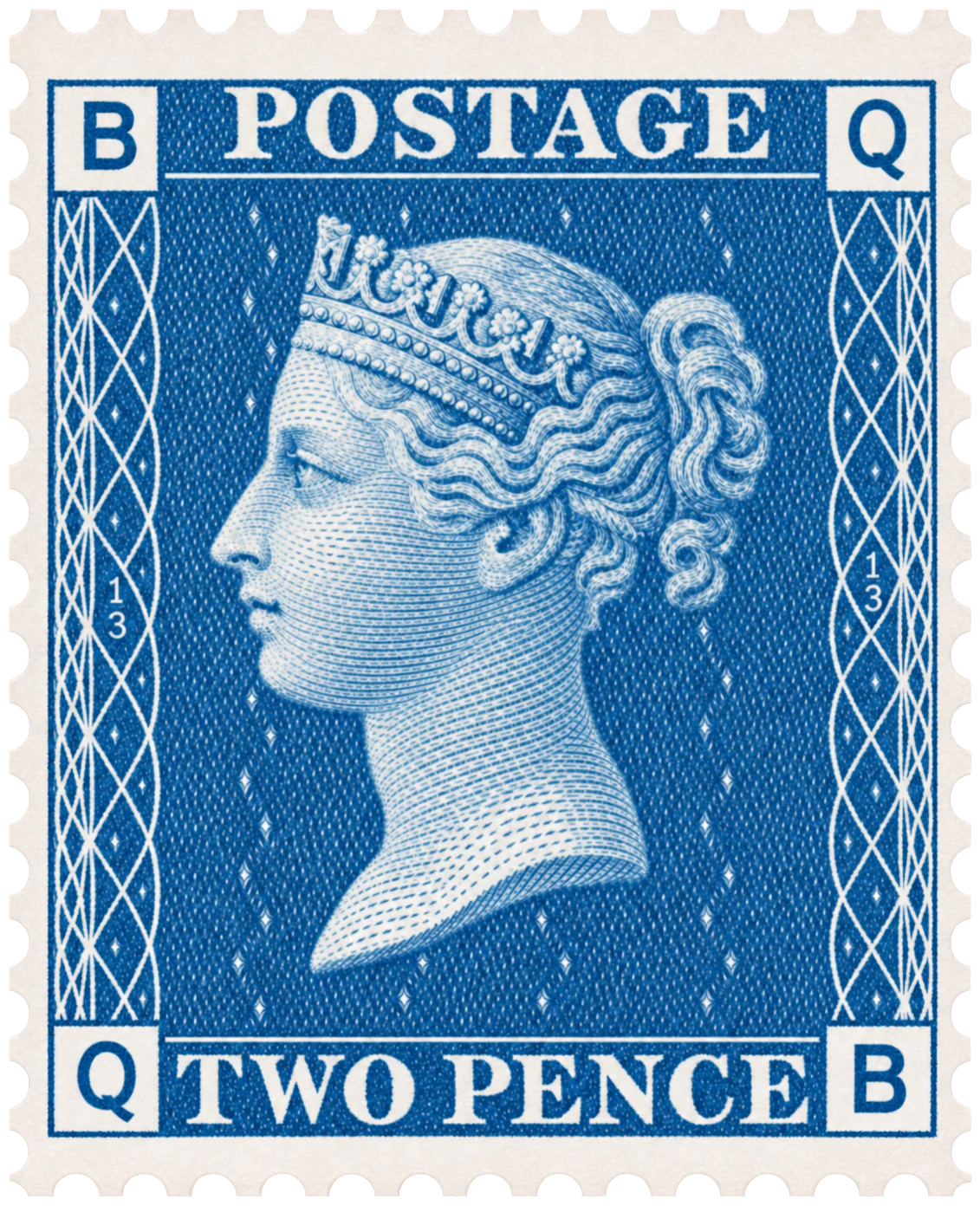
The white lines become thinner again
The most obvious difference between the 1858 and 1869 Two Pence Blues is the thickness of the two white horizontal lines.
One lies beneath POSTAGE, the other above TWO PENCE. Both became noticeably thinner when plate 13 entered production in 1869. [1]
The alteration was made when preparing the transfer roller used to create the new printing plates. Plates 13, 14 and 15 were all produced with the thinner lines.
The change did not affect Victoria's portrait or the surrounding decorative framework.
It was a small adjustment, but one that gives the later printing a visibly different appearance when placed beside its predecessor.
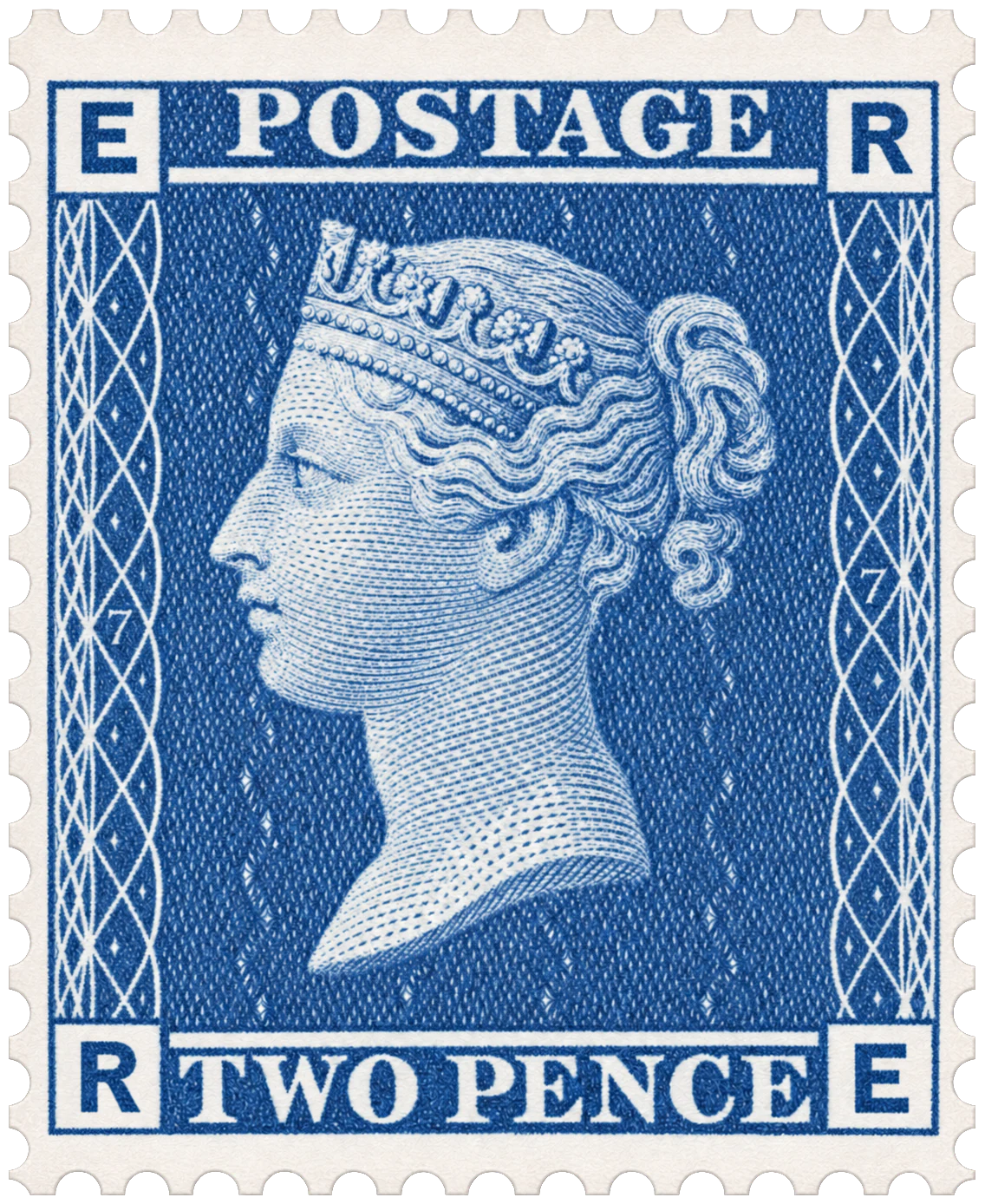
Compare the white lines beneath POSTAGE and above TWO PENCE.
Click either stamp to magnify
An old security feature with a new appearance
The white lines had originally been introduced in 1841, when the Post Office adopted a revised blue printing ink.
The purpose was to distinguish the new stamps from those printed in the earlier ink. The revised preparation was intended to be damaged by attempts to remove postal cancellations. [1]
By 1869, the lines had been part of the Two Pence Blue for nearly three decades.
The decision to make them thinner did not represent a documented new change in ink chemistry. The surviving accounts describe a modification to the engraved design, without establishing why it was made.
The lines therefore retained the appearance of an old security feature, even though their original purpose belonged to a much earlier stage in stamp production.
The portrait that needed no further changes
The 1869 Two Pence Blue retained the Die II portrait introduced in 1858.
That engraving had been adapted from William Humphrys's revised Penny Red die. Humphrys strengthened the original lines to improve the durability of the printing plates, while preserving Victoria's familiar appearance. [2]
For the thin-line issue, the printers continued using this established portrait. The change was confined to the horizontal rules.
Victoria's youthful likeness therefore survived another alteration to the stamp without requiring a new engraving.
The tiny plate numbers remain
The small white figures in the patterned borders identify the printing plate.
For the thin-line stamps, these numbers are 13, 14 or 15. They appear on both sides of Victoria's portrait, almost concealed within the engine-turned framework. [2]
The numbers had originally been introduced in 1858 as an additional precaution against fraud. Officials had considered placing coloured numerals in white panels, but rejected the idea because it spoiled the appearance of the stamp.
The alternative was to engrave tiny white numbers directly into the patterned border.
The later Two Pence Blue retained this discreet solution, preserving security information without disturbing the overall composition.
Four letters and no stars
The upper corners of the 1869 Two Pence Blue contain letters rather than the star-like ornaments used on earlier stamps.
The letters in the lower corners identify the stamp's position on the printing sheet. Those above repeat the same pair in reverse order. Thus, a stamp with Q and B below has B and Q above. [2]
The arrangement was intended to expose attempts to assemble fraudulent stamps from uncancelled pieces of used examples.
It had been introduced on the Two Pence Blue in 1858 and was retained unchanged in 1869.
The four corners provided a simple check that could be understood without specialised equipment.
Blue with a hint of violet
The later Two Pence Blue was not always printed in exactly the same shade.
Wright and Creeke recorded colours ranging from medium dull blue to very dark blue. Towards the end of production, some impressions developed a violet tinge. [2]
These variations reflected differences in the printing ink and production conditions rather than changes to the engraved design.
The colour could therefore shift while the portrait, lettering and fine white rules remained the same.
The last line-engraved Two Pence stamps retained their familiar blue identity, even as their shades varied.
A portrait of a fifteen-year-old princess
Victoria's portrait originated before she became Queen. William Wyon, Chief Engraver at the Royal Mint, created a medal commemorating her visit to the City of London in November 1837. Its portrait drew on a sketch made in 1834, when Victoria was fifteen. The medal was issued in 1838. [3]
Rowland Hill chose Wyon's portrait for the first postage stamps. Henry Corbould prepared a drawing from the medal, which became the basis for the engraving.
While Victoria grew older, her youthful likeness continued to appear on British postage stamps throughout her reign. [4, 5]
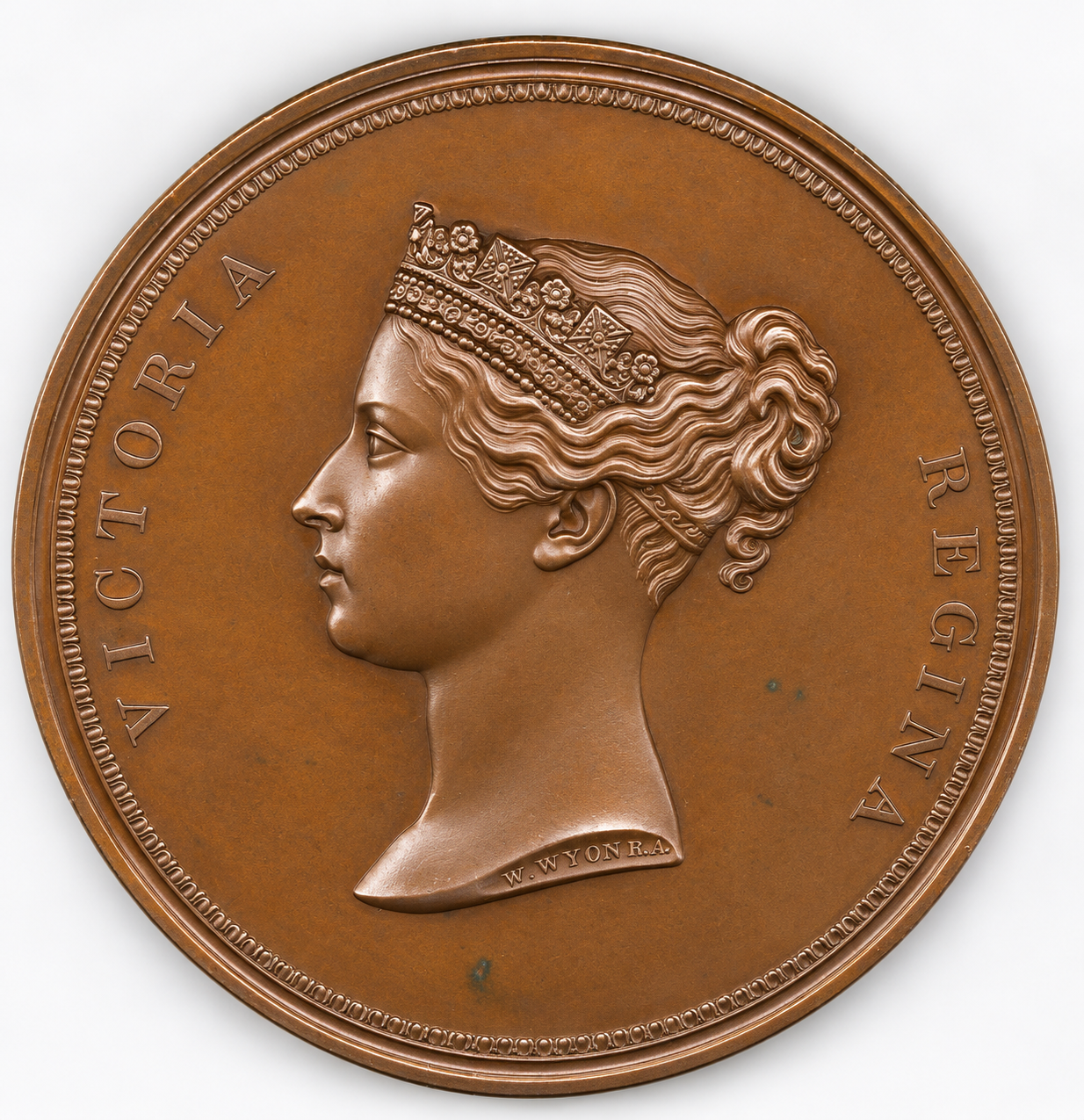
Image information
Click image to magnify
Bronze medal showing the young Victoria in left-facing profile, wearing the diamond diadem, with the inscription VICTORIA REGINA.
- Credit
- Heritage Auctions, via Wikimedia Commons. CC BY 3.0.
- Notes
- Brightness, contrast, sharpness and colour balance adjusted by Stunning Stamps.
The diamond diadem made for a king
The ornament in Victoria's hair was not made for her. The diamond diadem had been commissioned for George IV's coronation in 1821. [6]
It contains 1,333 diamonds, with crosses and the national emblems of the rose, thistle and shamrock. The diamonds were originally hired, but George IV kept them and paid more than £8,000. Queen Adelaide later wore the ornament.
Victoria wore the diadem in portraits, and Wyon included it in the image used for Britain's first postage stamps.
At stamp size, its elaborate jewels became tiny engraved marks. A magnificent royal ornament had become part of an everyday object worth two pence.
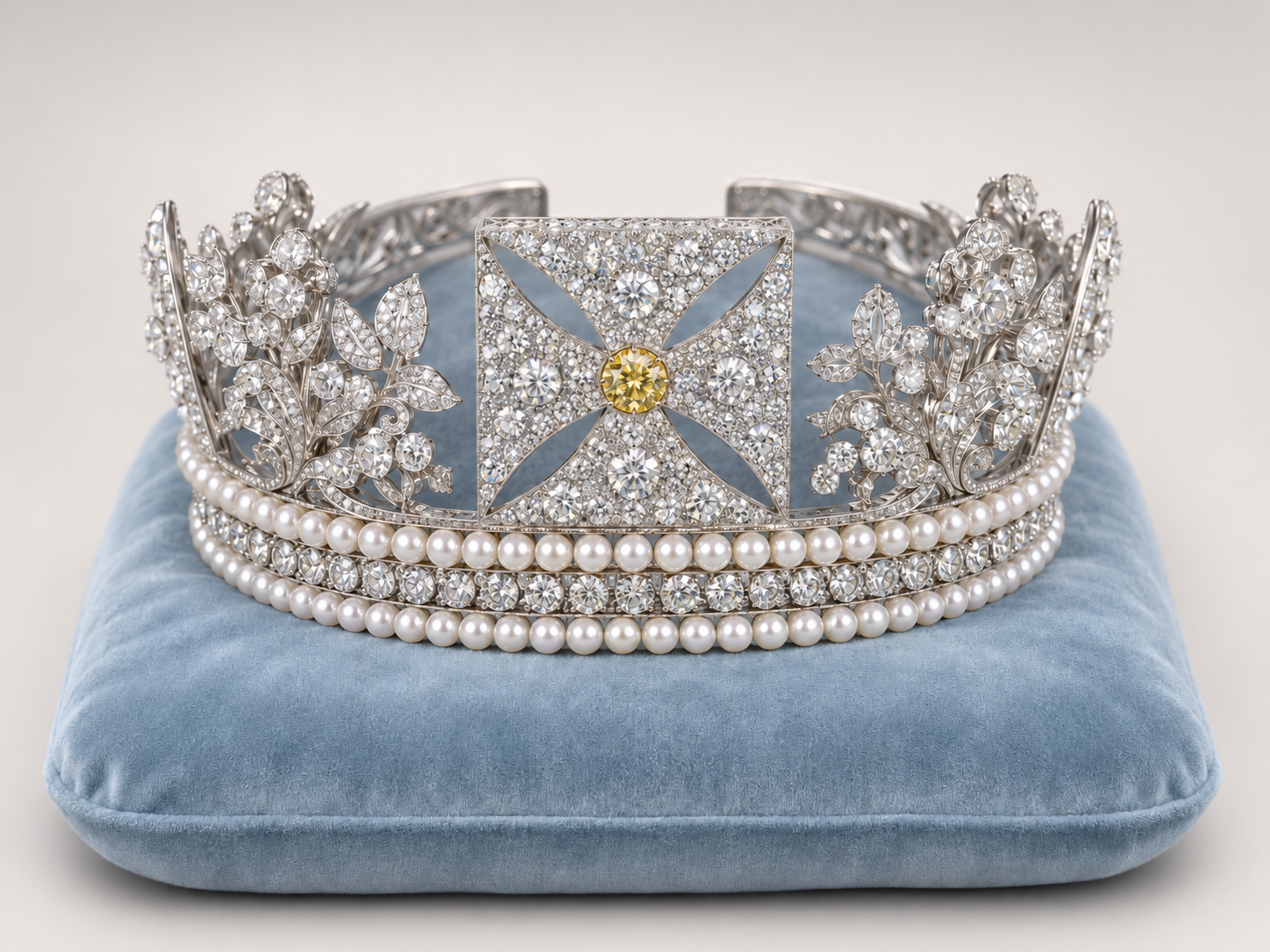
Image information
Click image to magnify
Digitally created illustration of the diamond diadem, with crosses, floral emblems and rows of pearls, resting on a blue cushion.
- Credit
- Stunning Stamps.
- Notes
- Digitally created.
Sources
- Fred J. Melville: Great Britain — Line-Engraved Stamps (1909), pp. 58–61
- Hastings E. Wright and A. B. Creeke: A History of the Adhesive Stamps of the British Isles (1899), pp. 53–56
- Douglas N. Muir, Royal Mint Museum: William Wyon & the Penny Black
- Heritage Auctions, William Wyon medal photograph, via Wikimedia Commons (enhanced for display)
- Wyon medal photograph: Creative Commons Attribution 3.0 licence
- Royal Collection Trust: George IV's Diamond Diadem
