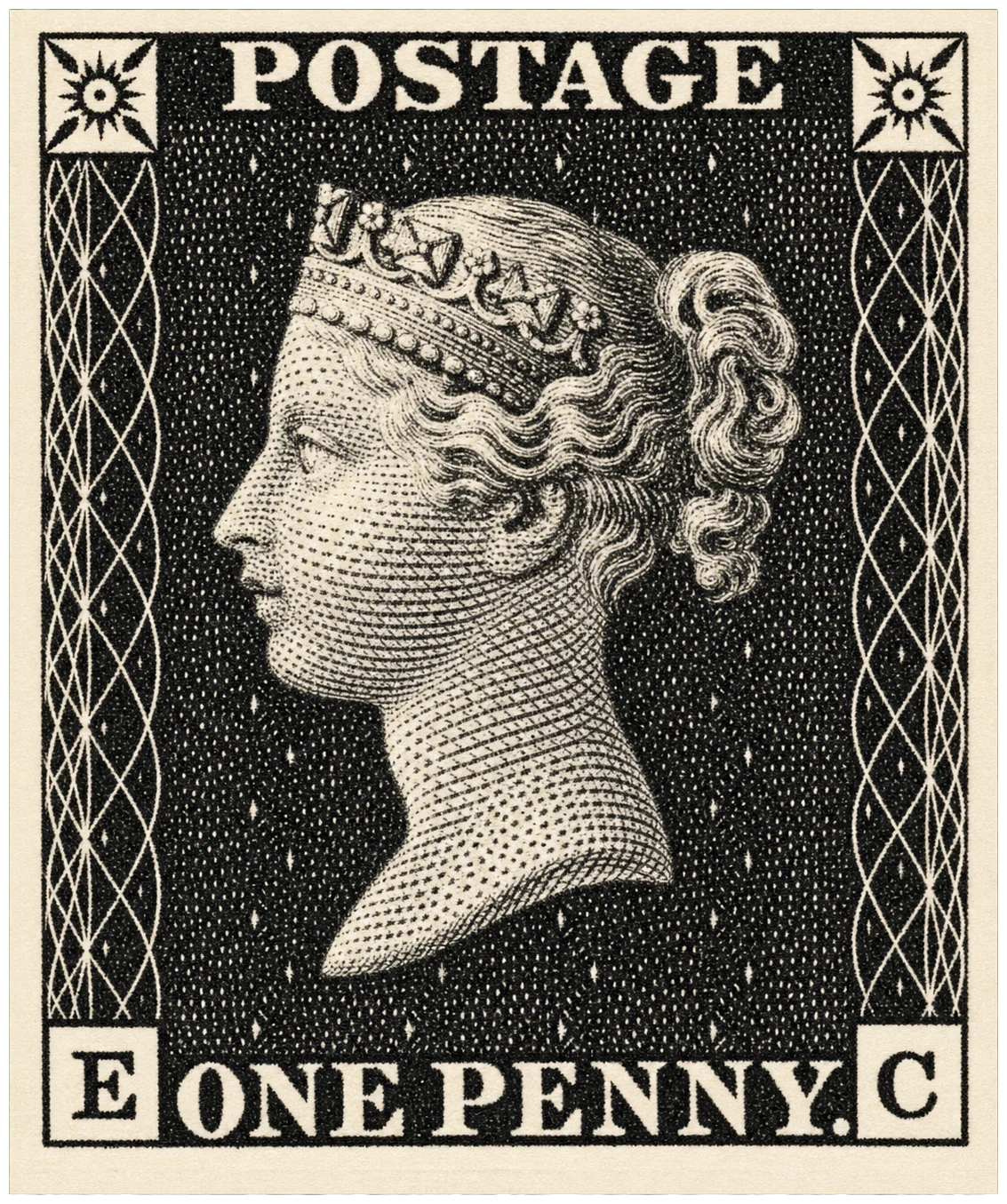
A small portrait of Victoria could now show that a letter’s postage had been paid. Valid from 6 May 1840, the Penny Black was the world’s first adhesive postage stamp. It joined a postal reform already under way: a penny carried an ordinary prepaid inland letter weighing up to half an ounce, regardless of distance. [1, 2]
Stories
2,600 ideas, no winning design
A competition with 2,600 ideas — but no winning design
In 1839, the Treasury invited the public to suggest ways of paying postage in advance. More than 2,600 proposals arrived. Some were written explanations, others included drawings and experimental designs. John Little even proposed a booklet containing 1,000 stamps, anticipating a familiar way of buying postage long before stamp booklets became commonplace. [10]
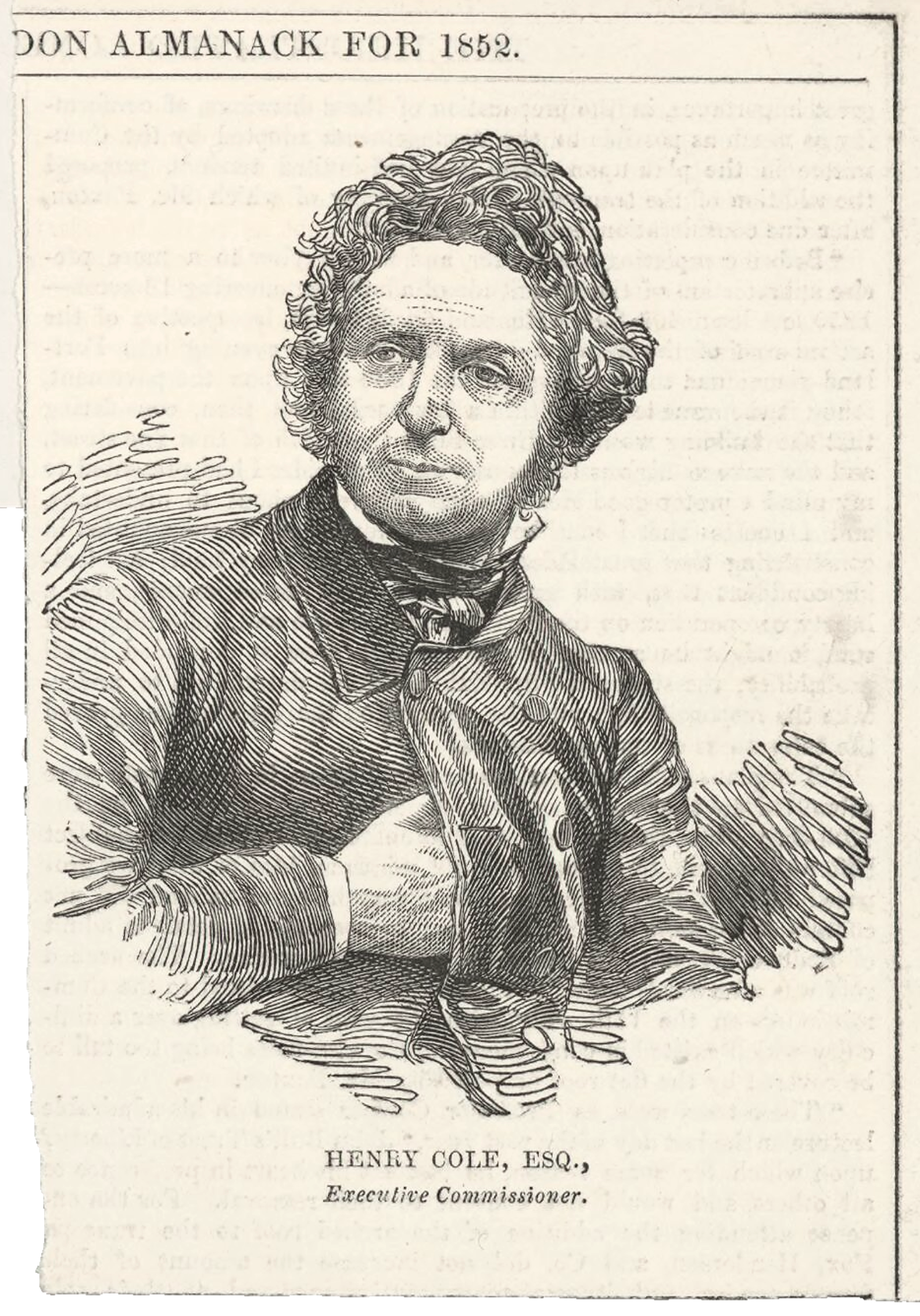
Rowland Hill and his assistant Henry Cole examined the entries. Four received prizes of £100 each, but none of the winning designs resembled the eventual Penny Black. The design that changed postal history emerged instead from Hill's preference for a royal portrait and the skills of specialist security printers. [10, 11]
Henry Cole, who helped review the 1839 proposals, pictured in 1852.Image information
Click image to magnify
Engraved portrait of Henry Cole standing in a dark coat.
Credit
Unidentified engraver, Henry Cole, Esq., Executive Commissioner (1852), National Library of Wales, via Wikimedia Commons. Public domain.
Rowland Hill is remembered as the father of the Penny Black, but his elder brother Edwin had an important job behind the scenes. An engineer and inventor, Edwin took responsibility for obtaining the specially watermarked paper needed for the new stamps. [12]
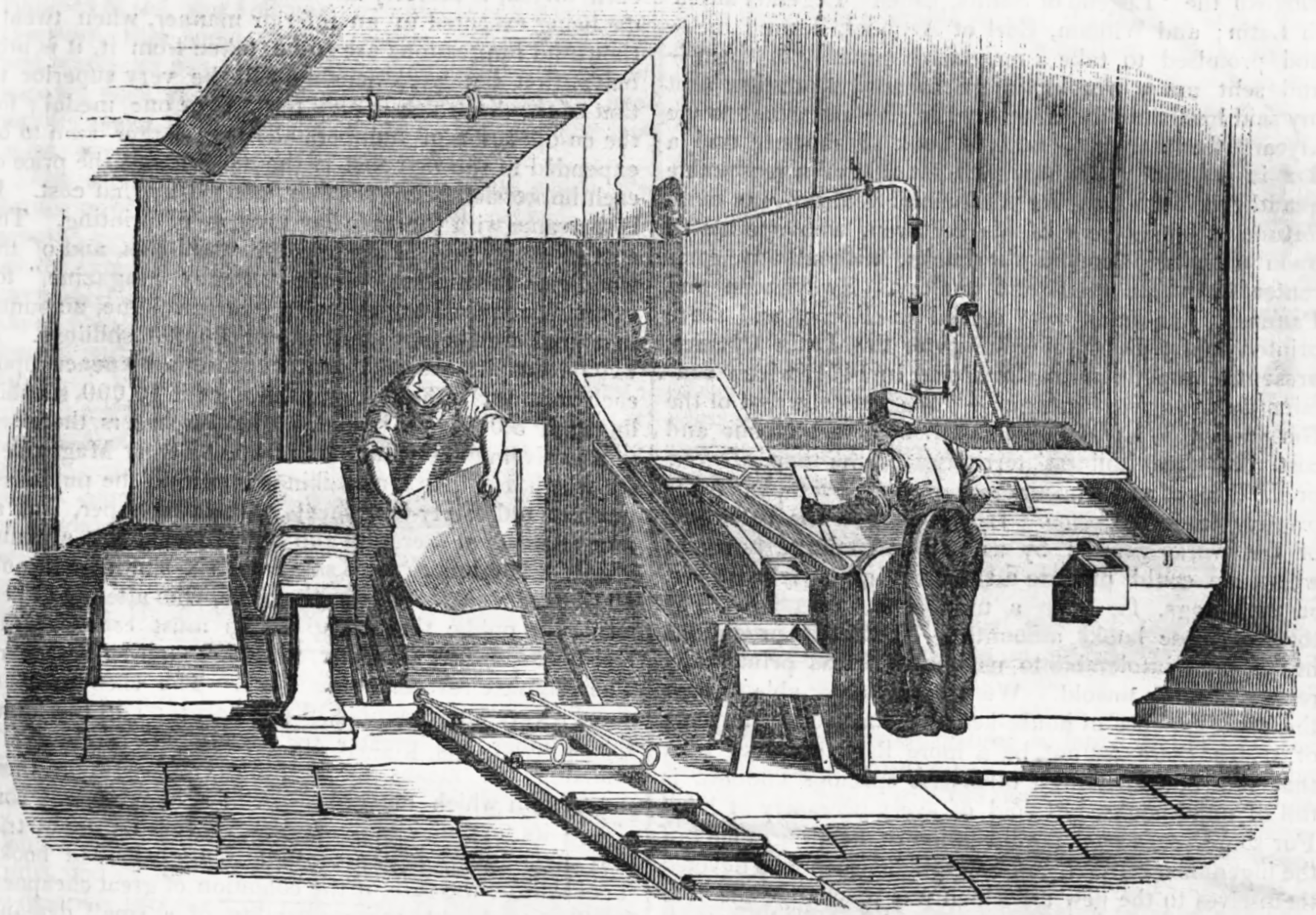
At Rush Mills near Northampton, Stacey Wise manufactured the paper by hand. Each sheet needed 240 small crown watermarks, one beneath every stamp. The crowns were made from pieces of brass wire, individually shaped and stitched to the papermaking mould. Their impressions became part of the paper as it was formed.
The printed portrait might attract attention, but the hidden crowns were another part of making the stamp trustworthy. Edwin's contribution was less visible than his brother's, yet the success of the new postage stamp depended on work like his. [12]
Hand papermaking in 1833. This is not a view of Rush Mills.Image information
Click image to magnify
Woodcut showing workers making paper by hand among vats and frames.
Credit
Unidentified illustrator, Paper Making by Hand, The Penny Magazine, 28 September 1833; HathiTrust via Wikimedia Commons. Public domain.
Why a chemist who studied rocks helped make stamps
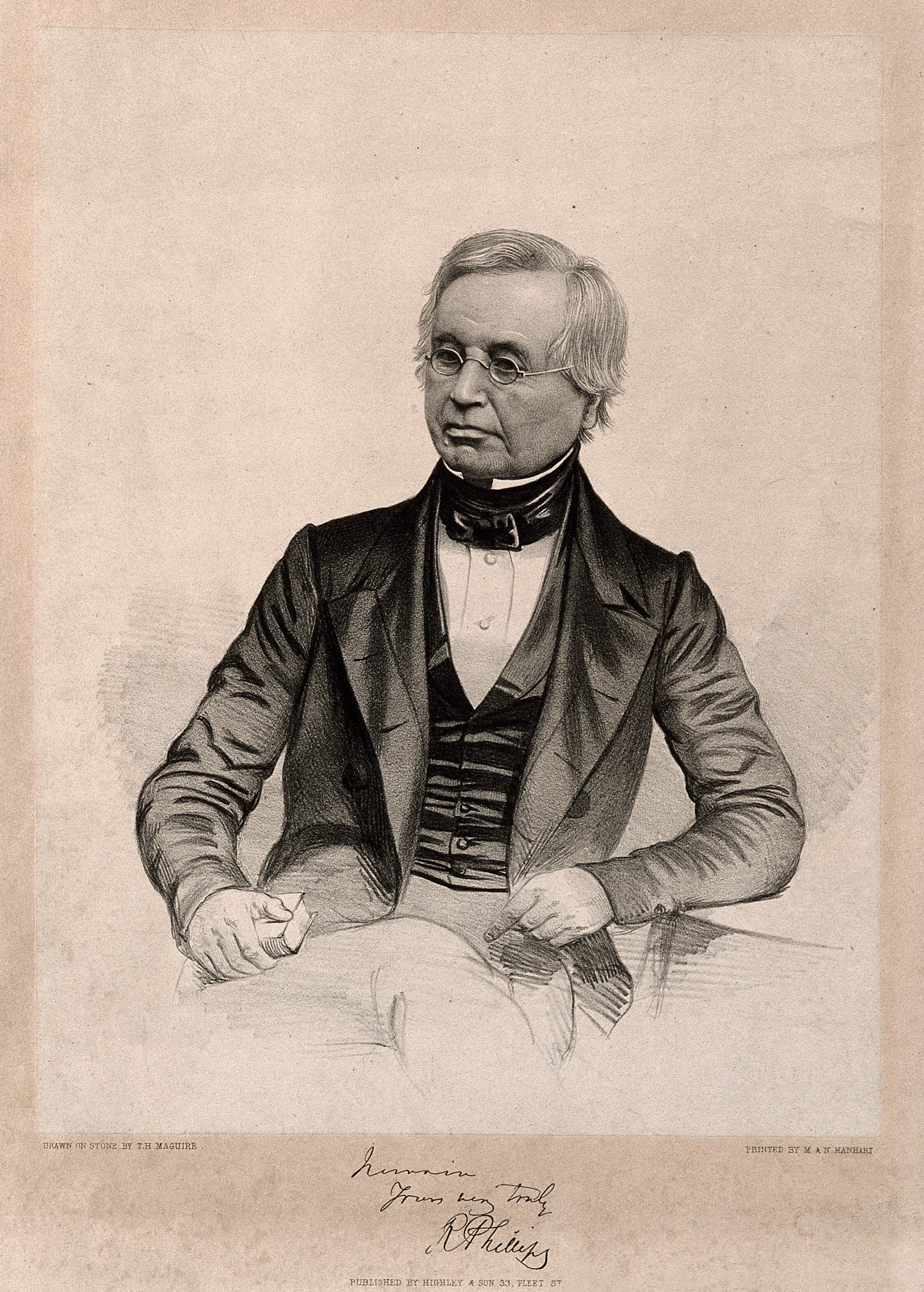
Richard Phillips was a chemist at London's Museum of Economic Geology. His ordinary work concerned minerals and other scientific materials, but Rowland Hill needed someone who could test the materials for an entirely new product: the adhesive postage stamp.
Early in 1840, Phillips examined samples of gum intended to make stamps stick to letters. He also investigated inks and methods of removing postal cancellations. The problem was not simply making a stamp that looked convincing. It had to adhere reliably and resist attempts to use it more than once. [13]
Phillips continued working on stamp inks after the Penny Black appeared. A project that belonged to the Post Office had found its way into a geological laboratory, where chemistry helped shape the next generation of stamps.
Richard Phillips, who tested gum and inks for the early stamps.Image information
Click image to magnify
Lithographic portrait of Richard Phillips, seated and wearing round spectacles.
Credit
Thomas Herbert Maguire, Richard Phillips, Wellcome Collection, 7821i / V0004647. Public Domain Mark 1.0 (current Wellcome source).
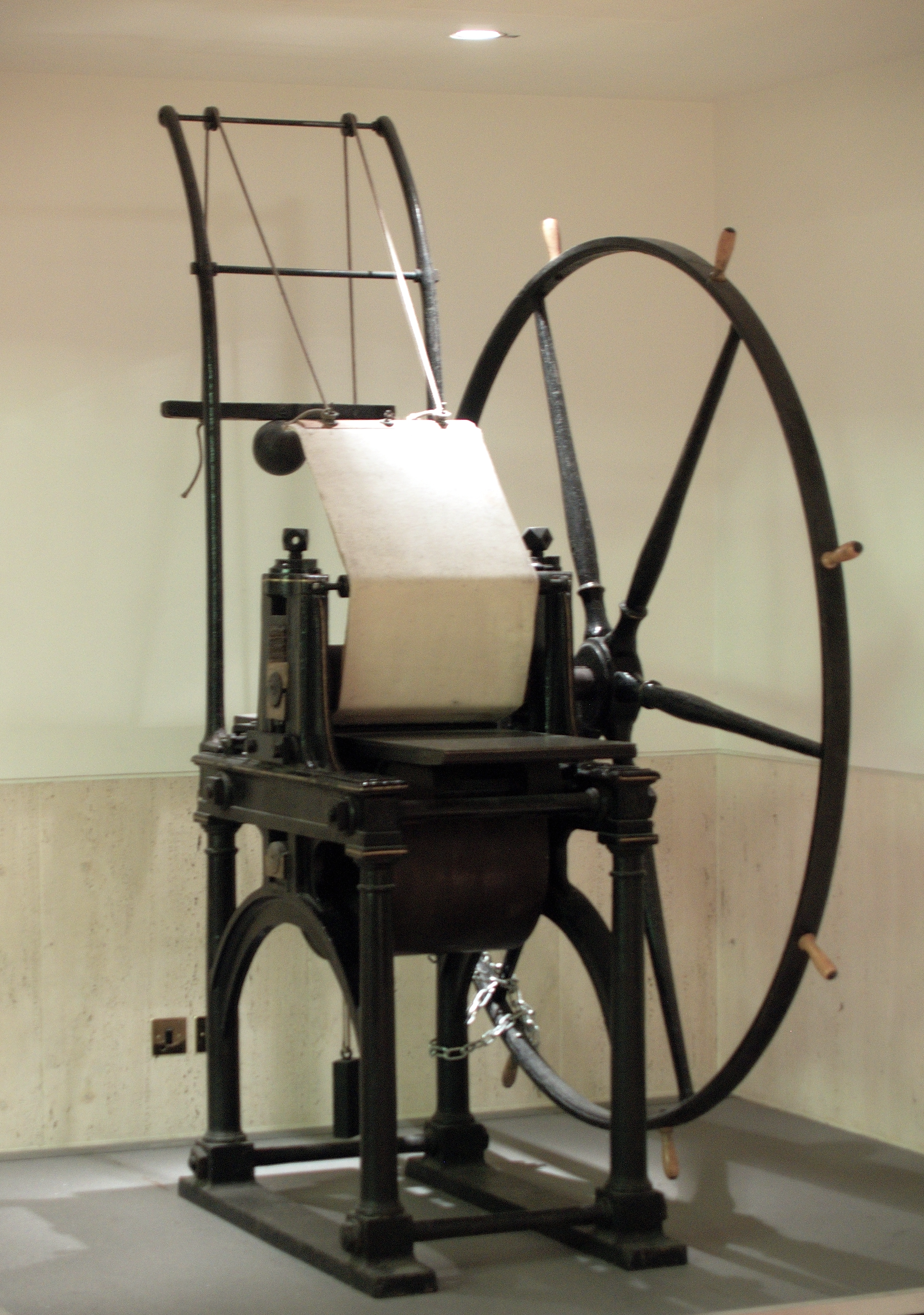
By the spring of 1840, the design had to become a mass-produced object. Perkins, Bacon & Petch began printing the Penny Black on 11 April at their Whitefriars Street works in London. The firm used flat-bed presses operated by large handwheels, a system developed by Jacob Perkins. [11]
Before printing, a single engraved steel die had been used to make a plate carrying 240 stamp impressions. Each sheet then had to be printed on the specially prepared paper, dried and gummed.
By early May, five presses, later six, were working day and night. Production had reached around 600,000 stamps daily. The familiar little black stamp was the result of an extraordinary effort by engravers, papermakers, press operators and other workers, all bringing a new system into existence in a matter of months. [11]
A surviving Perkins press, photographed at the British Library in 2009.Image information
Click image to magnify
Historic iron printing press with a large spoked handwheel, displayed in a museum.
Credit
Photograph by takomabibelot, Perkins D cylinder printing press in the British Library, 2009; via Wikimedia Commons. CC BY 2.0.
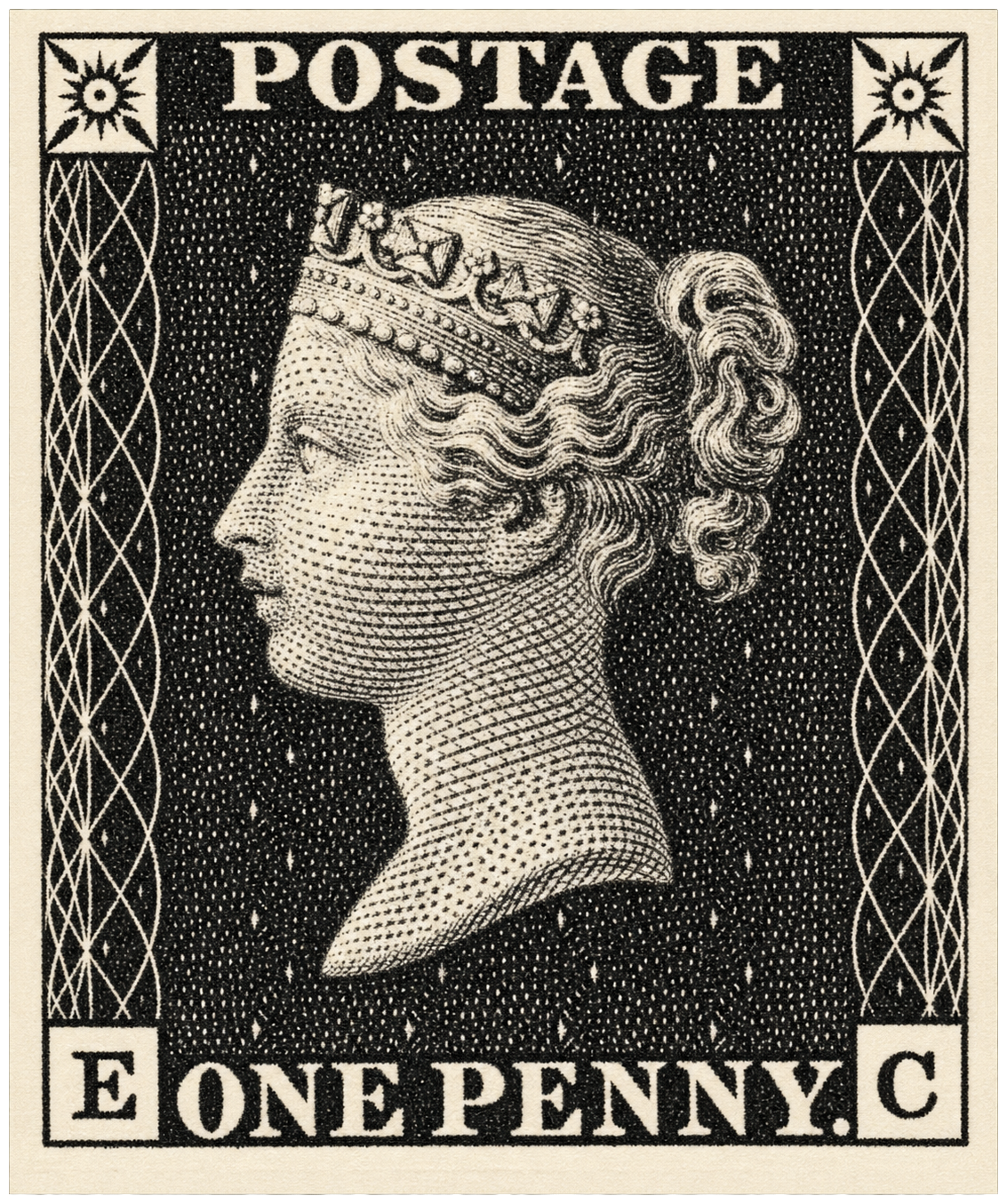
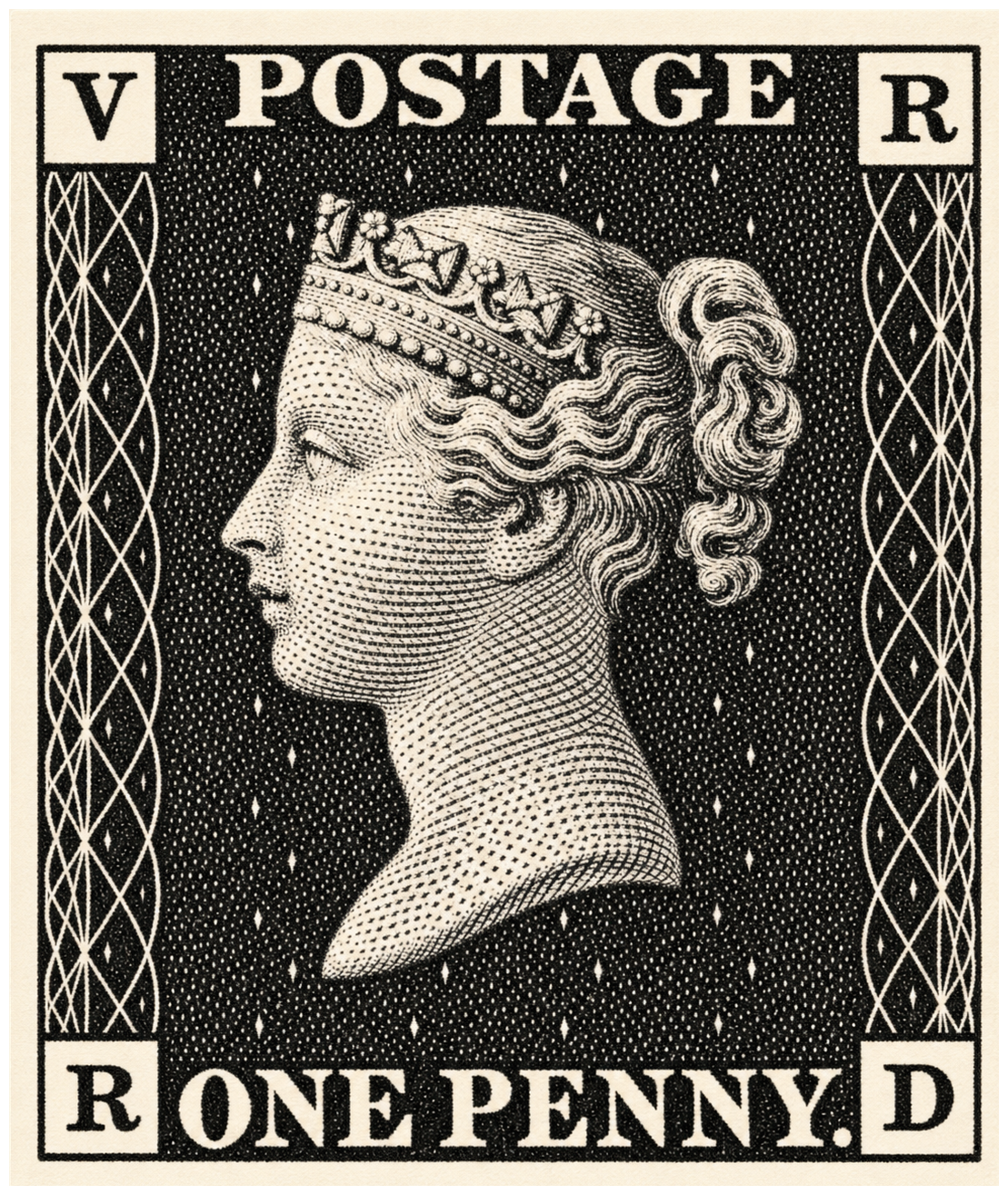
Not every Penny Black prepared in 1840 reached the public. A separate version was produced for government correspondence. Instead of the star-like ornaments in its upper corners, it bore the letters V and R, for Victoria Regina. [14]
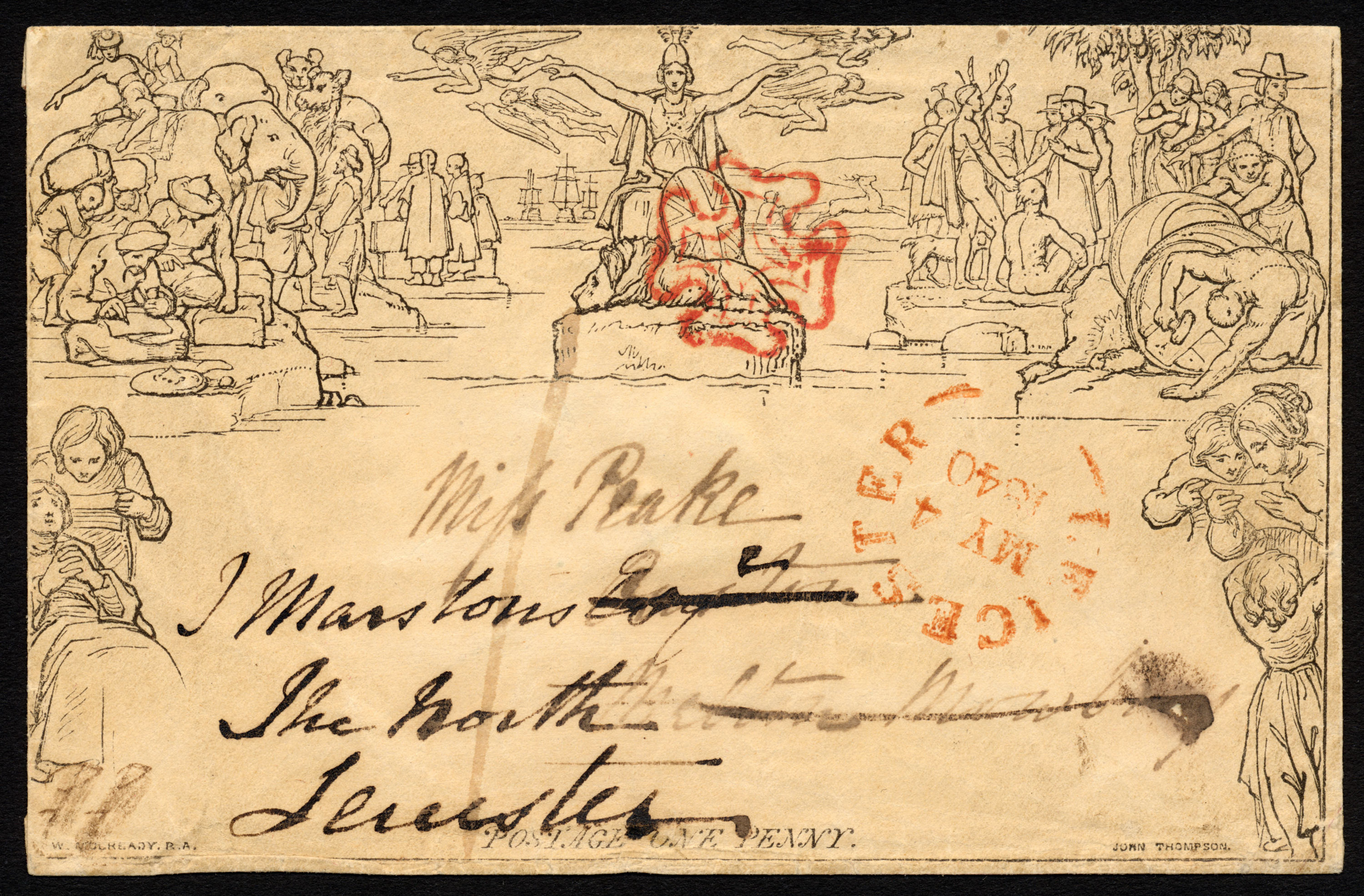
The proposal was abandoned. Government departments were instead supplied with stocks of the prepaid envelopes and letter sheets designed by William Mulready. The special official stamps were no longer needed. [15]
According to the Smithsonian's National Postal Museum, officials destroyed about 94 per cent of the V.R. stamps that had been printed. Surviving examples reveal an alternative version of the world's first postage stamp: carefully prepared, but never officially issued. [14]
The issued Penny Black, with stars in the upper corners.Image information
Click image to magnify
The issued 1840 Penny Black, with star ornaments above and E and C below.
Credit
Stunning Stamps
Notes
Digitally reconstructed
The unissued official stamp, with V and R in the upper corners.Image information
Click image to magnify
The unissued V.R. Penny Black, with V and R above and R and D below.
Credit
Stunning Stamps
Notes
Digitally reconstructed
A Mulready prepaid envelope from May 1840; this example is not identified as official correspondence.Image information
Click image to magnify
Mulready prepaid envelope with Britannia, allegorical figures, a handwritten address and red Leicester postal marks.
Credit
Design by William Mulready, engraved by John Thompson. Smithsonian National Postal Museum 0.205561.7, via Wikimedia Commons. CC0.
Every page is written to make sense on its own. Visitors often arrive directly at a particular stamp or subject, without having explored the rest of the site.
Some stories are relevant to several stamps, so they are repeated where they help explain what you're looking at. For those exploring a series, the details specific to each stamp generally come first, with the more familiar stories further down the page.
This way, you can explore the site in any order without missing interesting background.
A pale royal profile stands within dark, intricately patterned borders. The portrait came from a medal; the surrounding lettering and corner ornaments turned it into a small, repeatable mark of postage paid. [16]
The country identifies the postal authority that issued the stamp. The monarch identifies the ruler whose portrait it carries. A definitive is an everyday stamp intended for regular postal use.
On this stamp
This British stamp carries the portrait of Queen Victoria, whose reign began in 1837. It belongs to the first family of adhesive postage stamps.
The denomination is the stamp’s face value: the amount of postage it represents. Its price to a collector can be quite different.
In Britain’s old currency, 12 pence made one shilling and 20 shillings made one pound: 240 pence altogether. The abbreviations were d for pence, s for shillings and £ for pounds. The d comes from the Latin denarius. A halfpenny, written ½d, was half an old penny.
On this stamp
One old penny was one-twelfth of a shilling and one two-hundred-and-fortieth of a pound. The inscription ONE PENNY states its postal value.
A shade is a variation within a stamp’s colour. Some variations receive their own catalogue numbers even though the design and denomination stay the same.
Compare known examples under consistent lighting. Fading can change a stamp’s appearance, and photographs or screens can alter how colours look. A catalogue colour name helps describe a shade; it is not a colour test by itself.
On this stamp
Black is the defining colour of this penny issue. The illustrated selection is SG2; its screen appearance is not a calibrated test of shade.
A stamp can be printed, sent to post offices, put on sale and made valid for postage on different dates. An official notice or instruction can establish when it was intended to be used; a dated letter shows that a particular example was actually used.
An early surviving cover is evidence of use by that day. It does not necessarily identify the first day of sale. A year in the heading may also cover later printings of the same design.
On this stamp
The Penny Black became valid for postage on 6 May 1840. Sales in London had begun on 1 May. A cover dated before 6 May records early use, rather than an earlier official validity date.
This set brings together the original black penny and blue twopence of 1840 and the red penny and revised blue twopence introduced in 1841. All were printed from engraved plates and supplied without perforations.
The dates identify the introduction of the designs and colours. They do not mean that production ended in 1841: the red penny and white-line blue twopence continued in imperforate form before perforated stamps appeared in 1854.
On this stamp
The Penny Black is one of the four canonical articles in this set. The set dates describe introductions, not the last year in which every stamp could be used.
The upper corners contain star ornaments and the lower corners contain check letters. The 1840 penny and twopence and the 1841 red penny have no white horizontal rules separating the portrait from the inscription tablets.
On the revised 1841 twopence, a white line runs below POSTAGE and another above TWO PENCE. These lines distinguish the new blue printing from the earlier issue even though the denomination and broad colour remained the same.
On this stamp
The Penny Black has stars in its upper corners and no white horizontal rules above or below the portrait.
Perkins Bacon was a London security printer. Its engraved stamp production combined the preparation of steel plates with the repeated inking, wiping and pressing of sheets.
On this stamp
Perkins, Bacon & Petch printed the Penny Black from engraved steel plates. The stamps were supplied imperforate.
Line engraving is a form of recess, or intaglio, printing. The lines that carry ink are cut below the surface of a metal plate. After inking the plate, the printer wipes the flat surface clean, leaving ink in the engraved grooves.
Damp paper is pressed firmly against the plate and takes up the ink from those grooves. The fine coloured lines form the image; the spaces between them leave the paper visible. This differs from surface printing, where the raised parts of the printing surface carry the ink.
For these stamps, a transfer roller repeated the design from the original die across a steel printing plate. The corner letters were then punched into each position. The sheets were printed, gummed and dried before being supplied for use.
Enlarged cross-section. Engraved lines hold the ink; the surrounding surface is wiped clean before printing.Image information
Side view of recess printing: ink remains in grooves below the plate surface and pressure brings paper into contact with it.
Credit
Stunning Stamps · 2026
On this stamp
Penny Black was printed by Perkins, Bacon & Petch from engraved steel plates, using black ink. The pale parts of the image are unprinted paper.
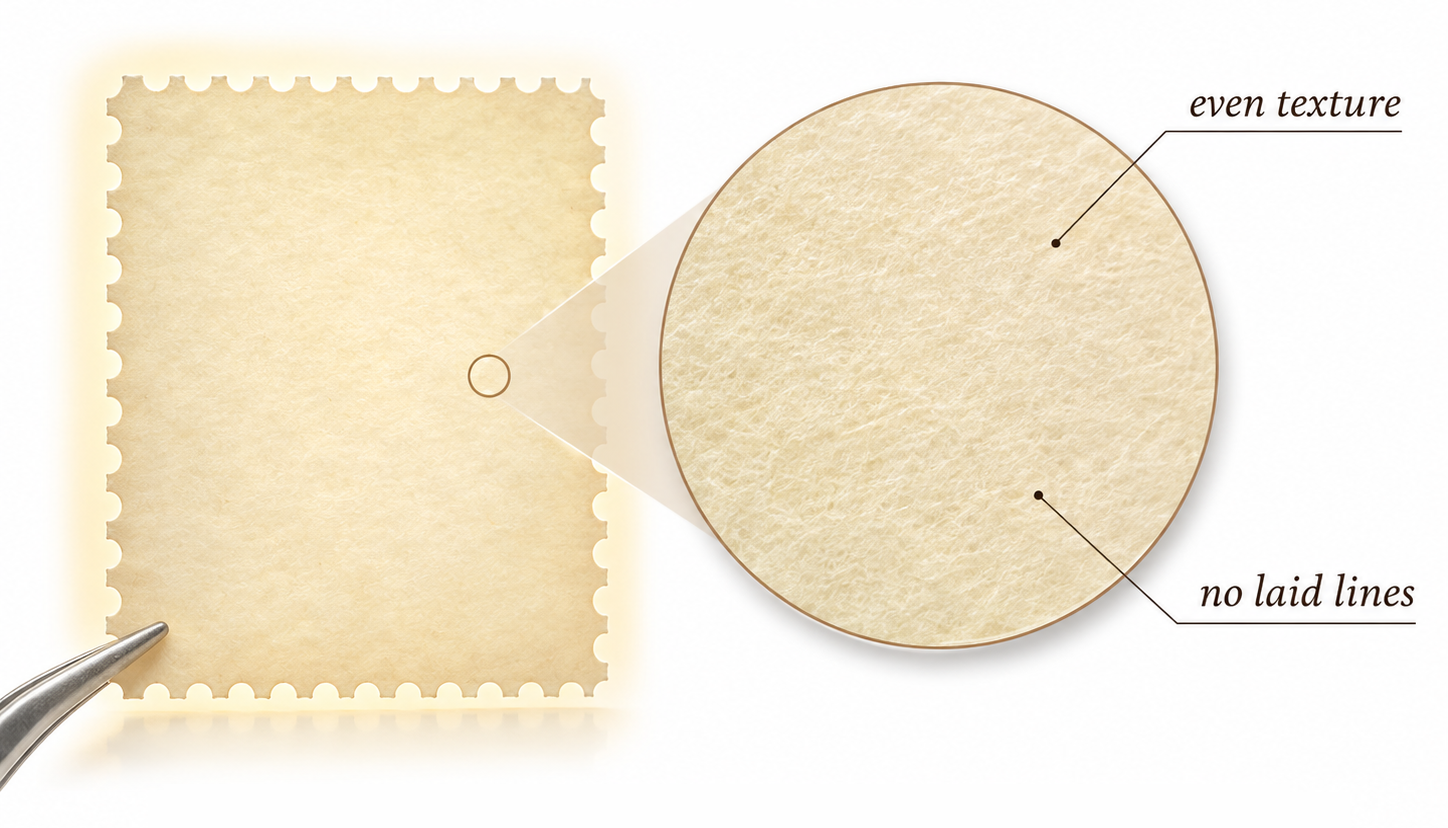
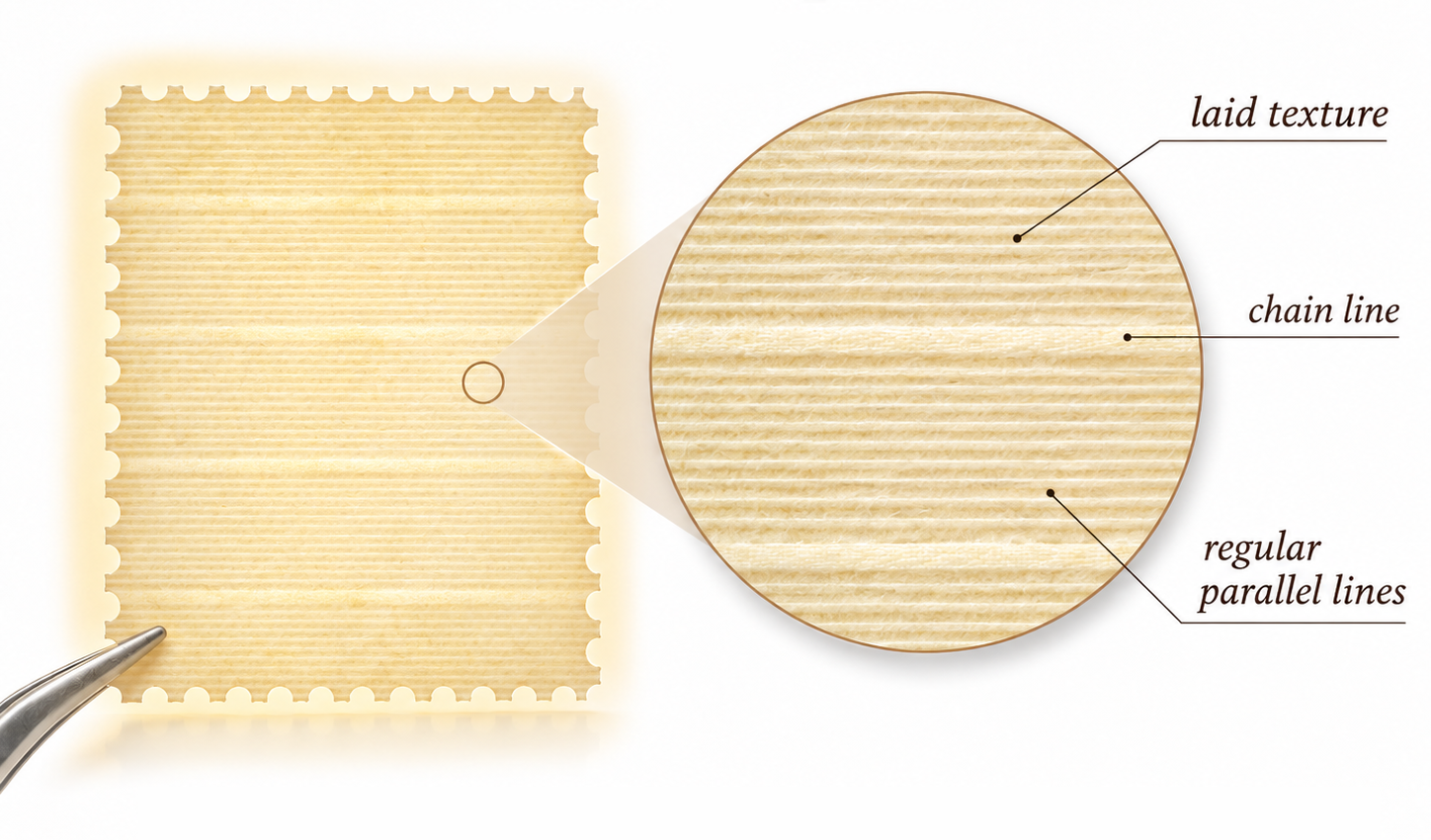
Wove describes the structure of the paper. Viewed against the light, it has a fairly even appearance. Laid paper instead shows a regular pattern of lines left by its manufacture.
Paper structure and watermark are separate characteristics: wove paper can carry a watermark. Both can help distinguish stamps with similar printed designs.
Wove paper: even texture without laid lines.Image information
Click image to magnify
Diagram of wove paper with a magnified inset showing an even texture without laid lines.
Credit
Stunning Stamps · 2026
Notes
Digitally constructed
Laid paper: regular parallel lines, shown for comparison.Image information
Click image to magnify
Diagram of laid paper with a magnified inset showing regular parallel lines.
Credit
Stunning Stamps · 2026
Notes
Digitally constructed
On this stamp
The Penny Black was printed on handmade wove paper with a Small Crown watermark. Wove describes the texture; Small Crown describes the separate watermark pattern.
A watermark is a pattern within the paper, formed during manufacture. It is separate from the printed image and can become visible when light passes through the sheet.
These issues used handmade paper with a Small Crown intended for each stamp position. Crown-shaped wires on the papermaking mould formed the pattern. The crowns were made individually, so their outlines were not absolutely identical.
Paper could be placed the other way up for printing, producing an inverted watermark. A faint or incomplete crown must be assessed from the original paper; the portrait on the front does not establish its orientation.
On this stamp
The Penny Black used Small Crown paper. The watermark belongs to the paper beneath the design and is not visible in this front-view reconstruction.
Imperforate means that a sheet has no punched holes to guide separation. A clerk or customer cut the stamps apart. The spaces between the printed designs therefore became the margins of the individual stamps.
Cuts could be close, uneven or slanting. When examining an original, look at each side separately: a margin may be clear on three sides but touch the printed frame on the fourth. Attached pairs and blocks can also show how closely the stamps sat together in the sheet.
A margin is the blank paper outside the printed design. It is different from the white areas deliberately left within the design, such as the portrait and lettering. A perforation gauge has no role in measuring these cut edges.
On this stamp
This page covers the imperforate Penny Black. The original stamps were cut from sheets; the later perforated issues are separate entries in the collection.
The printing plate carried one pane of 240 stamps: twenty rows of twelve. A pane is a group of stamps within a sheet; here the stamps formed a single uninterrupted group, with no gutter dividing it into smaller panes.
At one penny each, a row of twelve cost one shilling and the complete sheet cost one pound. At twopence each, those amounts doubled to two shillings per row and two pounds per sheet.
The surrounding sheet margins carried instructions, prices and plate numbers. Those inscriptions were outside the individual stamp designs and normally disappeared when a stamp was cut from the sheet.
On this stamp
A complete sheet of the Penny Black contained 240 stamps. Its face value was £1; each row of twelve was worth 1s.
The gum is the adhesive coating on the back. The printed sheets were gummed and dried; moistening the back allowed the sender to attach a stamp to a letter.
On an unused original, the gum is a separate feature from the paper and printed design. The front of a stamp cannot show whether its original gum survives. Old paper and gum also vary in appearance, so neither should be judged from a front-view illustration.
On this stamp
The Penny Black was supplied as a gummed adhesive stamp. Its modern front-view illustration records neither the survival nor the condition of original gum.
Uniform Penny Postage began on 10 January 1840, before adhesive stamps went on sale. For an ordinary prepaid General Post letter within the United Kingdom, the charge depended on weight: 1d up to half an ounce, 2d over half an ounce and up to one ounce, then 4d over one ounce and up to two ounces.
Stamps could be combined to make up the required amount. A heavier letter did not require a single stamp of exactly that value: two penny stamps could pay the twopenny rate, for example. Foreign destinations and special services had their own charges.
On this stamp
One Penny Black could prepay an ordinary General Post inland letter weighing no more than half an ounce. A heavier letter needed more postage.
Uniform Penny Postage began on 10 January 1840, before adhesive stamps went on sale. For an ordinary prepaid General Post letter within the United Kingdom, the charge depended on weight: 1d up to half an ounce, 2d over half an ounce and up to one ounce, then 4d over one ounce and up to two ounces.
Stamps could be combined to make up the required amount. A heavier letter did not require a single stamp of exactly that value: two penny stamps could pay the twopenny rate, for example. Foreign destinations and special services had their own charges.
On this stamp
A General Post inland letter over one ounce and up to two ounces cost 4d: four penny stamps could make up that amount.
A cancellation marks a stamp as used so that it cannot pay postage again. On these early British stamps, the familiar Maltese Cross is an ornamental obliterating mark; the date and place of posting may appear in a separate handstamp on the letter.
The original black penny was normally cancelled in red. The introduction of the red penny in 1841 allowed a black cancellation to show clearly. The change followed experiments with stamp and cancelling inks intended to make removal of the cancellation more difficult.
The Maltese Cross was followed by numeral cancellations from 1844. A design introduced in 1841 can therefore bear either kind, depending on when and where the stamp was used.
On this stamp
Red Maltese Cross cancellations are characteristic of the Penny Black. Black cancellations also occur; colour alone is not a reliable way to date a loose stamp.
A stamp catalogue gives each listed issue a reference number. SG means Stanley Gibbons, the publisher of the catalogue used here. These numbers help collectors refer to the same issue; they are not serial numbers printed on individual stamps.
A range of numbers groups related entries. Colour, paper or perforation differences may account for separate listings within that range.
On this stamp
The recorded reference is SG2, with letters E–C. Plate 5 in the recorded reference specimen. This identifies the illustrated selection, rather than every shade or printing of the issue.
Read the two lower corner letters from left to right. The left letter gives the row, A to T; the right gives the position within that row, A to L. A–A is the top-left stamp and T–L is the bottom-right stamp in a sheet of twenty rows of twelve.
Each pair occurs once in a complete sheet. The letters were punched into the plate separately after the design had been transferred, so their precise placement can vary.
The same letter pairs recur on different plates. They locate a stamp within the sheet, but cannot identify its plate alone. Plate identification combines the lettering with other small, documented features of the printed impression.
On this stamp
The illustration carries E–C: row five, position three. Other positions have different pairs.
The die carried the original engraved design. A transfer roller copied that design into the many positions on a printing plate. A plate was the working surface from which complete sheets were printed.
These early stamps have no plate number inside the individual design. Numbers appeared in the outer sheet margins. Once that margin was removed, identification depended on comparison with recorded impressions: the positions of corner letters, small flaws, repairs and other recurring details.
Several plates could carry the same design and the same corner-letter pair. A catalogue number, a colour name or the letters alone therefore cannot establish a plate.
On this stamp
Eleven numbered plates were used for the Penny Black. Plate 5 is recorded for the reference specimen selected for this illustration. That provenance does not establish that every microscopic feature of the reconstruction is a faithful plate diagnostic.
William Wyon was a medallist and engraver at the Royal Mint. His models of royal heads were made for coins and medals and also became sources for stamp portraits.
On this stamp
Wyon’s City of London medal supplied the portrait source used on the Penny Black.
Henry Corbould was a draughtsman and book illustrator. He trained with his father and at the Royal Academy Schools, where he received a silver medal for a life study.
On this stamp
Corbould’s drawing after Wyon’s medal helped prepare the original portrait carried by the Penny Black.
Charles Heath was an engraver and publisher of illustrated books. Work from his workshop could carry his signature even when assistants had contributed to the engraving.
Frederick Heath, Charles Heath’s son, was an engraver working in the family’s illustrated-book business. His surviving prints include engraved interpretations of other artists’ paintings.
On this stamp
The original portrait engraving is attributed to Charles Heath or his son Frederick; the individual responsibility remains unresolved. This is the portrait engraved for the first penny stamp.