
The design of the 1d black
Queen Victoria · Great Britain · Perkins, Bacon & Petch · 1840
A portrait of a fifteen-year-old princess
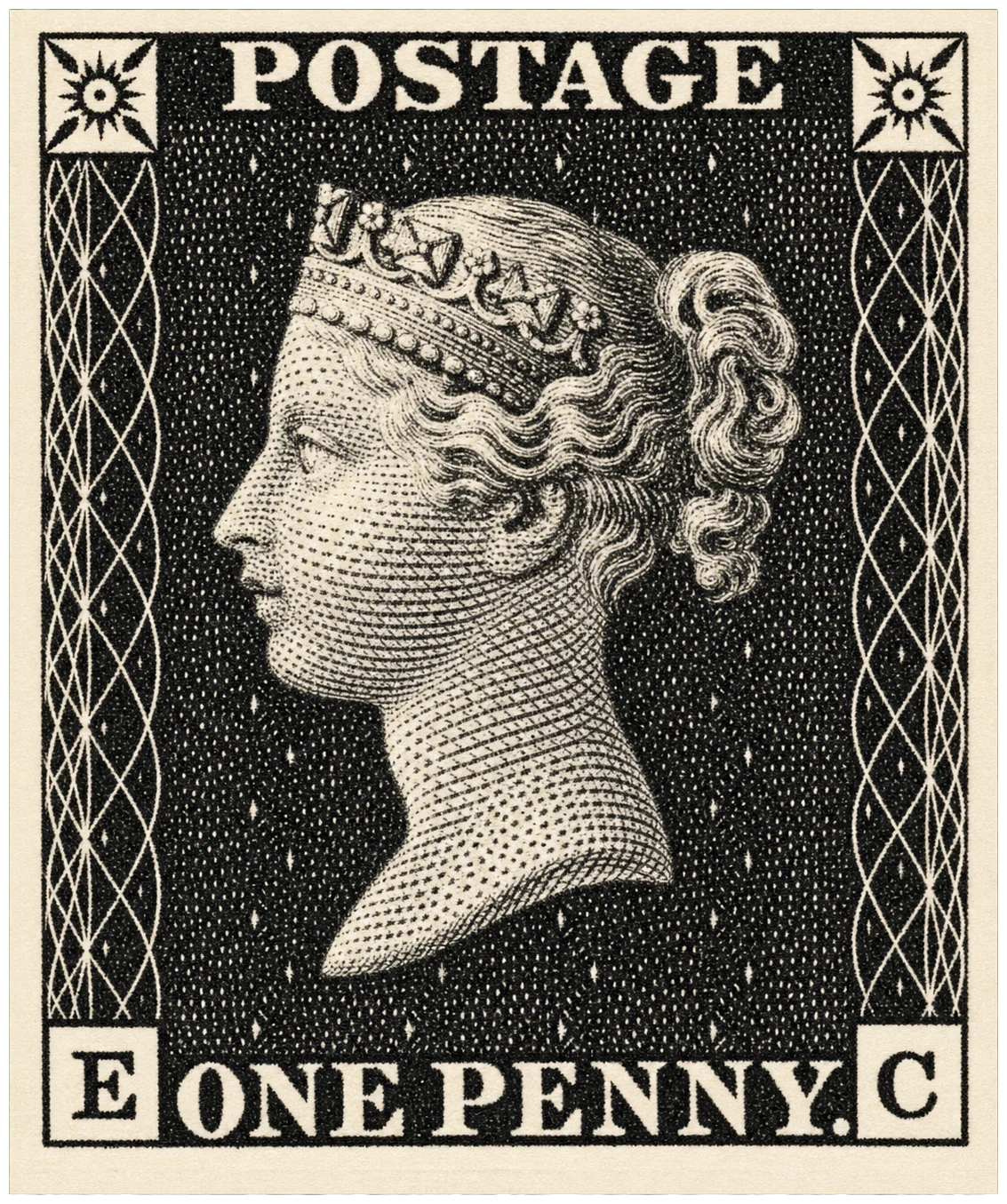
The young Queen Victoria on the Penny Black was based on an image made before she became Queen. William Wyon, Chief Engraver at the Royal Mint, created a medal commemorating Victoria's visit to the City of London in November 1837. Its portrait drew on a sketch made in 1834, when Victoria was only fifteen. The medal was issued in 1838. [1]
Rowland Hill selected Wyon's portrait as the basis for the new stamp. The printers commissioned the artist Henry Corbould to prepare a drawing from the medal, which was then translated into an engraving for printing. Wyon provided the original image, but did not engrave the Penny Black's printing die.
The profile became one of the most enduring images of Victoria. While the Queen grew older, her youthful likeness continued to appear on British postage stamps throughout her reign. [1, 2, 3]
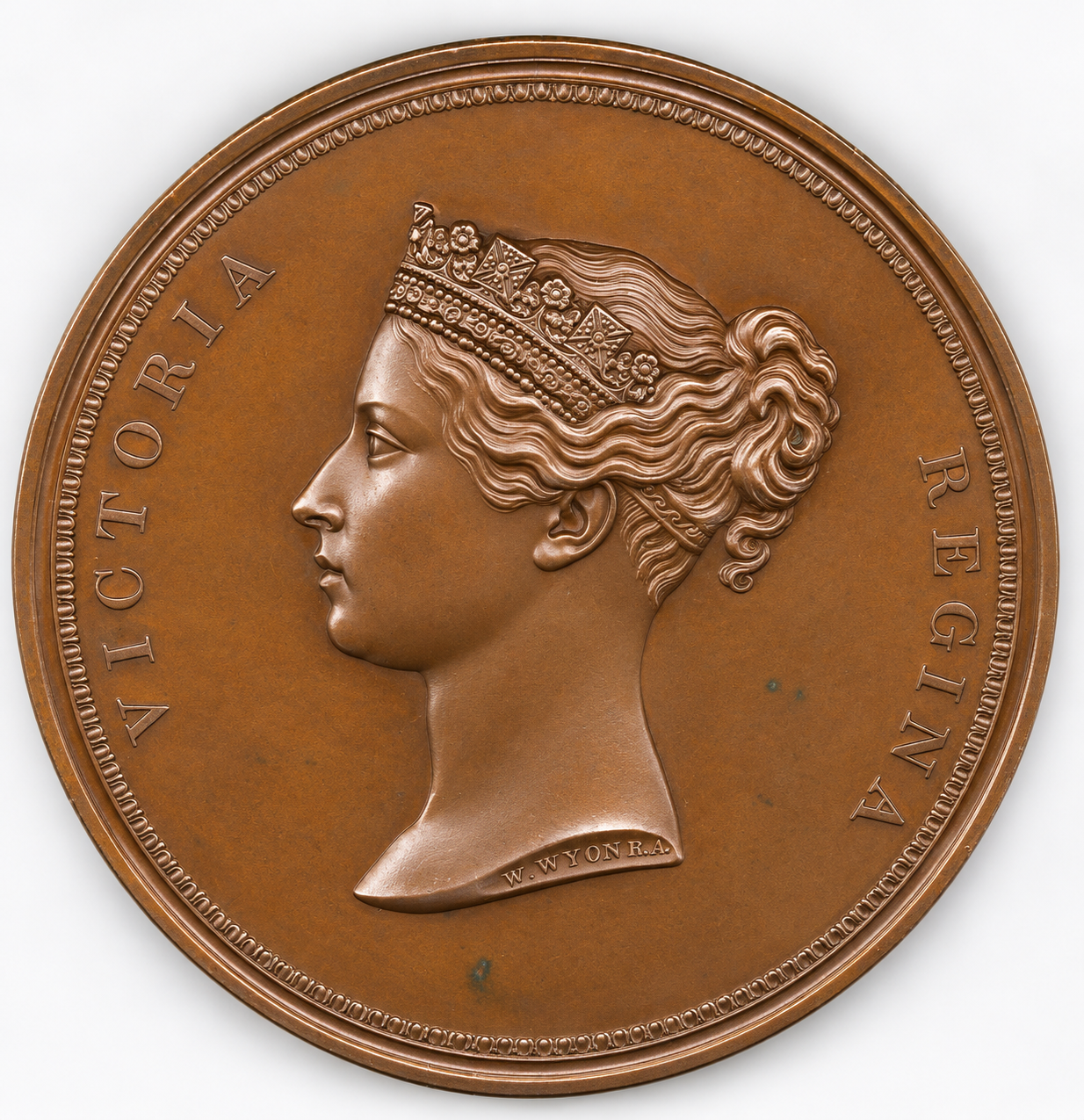
Image information
Click image to magnify
Bronze medal showing the young Victoria in left-facing profile, wearing the diamond diadem, with the inscription VICTORIA REGINA.
- Credit
- Heritage Auctions, via Wikimedia Commons. CC BY 3.0.
- Notes
- Brightness, contrast, sharpness and colour balance adjusted by Stunning Stamps.
The diamond diadem made for a king
The ornament in Victoria's hair has an unexpected history. It is not a crown made for the young Queen, but a diamond diadem commissioned for George IV's coronation in 1821. [4]
The diadem contains 1,333 diamonds, with crosses and the national emblems of the rose, thistle and shamrock. The diamonds were originally hired for George IV's coronation, but he decided to keep them and paid a bill of more than £8,000. Later, Queen Adelaide wore the ornament, establishing its association with royal women.
Victoria wore the same diadem in portraits, and Wyon included it in the image that became the Penny Black. At stamp size, its elaborate jewels are reduced to tiny engraved marks. A magnificent piece of royal jewellery had become part of an everyday object worth one penny. [4]

Image information
Click image to magnify
Digitally created illustration of the diamond diadem, with crosses, floral emblems and rows of pearls, resting on a blue cushion.
- Credit
- Stunning Stamps.
- Notes
- Digitally created.
The engraving that had to be made twice
The first attempt to engrave Victoria's portrait did not work. Charles Heath's engraving workshop, in which his son Frederick also worked, was entrusted with turning Henry Corbould's drawing into a printing die. The engraving was delicate, but its portrait and background were too faint to transfer successfully to the steel printing plates. [5]
A second die had to be prepared. It used stronger engraving and a darker background. The new die was sent to Charles Heath on 16 January 1840 and returned on 20 February with the remark, "If that does not transfer well nothing will." This time the transfer succeeded.
A proof was sent to Queen Victoria before the lettering and corner ornaments had been added. She replied in a handwritten letter expressing her "high appreciation" of the design. The Queen had approved a portrait that was not yet a complete postage stamp. [5]
Why the background resembles a banknote
The intricate pattern behind Victoria's head was intended to make the stamp difficult to forge. Rowland Hill believed that a finely executed human face would be particularly difficult to copy convincingly, because people readily notice small differences in facial features. [5]
Perkins, Bacon & Petch specialised in security printing. The firm used a technique called engine-turning to produce elaborate geometric patterns, familiar from banknotes. The portrait was surrounded by closely worked lines that would be difficult to reproduce accurately.
The stamp was printed by line engraving, with ink held in fine recesses in a steel plate. Its decorative complexity was therefore purposeful. The appearance of the Penny Black was shaped as much by the fear of forgery as by the desire for an attractive design. [5]
Two letters added by hand
The letters in the lower corners are not the engraver's initials. They show the stamp's position in the original printing sheet.
Each sheet contained 240 stamps, arranged in twenty rows of twelve. The left corner letter identified the row, from A to T; the right identified the column, from A to L. The first stamp was therefore AA and the last TL. A complete sheet had a face value of exactly one pound. [5]
The first proof sheet, taken on 1 April 1840, did not yet contain the letters. They were punched individually into the printing plate afterwards, giving every position its own identification. The work was a painstaking addition to a design intended for mass production.
These small letters are a reminder that even the world's first printed postage stamps depended on the careful handwork of skilled craftsmen.
Why the edges have no perforations
The Penny Black was produced before perforations became a normal part of British postage stamps. Its printing sheets contained stamps divided by narrow unprinted spaces, but no rows of punched holes. [6]
The stamps had to be separated with scissors. Cutting between closely spaced designs was not always easy, and the resulting edges could be uneven or cut close to the printed frame.
Henry Archer subsequently developed machinery for perforating stamps, and perforated British postage stamps entered regular use in 1854. The Penny Black belongs to the earlier period, when producing the printed sheet was only part of the job: somebody still had to cut the individual stamps apart. [6]
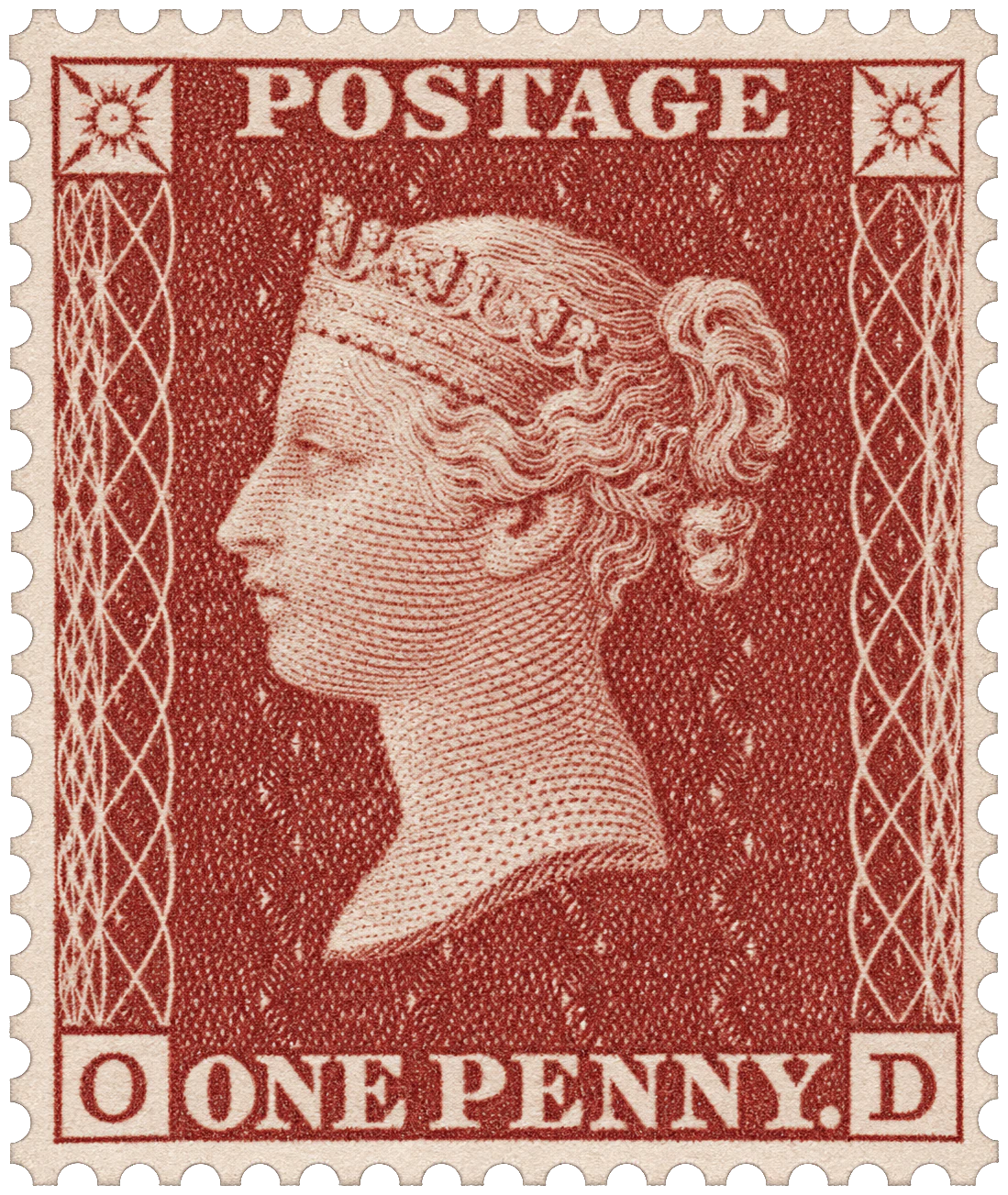
Compare the outside edges. These separate illustrations do not identify the same printing plate or sheet position.
Click either stamp to magnify
The chemist who helped turn black into red
The Penny Black's colour was short-lived because the Post Office had underestimated a practical problem. The red ink used to cancel stamps could sometimes be removed without seriously damaging the black printing underneath. That made it possible for a dishonest person to reuse a stamp. [7]
Rowland Hill sought help from chemists, including Richard Phillips of the Museum of Economic Geology. During 1840, experimental stamps were printed in several colours, including blue, green, rose and red-brown. These experiments became known as the Rainbow Trials.
Phillips tested stamp inks and cancellation inks, including their resistance to attempts at removal. One surviving experimental sheet was even exposed to sunlight from 21 October to 6 November 1840. [8]
The solution was to print the penny stamp in red-brown and use a more effective black cancellation. The Penny Red appeared on 10 February 1841. Victoria's portrait and the essential design remained, but the famous black colour had lasted less than a year. [7]
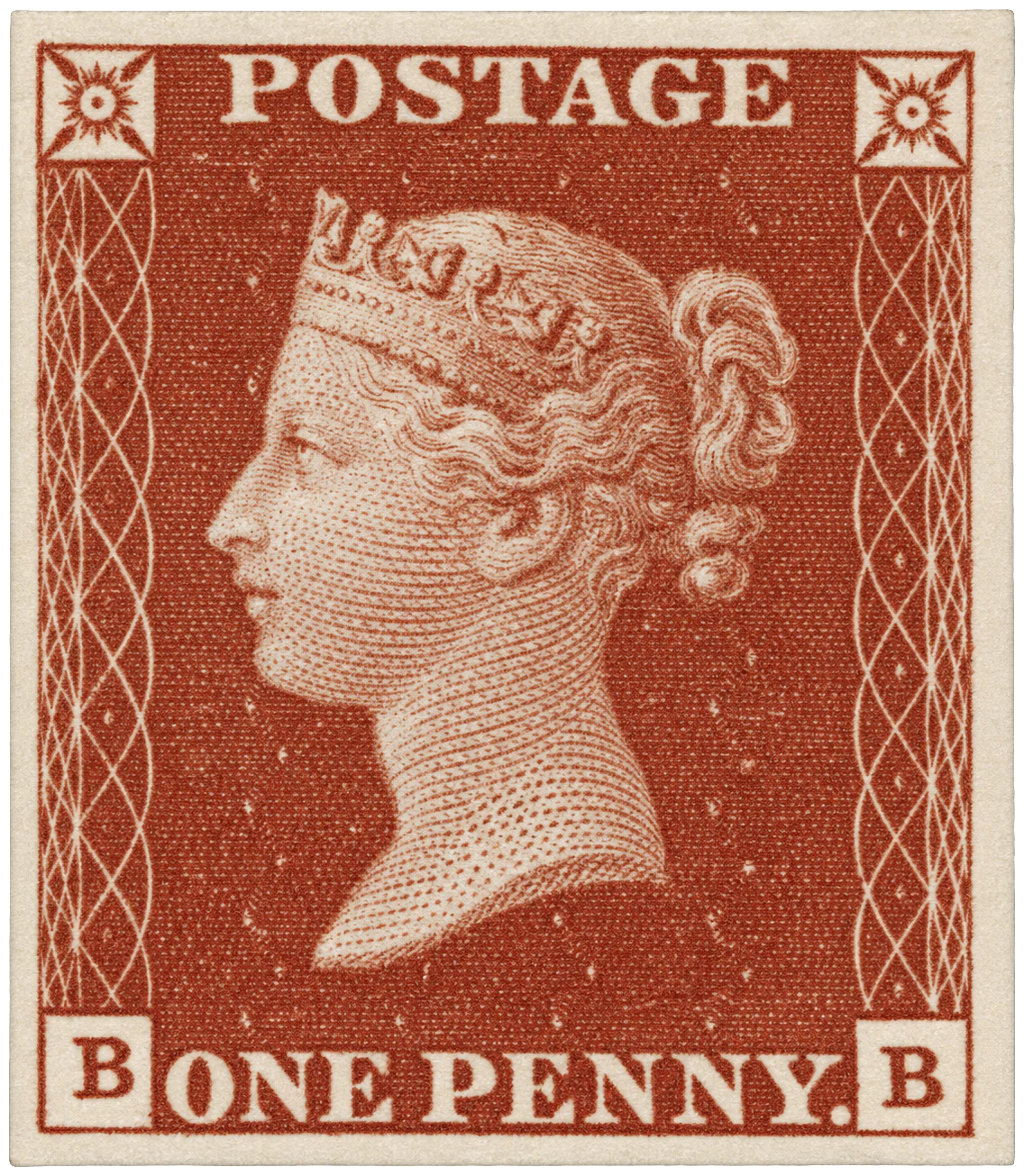
The issued designs before and after the colour change. The illustrations do not reproduce the same plate position or show cancellation tests.
Click either stamp to magnify
Sources
- Douglas N. Muir, Royal Mint Museum: William Wyon & the Penny Black
- Heritage Auctions, William Wyon medal photograph, via Wikimedia Commons (enhanced for display)
- Wyon medal photograph: Creative Commons Attribution 3.0 licence
- Royal Collection Trust: George IV's Diamond Diadem
- Douglas N. Muir: Creating the Penny Black, Gibbons Stamp Monthly
- Michael Kogan: 185th Anniversary of the Penny Black, Gibbons Stamp Monthly
- Smithsonian National Postal Museum: Introducing the Penny Red
- David G. Bate, British Geological Survey: Richard Phillips and his experimental work on the Penny Black and Penny Red
