
The design of the 1d red-brown
Queen Victoria · Great Britain · Perkins, Bacon & Petch · 1841
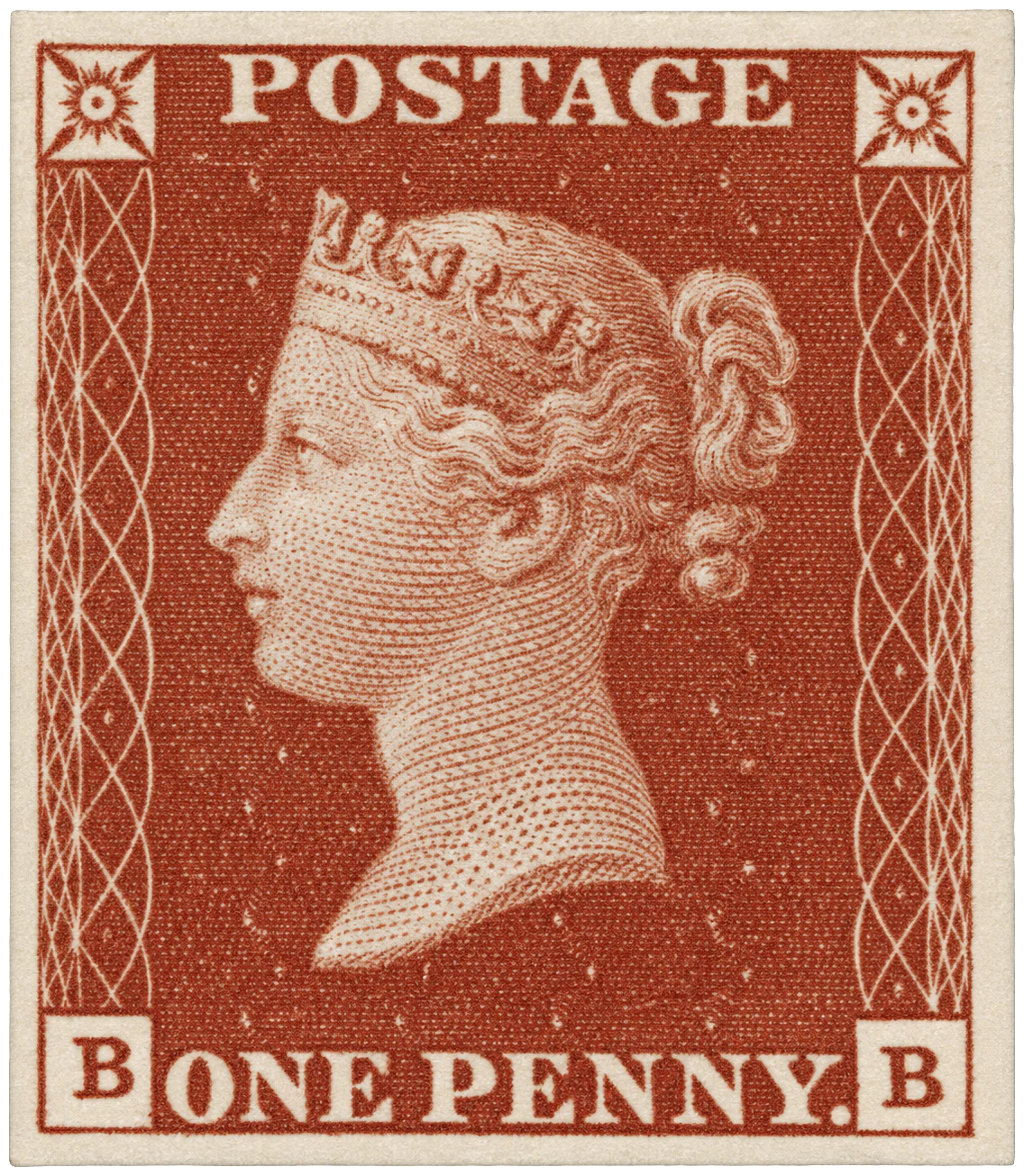
The Penny Black's printing plates turn red
The first Penny Reds were printed from steel plates that had already produced Penny Blacks. Perkins, Bacon & Petch did not have to commission a new portrait or create an entirely new design. The printers could use the existing plates and change the ink. [1]
This created an unusual connection between the two stamps. A Penny Black and a Penny Red can sometimes be traced to exactly the same position on the same printing plate. Their lower corner letters match, but so can minute irregularities in the engraving.
Several original plates were used for both colours, including plates 1, 2, 5, 8, 9, 10 and 11. Some had already undergone repairs while printing the black stamps and required further attention during their red-printing careers. [2]
The change that gave Britain one of its most familiar stamps was therefore largely a change of printing ink. Two stamps of different colours could be the work of the same engraved piece of steel.
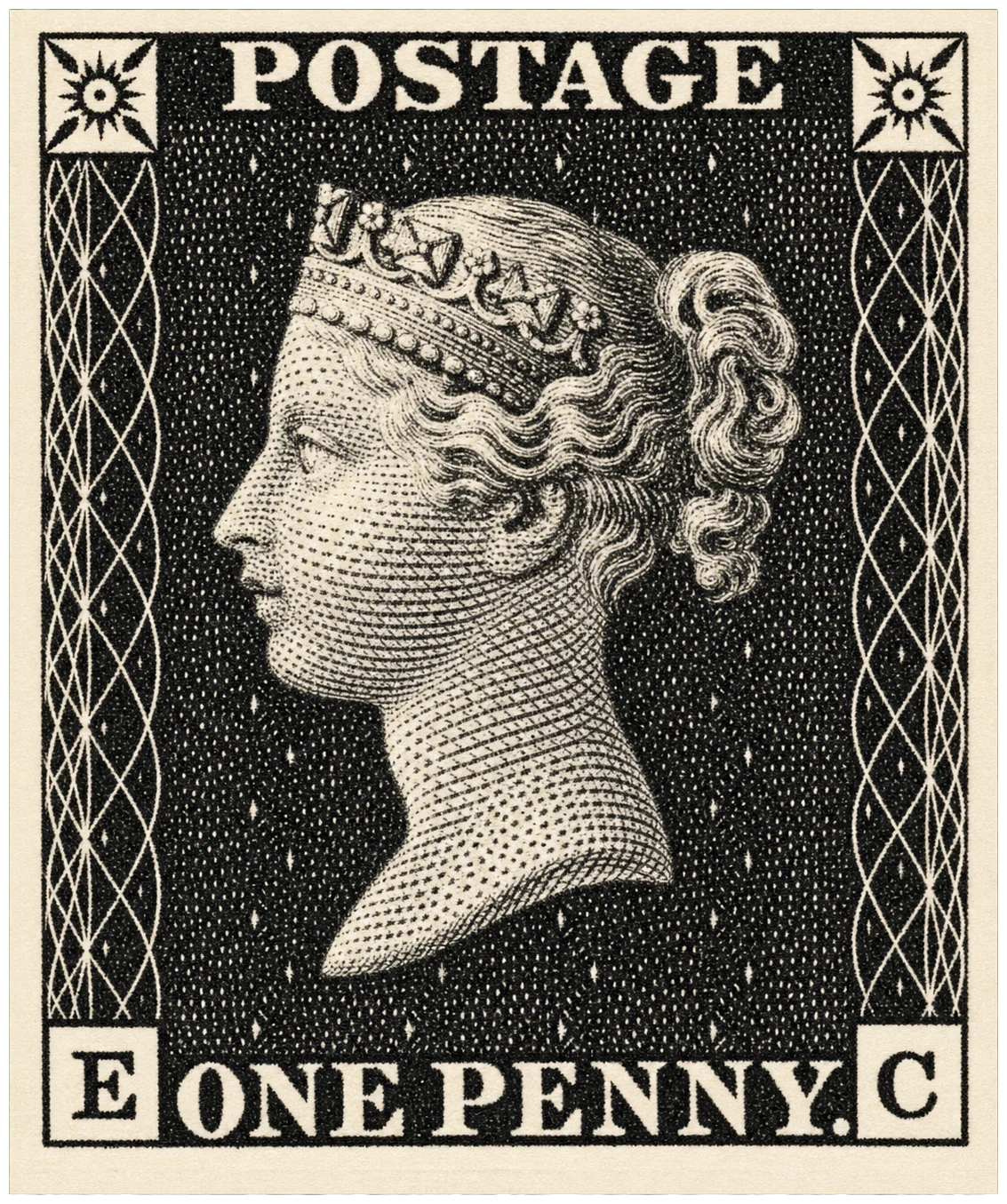
The issued designs before and after the colour change. The illustrations do not reproduce the same plate position or show cancellation tests.
Click either stamp to magnify
The printer who preferred pink
In June 1840, while the Penny Black was still new, J. B. Bacon of Perkins, Bacon & Petch sent Richard Phillips samples of experimental stamps printed in different inks.
Bacon particularly liked one colour, which he called "Pink". He thought it was the best for printing and likely to perform well in Phillips's chemical tests. His letter of 4 June also mentioned a specially treated black ink, although he considered the pink more promising. [3]
The experiments became known as the Rainbow Trials. Stamps were printed in several colours, including blues, greens, black and shades of red. Some trial impressions had an unusual feature: the upper-right corner ornament was left blank. [1]
The eventual stamp is commonly called the Penny Red, but its printing colour was red-brown. It was the outcome of a lengthy investigation, not simply a decision to replace black with a more attractive colour.
Why the red ink was meant to be vulnerable
The Penny Black's problem was that its printed image was too resistant to chemicals. A cancellation could sometimes be removed while leaving the underlying stamp sufficiently intact to be used again.
The solution seems almost backwards. Instead of making the Penny Red's printing ink even more permanent, Rowland Hill wanted it to be vulnerable to the chemicals used to remove cancellations. Any attempt to clean away the black mark should also damage the red stamp beneath it. [4]
Richard Phillips tested suitable red-brown inks alongside more durable black cancelling inks. The colour and chemical properties had to work together: a stamp that was easy to cancel visibly, but difficult to restore to an unused appearance.
This explains why the Penny Red was printed in a different colour while retaining the familiar design. The change was intended to make the stamp more secure, not to make Victoria's portrait more decorative. [3]
The printing plate with five recorded states
The first printing plate for the Penny Black had an unexpectedly difficult life. In the rush to begin production in April 1840, it was put to press before being properly hardened. Its engraved lines wore rapidly, and by May all 240 stamp impressions needed to be restored. [5]
The repaired plate was hardened and returned to production. It became known to collectors as plate 1b, distinguishing it from its original condition, plate 1a.
When the Penny Red appeared in 1841, the same plate was still in service. Further wear resulted in three more stages of repair, giving some stamp positions as many as five identifiable states, known as 1a to 1e.
The restorers used a transfer roller to deepen worn engraved lines. Occasionally the roller did not coincide exactly with the original impression, leaving doubled details that are still visible on surviving stamps. A small difference in the corner ornament, frame or lettering can reveal the history of work carried out on a steel plate more than 180 years ago. [5]
A portrait of a fifteen-year-old princess
The young Queen Victoria on the Penny Red was based on an image made before she became Queen. William Wyon, Chief Engraver at the Royal Mint, created a medal commemorating Victoria's visit to the City of London in November 1837. Its portrait drew on a sketch made in 1834, when Victoria was only fifteen. The medal was issued in 1838. [6]
Rowland Hill selected Wyon's portrait as the basis for the new stamp. The printers commissioned the artist Henry Corbould to prepare a drawing from the medal, which was then translated into an engraving for printing. Wyon provided the original image, but did not engrave the postage stamp's printing die.
The profile became one of the most enduring images of Victoria. While the Queen grew older, her youthful likeness continued to appear on British postage stamps throughout her reign. [6, 7, 8]
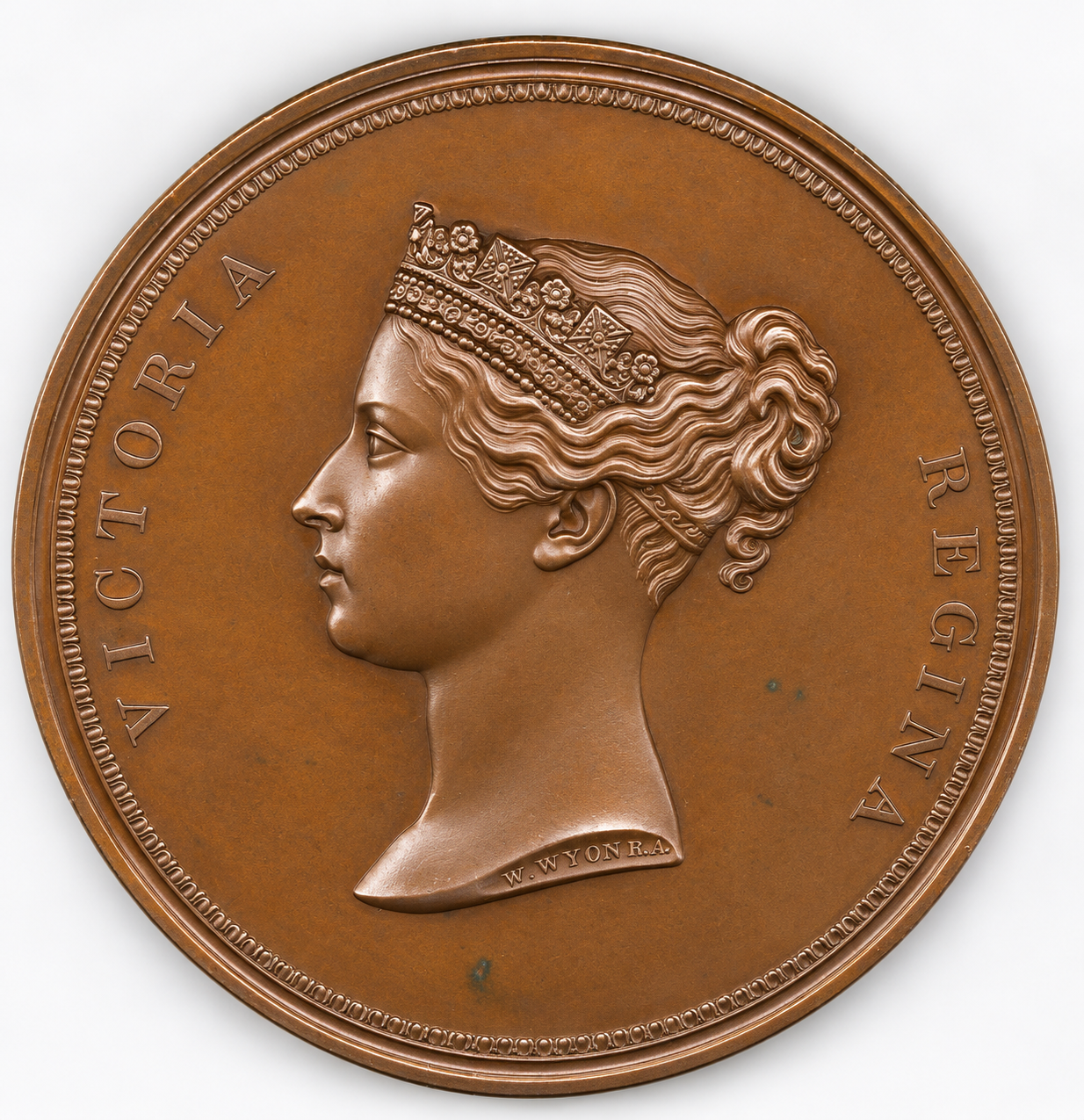
Image information
Click image to magnify
Bronze medal showing the young Victoria in left-facing profile, wearing the diamond diadem, with the inscription VICTORIA REGINA.
- Credit
- Heritage Auctions, via Wikimedia Commons. CC BY 3.0.
- Notes
- Brightness, contrast, sharpness and colour balance adjusted by Stunning Stamps.
The diamond diadem made for a king
The ornament in Victoria's hair has an unexpected history. It is not a crown made for the young Queen, but a diamond diadem commissioned for George IV's coronation in 1821. [9]
The diadem contains 1,333 diamonds, with crosses and the national emblems of the rose, thistle and shamrock. The diamonds were originally hired for George IV's coronation, but he decided to keep them and paid a bill of more than £8,000. Later, Queen Adelaide wore the ornament, establishing its association with royal women.
Victoria wore the same diadem in portraits, and Wyon included it in the image that became Britain's first postage stamps. At stamp size, its elaborate jewels are reduced to tiny engraved marks. A magnificent piece of royal jewellery had become part of an everyday object worth one penny. [9]

Image information
Click image to magnify
Digitally created illustration of the diamond diadem, with crosses, floral emblems and rows of pearls, resting on a blue cushion.
- Credit
- Stunning Stamps.
- Notes
- Digitally created.
Why the background resembles a banknote
The intricate pattern behind Victoria's head was intended to make the stamp difficult to forge. Rowland Hill believed that a finely executed human face would be particularly difficult to copy convincingly, because people readily notice small differences in facial features. [10]
Perkins, Bacon & Petch specialised in security printing. The firm used a technique called engine-turning to produce elaborate geometric patterns, familiar from banknotes. The portrait was surrounded by closely worked lines that would be difficult to reproduce accurately.
The stamp was printed by line engraving, with ink held in fine recesses in a steel plate. Its decorative complexity was therefore purposeful. The appearance of the Penny Red was shaped as much by the fear of forgery as by the desire for an attractive design. [10]
Two letters added by hand
The letters in the lower corners are not the engraver's initials. They show the stamp's position in the original printing sheet.
Each sheet contained 240 stamps, arranged in twenty rows of twelve. The left corner letter identified the row, from A to T; the right identified the column, from A to L. The first stamp was therefore AA and the last TL. A complete sheet had a face value of exactly one pound. [6]
The original printing die did not contain these identifying letters. They were punched individually into each position on the steel printing plate. Because the work was done by hand, some letters were incorrectly placed and had to be corrected. Traces of these mistakes can sometimes be seen on surviving stamps. [11]
These small letters are a reminder that even the world's earliest printed postage stamps depended on the careful handwork of skilled craftsmen.
Why the edges have no perforations
The original Penny Red was produced before perforations became a normal part of British postage stamps. Its printing sheets contained stamps divided by narrow unprinted spaces, but no rows of punched holes. [1]
The stamps had to be separated with scissors. Cutting between closely spaced designs was not always easy, and the resulting edges could be uneven or cut close to the printed frame.
Henry Archer subsequently developed machinery for perforating stamps, and perforated British postage stamps entered regular use in 1854. The original 1841 Penny Red belongs to the earlier period, when producing the printed sheet was only part of the job: somebody still had to cut the individual stamps apart. [12]
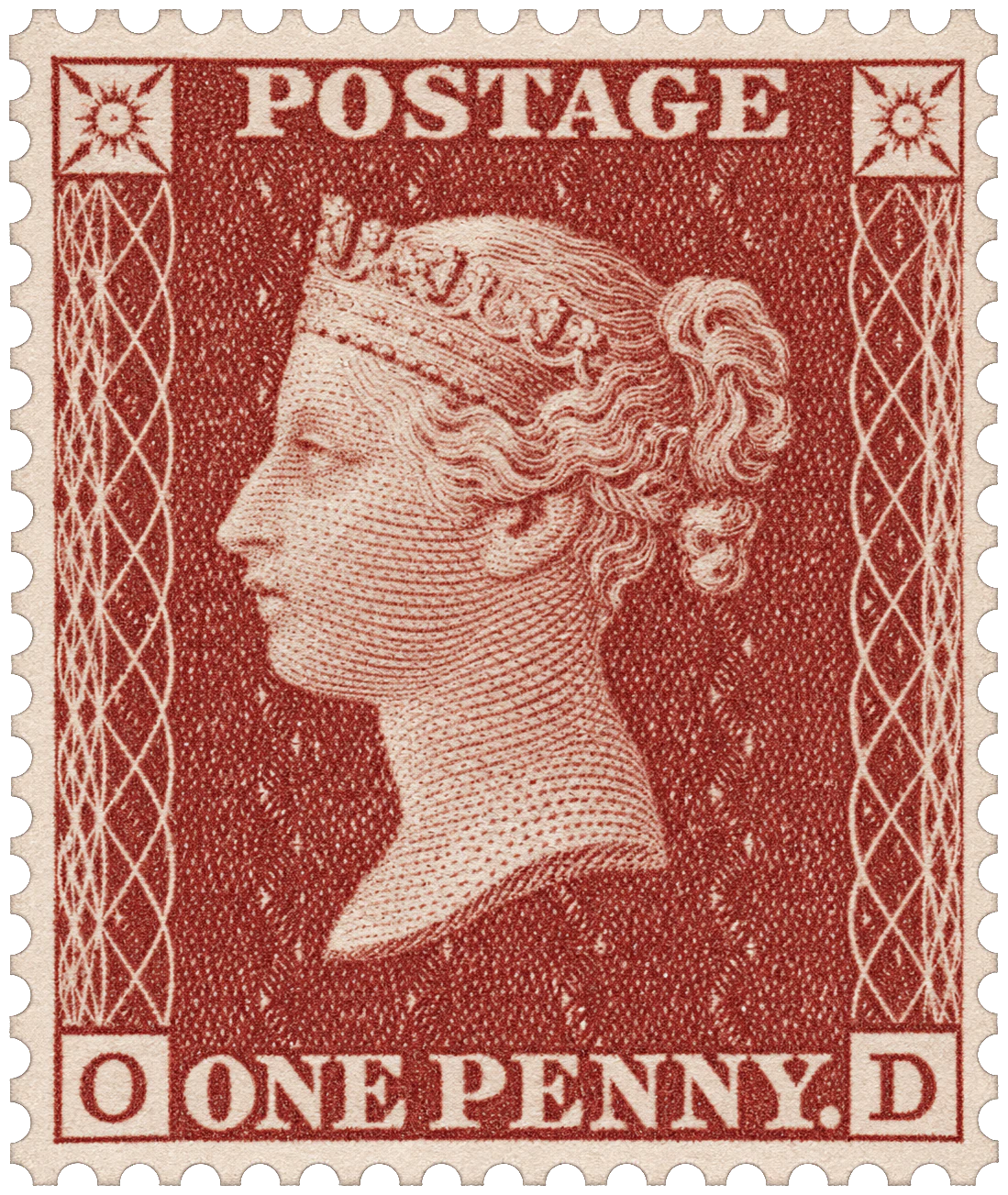
Compare the outside edges. These separate illustrations do not identify the same printing plate or sheet position.
Click either stamp to magnify
Sources
- Stanley Gibbons: How to collect Penny Red stamps
- Stanley Gibbons: 175th Anniversary of the Penny Black — printing plates and first red impressions
- David G. Bate, British Geological Survey: Richard Phillips and his experimental work on the Penny Black and Penny Red
- Smithsonian National Postal Museum: Introducing the Penny Red
- Scott Treacey, Royal Philatelic Society London: Great Britain, Line-Engraved Plate Repairs, 1840–1855 (2017), pp. 1–3
- Douglas N. Muir, Royal Mint Museum: William Wyon & the Penny Black
- Heritage Auctions, William Wyon medal photograph, via Wikimedia Commons (enhanced for display)
- Wyon medal photograph: Creative Commons Attribution 3.0 licence
- Royal Collection Trust: George IV's Diamond Diadem
- Douglas N. Muir: Creating the Penny Black, Gibbons Stamp Monthly
- H. S. Hodson: A Study of the Corner Lettering of the 1d Black, 1840, and 1d Red, 1841–54, The Philatelic Record (1907)
- Michael Kogan: 185th Anniversary of the Penny Black, Gibbons Stamp Monthly
