
Understanding the stamp details
1d red-brown · Perkins, Bacon & Petch
Country and monarch
The country identifies the postal authority that issued the stamp. The monarch identifies the ruler whose portrait it carries. A definitive is an everyday stamp intended for regular postal use.
On this stamp
This British stamp carries the portrait of Queen Victoria, whose reign began in 1837. It belongs to the first family of adhesive postage stamps.
Denomination
The denomination is the stamp’s face value: the amount of postage it represents. Its price to a collector can be quite different.
In Britain’s old currency, 12 pence made one shilling and 20 shillings made one pound: 240 pence altogether. The abbreviations were d for pence, s for shillings and £ for pounds. The d comes from the Latin denarius. A halfpenny, written ½d, was half an old penny.
On this stamp
One old penny was one-twelfth of a shilling and one two-hundred-and-fortieth of a pound. The inscription ONE PENNY states its postal value.
Stamp shades
A shade is a variation within a stamp’s colour. Some variations receive their own catalogue numbers even though the design and denomination stay the same.
Compare known examples under consistent lighting. Fading can change a stamp’s appearance, and photographs or screens can alter how colours look. A catalogue colour name helps describe a shade; it is not a colour test by itself.
On this stamp
Red-brown is the colour of this illustrated penny. Original printings vary in shade and the paper can appear blued; paper tone and ink shade should be considered separately.
Issue dates and recorded use
A stamp can be printed, sent to post offices, put on sale and made valid for postage on different dates. An official notice or instruction can establish when it was intended to be used; a dated letter shows that a particular example was actually used.
An early surviving cover is evidence of use by that day. It does not necessarily identify the first day of sale. A year in the heading may also cover later printings of the same design.
On this stamp
The red penny was introduced on 10 February 1841. The official instructions allowed stocks of the old black stamps to circulate alongside the new red ones, so the colour change did not make every surviving Penny Black immediately unusable.
Sources
- Wright and Creeke, A History of the Adhesive Stamps of the British Isles (1899), introduction p. xxiii; pp. 1–3, 11, 18–19, 24–28, 46–51
- The Postal Museum: The first ever stamp — the Penny Black, printing, sheets and dates
- Smithsonian National Postal Museum: Introducing the Penny Red, ink trials and 10 February 1841 introduction
The imperforate line-engraved issues
This set brings together the original black penny and blue twopence of 1840 and the red penny and revised blue twopence introduced in 1841. All were printed from engraved plates and supplied without perforations.
The dates identify the introduction of the designs and colours. They do not mean that production ended in 1841: the red penny and white-line blue twopence continued in imperforate form before perforated stamps appeared in 1854.
On this stamp
The 1841 Penny Red is one of the four canonical articles in this set. The set dates describe introductions, not the last year in which every stamp could be used.
Stars and white lines
The upper corners contain star ornaments and the lower corners contain check letters. The 1840 penny and twopence and the 1841 red penny have no white horizontal rules separating the portrait from the inscription tablets.
On the revised 1841 twopence, a white line runs below POSTAGE and another above TWO PENCE. These lines distinguish the new blue printing from the earlier issue even though the denomination and broad colour remained the same.
On this stamp
The 1841 Penny Red has stars in its upper corners and no white horizontal rules above or below the portrait.
Printer
Perkins Bacon was a London security printer. Its engraved stamp production combined the preparation of steel plates with the repeated inking, wiping and pressing of sheets.
On this stamp
Perkins, Bacon & Petch printed the 1841 Penny Red from engraved steel plates. The stamps were supplied imperforate.
Sources
- R. C. A. Payne, The Perkins Bacon Story (RPSL, 9 May 1996), company styles, PDF p. 2
- Wright and Creeke, A History of the Adhesive Stamps of the British Isles (1899), pp. 11, 34–35
- Wright and Creeke, A History of the Adhesive Stamps of the British Isles (1899), introduction p. xxiii; pp. 1–3, 11, 18–19, 24–28, 46–51
Printing from engraved lines
Line engraving is a form of recess, or intaglio, printing. The lines that carry ink are cut below the surface of a metal plate. After inking the plate, the printer wipes the flat surface clean, leaving ink in the engraved grooves.
Damp paper is pressed firmly against the plate and takes up the ink from those grooves. The fine coloured lines form the image; the spaces between them leave the paper visible. This differs from surface printing, where the raised parts of the printing surface carry the ink.
For these stamps, a transfer roller repeated the design from the original die across a steel printing plate. The corner letters were then punched into each position. The sheets were printed, gummed and dried before being supplied for use.
Image information
Side view of recess printing: ink remains in grooves below the plate surface and pressure brings paper into contact with it.
- Credit
- Stunning Stamps · 2026
On this stamp
1841 Penny Red was printed by Perkins, Bacon & Petch from engraved steel plates, using red-brown ink. The pale parts of the image are unprinted paper.
Wove paper
Wove describes the structure of the paper. Viewed against the light, it has a fairly even appearance. Laid paper instead shows a regular pattern of lines left by its manufacture.
Paper structure and watermark are separate characteristics: wove paper can carry a watermark. Both can help distinguish stamps with similar printed designs.
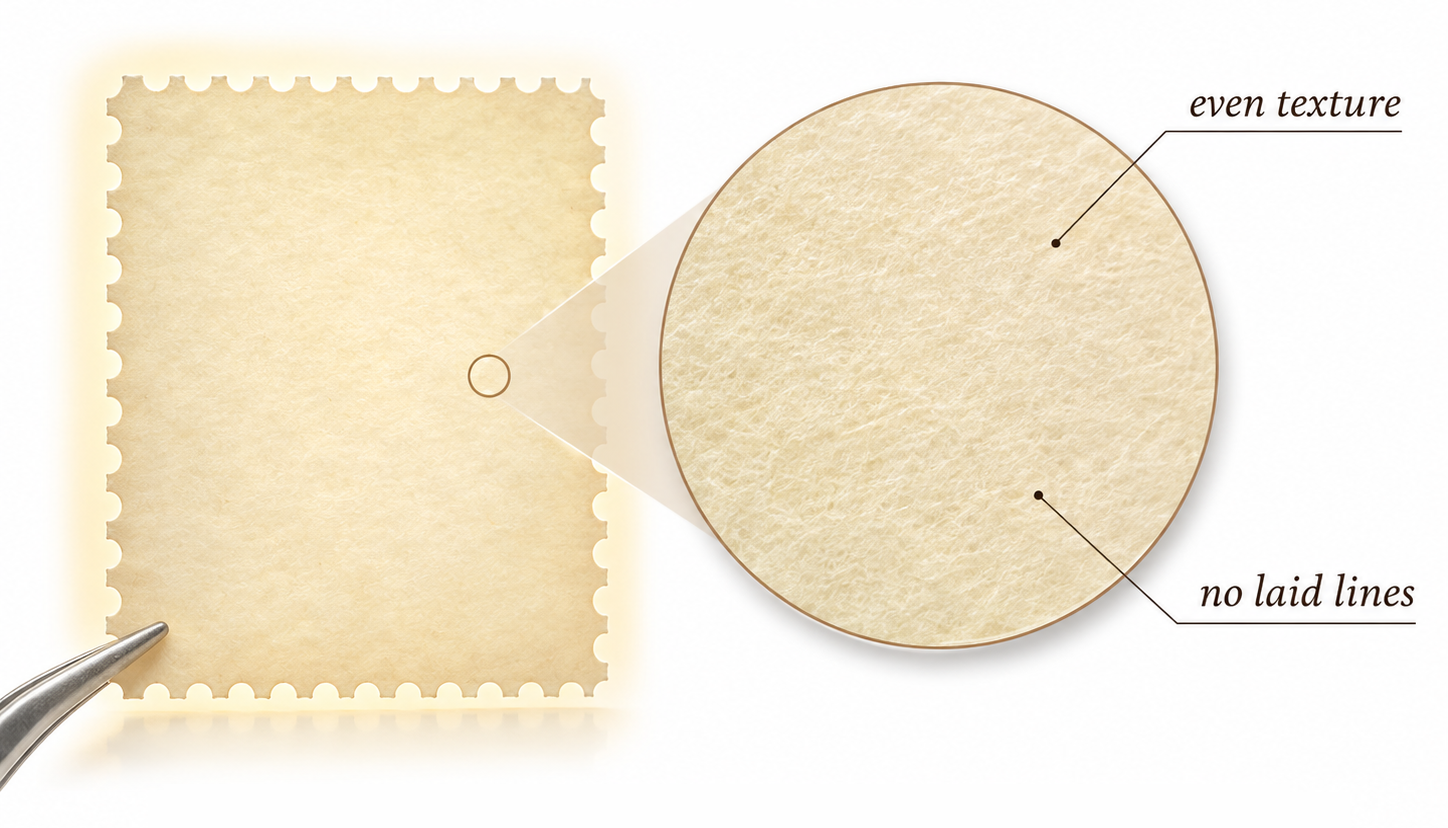
Image information
Click image to magnify
Diagram of wove paper with a magnified inset showing an even texture without laid lines.
- Credit
- Stunning Stamps · 2026
- Notes
- Digitally constructed
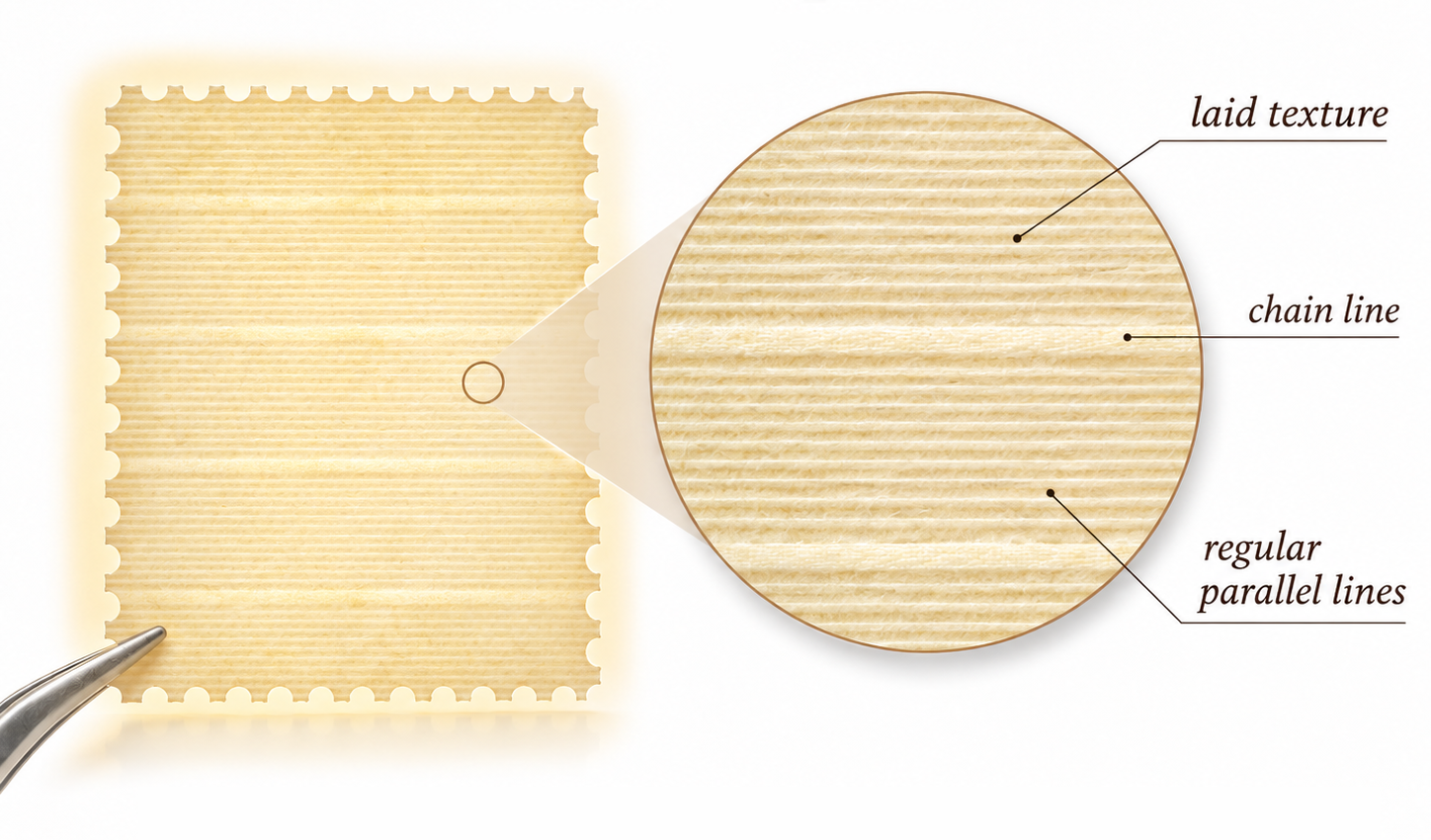
Image information
Click image to magnify
Diagram of laid paper with a magnified inset showing regular parallel lines.
- Credit
- Stunning Stamps · 2026
- Notes
- Digitally constructed
On this stamp
The 1841 Penny Red was printed on handmade wove paper with a Small Crown watermark. Wove describes the texture; Small Crown describes the separate watermark pattern. Original paper can show blueing; that appearance is distinct from the lines left in laid paper.
Small Crown watermark
A watermark is a pattern within the paper, formed during manufacture. It is separate from the printed image and can become visible when light passes through the sheet.
These issues used handmade paper with a Small Crown intended for each stamp position. Crown-shaped wires on the papermaking mould formed the pattern. The crowns were made individually, so their outlines were not absolutely identical.
Paper could be placed the other way up for printing, producing an inverted watermark. A faint or incomplete crown must be assessed from the original paper; the portrait on the front does not establish its orientation.
On this stamp
The 1841 Penny Red used Small Crown paper. The watermark belongs to the paper beneath the design and is not visible in this front-view reconstruction.
Imperforate stamps and margins
Imperforate means that a sheet has no punched holes to guide separation. A clerk or customer cut the stamps apart. The spaces between the printed designs therefore became the margins of the individual stamps.
Cuts could be close, uneven or slanting. When examining an original, look at each side separately: a margin may be clear on three sides but touch the printed frame on the fourth. Attached pairs and blocks can also show how closely the stamps sat together in the sheet.
A margin is the blank paper outside the printed design. It is different from the white areas deliberately left within the design, such as the portrait and lettering. A perforation gauge has no role in measuring these cut edges.
On this stamp
This page covers the imperforate 1841 Penny Red. The original stamps were cut from sheets; the later perforated issues are separate entries in the collection.
Sheets of 240 stamps
The printing plate carried one pane of 240 stamps: twenty rows of twelve. A pane is a group of stamps within a sheet; here the stamps formed a single uninterrupted group, with no gutter dividing it into smaller panes.
At one penny each, a row of twelve cost one shilling and the complete sheet cost one pound. At twopence each, those amounts doubled to two shillings per row and two pounds per sheet.
The surrounding sheet margins carried instructions, prices and plate numbers. Those inscriptions were outside the individual stamp designs and normally disappeared when a stamp was cut from the sheet.
On this stamp
A complete sheet of the 1841 Penny Red contained 240 stamps. Its face value was £1; each row of twelve was worth 1s.
Gum and use
The gum is the adhesive coating on the back. The printed sheets were gummed and dried; moistening the back allowed the sender to attach a stamp to a letter.
On an unused original, the gum is a separate feature from the paper and printed design. The front of a stamp cannot show whether its original gum survives. Old paper and gum also vary in appearance, so neither should be judged from a front-view illustration.
On this stamp
The 1841 Penny Red was supplied as a gummed adhesive stamp. Its modern front-view illustration records neither the survival nor the condition of original gum.
Prepaid inland letter rates
Uniform Penny Postage began on 10 January 1840, before adhesive stamps went on sale. For an ordinary prepaid General Post letter within the United Kingdom, the charge depended on weight: 1d up to half an ounce, 2d over half an ounce and up to one ounce, then 4d over one ounce and up to two ounces.
Stamps could be combined to make up the required amount. A heavier letter did not require a single stamp of exactly that value: two penny stamps could pay the twopenny rate, for example. Foreign destinations and special services had their own charges.
On this stamp
One 1841 Penny Red could prepay an ordinary General Post inland letter weighing no more than half an ounce. A heavier letter needed more postage.
Prepaid inland letter rates
Uniform Penny Postage began on 10 January 1840, before adhesive stamps went on sale. For an ordinary prepaid General Post letter within the United Kingdom, the charge depended on weight: 1d up to half an ounce, 2d over half an ounce and up to one ounce, then 4d over one ounce and up to two ounces.
Stamps could be combined to make up the required amount. A heavier letter did not require a single stamp of exactly that value: two penny stamps could pay the twopenny rate, for example. Foreign destinations and special services had their own charges.
On this stamp
A General Post inland letter over one ounce and up to two ounces cost 4d: four penny stamps could make up that amount.
Cancellations and postal use
A cancellation marks a stamp as used so that it cannot pay postage again. On these early British stamps, the familiar Maltese Cross is an ornamental obliterating mark; the date and place of posting may appear in a separate handstamp on the letter.
The original black penny was normally cancelled in red. The introduction of the red penny in 1841 allowed a black cancellation to show clearly. The change followed experiments with stamp and cancelling inks intended to make removal of the cancellation more difficult.
The Maltese Cross was followed by numeral cancellations from 1844. A design introduced in 1841 can therefore bear either kind, depending on when and where the stamp was used.
On this stamp
The 1841 Penny Red can bear a black Maltese Cross or, on later use, a numeral cancellation. A complete cover helps relate the obliterating mark to a date and place.
Sources
- Smithsonian National Postal Museum: Introducing the Penny Red, ink trials and 10 February 1841 introduction
- Edward Klempka, Gibbons Stamp Monthly: Britain’s 1840 and 1841 Two Pence Issues, plates, white lines and cancellations
- American Philatelic Society: Stamp Vocabulary, imperforate, gum and cancellation
Catalogue references
A stamp catalogue gives each listed issue a reference number. SG means Stanley Gibbons, the publisher of the catalogue used here. These numbers help collectors refer to the same issue; they are not serial numbers printed on individual stamps.
A range of numbers groups related entries. Colour, paper or perforation differences may account for separate listings within that range.
On this stamp
The recorded reference is SG8, with letters B–B. No printing plate is assigned to this reconstruction. This identifies the illustrated selection, rather than every shade or printing of the issue.
Letters within the sheet
Read the two lower corner letters from left to right. The left letter gives the row, A to T; the right gives the position within that row, A to L. A–A is the top-left stamp and T–L is the bottom-right stamp in a sheet of twenty rows of twelve.
Each pair occurs once in a complete sheet. The letters were punched into the plate separately after the design had been transferred, so their precise placement can vary.
The same letter pairs recur on different plates. They locate a stamp within the sheet, but cannot identify its plate alone. Plate identification combines the lettering with other small, documented features of the printed impression.
On this stamp
The illustration carries B–B: row two, position two. Other positions have different pairs.
Dies, plates and plate identification
The die carried the original engraved design. A transfer roller copied that design into the many positions on a printing plate. A plate was the working surface from which complete sheets were printed.
These early stamps have no plate number inside the individual design. Numbers appeared in the outer sheet margins. Once that margin was removed, identification depended on comparison with recorded impressions: the positions of corner letters, small flaws, repairs and other recurring details.
Several plates could carry the same design and the same corner-letter pair. A catalogue number, a colour name or the letters alone therefore cannot establish a plate.
On this stamp
The red penny was printed from both reused black plates and further plates made for red printing. No plate has been assigned to this reconstruction; its B–B letters are a position in the sheet.
Portrait source
William Wyon was a medallist and engraver at the Royal Mint. His models of royal heads were made for coins and medals and also became sources for stamp portraits.
On this stamp
Wyon’s City of London medal supplied the portrait source used on the 1841 Penny Red.
Sources
- Museums Victoria: William Wyon, Medallist & Engraver
- Douglas N. Muir, William Wyon & the Penny Black, Royal Mint Museum
- Wright and Creeke, A History of the Adhesive Stamps of the British Isles (1899), pp. 11, 34–35
- Wright and Creeke, A History of the Adhesive Stamps of the British Isles (1899), introduction p. xxiii; pp. 1–3, 11, 18–19, 24–28, 46–51
Original portrait drawing
Henry Corbould was a draughtsman and book illustrator. He trained with his father and at the Royal Academy Schools, where he received a silver medal for a life study.
On this stamp
Corbould’s drawing after Wyon’s medal helped prepare the original portrait carried by the 1841 Penny Red.
Sources
- Lucy Peltz, Henry Corbould, Oxford Dictionary of National Biography — introductory extract
- Douglas N. Muir, William Wyon & the Penny Black, Royal Mint Museum
- Wright and Creeke, A History of the Adhesive Stamps of the British Isles (1899), pp. 11, 34–35
- Wright and Creeke, A History of the Adhesive Stamps of the British Isles (1899), introduction p. xxiii; pp. 1–3, 11, 18–19, 24–28, 46–51
Original portrait engraving
Charles Heath was an engraver and publisher of illustrated books. Work from his workshop could carry his signature even when assistants had contributed to the engraving.
Frederick Heath, Charles Heath’s son, was an engraver working in the family’s illustrated-book business. His surviving prints include engraved interpretations of other artists’ paintings.
On this stamp
The original portrait engraving is attributed to Charles Heath or his son Frederick; the individual responsibility remains unresolved. This stamp inherits that original portrait; it does not represent a new portrait commission.
Sources
- University of Edinburgh, Walter Scott Digital Archive: Charles Heath
- Douglas N. Muir, William Wyon & the Penny Black, Royal Mint Museum
- Wright and Creeke, A History of the Adhesive Stamps of the British Isles (1899), pp. 11, 34–35
- Wellcome Collection: A young bride in Naples, engraved by Frederick A. Heath after Thomas Uwins (1847), 28393i
- Wright and Creeke, A History of the Adhesive Stamps of the British Isles (1899), introduction p. xxiii; pp. 1–3, 11, 18–19, 24–28, 46–51