
Understanding the stamp details
1d red-brown · Die II · Perkins, Bacon & Co.
Die I and Die II
A die is the master engraving from which the design is transferred to printing plates. A plate contains the many stamp images used to print a sheet. A change of master die can affect a whole family of plates; it is different from repairing one position on a particular plate.
The penny’s Die II came from William Humphrys’s strengthening of a reproduction of the earlier engraving. The original die was preserved. The revised portrait generally has fuller contours and more clearly defined features, but reliable identification requires comparison of several engraved details on an original.
Die, plate and perforation are separate classifications. A change in the edge holes does not itself mean that the portrait was re-engraved. The penny’s Die II terminology should not be transferred to a twopence merely because the stamps share a year or a gauge.
On this stamp
On this stamp, Die II identifies William Humphrys's revision of the earlier portrait. He worked on a reproduction of the original die, deepening its lines. The original was preserved. The revision was approved in November 1854, before its appearance on issued stamps in 1855.
Sources
- Wright and Creeke, A History of the Adhesive Stamps of the British Isles (1899), pp. 1–11, 30–36 and 51–53: line engraving, perforation, paper and the two values
- Tony Ward, Introduction to Penny Stars (IPDA), pp. 6–15: gauges, alphabets, dies and crown watermarks
- Wright and Creeke, A History of the Adhesive Stamps of the British Isles (1899), pp. 1–3, 11, 18, 33–35 and die comparisons
Perforations 16 and 14
A perforation gauge expresses the number of holes along a distance of two centimetres. It is not the total number around a stamp. Gauge 16 has more closely spaced holes than gauge 14.
The early fine perforation caused two related problems: it removed so much paper that neighbouring stamps separated too easily, and the holes left too little metal in the plates into which the perforating pins descended. In January 1855 the spacing was altered so that fourteen pins occupied the distance previously taken by sixteen. More paper remained between holes, and more metal between the holes in the equipment.
The two gauges overlapped in use. Earlier fine-gauge equipment continued to be used while serviceable, so 16 does not invariably mean an earlier stamp than 14. On an original, measure the spacing against a perforation gauge; the total number of teeth on an enlarged picture is not a calibrated measurement.
Image information
Enlarged perforation spacing: fourteen equal intervals between hole centres span 20 millimetres. This is a schematic, not a ruler.
- Credit
- Stunning Stamps · 2026
On this stamp
The older gauge continued in use while its equipment remained serviceable. Both perforations occur on the Die II stamps covered here. A perforation difference on its own does not establish a different portrait or a later issue date.
Letters within the sheet
Read the two lower corner letters from left to right. The left letter gives the row, A to T; the right gives the position within that row, A to L. A–A is the top-left stamp and T–L is the bottom-right stamp in a sheet of twenty rows of twelve.
Each pair occurs once in a complete sheet. The letters were punched into the plate separately after the design had been transferred, so their precise placement can vary.
The same letter pairs recur on different plates. They locate a stamp within the sheet, but cannot identify its plate alone. Plate identification combines the lettering with other small, documented features of the printed impression.
On this stamp
The selected illustrations show J–I (row ten, position nine) and R–I (row eighteen, position nine). Other stamps of these issues carry different pairs.
Sources
- Wright and Creeke, A History of the Adhesive Stamps of the British Isles (1899), pp. 1–11, 30–36 and 51–53: line engraving, perforation, paper and the two values
- Wright and Creeke, A History of the Adhesive Stamps of the British Isles (1899), pp. 1–3, 11, 18, 33–35 and die comparisons
- Cavendish: SG21 mint trio, selected J–I specimen
- Sturminster Stamps: Penny Reds on Small Crown paper, including SG24 plate 4
The corner-letter alphabets
Alphabet describes the shapes of the letters punched into the lower corner squares. It does not change their meaning: the left letter still gives the row and the right letter the position within it.
On the penny, Alphabet II has comparatively broad, substantial forms; Alphabet III is generally taller and narrower. These classifications help separate printings that otherwise share a portrait and denomination.
Ink spread, wear, a cancellation or an unclear photograph can hide the distinguishing details. Use documented letter comparisons on an original stamp, and check the paper and watermark as well. A pair such as D–J gives a sheet position, not an alphabet classification by itself.
On this stamp
Both illustrated versions are recorded as Alphabet II. The reconstructed images are not a substitute for comparison of microscopic letter shapes on an original stamp.
Sources
- Tony Ward, Introduction to Penny Stars (IPDA), pp. 6–15: gauges, alphabets, dies and crown watermarks
- Wright and Creeke, A History of the Adhesive Stamps of the British Isles (1899), pp. 1–11, 30–36 and 51–53: line engraving, perforation, paper and the two values
- Cavendish: SG21 mint trio, selected J–I specimen
- Sturminster Stamps: Penny Reds on Small Crown paper, including SG24 plate 4
Small Crown watermark
A watermark is a pattern within the paper, formed during manufacture. It is separate from the printed image and can become visible when light passes through the sheet.
Small Crown paper was made with one crown intended for each stamp position. The crown-shaped pieces on the papermaking mould were fashioned individually, so their outlines can vary. The later introduction of Large Crown paper is a separate change from the revision of the portrait or the perforation gauge.
Paper could be placed the other way up for printing, producing an inverted watermark. A faint or incomplete crown must be assessed from the original paper; the portrait on the front does not establish its orientation.
On this stamp
Both versions here belong to the Small Crown issue. The watermark cannot be read from these front-view reconstructions.
Sources
- Wright and Creeke, A History of the Adhesive Stamps of the British Isles (1899), pp. 1–11, 30–36 and 51–53: line engraving, perforation, paper and the two values
- Tony Ward, Introduction to Penny Stars (IPDA), pp. 6–15: gauges, alphabets, dies and crown watermarks
- American Philatelic Society: Watermarks — A Philatelic Introduction, handmade Small Crown paper
- H. L’Estrange Ewen, Standard Priced Catalogue of the Stamps and Postmarks of the United Kingdom (1898), p. 20 — historical early-use records
Why the heading says 1855
An approval date, a plate’s first printing date and a stamp’s first postal use describe different events. The revised die was approved on 11 November 1854 and its first plate went to press on 16 January 1855. Neither establishes when an individual perforation variety was first sold.
Ewen’s 1898 catalogue reported 6 March 1855 for the Small Crown, Die II, perforation 16 stamp and 28 February 1855 for perforation 14. These are the early uses known to that author at that time.
On this stamp
The heading retains the year 1855. Ewen’s observations are not asserted as official release dates or as the earliest examples known today.
Sources
- Wright and Creeke, A History of the Adhesive Stamps of the British Isles (1899), introduction p. xxiii; pp. 1–3, 11, 18–19, 24–28, 46–51
- The Postal Museum: The first ever stamp — the Penny Black, printing, sheets and dates
- Wright and Creeke, A History of the Adhesive Stamps of the British Isles (1899), pp. 1–3, 11, 18, 33–35 and die comparisons
- H. L’Estrange Ewen, Standard Priced Catalogue of the Stamps and Postmarks of the United Kingdom (1898), p. 20 — historical early-use records
Printing from engraved lines
Line engraving is a form of recess, or intaglio, printing. The lines that carry ink are cut below the surface of a metal plate. After inking the plate, the printer wipes the flat surface clean, leaving ink in the engraved grooves.
Damp paper is pressed firmly against the plate and takes up the ink from those grooves. The fine coloured lines form the image; the spaces between them leave the paper visible. This differs from surface printing, where the raised parts of the printing surface carry the ink.
A transfer roller repeated the design from the die across a steel plate. The corner letters were added separately to each position. Printing, gumming and drying preceded perforation: punching the holes was a separate operation from making the coloured image.
Image information
Side view of recess printing: ink remains in grooves below the plate surface and pressure brings paper into contact with it.
- Credit
- Stunning Stamps · 2026
On this stamp
The Penny Red was printed by this recess process. The later steam-press experiments concern attempts to mechanise the work.
Printer
Perkins Bacon was a London security printer. Its engraved stamp production combined the preparation of steel plates with the repeated inking, wiping and pressing of sheets.
On this stamp
Perkins, Bacon & Co. printed these 1855 Die II Penny Reds by intaglio from engraved steel plates. The page groups the perforation 16 and perforation 14 versions.
Die II re-engraving
William Humphrys trained in Philadelphia and engraved banknotes before working in London. His career included book illustration and the fine steel engraving used for security printing.
On this stamp
Humphrys revised the inherited portrait for Die II, working on a reproduction while the original die remained intact. His later retouch is distinct from the original engraving used for the Penny Black.
Portrait source
William Wyon was a medallist and engraver at the Royal Mint. His models of royal heads were made for coins and medals and also became sources for stamp portraits.
On this stamp
Wyon’s City of London medal supplied the earlier portrait source. This likeness was inherited by the Penny Red; Wyon did not carry out the Die II re-engraving.
Original portrait drawing
Henry Corbould was a draughtsman and book illustrator. He trained with his father and at the Royal Academy Schools, where he received a silver medal for a life study.
On this stamp
Corbould’s drawing after Wyon’s medal helped prepare the original stamp portrait. It was inherited by this later Penny Red; he was not commissioned for the 1855 retouch.
Original portrait engraving
Charles Heath was an engraver and publisher of illustrated books. Work from his workshop could carry his signature even when assistants had contributed to the engraving.
Frederick Heath, Charles Heath’s son, was an engraver working in the family’s illustrated-book business. His surviving prints include engraved interpretations of other artists’ paintings.
On this stamp
The inherited portrait engraving is attributed to Charles Heath or his son Frederick; their individual roles remain unresolved. William Humphrys’s later Die II revision is a separate, documented contribution.
Sources
- Douglas N. Muir, William Wyon & the Penny Black, Royal Mint Museum
- Wright and Creeke, A History of the Adhesive Stamps of the British Isles (1899), pp. 11, 34–35
- University of Edinburgh, Walter Scott Digital Archive: Charles Heath
- Wellcome Collection: A young bride in Naples, engraved by Frederick A. Heath after Thomas Uwins (1847), 28393i
Country and monarch
The country identifies the postal authority that issued the stamp. The monarch identifies the ruler whose portrait it carries. A definitive is an everyday stamp intended for regular postal use.
On this stamp
This Great Britain definitive carries Queen Victoria’s portrait.
Denomination
The denomination is the stamp’s face value: the amount of postage it represents. Its price to a collector can be quite different.
In Britain’s old currency, 12 pence made one shilling and 20 shillings made one pound: 240 pence altogether. The abbreviations were d for pence, s for shillings and £ for pounds. The d comes from the Latin denarius. A halfpenny, written ½d, was half an old penny.
On this stamp
Twelve penny stamps made one shilling; a sheet of 240 had a face value of one pound.
Stamp shades
A shade is a variation within a stamp’s colour. Some variations receive their own catalogue numbers even though the design and denomination stay the same.
Compare known examples under consistent lighting. Fading can change a stamp’s appearance, and photographs or screens can alter how colours look. A catalogue colour name helps describe a shade; it is not a colour test by itself.
On this stamp
Both illustrated 1855 versions are described as red-brown. Their paper, watermark and perforation must also be considered when identifying an original.
The perforated Stars issues
Stars names the ornaments in the two upper corner squares. The lower squares contain check letters identifying a position in the sheet. It distinguishes this design family from later stamps with letters in all four corners.
The set brings together the early perforated penny and twopence designs shown here. Perforation, portrait die, corner-letter style, paper and watermark changed at different times. The dates in the set heading identify these selected articles; they are not a claim that every Stars variety ended in 1857.
On this stamp
The upper squares contain stars and the lower squares contain letters. Both illustrated perforation versions remain together in this article.
Wove paper
Wove describes the structure of the paper. Viewed against the light, it has a fairly even appearance. Laid paper instead shows a regular pattern of lines left by its manufacture.
Paper structure and watermark are separate characteristics: wove paper can carry a watermark. Both can help distinguish stamps with similar printed designs.
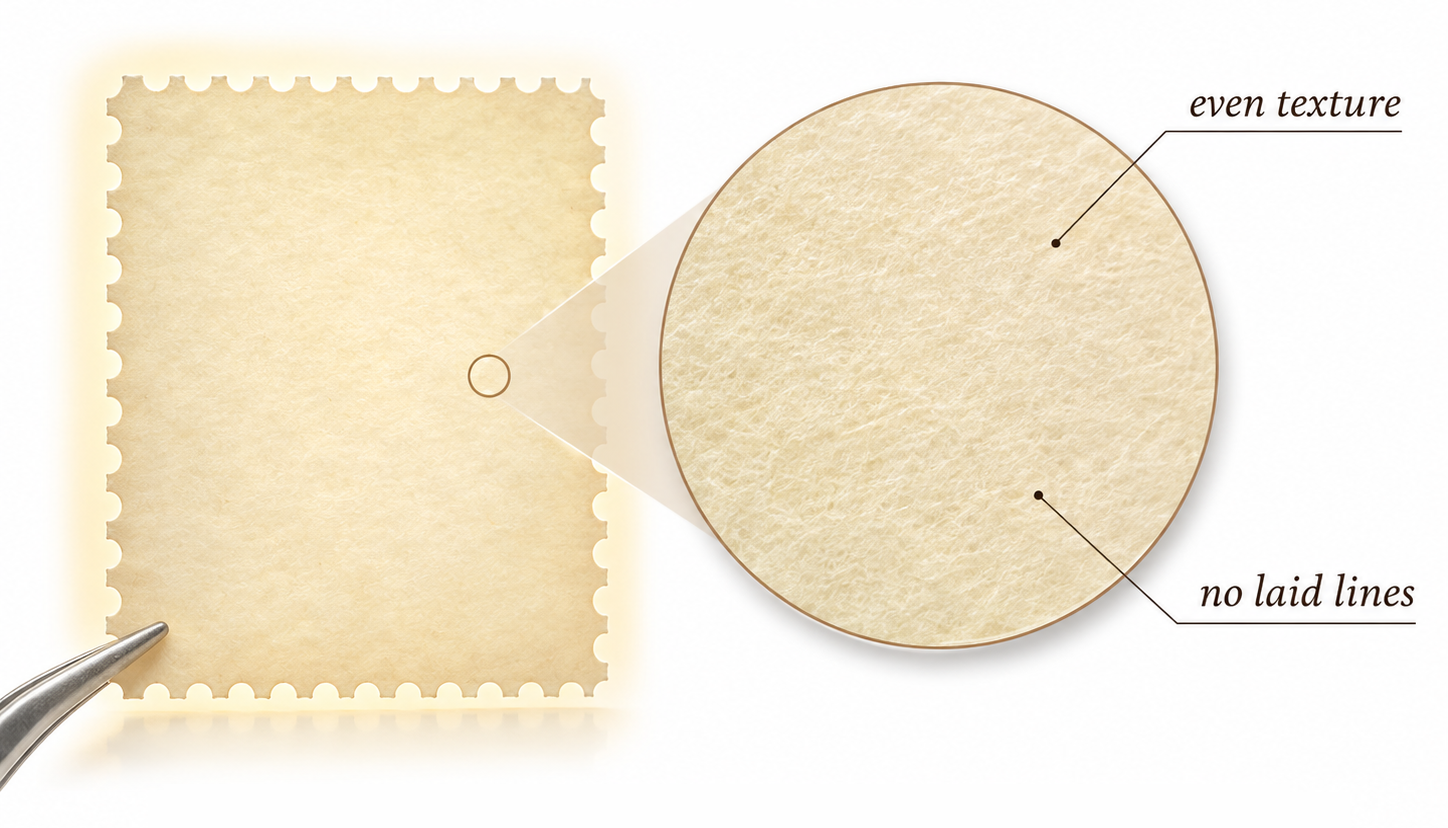
Image information
Click image to magnify
Diagram of wove paper with a magnified inset showing an even texture without laid lines.
- Credit
- Stunning Stamps · 2026
- Notes
- Digitally constructed
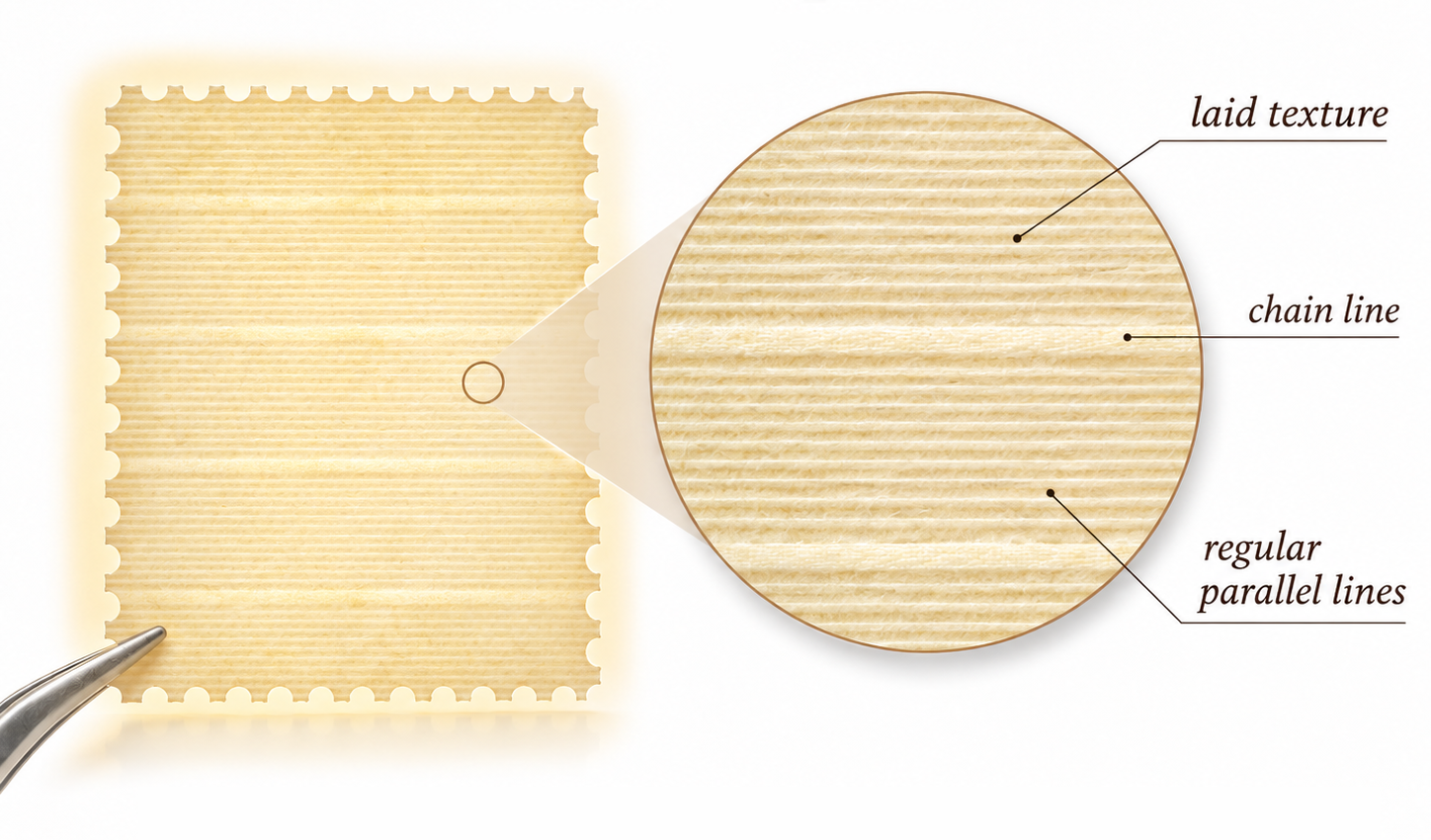
Image information
Click image to magnify
Diagram of laid paper with a magnified inset showing regular parallel lines.
- Credit
- Stunning Stamps · 2026
- Notes
- Digitally constructed
On this stamp
The Small Crown issues can show a blue cast in the paper, of varying strength. Wove describes its structure. The clean front-view reconstructions do not establish the degree of blueing on an original.
Sheets of 240 stamps
The printing plate carried one pane of 240 stamps: twenty rows of twelve. A pane is a group of stamps within a sheet; here the stamps formed a single uninterrupted group, with no gutter dividing it into smaller panes.
At one penny each, a row of twelve cost one shilling and the complete sheet cost one pound. At twopence each, those amounts doubled to two shillings per row and two pounds per sheet.
The outer margins carried instructions, prices and plate numbers. These lay outside the individual designs and were normally lost when the stamps were separated. A number in the sheet margin is therefore different from the corner letters on each stamp.
On this stamp
Twenty rows of twelve pennies made a sheet of 240 stamps with a face value of one pound.
Gum and use
The gum is the adhesive coating on the back. The printed sheets were gummed and dried; moistening the back allowed the sender to attach a stamp to a letter.
On an unused original, the gum is a separate feature from the paper and printed design. The front of a stamp cannot show whether its original gum survives. Old paper and gum also vary in appearance, so neither should be judged from a front-view illustration.
On this stamp
The illustrations show the front of the stamps. They make no claim about surviving original gum on a physical specimen.
Catalogue references
A stamp catalogue gives each listed issue a reference number. SG means Stanley Gibbons, the publisher of the catalogue used here. These numbers help collectors refer to the same issue; they are not serial numbers printed on individual stamps.
A range of numbers groups related entries. Colour, paper or perforation differences may account for separate listings within that range.
On this stamp
The perforation 16 illustration is recorded as SG21 · J–I; plate not assigned. The reference describes its source; the reconstruction is not a certificate of shade or microscopic plate details.
Sources
- Stanley Gibbons: Philatelic terms for beginners
- Recorded illustration reference: Great Britain Queen Victoria 1855 penny red-brown Stars, Die II, Alphabet II, perforation16, SG21; corner letters J/I
- Recorded illustration reference: Great Britain1855 penny red-brown Stars, DieII, AlphabetII, SmallCrown perforation14, SG24 plate4, R/I
Catalogue references
A stamp catalogue gives each listed issue a reference number. SG means Stanley Gibbons, the publisher of the catalogue used here. These numbers help collectors refer to the same issue; they are not serial numbers printed on individual stamps.
A range of numbers groups related entries. Colour, paper or perforation differences may account for separate listings within that range.
On this stamp
The perforation 14 illustration is recorded as SG24 · R–I · plate 4. The reference describes its source; the reconstruction is not a certificate of shade or microscopic plate details.
Sources
- Stanley Gibbons: Philatelic terms for beginners
- Recorded illustration reference: Great Britain Queen Victoria 1855 penny red-brown Stars, Die II, Alphabet II, perforation16, SG21; corner letters J/I
- Recorded illustration reference: Great Britain1855 penny red-brown Stars, DieII, AlphabetII, SmallCrown perforation14, SG24 plate4, R/I
Dies, plates and plate identification
The die carried the original engraved design. A transfer roller copied that design into the many positions on a printing plate. A plate was the working surface from which complete sheets were printed.
These early stamps have no plate number inside the individual design. Numbers appeared in the outer sheet margins. Once that margin was removed, identification depended on comparison with recorded impressions: the positions of corner letters, small flaws, repairs and other recurring details.
Several plates could carry the same design and the same corner-letter pair. A catalogue number, a colour name or the letters alone therefore cannot establish a plate.
On this stamp
Perforation 14: plate 4; perforation 16: not assigned. A recorded plate belongs to that specimen reference, not automatically to every stamp in the grouped article.
Sources
- Wright and Creeke, A History of the Adhesive Stamps of the British Isles (1899), pp. 1–11, 30–36 and 51–53: line engraving, perforation, paper and the two values
- Recorded illustration reference: Great Britain Queen Victoria 1855 penny red-brown Stars, Die II, Alphabet II, perforation16, SG21; corner letters J/I
- Recorded illustration reference: Great Britain1855 penny red-brown Stars, DieII, AlphabetII, SmallCrown perforation14, SG24 plate4, R/I
Prepaid inland letter rates
Uniform Penny Postage began on 10 January 1840, before adhesive stamps went on sale. For an ordinary prepaid General Post letter within the United Kingdom, the charge depended on weight: 1d up to half an ounce, 2d over half an ounce and up to one ounce, then 4d over one ounce and up to two ounces.
Stamps could be combined to make up the required amount. A heavier letter did not require a single stamp of exactly that value: two penny stamps could pay the twopenny rate, for example. Foreign destinations and special services had their own charges.
On this stamp
One penny paid the ordinary prepaid inland letter rate up to half an ounce. Heavier letters and additional services required more postage.
Numeral cancellations and postal use
The cancellation is the inked mark that prevents a stamp being used again. By the period of these issues, barred obliterators with office numbers had succeeded the Maltese Cross as the usual form. A town or date mark could be applied separately, or alongside the obliterator in a combined device.
The office number is part of the postmark, not a printing-plate number. A cancellation can cover the portrait, letters or fine plate details; it must be distinguished from marks produced during printing.
An unused reconstruction has no such mark. For a used original, the whole cover gives the strongest context for interpreting the date, route and postage. A loose stamp seldom establishes all three.
On this stamp
Both reconstructions are shown unused. On originals, a numeral cancellation can help identify a posting office, but it is unrelated to the stamp’s plate number.