
The design of the 2d deep blue
Queen Victoria · Great Britain · Perkins, Bacon & Co. · 1854
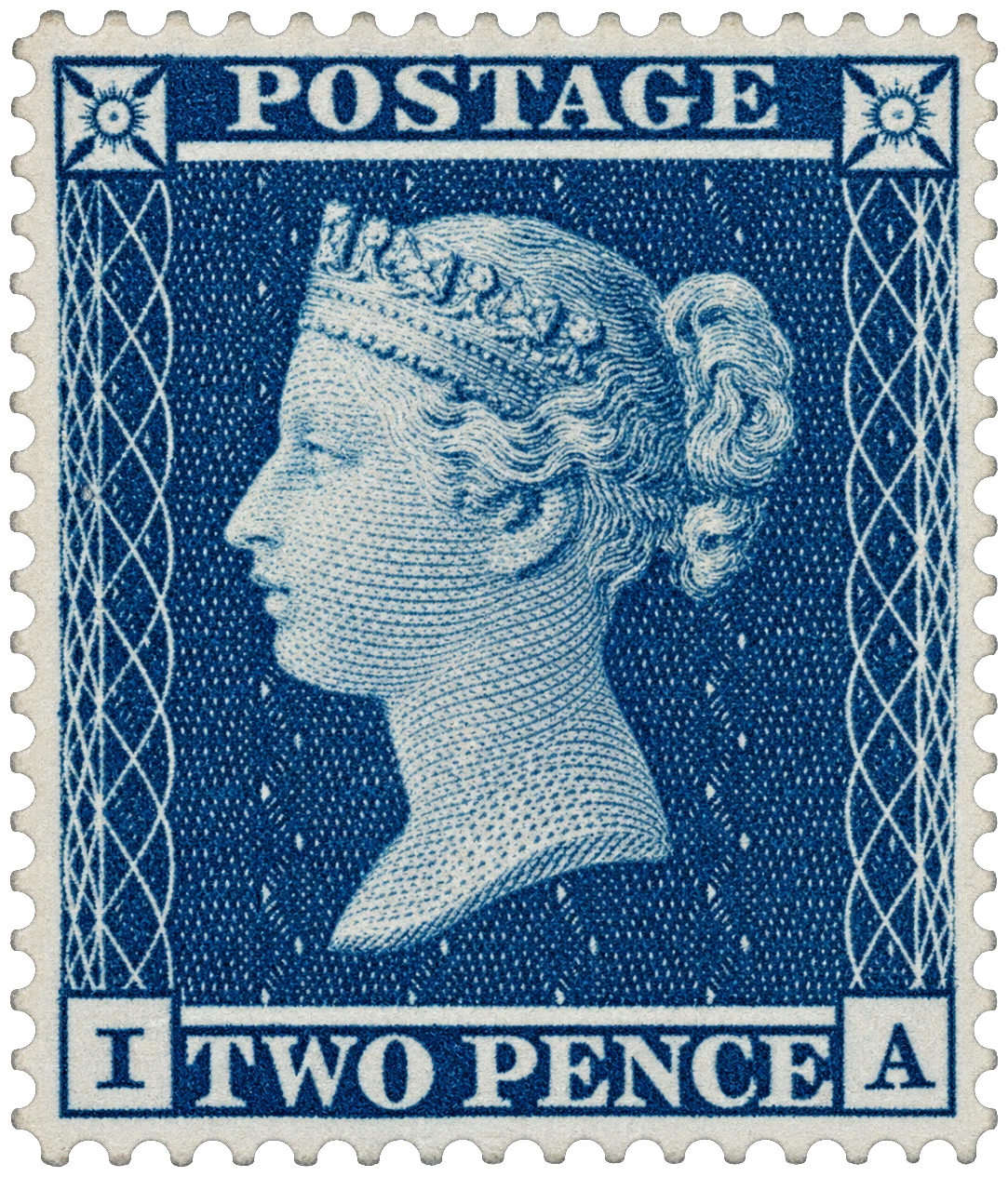
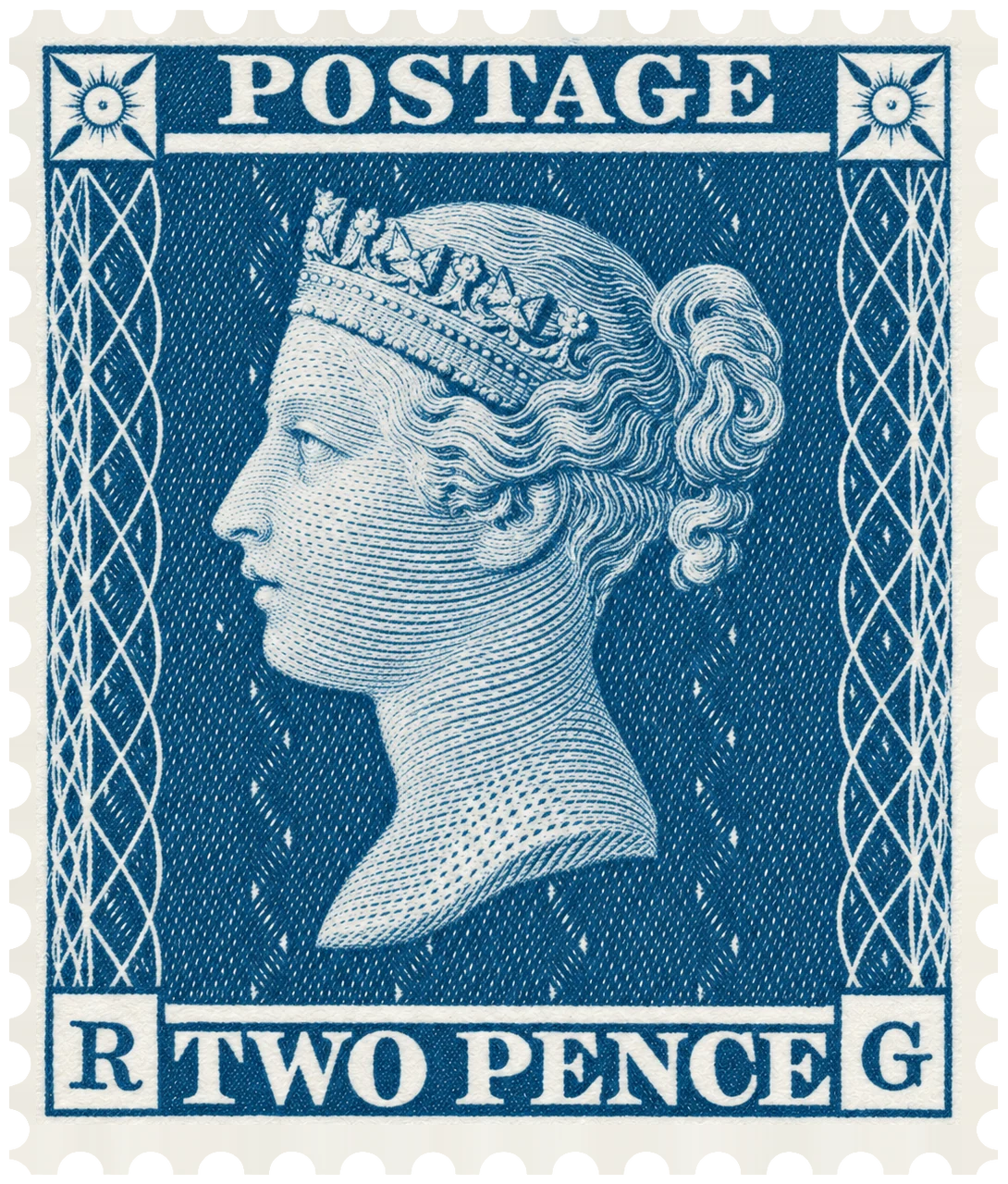
Two white lines inherited from 1841
Look closely above and below Victoria's portrait. A white horizontal line runs beneath POSTAGE, and another appears above TWO PENCE.
These lines were introduced in 1841, when the Post Office changed the blue printing ink. The original ink had proved too resistant to chemicals used to remove cancellations. The replacement was intended to be damaged by any attempt to clean a stamp. [1]
The Treasury wanted stamps printed in the new ink to be distinguishable from the old ones. Two white lines provided a simple solution without changing the denomination or colour.
The 1854 perforated stamps retained these lines. They are a reminder that the design had already been modified once for security reasons, long before the introduction of perforations.
The Queen who appeared to wear spectacles
One impression on printing plate 4 developed an extraordinary flaw. A fine scratch crossed Victoria's face, running from the eye towards the ear.
On the stamp with lower corner letters B H, the mark gives the impression that the Queen is wearing spectacles. It became known as the Spectacles Flaw. [2]
The flaw appeared during the plate's working life and can be found on both imperforate and perforated stamps.
It was not part of the engraved design. A small piece of accidental damage to the steel plate had become visible in every impression taken from that position.
The flaw is particularly amusing because Victoria's portrait was otherwise reproduced with such care. A tiny scratch had given the young Queen an unexpected accessory.
The star with a missing ray
The ornaments in the upper corners are called stars, although they are more elaborate than ordinary five-pointed stars.
On plate 4, the upper-left star has a distinctive flaw. One of its rays, at approximately the eight o'clock position, is missing. [3]
The flaw was transferred from the original die arrangement and appears repeatedly across stamps printed from the plate.
It is a tiny detail, easily overlooked without magnification, but it also occurs on plate 5 and cannot identify plate 4 on its own. [4]
The missing ray shows how a small imperfection could become part of an otherwise carefully repeated design. What began as a flaw was reproduced hundreds of times across successive printing sheets.
The tiny holes that changed twice
The two versions of the 1854 Two Pence Blue have the same engraved design, but their perforations differ.
The first, introduced in 1854, has sixteen perforation intervals over two centimetres. In early 1855, the spacing changed to fourteen, removing less paper and leaving stronger joins between stamps. [5]
The change also helped the machinery. With sixteen closely spaced holes, the steel plate supporting the paper had too little metal between the openings for the punching pins. Fourteen holes allowed a stronger plate.
The machines did not need replacing. Different pins and matching guide plates could be fitted to the existing equipment.
Both gauges continued in use for some time. The stamps preserve successive attempts to make the same invention work more reliably.
The larger letters of a new printing plate
In June 1855, the printers completed plate 5, replacing the ageing plate 4.
The new plate retained Victoria's portrait, the white lines and the star ornaments, but its lower corner letters were noticeably larger. A different set of letter punches had been used. [1]
Plate 4 had used relatively small letters. Those on plate 5 were broader and more prominent.
The change was not intended as a new stamp design. It reflected developments in the tools used to prepare the printing plates.
A careful comparison of the lower corners can therefore reveal something about the craftsmen who made the plates, even when the rest of the stamps appears almost identical.
Two letters added by hand
The letters in the lower corners are not the engraver's initials. They identify the stamp's position in the printing sheet.
Each sheet contained 240 stamps, arranged in twenty rows of twelve. The left letter identified the row, from A to T; the right identified the column, from A to L. The first stamp was AA and the last TL. A complete sheet was worth two pounds. [1]
The original printing die did not contain these letters. They were punched individually into each position on the steel plate.
Occasionally letters were incorrectly positioned or needed correcting, leaving tiny differences visible on surviving stamps.
The small letters remind us that even early mass-produced postage stamps depended on careful handwork.
Why the paper sometimes looks blue
The perforated Two Pence Blue was printed on paper that could acquire a bluish tint. This was not simply ink showing through from the front.
The colour was associated with chemical ingredients used in the printing ink. Prussiate of potash, introduced during earlier security experiments, could contribute to blue discolouration when the ink contacted dampened paper. [1]
The effect varied between printings and could be particularly noticeable on the reverse.
These perforated stamps retained a characteristic of the earlier imperforate Two Pence Blue. Beneath the new rows of holes was the same paper-and-ink technology developed during the experiments of 1840 and 1841.
A portrait of a fifteen-year-old princess
Victoria's portrait originated before she became Queen. William Wyon, Chief Engraver at the Royal Mint, created a medal commemorating her visit to the City of London in November 1837. Its portrait drew on a sketch made in 1834, when Victoria was fifteen. The medal was issued in 1838. [6]
Rowland Hill chose Wyon's portrait for the new postage stamps. Henry Corbould prepared a drawing from the medal, which was then translated into an engraving. Wyon supplied the original image but did not engrave the postage stamp's printing die.
The profile became one of Victoria's most enduring images. While the Queen grew older, her youthful likeness continued to appear on British postage stamps throughout her reign. [7, 8]
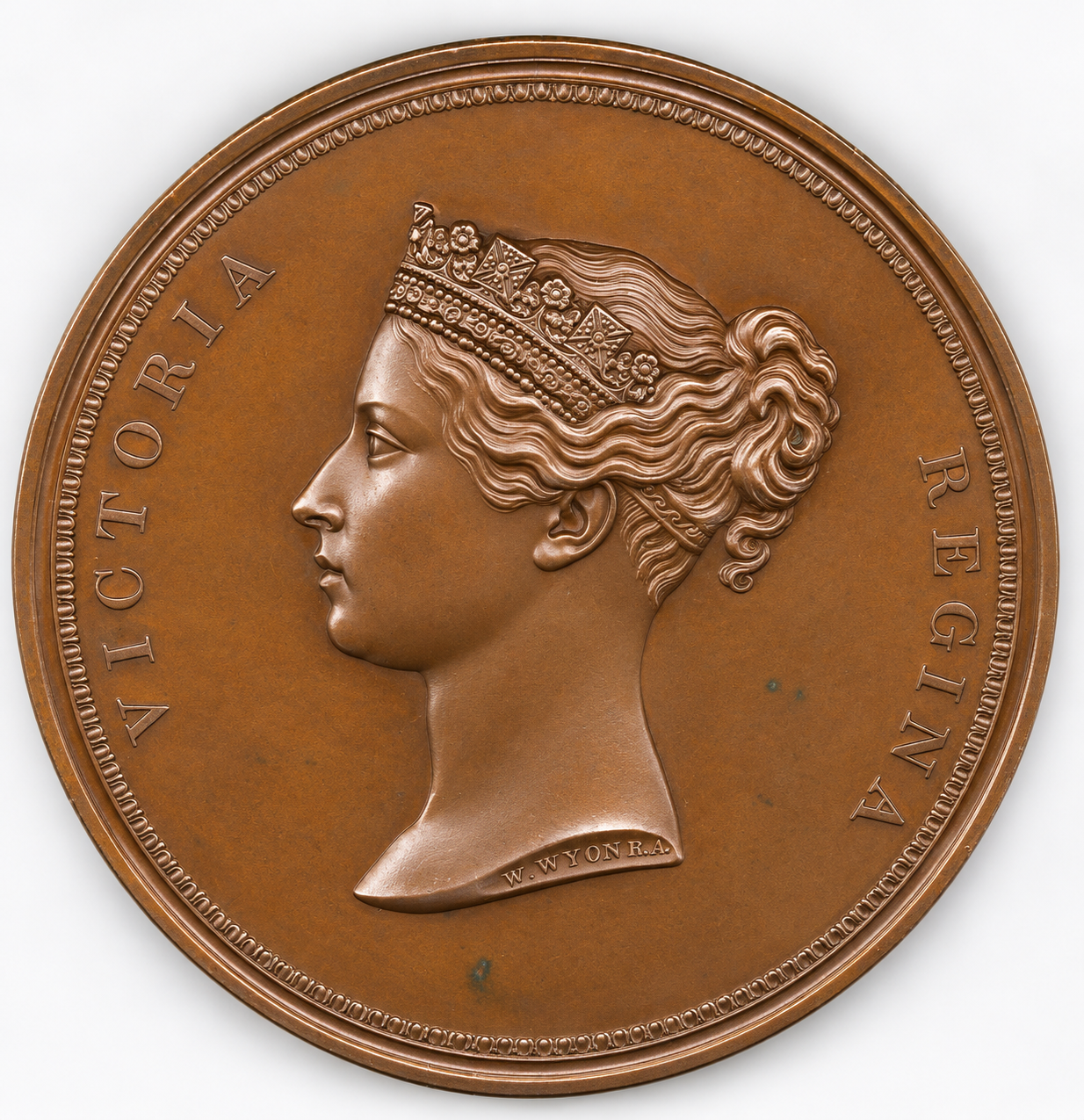
Image information
Click image to magnify
Bronze medal showing the young Victoria in left-facing profile, wearing the diamond diadem, with the inscription VICTORIA REGINA.
- Credit
- Heritage Auctions, via Wikimedia Commons. CC BY 3.0.
- Notes
- Brightness, contrast, sharpness and colour balance adjusted by Stunning Stamps.
The diamond diadem made for a king
The ornament in Victoria's hair was not made for her. The diamond diadem had been commissioned for George IV's coronation in 1821. [9]
It contains 1,333 diamonds, with crosses and the national emblems of the rose, thistle and shamrock. The diamonds were originally hired for George IV's coronation, but he kept them and paid more than £8,000. Queen Adelaide later wore the ornament, establishing its association with royal women.
Victoria wore the diadem in portraits, and Wyon included it in the image used for Britain's first postage stamps. At stamp size, its elaborate jewels became tiny engraved marks.
A magnificent royal ornament had become part of an everyday object worth two pence.
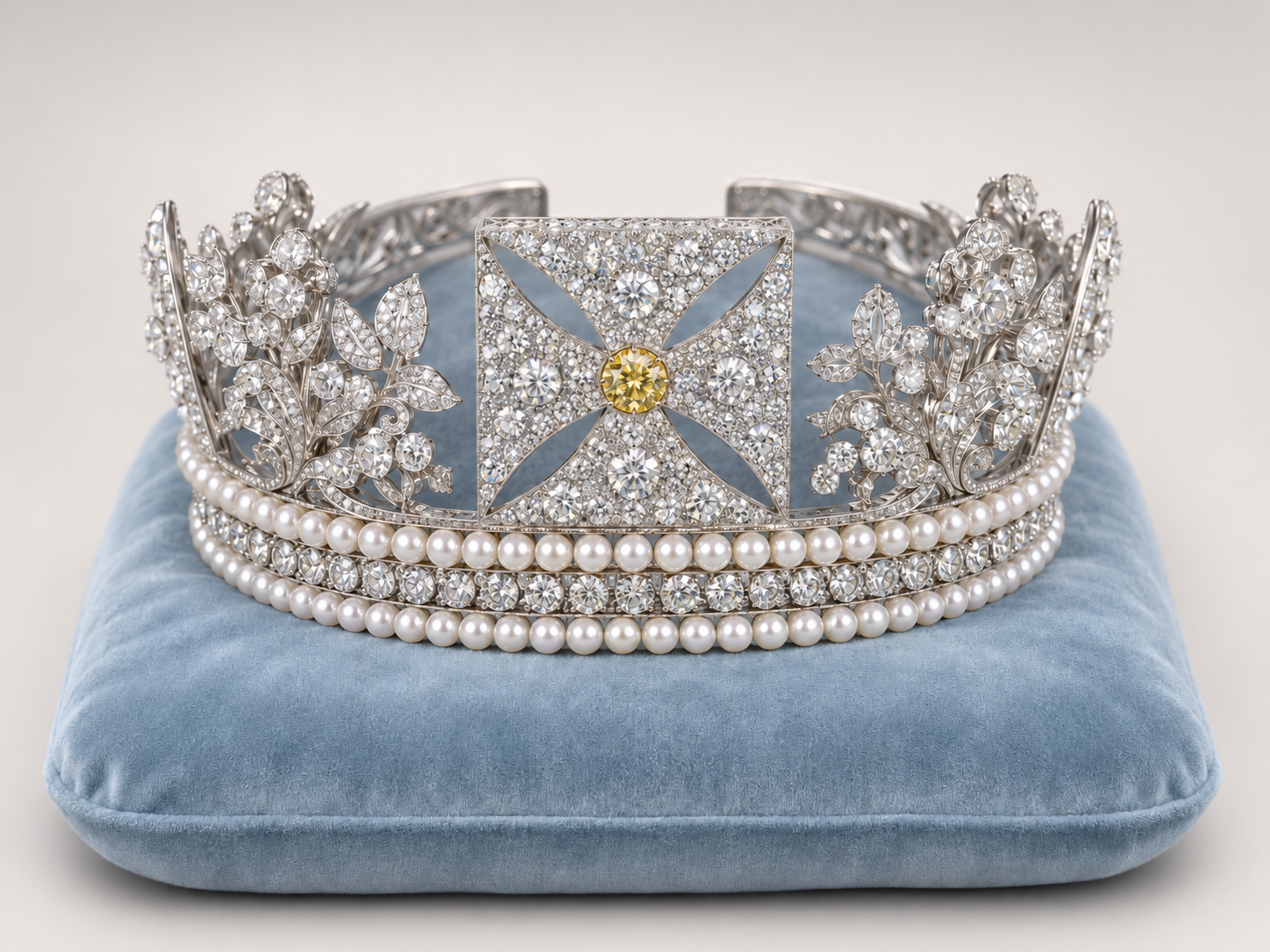
Image information
Click image to magnify
Digitally created illustration of the diamond diadem, with crosses, floral emblems and rows of pearls, resting on a blue cushion.
- Credit
- Stunning Stamps.
- Notes
- Digitally created.
Sources
- Fred J. Melville: Great Britain — Line-Engraved Stamps, pp. 58–60
- The Swedish Tiger: Two Penny Blue, plate 4 — the Spectacles Flaw
- Penny Black 1840: Strip of 2d Blues from Plate 4 — identification of the star flaw
- Bill (emason), GB QV 2d Blue, Plates 1-6, Stampboards, 11 October 2018: illustrated Plate 4 perforated and Plate 5 perforated comparisons
- Hastings E. Wright and A. B. Creeke: A History of the Adhesive Stamps of the British Isles (1899)
- Douglas N. Muir, Royal Mint Museum: William Wyon & the Penny Black
- Heritage Auctions, William Wyon medal photograph, via Wikimedia Commons (enhanced for display)
- Wyon medal photograph: Creative Commons Attribution 3.0 licence
- Royal Collection Trust: George IV's Diamond Diadem
