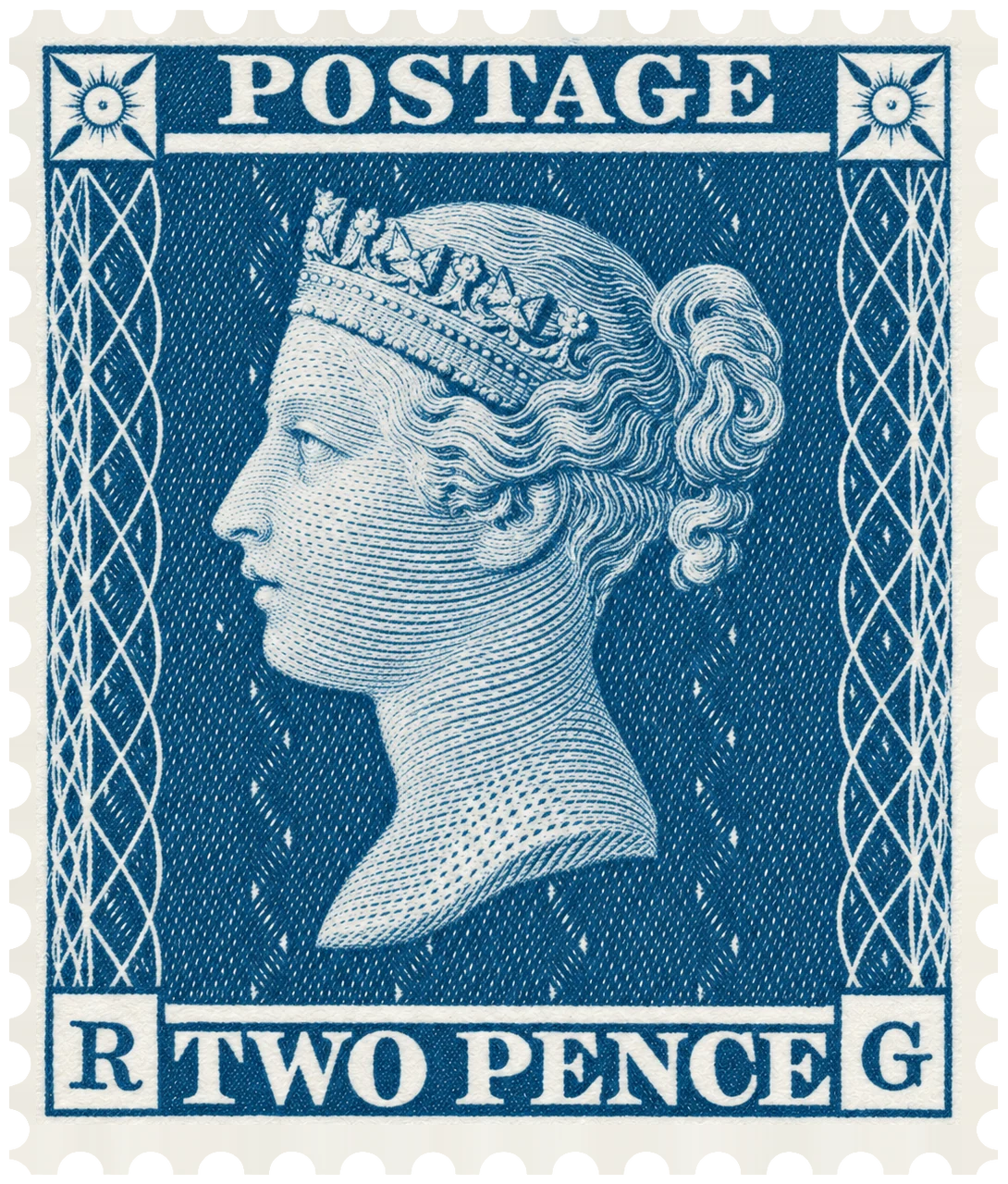
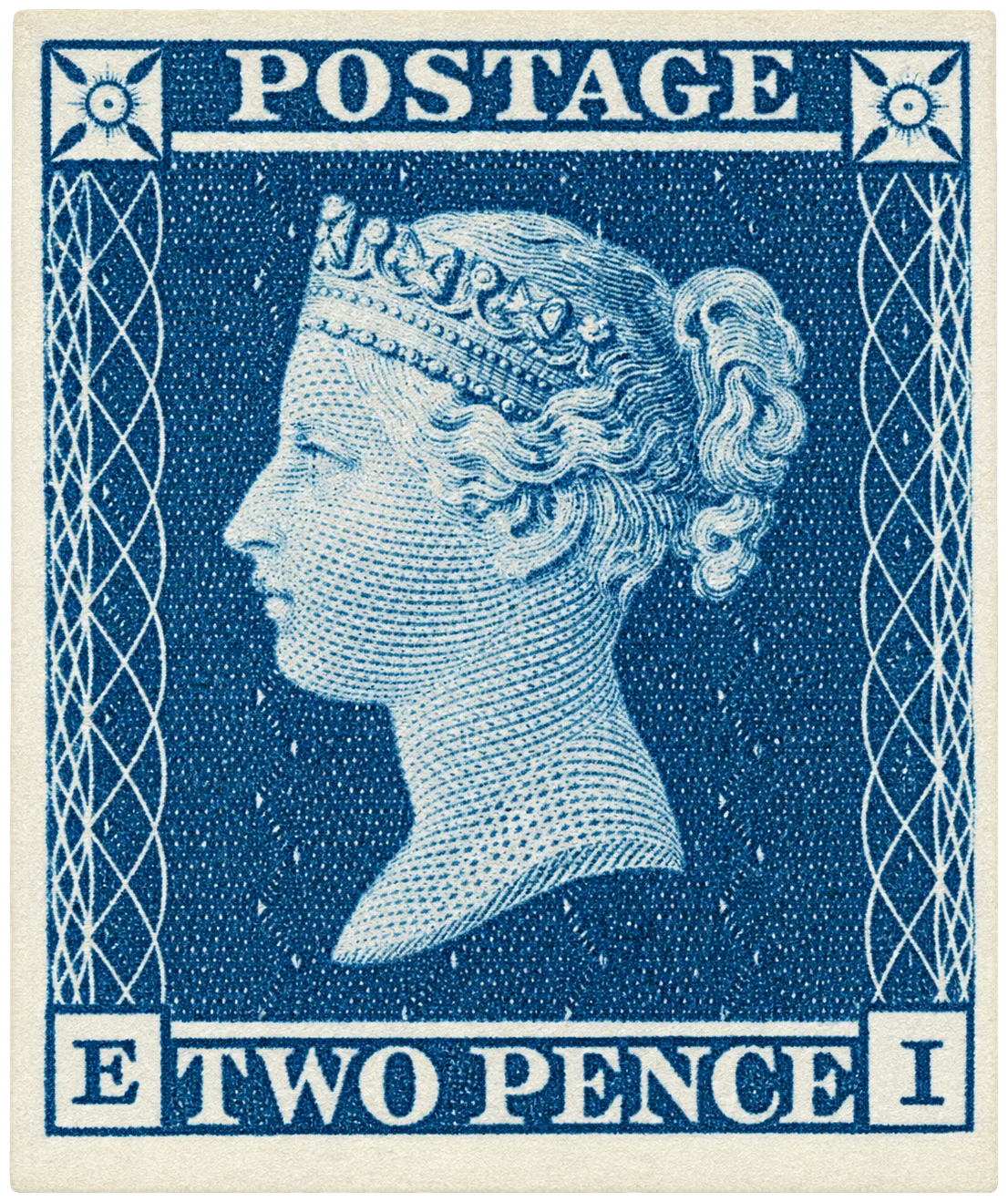
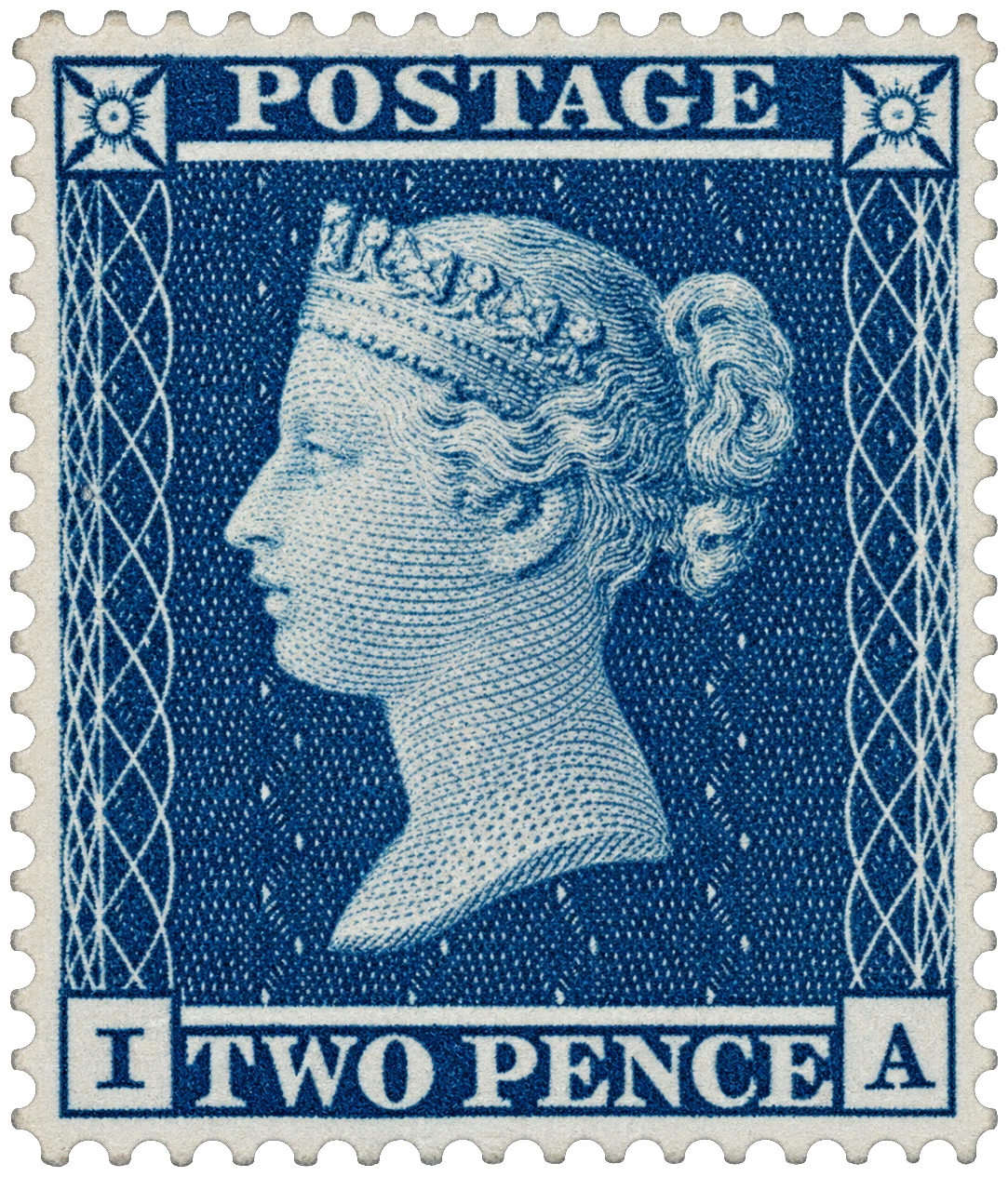
The Two Pence Blue gained perforations in 1854, using the same printing plate that had produced imperforate stamps since 1849. The first holes were too closely spaced, making sheets fragile. A wider spacing followed in 1855. Both versions retained Victoria's familiar portrait and the white lines introduced in 1841. [1, 2]
Stories
The old printing plate given a new job
The old printing plate given a new job
When the Two Pence Blue gained perforations in 1854, its printers did not need to create a new design or printing plate.
Perkins, Bacon & Co. continued using plate 4, completed in November 1849. For more than four years it had produced imperforate stamps, which had to be separated with scissors. Now its sheets were sent to Somerset House for perforating. [1]
Plate 4 became the only Two Pence Blue printing plate used for both imperforate and perforated stamps. The earliest recorded perforated example is dated 13 March 1854. [9]
The change was made after printing, not during it. An old steel plate could continue producing the familiar blue stamps while new machinery transformed the way they were separated.
Compare the outside edges. These separate illustrations do not identify the same printing plate or sheet position.
Click either stamp to magnify
The printing plate that needed repairing
Plate 4 had been working since 1849, and its engraved impressions were showing signs of wear.
In October 1853, eleven stamp positions were repaired by a process known as re-entry. A hardened transfer roller was pressed into the steel plate to deepen worn lines and restore the design. [10]
The plate continued printing after perforations were introduced. In April 1855, further repairs were needed. Some positions were restored for a second time, creating three recognisable states of the engraving.
The repairs were not always perfectly aligned with the original impressions, occasionally leaving doubled lines.
Plate 4 was finally withdrawn in June 1855. Its successive repairs preserve evidence of the engravers who kept an ageing piece of equipment working.
The inventor who refused to accept £500
Henry Archer, an Irish businessman, had an idea that would transform postage stamps. Instead of cutting them apart with scissors, people could separate them along rows of tiny holes made by a machine.
Archer began experimenting in 1847. He patented a perforating machine in 1848 and offered his invention to the government. The Treasury was interested, but negotiations over payment became protracted. [11]
In September 1850, the Treasury offered him £500. Archer refused. He subsequently rejected offers of £600 in January 1851 and £2,000 a year later.
A House of Commons committee eventually recommended purchasing his invention. In June 1853, Archer received £4,000 for the machinery, patents and expenses.
The first regularly perforated Two Pence Blues appeared in 1854. Archer had spent six years experimenting and negotiating for a change that became an indispensable feature of postage stamps.
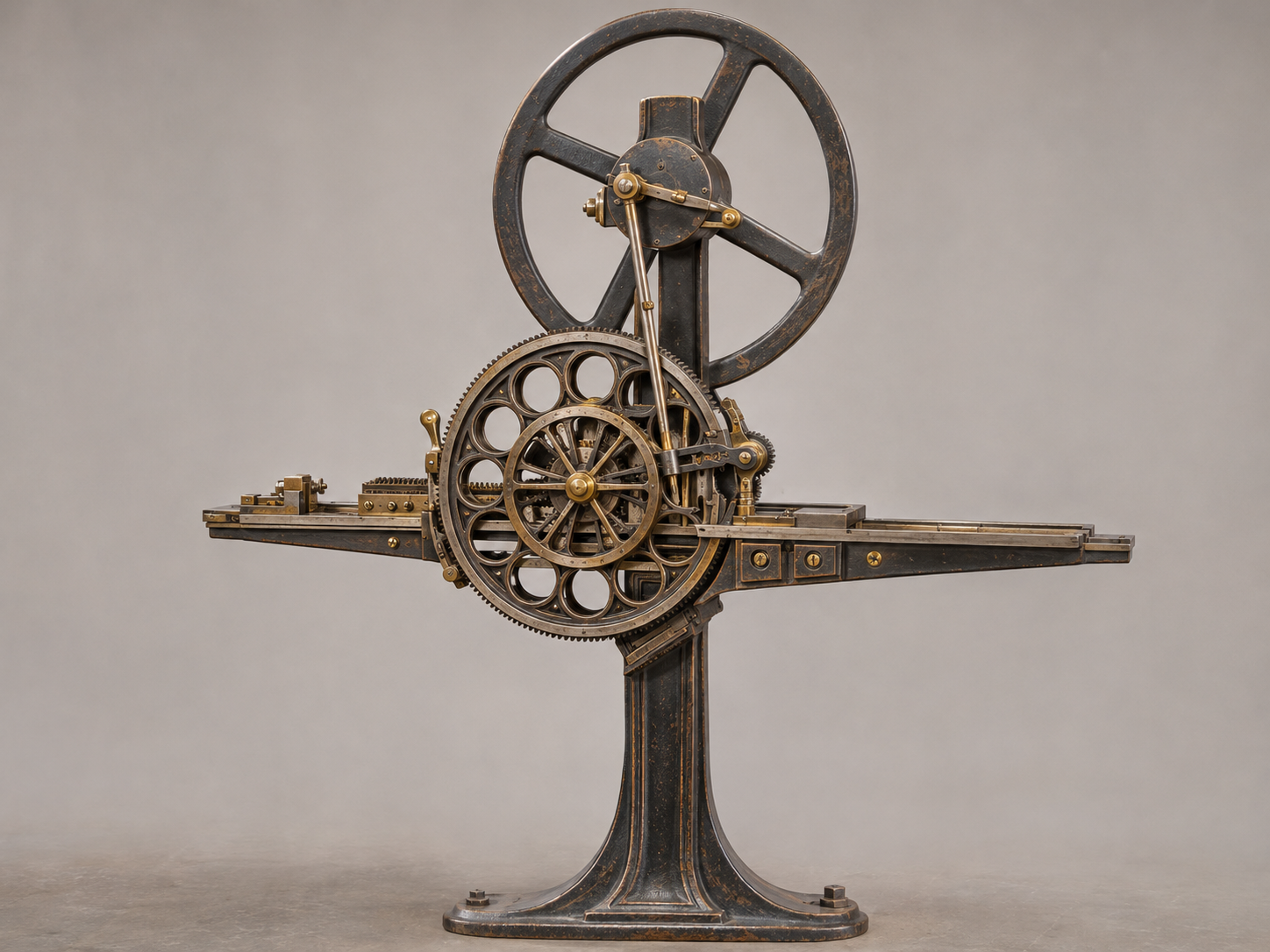
Interpretive reconstruction based on Henry Archer’s 1848 perforating-machine patent.Image information
Click image to magnify
Digital reconstruction of Archer’s perforating machine, with a tall flywheel, central column, exposed gears and a horizontal paper bed.
Credit
Stunning stamps. Digitally reconstructed
The machine defeated by stamp gum
Archer's first attempts did not go smoothly. His original machine made small cuts between stamps, a method known as rouletting. Unfortunately, its cutting wheels rapidly damaged the surface beneath the paper.
A revised machine used lancet-shaped blades, but these became blunt. Archer eventually developed a machine that punched out small circular pieces of paper instead. [2]
In December 1848, the new machine was sent to Perkins, Bacon & Petch for trials. It failed again, this time because the punching tools became clogged with gum from the backs of the stamp sheets.
Edwin Hill, Rowland Hill's elder brother, sought advice from the experienced printer Thomas De La Rue. Archer made further changes and resumed his experiments.
The problem had seemed simple: make holes between stamps. In practice, Archer had to overcome damaged machinery, blunt blades, sticky gum and wasted paper.
The holes that were too close together
The first regularly perforated Two Pence Blues appeared in 1854. Their holes were spaced at sixteen per two centimetres, known as perforation 16.
Initially successful, the arrangement soon revealed problems. The holes were so close together that sheets could separate accidentally during handling. They also weakened the steel plates into which the punching pins descended. [2]
In early 1855, the government introduced a wider spacing of fourteen holes per two centimetres. More paper remained between the holes, and the supporting steel plates were stronger.
The new arrangement worked better, although both gauges continued in use for some time. The two versions tell a revealing story of Victorian engineering: the first solution worked, but experience showed how to improve it.
Three Hills and a new machine
Henry Archer devised the system, but several people helped turn it into a practical operation.
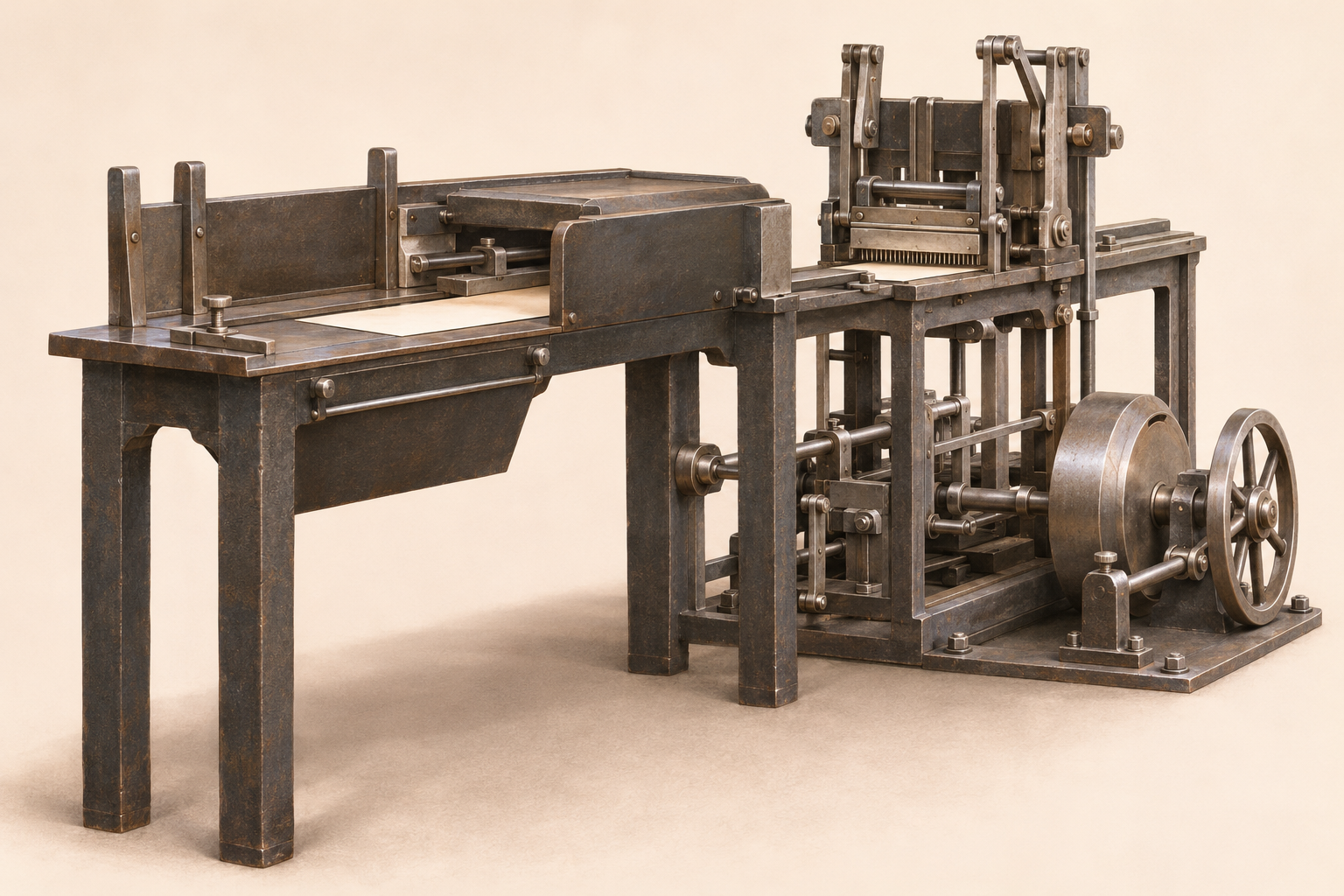
After purchasing his invention in 1853, the government ordered new perforating machines from David Napier & Son of Lambeth. These were developed versions of Archer's machine, designed for larger quantities of stamps. [11]
Edwin Hill, who supervised stamp production at Somerset House, suggested improvements during construction. Further changes were made by Edwin and his son Ormond after the machines began work.
Rowland Hill had helped introduce the postage stamp. Now his elder brother and nephew were solving the practical problem of making stamps easier to separate.
Perkins, Bacon & Co. continued printing the stamps, but perforating was carried out separately at Somerset House. Production depended on cooperation between private printers, government engineers and the Hill family.
Interpretive reconstruction of a Victorian Napier-pattern stamp perforating machine.Image information
Click image to magnify
Digitally reconstructed illustration of a Victorian stamp perforating machine, with a long feed table on legs leading to an upright punching assembly and a low wheel at the right.
Credit
Stunning stamps. Digitally reconstructed
Why do some stories appear on several pages?
Every page is written to make sense on its own. Visitors often arrive directly at a particular stamp or subject, without having explored the rest of the site.
Some stories are relevant to several stamps, so they are repeated where they help explain what you're looking at. For those exploring a series, the details specific to each stamp generally come first, with the more familiar stories further down the page.
This way, you can explore the site in any order without missing interesting background.
Design
2d deep blue · Perforation 16Stunning StampsOptions
Perkins Bacon was a London security printer. Its engraved stamp production combined the preparation of steel plates with the repeated inking, wiping and pressing of sheets.
On this stamp
Perkins, Bacon & Co. printed the Two Pence Blues of 1854 and 1855. Perforating was carried out separately at Somerset House.
William Wyon was a medallist and engraver at the Royal Mint. His models of royal heads were made for coins and medals and also became sources for stamp portraits.
On this stamp
Wyon’s City of London medal supplied the inherited portrait used on the Two Pence Blue of 1854–1855.
Henry Corbould was a draughtsman and book illustrator. He trained with his father and at the Royal Academy Schools, where he received a silver medal for a life study.
On this stamp
Corbould’s drawing after Wyon’s medal helped prepare the original portrait inherited by the Two Pence Blue of 1854–1855.
Charles Heath was an engraver and publisher of illustrated books. Work from his workshop could carry his signature even when assistants had contributed to the engraving.
Frederick Heath, Charles Heath’s son, was an engraver working in the family’s illustrated-book business. His surviving prints include engraved interpretations of other artists’ paintings.
On this stamp
The inherited portrait engraving is attributed to Charles Heath or his son Frederick; their individual roles remain unresolved. Neither is being credited with a new engraving commissioned for the introduction of perforation.
The country identifies the postal authority that issued the stamp. The monarch identifies the ruler whose portrait it carries. A definitive is an everyday stamp intended for regular postal use.
On this stamp
This Great Britain definitive carries Queen Victoria’s portrait.
The denomination is the stamp’s face value: the amount of postage it represents. Its price to a collector can be quite different.
In Britain’s old currency, 12 pence made one shilling and 20 shillings made one pound: 240 pence altogether. The abbreviations were d for pence, s for shillings and £ for pounds. The d comes from the Latin denarius. A halfpenny, written ½d, was half an old penny.
On this stamp
Twopence was twice the penny value. Twelve twopenny stamps made two shillings.
A shade is a variation within a stamp’s colour. Some variations receive their own catalogue numbers even though the design and denomination stay the same.
Compare known examples under consistent lighting. Fading can change a stamp’s appearance, and photographs or screens can alter how colours look. A catalogue colour name helps describe a shade; it is not a colour test by itself.
On this stamp
The perforation 16 reference is described as deep blue and the perforation 14 reference as blue. These are the recorded illustration descriptions, not a colour measurement made from the screen.
A stamp can be printed, sent to post offices, put on sale and made valid for postage on different dates. An official notice or instruction can establish when it was intended to be used; a dated letter shows that a particular example was actually used.
An early surviving cover is evidence of use by that day. It does not necessarily identify the first day of sale. A year in the heading may also cover later printings of the same design.
On this stamp
The article begins with the 1854 perforation 16 issue; its grouped perforation 14 version is dated 1855. Wright and Creeke record the first official perforating of the twopence on 31 January 1854, which is not itself proof of its first retail sale.
Stars names the ornaments in the two upper corner squares. The lower squares contain check letters identifying a position in the sheet. It distinguishes this design family from later stamps with letters in all four corners.
The set brings together the early perforated penny and twopence designs shown here. Perforation, portrait die, corner-letter style, paper and watermark changed at different times. The dates in the set heading identify these selected articles; they are not a claim that every Stars variety ended in 1857.
On this stamp
The upper squares contain stars and the lower squares contain letters. Both illustrated perforation versions remain together in this article.
The twopence retains two white horizontal lines, one below POSTAGE and one above TWO PENCE. They were introduced with the revised blue issue in 1841, before perforation became routine.
The lines are part of the central printed design, not gaps between stamps. They help distinguish this design from the 1840 blue. The addition of perforations in 1854 changed how the sheet was separated while retaining those lines.
On this stamp
Both illustrations use the plate 4 twopence design with its two white lines. The change from fine to coarser perforations did not add those lines.
A perforation gauge expresses the number of holes along a distance of two centimetres. It is not the total number around a stamp. Gauge 16 has more closely spaced holes than gauge 14.
The early fine perforation caused two related problems: it removed so much paper that neighbouring stamps separated too easily, and the holes left too little metal in the plates into which the perforating pins descended. In January 1855 the spacing was altered so that fourteen pins occupied the distance previously taken by sixteen. More paper remained between holes, and more metal between the holes in the equipment.
The two gauges overlapped in use. Earlier fine-gauge equipment continued to be used while serviceable, so 16 does not invariably mean an earlier stamp than 14. On an original, measure the spacing against a perforation gauge; the total number of teeth on an enlarged picture is not a calibrated measurement.
Enlarged spacing diagram, not to scale. Match the spacing with a perforation gauge.Image information
Enlarged perforation spacing: fourteen equal intervals between hole centres span 20 millimetres. This is a schematic, not a ruler.
Credit
Stunning Stamps · 2026
On this stamp
This article shows separate stamps gauging 16 and 14 in both directions. It is not a compound 16 × 14 perforation.
Line engraving is a form of recess, or intaglio, printing. The lines that carry ink are cut below the surface of a metal plate. After inking the plate, the printer wipes the flat surface clean, leaving ink in the engraved grooves.
Damp paper is pressed firmly against the plate and takes up the ink from those grooves. The fine coloured lines form the image; the spaces between them leave the paper visible. This differs from surface printing, where the raised parts of the printing surface carry the ink.
A transfer roller repeated the design from the die across a steel plate. The corner letters were added separately to each position. Printing, gumming and drying preceded perforation: punching the holes was a separate operation from making the coloured image.
Enlarged cross-section. Engraved lines hold the ink; the surrounding surface is wiped clean before printing.Image information
Side view of recess printing: ink remains in grooves below the plate surface and pressure brings paper into contact with it.
Credit
Stunning Stamps · 2026
On this stamp
Perkins, Bacon & Co. printed the design from engraved steel plates. The edge holes were punched separately after printing.
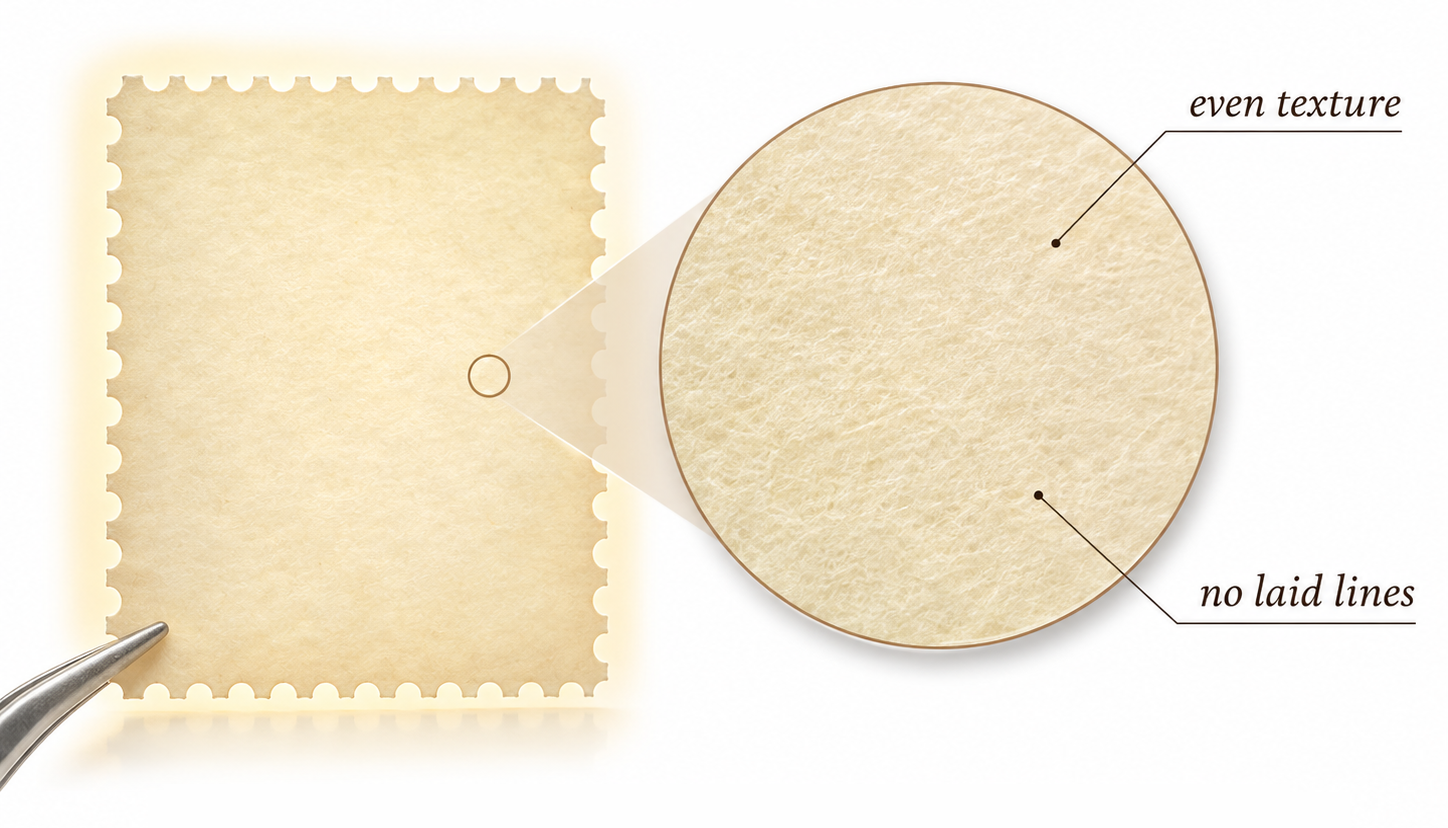
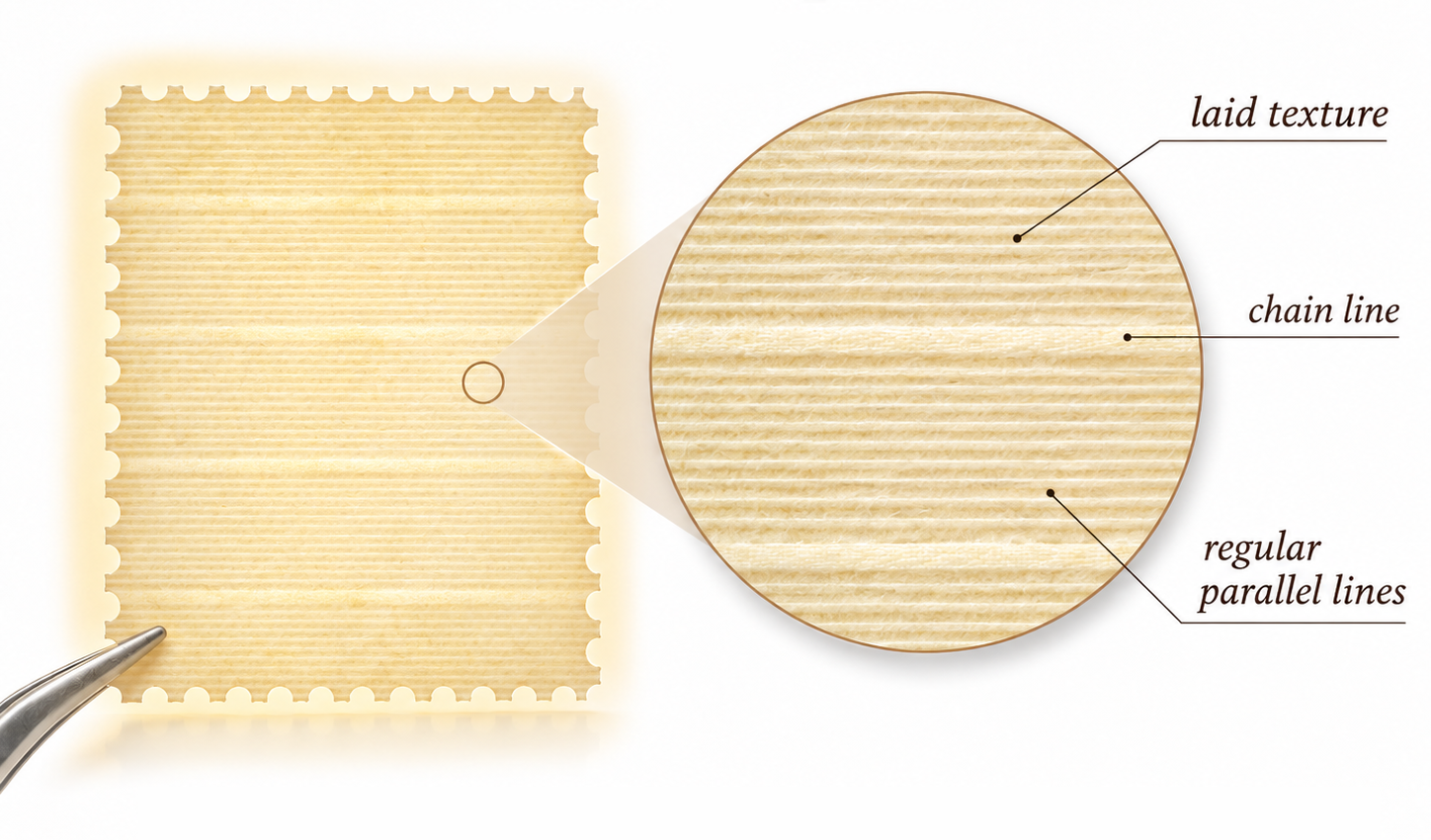
Wove describes the structure of the paper. Viewed against the light, it has a fairly even appearance. Laid paper instead shows a regular pattern of lines left by its manufacture.
Paper structure and watermark are separate characteristics: wove paper can carry a watermark. Both can help distinguish stamps with similar printed designs.
Wove paper: even texture without laid lines.Image information
Click image to magnify
Diagram of wove paper with a magnified inset showing an even texture without laid lines.
Credit
Stunning Stamps · 2026
Notes
Digitally constructed
Laid paper: regular parallel lines, shown for comparison.Image information
Click image to magnify
Diagram of laid paper with a magnified inset showing regular parallel lines.
Credit
Stunning Stamps · 2026
Notes
Digitally constructed
On this stamp
The Small Crown issues can show a blue cast in the paper, of varying strength. Wove describes its structure. The clean front-view reconstructions do not establish the degree of blueing on an original.
A watermark is a pattern within the paper, formed during manufacture. It is separate from the printed image and can become visible when light passes through the sheet.
Small Crown paper was made with one crown intended for each stamp position. The crown-shaped pieces on the papermaking mould were fashioned individually, so their outlines can vary. The later introduction of Large Crown paper is a separate change from the revision of the portrait or the perforation gauge.
Paper could be placed the other way up for printing, producing an inverted watermark. A faint or incomplete crown must be assessed from the original paper; the portrait on the front does not establish its orientation.
On this stamp
Both illustrated versions here belong to the Small Crown group. Later stamps of similar appearance also occur on Large Crown paper.
The printing plate carried one pane of 240 stamps: twenty rows of twelve. A pane is a group of stamps within a sheet; here the stamps formed a single uninterrupted group, with no gutter dividing it into smaller panes.
At one penny each, a row of twelve cost one shilling and the complete sheet cost one pound. At twopence each, those amounts doubled to two shillings per row and two pounds per sheet.
The outer margins carried instructions, prices and plate numbers. These lay outside the individual designs and were normally lost when the stamps were separated. A number in the sheet margin is therefore different from the corner letters on each stamp.
On this stamp
Twenty rows of twelve twopences made a sheet of 240 stamps with a face value of two pounds.
The gum is the adhesive coating on the back. The printed sheets were gummed and dried; moistening the back allowed the sender to attach a stamp to a letter.
On an unused original, the gum is a separate feature from the paper and printed design. The front of a stamp cannot show whether its original gum survives. Old paper and gum also vary in appearance, so neither should be judged from a front-view illustration.
On this stamp
The illustrations show the front of the stamps. They make no claim about surviving original gum on a physical specimen.
A stamp catalogue gives each listed issue a reference number. SG means Stanley Gibbons, the publisher of the catalogue used here. These numbers help collectors refer to the same issue; they are not serial numbers printed on individual stamps.
A range of numbers groups related entries. Colour, paper or perforation differences may account for separate listings within that range.
On this stamp
The perforation 16 illustration is recorded as SG19 · I–A · plate 4. The reference describes its source; the reconstruction is not a certificate of shade or microscopic plate details.
A stamp catalogue gives each listed issue a reference number. SG means Stanley Gibbons, the publisher of the catalogue used here. These numbers help collectors refer to the same issue; they are not serial numbers printed on individual stamps.
A range of numbers groups related entries. Colour, paper or perforation differences may account for separate listings within that range.
On this stamp
The perforation 14 illustration is recorded as SG23 · R–G · plate 4. The reference describes its source; the reconstruction is not a certificate of shade or microscopic plate details.
Read the two lower corner letters from left to right. The left letter gives the row, A to T; the right gives the position within that row, A to L. A–A is the top-left stamp and T–L is the bottom-right stamp in a sheet of twenty rows of twelve.
Each pair occurs once in a complete sheet. The letters were punched into the plate separately after the design had been transferred, so their precise placement can vary.
The same letter pairs recur on different plates. They locate a stamp within the sheet, but cannot identify its plate alone. Plate identification combines the lettering with other small, documented features of the printed impression.
On this stamp
I–A: row 9, position 1; R–G: row 18, position 7. These pairs identify the illustrated positions; other stamps of the same issues carry different letters.
The die carried the original engraved design. A transfer roller copied that design into the many positions on a printing plate. A plate was the working surface from which complete sheets were printed.
These early stamps have no plate number inside the individual design. Numbers appeared in the outer sheet margins. Once that margin was removed, identification depended on comparison with recorded impressions: the positions of corner letters, small flaws, repairs and other recurring details.
Several plates could carry the same design and the same corner-letter pair. A catalogue number, a colour name or the letters alone therefore cannot establish a plate.
On this stamp
Plate 4 for both illustrated references. A recorded plate belongs to that specimen reference, not automatically to every stamp in the grouped article.
Uniform Penny Postage began on 10 January 1840, before adhesive stamps went on sale. For an ordinary prepaid General Post letter within the United Kingdom, the charge depended on weight: 1d up to half an ounce, 2d over half an ounce and up to one ounce, then 4d over one ounce and up to two ounces.
Stamps could be combined to make up the required amount. A heavier letter did not require a single stamp of exactly that value: two penny stamps could pay the twopenny rate, for example. Foreign destinations and special services had their own charges.
On this stamp
One twopence could pay the ordinary prepaid inland letter rate over half an ounce and up to one ounce. Two penny stamps could pay the same charge.
The cancellation is the inked mark that prevents a stamp being used again. By the period of these issues, barred obliterators with office numbers had succeeded the Maltese Cross as the usual form. A town or date mark could be applied separately, or alongside the obliterator in a combined device.
The office number is part of the postmark, not a printing-plate number. A cancellation can cover the portrait, letters or fine plate details; it must be distinguished from marks produced during printing.
An unused reconstruction has no such mark. For a used original, the whole cover gives the strongest context for interpreting the date, route and postage. A loose stamp seldom establishes all three.
On this stamp
Both reconstructions are shown unused. On originals, a numeral cancellation can help identify a posting office, but it is unrelated to the stamp’s plate number.