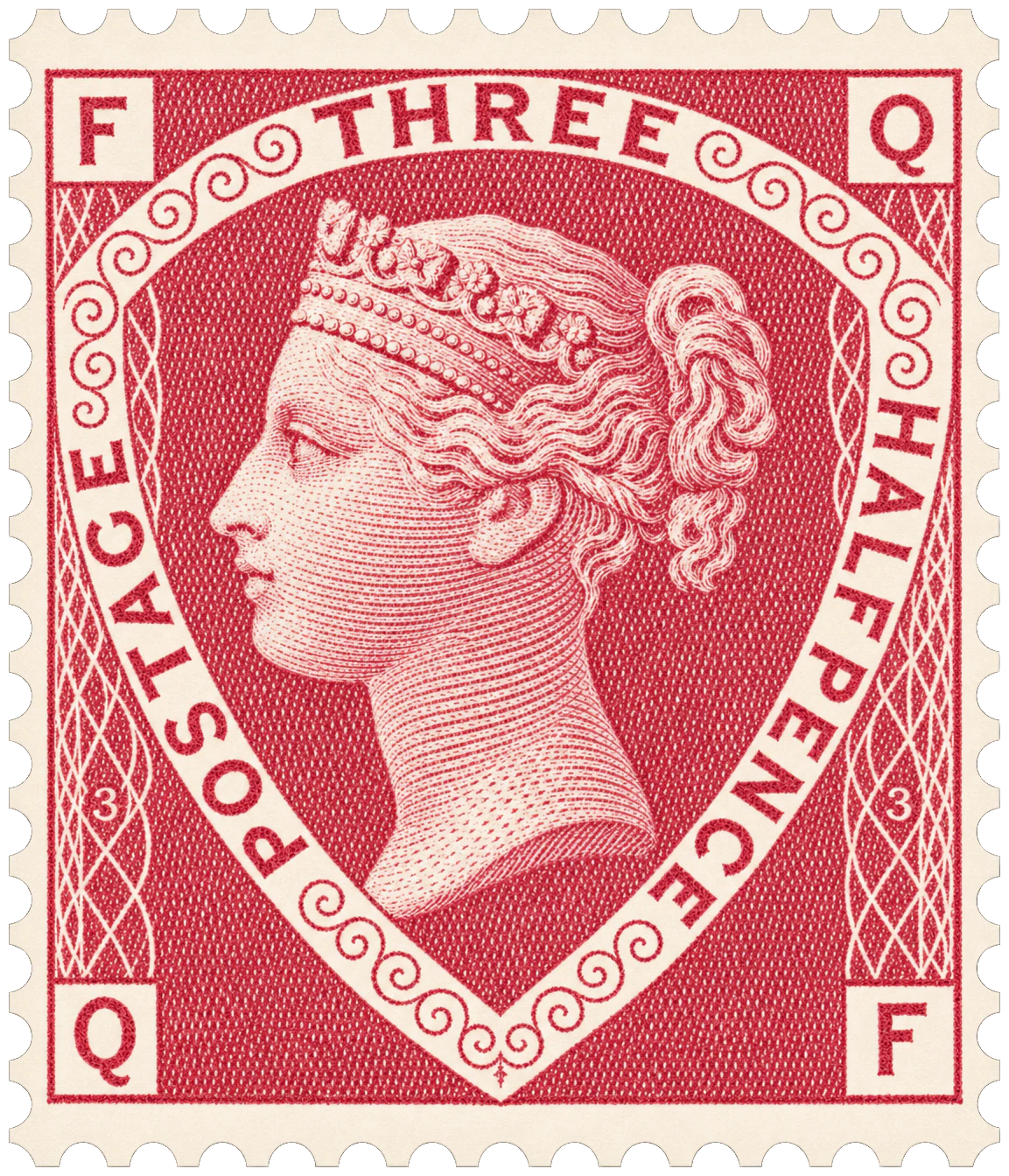
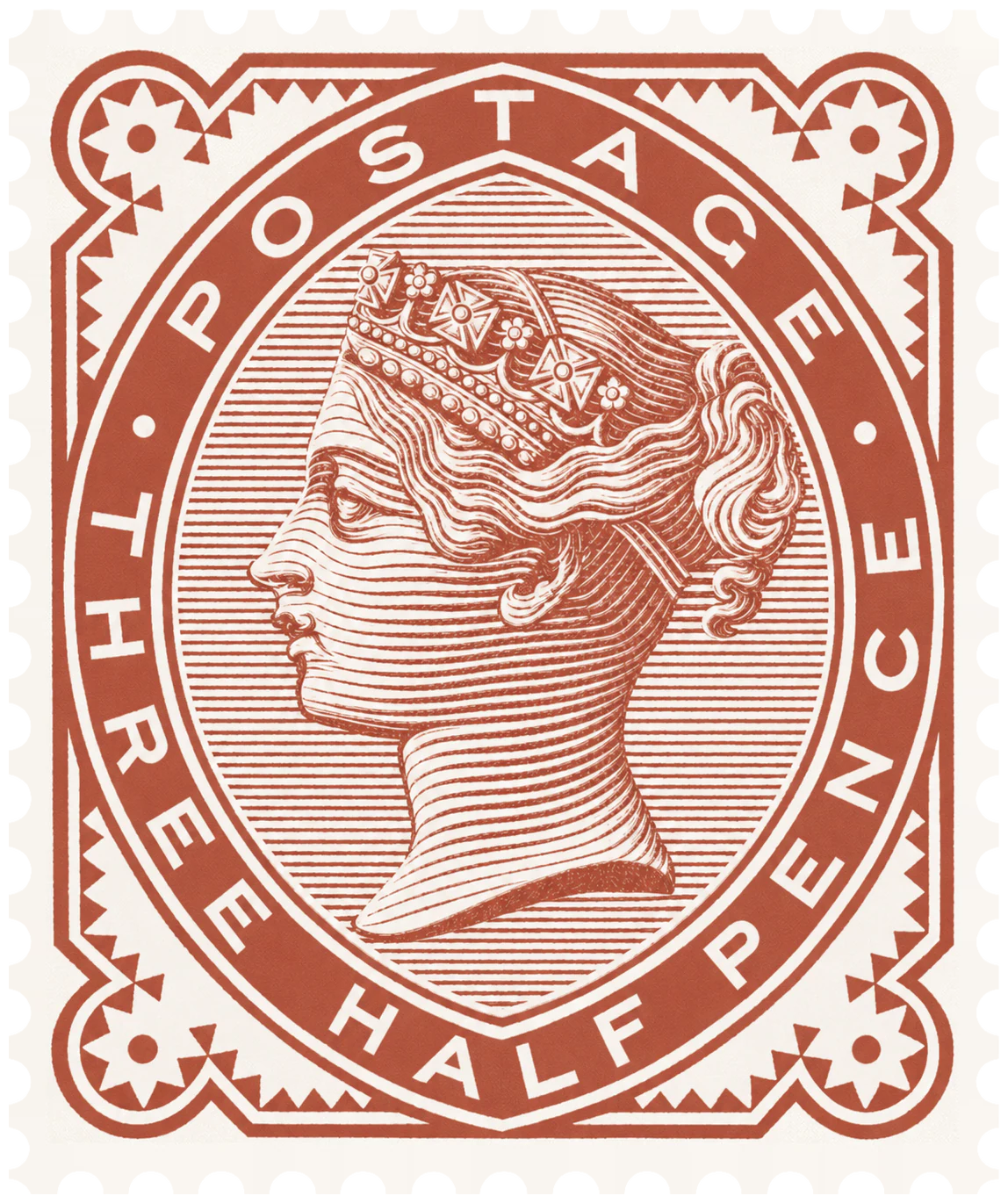
The three-halfpenny Venetian red of October 1880 replaced Perkins, Bacon & Co.'s unusual triangular design with a new surface-printed stamp. De La Rue enclosed Victoria's portrait within a pointed oval, leaving out the corner letters and plate numbers of its predecessor. Only two printing plates were required, and both were ready before the stamp appeared. Its colour was deliberately matched to the new Venetian-red penny.
Stories
The triangular stamp disappears
The triangular stamp disappears
Britain's earlier three-halfpenny stamp had an extraordinary history. Designed in 1860, it was printed in millions before the proposed postal-rate change was abandoned.
When the denomination was finally introduced in 1870, Perkins, Bacon & Co. reused the old printing plate. The stamp had a distinctive triangular frame, its inscriptions following three curved sides.
In 1880, De La Rue was given the task of replacing it. [11]
The new design was very different. Victoria's portrait sat within a pointed oval, surrounded by a simpler rectangular frame.
The new stamp appeared on 14 October.
A design that had taken ten years to reach the public was replaced by another made for the modern printing machinery of De La Rue.
Compare the portrait settings of the two three-halfpenny designs.
Click either stamp to magnify
The colour borrowed from the penny
The Post Office wanted the new three-halfpenny to match the colour of the Venetian-red penny introduced earlier in 1880.
A circular dated 21 September announced that the halfpenny and three-halfpenny stamps would shortly appear. It explicitly stated that the three-halfpenny would use the same colour as the penny. [11]
De La Rue therefore printed both values in Venetian red.
The stamps had different designs, but the ink-makers were expected to supply a sufficiently consistent colour.
The decision reveals the influence of official instructions over the appearance of a stamp. The engraver could arrange the portrait and ornament, but the colour had already been chosen by the authorities.
The two designs given the same general colour. These illustrations are not a calibrated ink comparison.
Click either stamp to magnify
Two plates prepared together
The three-halfpenny was simpler to manufacture than the enormously popular penny stamp.
De La Rue prepared only two printing plates for the new denomination. Both were officially registered on 23 August 1880 and put to press the following day. [12]
The printers used the same general sheet arrangement as the other new low values: 240 impressions divided into two panes of 120.
The two plates continued to supply the stamp throughout its working life.
The contrast with the penny is striking. De La Rue prepared more than thirty penny plates, but needed only two for the three-halfpenny.
The government could therefore use the same printing technology on a very different scale.
The discarded design that survived as a proof
The issued three-halfpenny was not the only design considered.
A surviving De La Rue die proof, printed in carmine, has been identified as an unissued design for the provisional three-halfpenny. [13]
The proof was preserved rather than turned into an ordinary postage stamp.
It provides evidence that the engravers experimented with alternative arrangements before settling on the familiar pointed oval.
Such preliminary impressions were part of the ordinary work of preparing a new issue. Most people saw only the finished stamp, but the design had passed through earlier stages of drawing, engraving and approval.
The stamp saved from a government presentation book
One three-halfpenny Venetian red survived in an unusual form.
It was a perforated impression removed from a presentation book prepared for members of a Post Office Stamp Committee during the 1880s. The book compared earlier and later British stamps, preserving examples of designs that had shaped the service. [14]
The stamp came from material originally retained during official registration rather than from an ordinary printing-sheet supply.
Its survival reveals another purpose of the printer's work. Proofs were not simply discarded after approval; some became records used by later officials studying the development of stamp design.
A portrait with a long history
The new three-halfpenny retained the youthful likeness of Victoria familiar from earlier British postage stamps.
Its ancestry reached back to William Wyon's medal portrait, derived from a sketch made when Victoria was fifteen. Henry Corbould adapted the image for the first postage stamps, while De La Rue subsequently developed portraits suited to surface printing. [15]
The 1880 stamp used a simpler, more strongly engraved image suited to modern machinery.
Victoria was now over sixty, but the familiar young Queen remained at the centre of the design.
Why do some stories appear on several pages?
Every page is written to make sense on its own. Visitors often arrive directly at a particular stamp or subject, without having explored the rest of the site.
Some stories are relevant to several stamps, so they are repeated where they help explain what you're looking at. For those exploring a series, the details specific to each stamp generally come first, with the more familiar stories further down the page.
This way, you can explore the site in any order without missing interesting background.
A pointed oval replaced the earlier triangular frame, with POSTAGE and THREE HALF PENCE following its curves. Look closer at the simplified corners, stronger portrait lines and the red chosen to match the penny. [16, 17]
De La Rue grew from a playing-card business into a major security printer. It supplied British postage stamps from the Victorian period and printed the Edward VII issues before the contract changed in 1911.
On this stamp
Thomas De La Rue & Co. designed and surface-printed the three-halfpenny Venetian red issued on 14 October 1880. Its pointed oval replaced Perkins Bacon’s triangular frame, with no corner letters or visible plate numbers. Two printing plates supplied the issue; the sources used here do not identify an individual engraver of the 1880 design.
Jean Ferdinand Joubert de la Ferté was a French engraver and photographer. He trained in Paris and later worked in London, where his engraving helped establish De La Rue’s surface-printed postage stamps.
On this stamp
Joubert engraved the earlier surface-printed Queen’s head after Corbould’s drawing. On the 1880 three-halfpenny Venetian red, this is a credit to the earlier portrait model. The coarser 1880 adaptation is attributed to De La Rue; its individual engraver is not established by the sources used here.
William Wyon was a medallist and engraver at the Royal Mint. His models of royal heads were made for coins and medals and also became sources for stamp portraits.
On this stamp
Wyon’s City of London medal supplied the youthful likeness behind the 1880 three-halfpenny Venetian red. The familiar portrait was adapted through drawings and engravings for British stamps; Wyon is credited as the earlier artistic source, not as the designer of the 1880 frame.
Henry Corbould was a draughtsman and book illustrator. He trained with his father and at the Royal Academy Schools, where he received a silver medal for a life study.
On this stamp
Corbould’s drawing after Wyon’s medal supplied the model for the earlier surface-printed Queen’s head. His connection to the 1880 three-halfpenny Venetian red is that inherited portrait source; he did not prepare its 1880 frame or new engraving.
The country identifies the postal authority that issued the stamp. The monarch identifies the ruler whose portrait it carries. A definitive is an everyday stamp intended for regular postal use.
On this stamp
The 1½d Venetian red is a Great Britain definitive from Victoria’s reign. The youthful portrait continues the established royal likeness in a coarser rendering prepared for the new surface-printed low values.
The denomination is the stamp’s face value: the amount of postage it represents. Its price to a collector can be quite different.
In Britain’s old currency, 12 pence made one shilling and 20 shillings made one pound: 240 pence altogether. The abbreviations were d for pence, s for shillings and £ for pounds. The d comes from the Latin denarius. A halfpenny, written ½d, was half an old penny.
On this stamp
1½d represents 1.5 old pence. A 240-stamp unit was worth 30s. The whole 240-stamp unit was also the post-office sheet.
A shade is a variation within a stamp’s colour. Some variations receive their own catalogue numbers even though the design and denomination stay the same.
Compare known examples under consistent lighting. Fading can change a stamp’s appearance, and photographs or screens can alter how colours look. A catalogue colour name helps describe a shade; it is not a colour test by itself.
On this stamp
This article represents Venetian red in the SG167 family. Original shades, changed colours and the differences introduced by photography must be kept separate. The reconstruction illustrates the intended family without acting as a calibrated shade standard.
A stamp can be printed, sent to post offices, put on sale and made valid for postage on different dates. An official notice or instruction can establish when it was intended to be used; a dated letter shows that a particular example was actually used.
An early surviving cover is evidence of use by that day. It does not necessarily identify the first day of sale. A year in the heading may also cover later printings of the same design.
On this stamp
The new Venetian-red three-halfpenny appeared on 14 October 1880, with the green halfpenny. The September circular announced its new design and specified the same colour as the penny. The later lilac three-halfpenny of April 1884 belongs to the unified postage-and-revenue series.
This family brought the everyday halfpenny, penny, three-halfpenny and twopenny into De La Rue’s surface-printed range. Each replaced a line-engraved denomination. The fivepenny was a new value, introduced in March 1881 for overseas correspondence.
Stronger portrait lines suited the new steam-powered production. Visible plate numbers disappeared, and only the penny retained corner letters. The different frames and colours still helped customers and counter staff recognise each value.
“Provisional Issue” is the family name used here. It does not mean that these were overprinted emergency stamps or that all five were issued together. The penny was replaced in 1881; the other designs or colours continued until the changes of 1884.
On this stamp
This 1½d belongs to the Provisional Issue of 1880–1881. It replaced a line-engraved stamp of the same denomination with a surface-printed design. The family shares Crown paper and gauge 14, while its frames and colours distinguish the values.
A stamp catalogue gives each listed issue a reference number. SG means Stanley Gibbons, the publisher of the catalogue used here. These numbers help collectors refer to the same issue; they are not serial numbers printed on individual stamps.
A range of numbers groups related entries. Colour, paper or perforation differences may account for separate listings within that range.
On this stamp
SG167 is the intended catalogue family of the existing reconstruction. The stamp has no check letters or printed plate number. The reference record documents the design represented; it does not authenticate hidden gum or microscopic varieties.
Typography, or surface printing, uses a raised printing surface. Ink is applied to the raised parts, then transferred to paper under pressure. The lower spaces leave the paper unprinted.
Fine lines and solid areas are both part of that raised image. This is the same basic principle as letterpress printing.
De La Rue reproduced a relief design from a steel die using moulds and electrotyping. Metal deposited on the moulds formed the repeated printing surfaces; these were mounted and faced to withstand use. The master die and the printing plate are different objects.
The new low values were drawn with stronger lines for steam-powered printing. The sheet was gummed first and printed dry in one colour. White lettering and ornament are areas of paper left without ink. Perforating was a separate operation after printing.
Surface printing, shown from the side. The paper is pressed onto the inked surface.Image information
Side view of surface printing. Paper is pressed down onto ink on the raised parts of a printing plate; the lower spaces do not touch the paper.
Credit
Stunning Stamps · 2026
On this stamp
De La Rue printed the 1½d in one colour from a raised electrotype surface. Stronger portrait and background lines suited steam-powered manufacture. The white inscriptions are unprinted paper. Gumming preceded printing, and perforating followed as a separate operation.
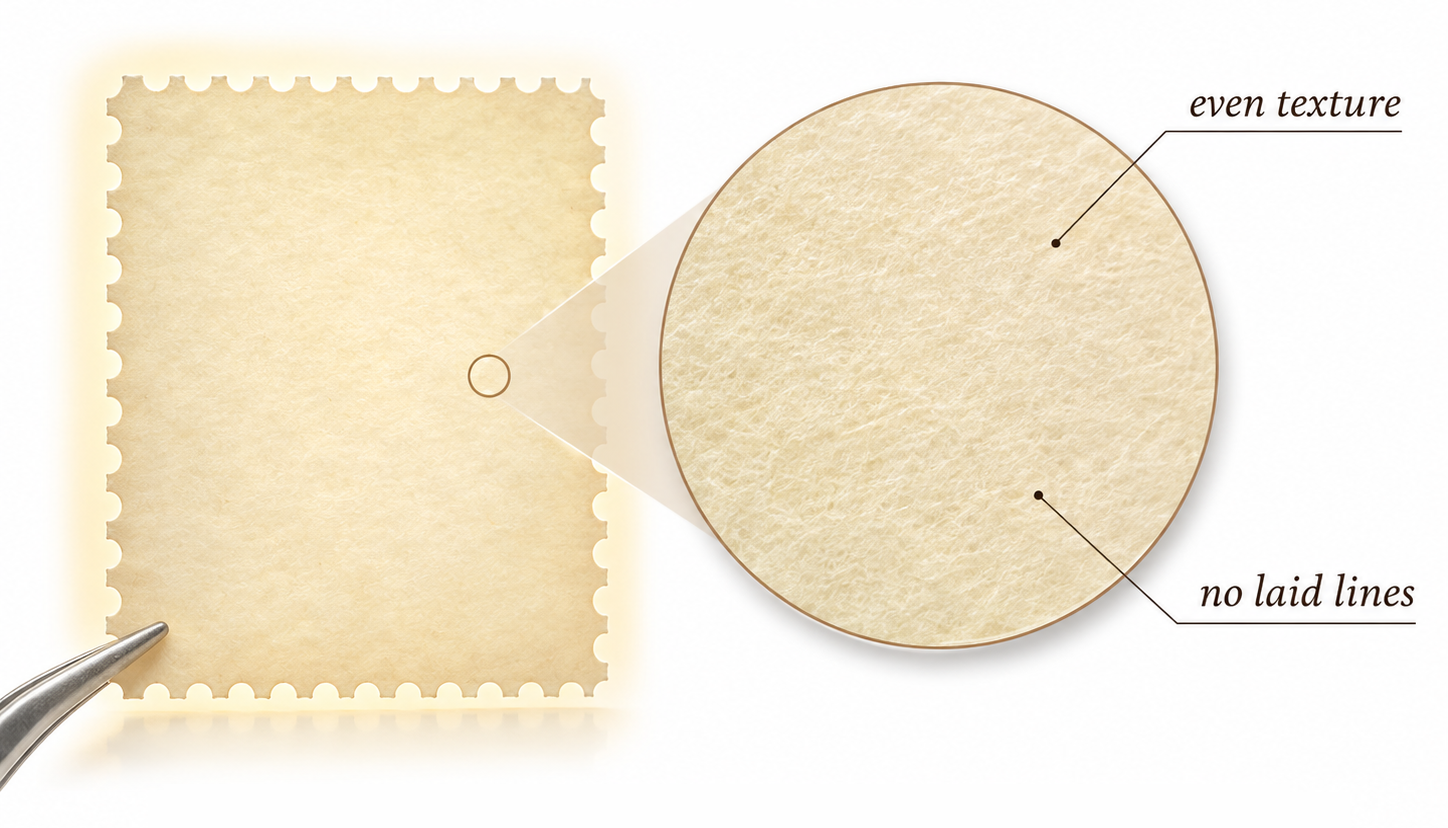
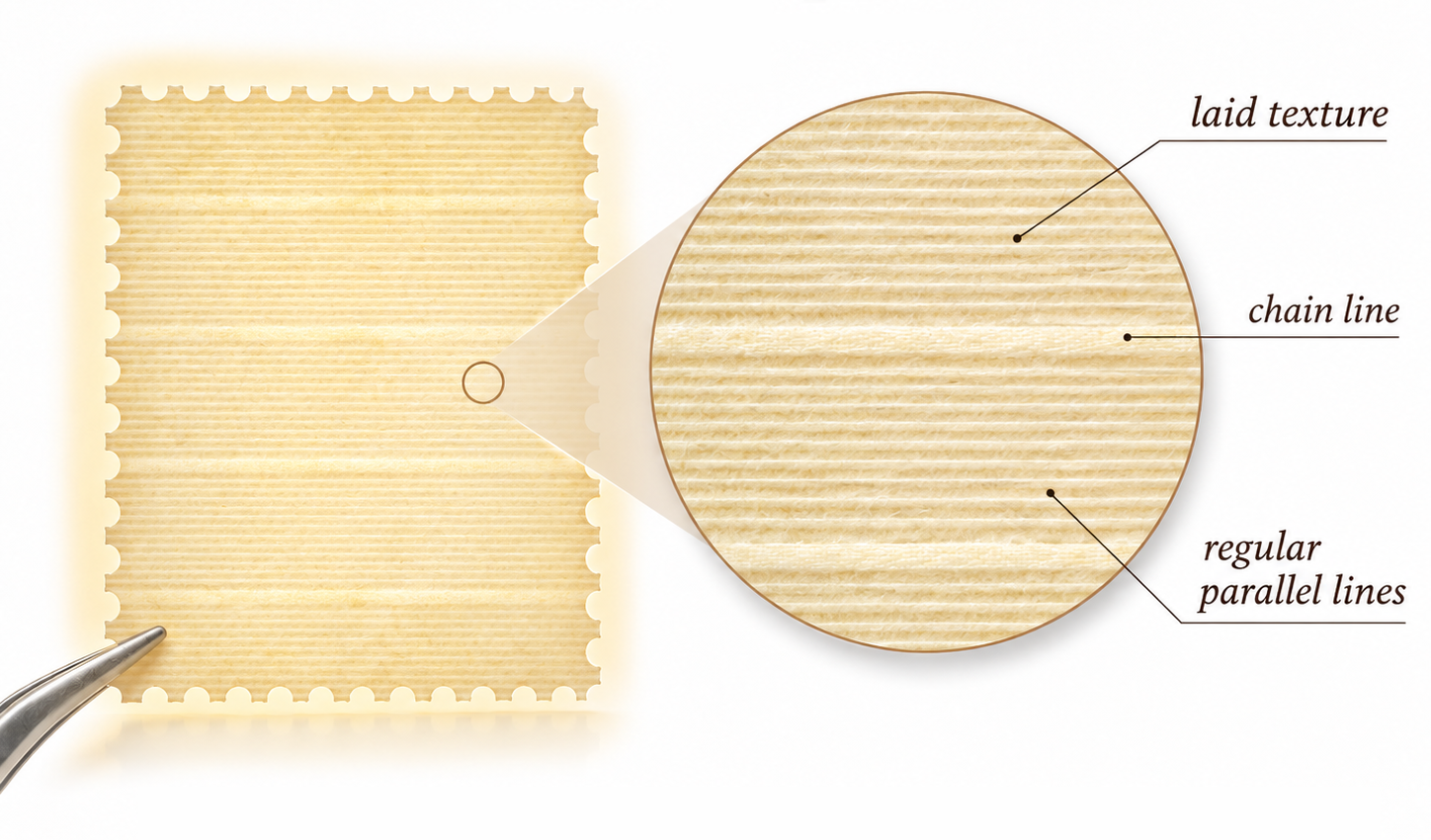
Wove describes the structure of the paper. Viewed against the light, it has a fairly even appearance. Laid paper instead shows a regular pattern of lines left by its manufacture.
Paper structure and watermark are separate characteristics: wove paper can carry a watermark. Both can help distinguish stamps with similar printed designs.
The 1880–1881 stamps used machine-made white wove paper. Its watermark was formed while the paper was wet by a patterned dandy roll, before the sheet was dried, gummed and printed. The even paper structure and the thinner Crown pattern are different features.
Wove paper: even texture without laid lines.Image information
Click image to magnify
Diagram of wove paper with a magnified inset showing an even texture without laid lines.
Credit
Stunning Stamps · 2026
Notes
Digitally constructed
Laid paper: regular parallel lines, shown for comparison.Image information
Click image to magnify
Diagram of laid paper with a magnified inset showing regular parallel lines.
Credit
Stunning Stamps · 2026
Notes
Digitally constructed
On this stamp
The SG167 family uses machine-made white wove paper carrying the Large (1880) Crown. Two 240-stamp units fitted the double mill sheet. The paper diagrams compare wove and laid structures; they do not depict an original sheet or imply a laid-paper issue.
Wove structure describes the way paper fibres are distributed. The finish describes its surface; thickness, colour and watermark are further separate properties. Smooth paper is not necessarily chalk-coated paper.
Wright and Creeke contrast the firm, milled surface of the earlier papers with a less firm texture from about 1880. This is a general period observation, not a precise thickness specification for every surviving stamp.
The Provisional Issue uses ordinary white Crown paper and predates the chalk-surfaced Edwardian issues. Examine an original’s paper and reverse to assess condition. A front illustration cannot establish a coating, gum condition or watermark orientation.
On this stamp
The 1½d is represented on ordinary white paper. The period account notes less firm paper from about 1880, but does not justify an exact thickness or coating claim for this illustration. No chalk-surface variety is assigned here.
Each stamp was printed in a single ink. A pale line within the design is usually unprinted paper rather than a second white ink. The apparent strength of the colour also depends on inking, paper and the condition of the surviving object.
Fugitive ink was intended to change when someone tried to wash away a cancellation and reuse the stamp. Wright and Creeke describe the Venetian-red penny’s reaction to acid and ammonia. This deliberate vulnerability should not be mistaken for proof that every modern faded example began as a different shade.
Colour names in early descriptions and later catalogues can differ. The twopenny is a useful example: its broad historical carmine-red range includes the pale-rose issue in this set. Photographs and reconstructed illustrations cannot settle fine shade distinctions.
On this stamp
The Venetian-red colour linked this value to the penny in the September 1880 announcement, while the pointed oval and value inscription separated them. Original shades vary. A new colour name alone does not identify a different plate or a perforation variety.
The Large (1880) Crown is a pattern formed within the paper, not a printed crown or an ornament on Victoria’s head. Raised designs on the papermaking roll displaced fibres, leaving thinner areas visible in transmitted light.
Each 240-stamp unit had two groups of 120 Crown positions, one above the other, with ten rows of twelve in each group. Watermarked POSTAGE lettering, corner lines and small crosses also appeared in the margins and gutter. These paper markings are distinct from inked marginal inscriptions.
The paper was manufactured in double units. Two 240-subject plates could therefore print 480 stamps across a complete mill sheet. A description of a 480-stamp printer’s sheet and one of a 240-stamp plate need not conflict.
All five values use this paper. It is separate from the Small and Large Crowns of the early line-engraved issues, and from the Garter, Spray and other papers of earlier surface printing. A face illustration does not authenticate which way an original’s watermark lies.
On this stamp
This 1½d uses the Large (1880) Crown, one watermark position for each stamp. The same paper pattern serves all five values. The front illustration cannot prove the direction or completeness of an individual watermark; examine the original paper to establish those properties.
Perforations are the rows of punched holes that let neighbouring stamps separate. Their gauge describes the spacing over a standard distance of 2 centimetres, rather than the total number of holes along a stamp’s edge.
A perforation gauge has rows of dots or lines at known spacings. Match an edge against them: the marks should line up all the way along. A single number applies to both directions; two numbers give the horizontal gauge first, then the vertical.
All five ordinary stamps in this series gauge 14 in both directions. They do not form a group of routine gauge-14 and gauge-16 alternatives like some earlier Victorian issues. Gauge is spacing over 2 cm, not a count of the teeth on a complete side.
The penny is a documented exception: Wright and Creeke record copies issued imperforate. That does not make every unperforated penny an issued error. Proofs, registration material and stamps with their perforations trimmed off must be distinguished. An imperforate pair or multiple provides more useful evidence than a close-cut single.
Perforating responsibility moved from Somerset House to De La Rue in 1880. Machines were transferred between June and the end of August; De La Rue assumed the work from September. This transition falls within the penny’s life, before the other four values appeared, without changing the ordinary gauge.
Enlarged spacing diagram, not to scale. Match the spacing with a perforation gauge.Image information
Enlarged perforation spacing: fourteen equal intervals between hole centres span 20 millimetres. This is a schematic, not a ruler.
Credit
Stunning Stamps · 2026
On this stamp
The ordinary 1½d Venetian red gauges 14 horizontally and vertically. Its introduction followed the 1880 transfer of perforating to De La Rue. No second ordinary perforation option is documented for this article. All five existing articles remain single entries.
Gum is the adhesive on the back of a stamp. For these De La Rue surface-printed issues, gum arabic was applied to the paper before printing. The sheet could then be printed without the preliminary dampening required by the earlier line-engraved method.
The gum and the printed ink are different layers with different purposes. A smooth printing face does not describe the adhesive on the reverse. On an unused original, the presence and condition of the gum are examined separately from the paper and watermark.
A front-view illustration supplies no evidence that original gum survives. Handling, removal from an album or later regumming may affect the back while leaving the printed design recognisable.
On this stamp
Pure white gum arabic was applied before the 1½d was printed. It was not the starch-based adhesive of the earlier line-engraved stamps. A front illustration cannot show whether a surviving original retains its gum, has been hinged or has been regummed.
A pane is a block of stamps within a larger sheet. A gutter is the unprinted gap between panes; selvedge is the outside paper margin. Those terms describe different positions, even when both look like blank paper.
Each plate in this series carried 240 stamps, arranged in two panes of 120, one above the other. Each pane had ten rows of twelve. Together they formed twenty stamp rows and twelve columns, separated across the middle by a horizontal gutter.
The papermaker supplied double-sized mill sheets. The stamps were printed from pairs of plates across the whole 480-stamp sheet. This explains why an archive may describe a double printer’s sheet with four panes, while a catalogue describes a 240-subject plate.
The diagram explains the terms sheet, pane and gutter; it is not a measured plan of this issue. The counts above and the individual note specify this series. Counter units could be smaller than a plate’s output, particularly for the fivepenny.
Sheet, panes and margins: a simplified example.Image information
A schematic printing sheet contains two panes separated by an unprinted gutter and surrounded by a margin.
Credit
Stunning Stamps · 2026
On this stamp
Each plate carried two panes of 120 stamps, each ten rows by twelve columns. The 240 stamps were worth 30s. Two plates printed across the double mill sheet, making 480 impressions in four panes. This separates the plate count from the larger paper unit.
The amount printed together was not always the amount supplied as one post-office accounting unit. Staff needed manageable blocks whose total face value could be checked when receiving and selling stock.
For the halfpenny, penny, three-halfpenny and twopenny, the full 240-stamp unit counted as a post-office sheet. These were worth 10s, £1, 30s and £2 respectively. The value of a 120-stamp pane was half that total.
The fivepenny differed. Each 120-stamp pane was divided into two blocks of sixty, each worth 25s. A hexagonal mark in the central gutter indicated the division. Four such counter sheets made the 240 stamps worth £5; a double mill sheet held twice that number.
On this stamp
All 240 stamps formed the post-office sheet, worth 30s. Each pane held 120 stamps, but was not the complete accounting unit for this value. The double mill sheet used at the printing stage held twice as many stamps.
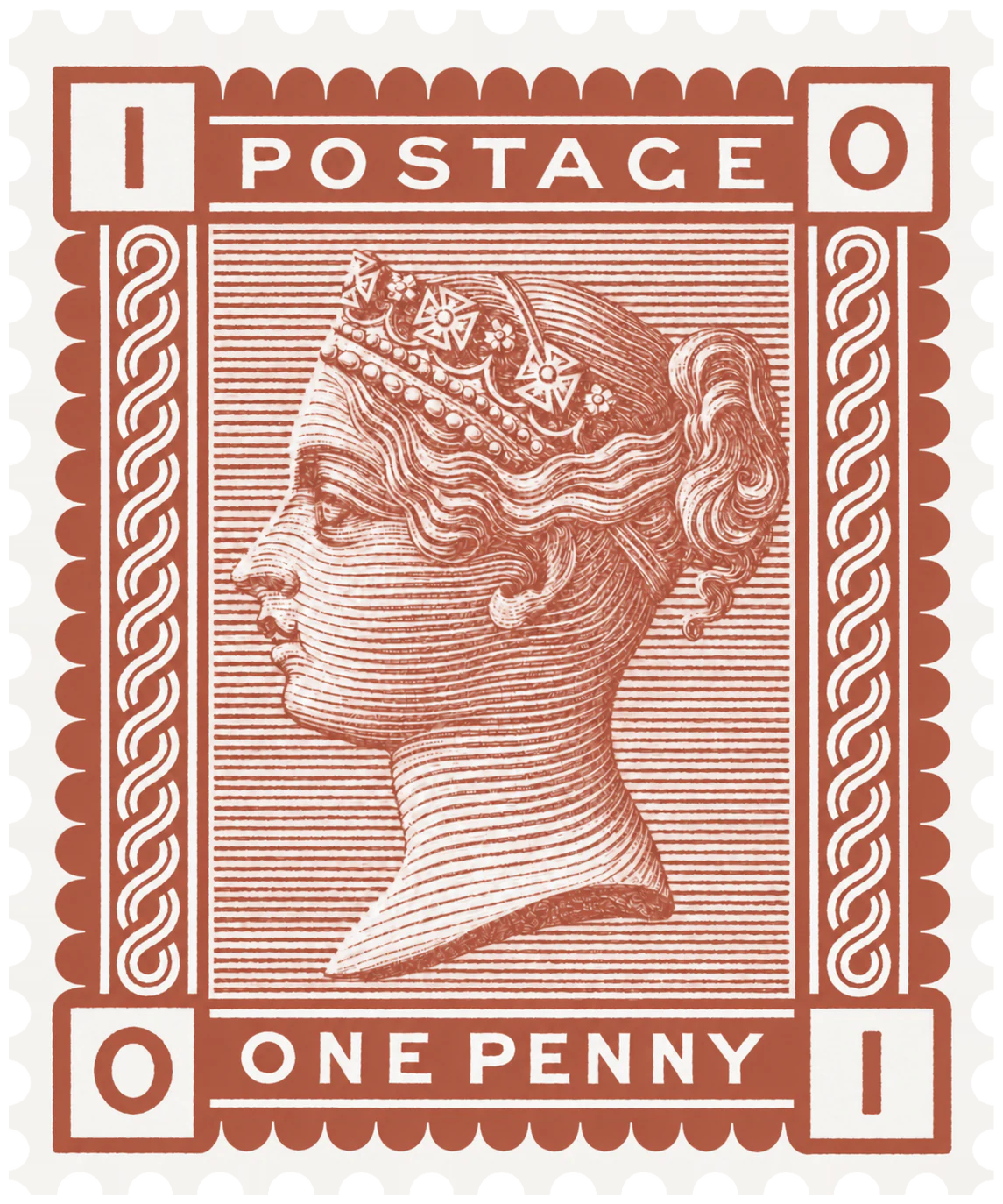
Only the penny in this series has check letters. The lower-left letter gives the row and the lower-right the column of the 240-stamp unit. Rows run A–T and columns A–L. The upper corners repeat the pair in reverse order.
Thus a stamp with O–I below has I–O above: row fifteen, column nine. The count continues into the lower pane rather than starting again at A. It does not identify a printing plate, a post office or an engraver.
The repeated pair was a safeguard against making a stamp from uncancelled pieces cut from different used stamps. The coloured letters sit on white squares. A different valid pair is another sheet position, not a variety on its own.
The other four values have no corner letters. Their absence is an intended feature, not a missing-print error. Plate positions on those values require specialised evidence rather than this letter-reading method.
On this stamp
The 1½d has no corner letters. That is normal for this design: only the penny retains them in the Provisional Issue. Do not infer a missing-letter error or a particular sheet position from the blank or ornamental corners.
A die supplies the design; a printing plate repeats it across a sheet. The 1880–1881 stamps carry no visible plate numbers, but the manufacturer still numbered and recorded the plates. Handwritten numbers on registration sheets are evidence from those records.
A registration impression records approval, often under the name imprimatur. A plate could be approved before public issue, kept in reserve, spoiled during preparation or never used for ordinary stamps. Counting prepared plates is therefore different from counting plates actually put to press.
Archive sheets sometimes have stamps removed, and double sheets can retain parts of both 240-subject units. The number now surviving on an archive sheet is not the original plate capacity. Museum descriptions preserve those distinctions.
Without printed plate figures, identification requires surviving records and specialised comparison of constant features. The reconstructions here represent design and catalogue families; they do not claim a plate that has not been established.
On this stamp
Only plates 1 and 2 were made and used, according to Wright and Creeke. Neither number appears on the stamps. A loose stamp cannot be assigned to a plate simply by its colour, and this reconstruction makes no plate identification.
Start with the value inscription, frame and colour. The halfpenny has curved inscription bands and angular corners; the penny has chain-like sides and lettered squares; the three-halfpenny has a pointed oval; the twopenny has straight sides and bowed bands; the fivepenny has a wavy, dotted oval.
Die proofs test an original design, plate proofs test its repeated impressions, and registration sheets record approval. SPECIMEN overprints mark reference or distribution material. None of those descriptions by itself establishes normal public sale.
An unperforated stamp needs particular care. The penny has a recorded issued imperforate exception, but a proof or a trimmed perforated single can also have straight edges. Provenance, paper, sufficient margins and adjoining impressions help distinguish them.
A small broken line can be a plate flaw, weak inking, later damage or a feature of reproduction. Fine varieties need original material and specialist comparison. The existing illustrations show the design without authenticating a rare flaw or error.
On this stamp
The pointed upright oval carries POSTAGE above and THREE HALF PENCE below in white lettering. Small ornaments occupy the corners outside the oval. The absence of check letters and visible plate figures distinguishes it from the 1870 line-engraved three-halfpenny.
The new plates removed the elaborate price inscriptions and visible plate/current numbers familiar from many earlier sheets. Wright and Creeke describe a small T-shaped guide at the foot and otherwise blank plate margins, with numbers added by hand on registration impressions.
Blank in printing does not mean blank in the paper. Watermarked lettering and other marginal paper marks can remain where there is no ink. Keep printed guides, handwritten archive annotations and watermarks separate.
The two full-width panes have a horizontal gutter, but no internal vertical gutter between columns. The broad side wing margins of earlier four- and twelve-pane surface-printed layouts should therefore not be transferred to this family.
The fivepenny adds a hexagonal division mark in the central gutter to help split each pane into sixty-stamp counter units. Outside selvedge, a horizontal gutter and an issued stamp’s narrow perforated margin are different parts of the sheet.
On this stamp
The 1½d has the two-pane layout with a horizontal gutter and no internal vertical gutters. The plate margins were blank apart from the small perforating guide at the foot. Printed guides and handwritten plate records must not be confused with watermarked POSTAGE in the surrounding paper. The earlier surface-printed wing-margin pattern does not apply.
The face value is the amount of postage represented, not a complete account of a journey. Date, destination, weight, route and service determine the charge. A stamp may pay the whole amount or only part of it.
At the introduction of this series, ordinary inland letters cost 1d up to 1 oz, 1½d over 1 oz up to 2 oz, and 2d over 2 oz up to 4 oz. Printed matter had its own conditions and began at ½d for 2 oz. Registration was an extra fee.
For overseas letters, the standard Postal Union scale used 2½d per ½ oz where that rate applied. Other destinations and routes required checking separately. The fivepenny’s announcement specifically mentioned correspondence with India and China; it did not make every fivepenny franking the same kind of letter.
A dated cover with its address, routing marks and complete franking supplies evidence that a detached stamp has lost. Compare the whole item before assigning it to a particular postal rate.
On this stamp
The inland scale introduced in October 1871 charged 1½d for a letter over 1 oz and not exceeding 2 oz. This gave the denomination a direct everyday use. It could also form part of a larger or overseas franking; the original item establishes the actual service.
A cancellation prevents a postage stamp being reused. A numeral in a cancelling mark may identify an office; an accompanying date stamp may record place and time. Neither is a printed plate number.
Cancellation and franking must be read together with the original item. A detached stamp can show that it was marked, but usually cannot establish its destination, weight or full postal charge. An early date of use is also different from the announced issue date.
The Venetian-red penny’s fugitive ink was intended to reveal attempts to remove a cancellation. Surviving colour can therefore be affected by treatment as well as fading or original variation. A coloured mark, pen stroke or unusual cancellation needs its own evidence before being assigned a postal or fiscal purpose.
On this stamp
The illustration is unused. On an original 1½d, any postal numeral or date mark would be a later cancellation, not part of the printed design. The original item supplies the address, date and other franking needed to interpret its use.