
The design of the 4d grey-brown
Queen Victoria · Great Britain · Thomas De La Rue & Co. · 1880
The green stamp becomes grey-brown
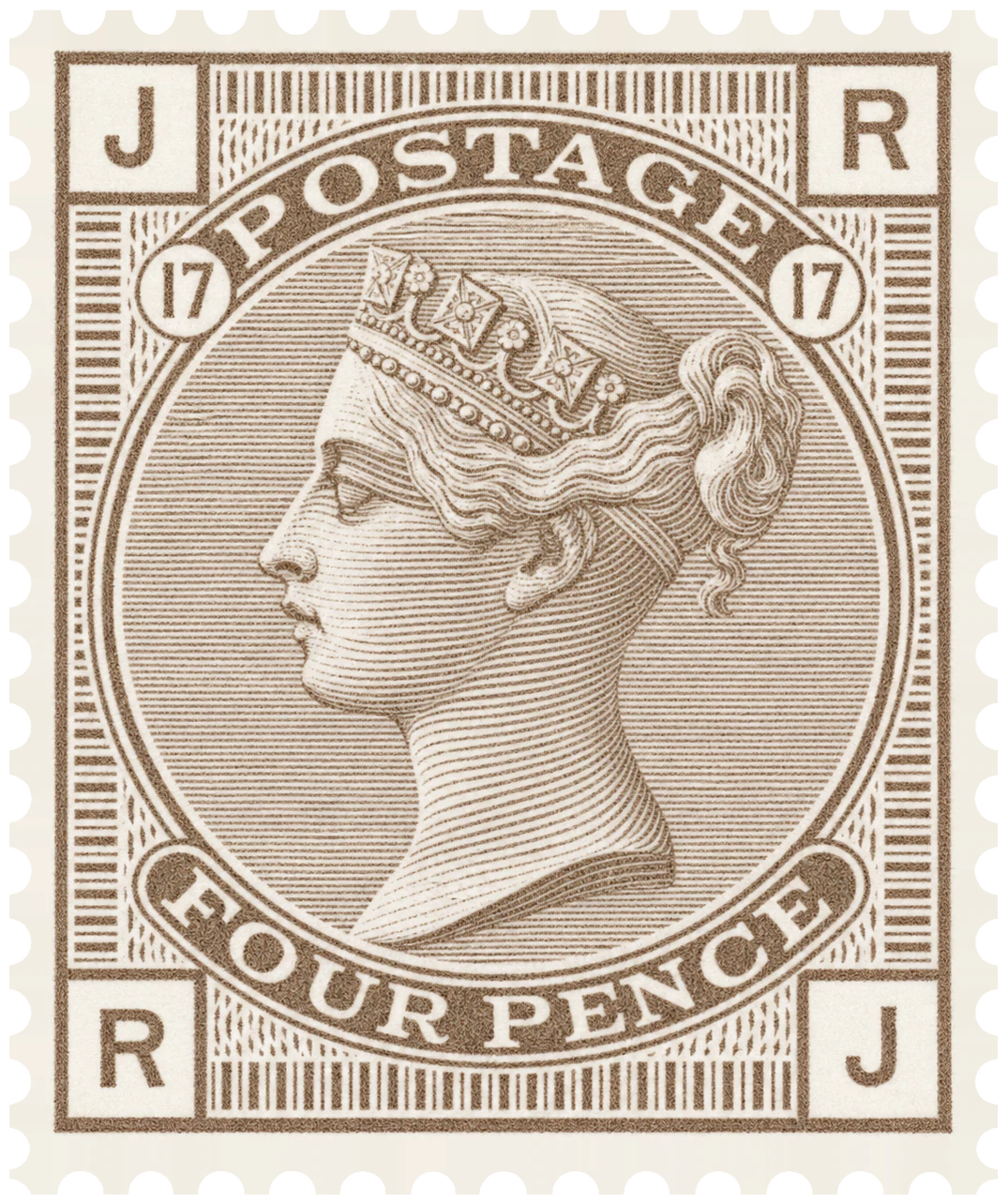
The fourpenny grey-brown retained the engraved design used for the sage-green stamp of 1877.
Victoria's portrait, the surrounding circle, inscriptions, corner letters and plate numbers remained unchanged. Only the printing ink was different. [1]
The new colour was described by contemporary philatelists as mouse-brown.
Its subdued appearance contrasts with the earlier vermilion and sage-green printings.
The change illustrates how much colour could alter the appearance of a stamp without the engraver touching the original design.
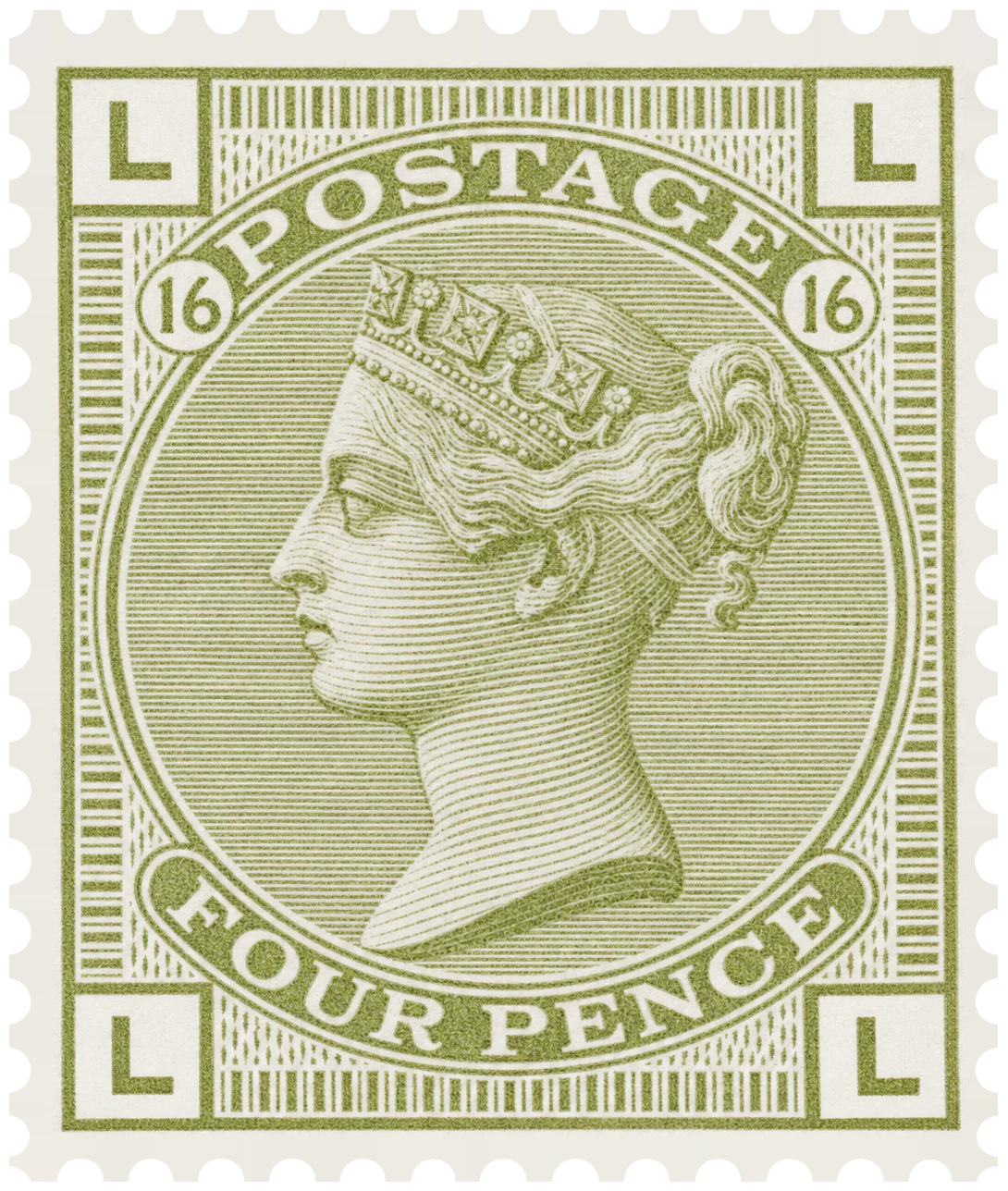
The same design in two issued colours. The illustrations do not identify a particular plate or registration sheet.
Click either stamp to magnify
The same plate in green and brown
Look at the small circular panels on either side of Victoria's portrait. Both contain the number 17.
The plate had been registered in sage-green in August 1877, but did not enter regular production until June 1880, when it was used for grey-brown stamps. [1]
A few green impressions had been printed during registration.
Examples of plate 17 in green and brown therefore provide a direct comparison of the same engraved design in two different inks.
The printing plate remained unchanged, even though the stamp's appearance had been transformed.
The corners retain their coloured letters
The grey-brown fourpenny has large coloured corner letters against white square backgrounds.
The lower letters identify its position in the printing sheet. Those above repeat the same pair in reverse order.
The arrangement was intended to make fraudulent alterations easier to detect. [1]
De La Rue had introduced this style of lettering for the fourpenny in 1876, replacing the earlier white letters on coloured backgrounds.
The grey-brown retained the arrangement unchanged.
A security feature developed years earlier remained part of the design through successive changes of colour.
The Garter hidden beneath the brown ink
The original grey-brown fourpenny was printed on paper carrying the Large Garter watermark.
The emblem represented the Order of the Garter and was formed within the paper during manufacture, rather than printed in ink.
The paper also carried the word MARK in its outer sheet margins. [1]
The same watermarked paper had been used for the earlier vermilion and sage-green fourpenny stamps.
The printed colour changed, but the hidden royal emblem remained unchanged.
Why some stamps lost their wide margin
The fourpenny printing sheets were originally divided into four panes of sixty stamps.
Where panes met, the perforating process could leave an unusually broad strip of paper along one side of a stamp, known as a wing margin.
But in September 1880, De La Rue took over perforating from Somerset House and altered the finishing process. [2]
Some stamps that would previously have had wing margins were now separated with ordinary margins.
A surviving grey-brown fourpenny dated 16 November 1880 demonstrates the change.
The edge of a stamp can therefore reveal something about the machinery and working arrangements used to finish it.
The crown that replaced the Garter
The first grey-brown stamps used Large Garter paper, but this was soon replaced by paper carrying the Large Crown watermark.
The new crown design was formed within the paper during manufacture, just as the Garter had been. [1]
The change required De La Rue to rearrange printing plate 17, replacing four panes of sixty stamps with two panes of 120.
Victoria's portrait and surrounding frame remained unchanged.
The transition shows how a new paper watermark could require substantial work on the printing equipment without altering the visible design.
A portrait passed between three artists
Victoria's likeness originated in a portrait by William Wyon, Chief Engraver at the Royal Mint. His medal portrait drew on a sketch made in 1834, when Victoria was fifteen. [3]
Henry Corbould prepared a drawing based on Wyon's portrait, which later supplied the model for Jean Ferdinand Joubert de la Ferté's surface-printed engraving.
The grey-brown fourpenny retained Joubert's interpretation.
The stamp brought together the work of artists whose contributions extended across more than forty years.
The diamond diadem made for a king
The ornament in Victoria's hair was commissioned for George IV's coronation in 1821. [4]
It contains 1,333 diamonds, with crosses and the national emblems of the rose, thistle and shamrock.
Victoria later wore the diadem in portraits, and it became a familiar feature of British postage stamps.
On the fourpenny grey-brown, its jewels are reduced to tiny printed lines. A magnificent royal ornament had become part of an everyday object worth fourpence.

Image information
Click image to magnify
Digitally created illustration of the diamond diadem, with crosses, floral emblems and rows of pearls, resting on a blue cushion.
- Credit
- Stunning Stamps.
- Notes
- Digitally created.
Sources
- Hastings E. Wright and A. B. Creeke: A History of the Adhesive Stamps of the British Isles (1899), pp. 101–103
- Robert B. Galland: The First Low Value Surface Printed Postage Stamps of Great Britain (2014), pp. 25–26
- Douglas N. Muir, Royal Mint Museum: William Wyon & the Penny Black
- Royal Collection Trust: George IV's Diamond Diadem