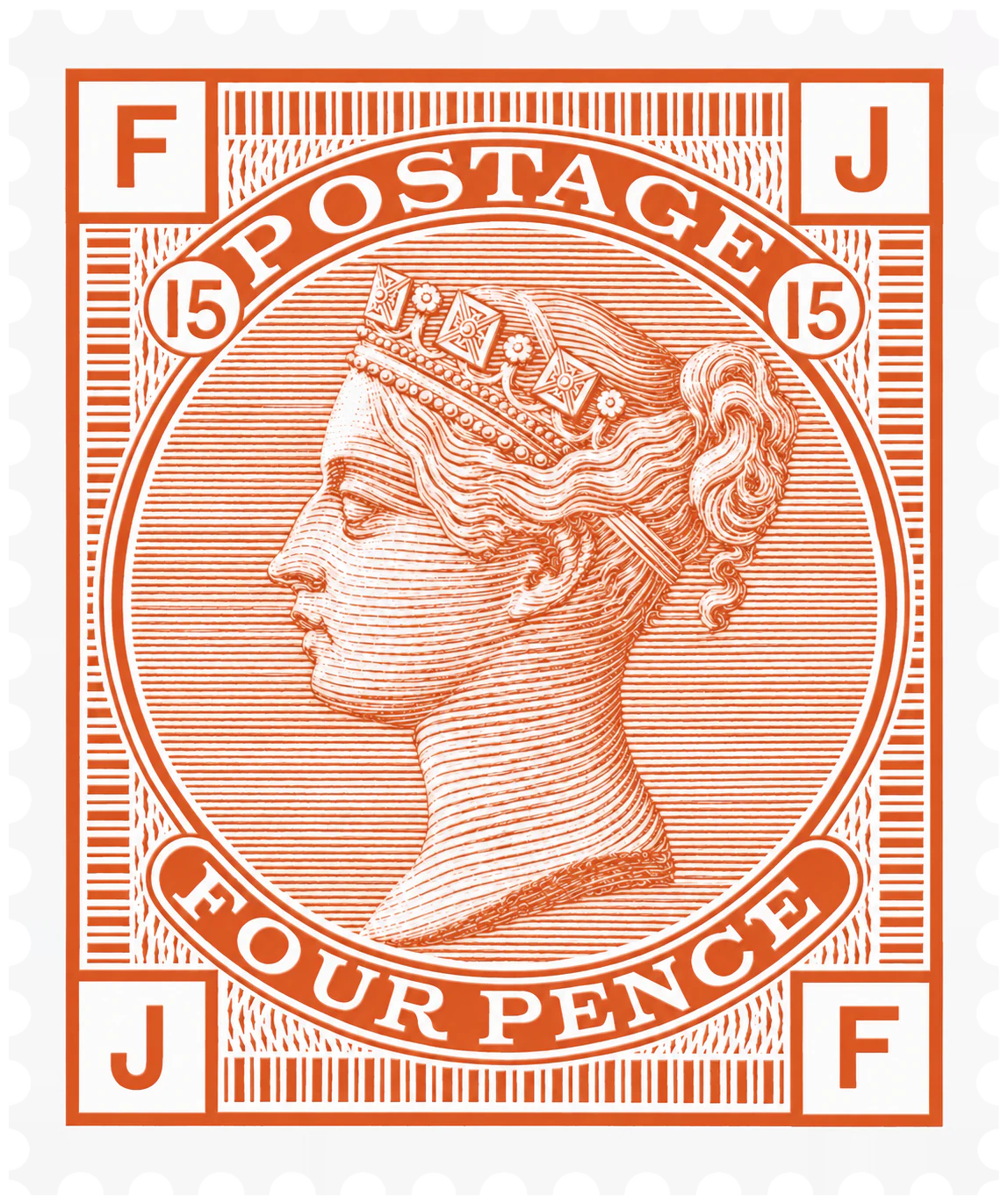
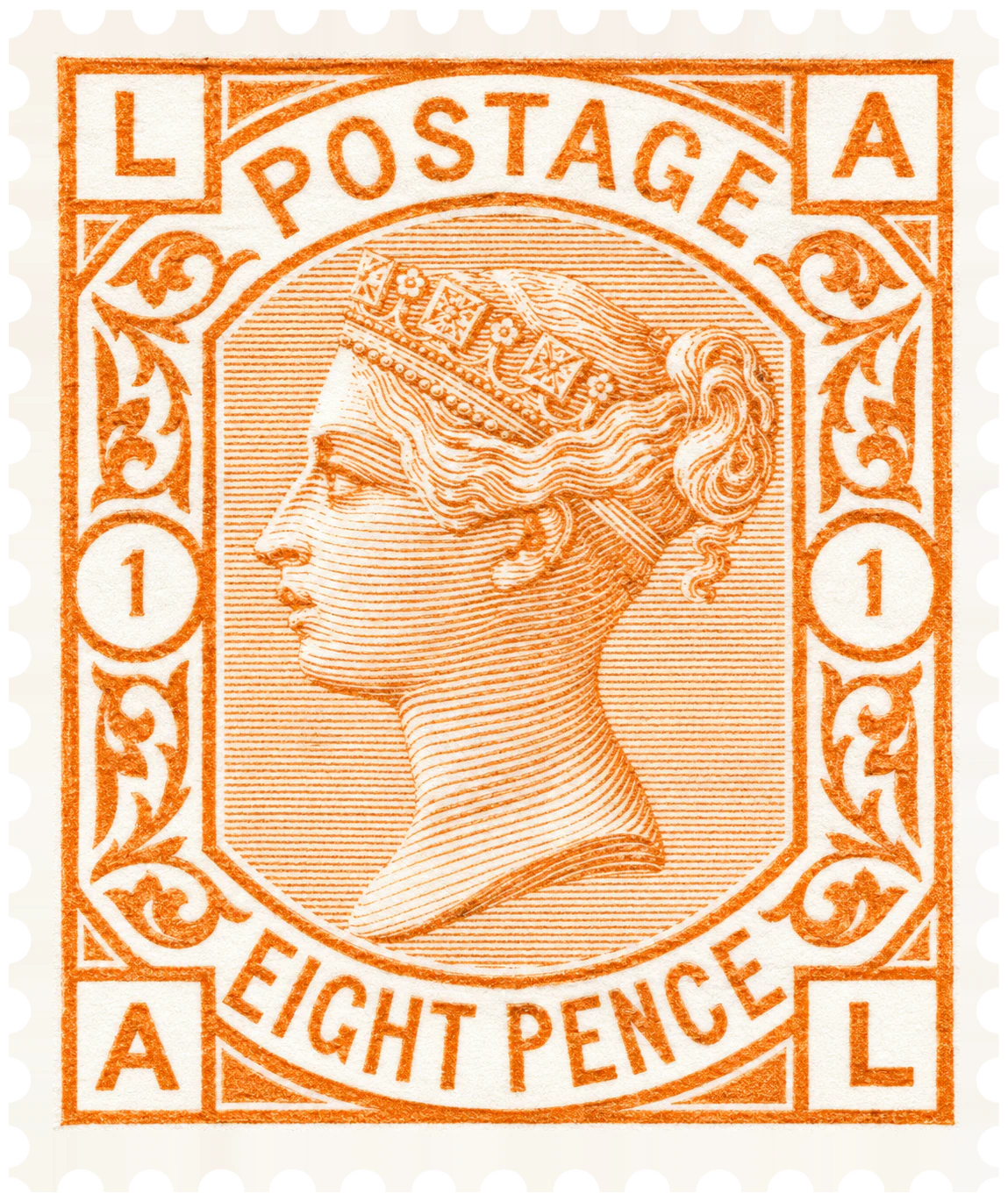
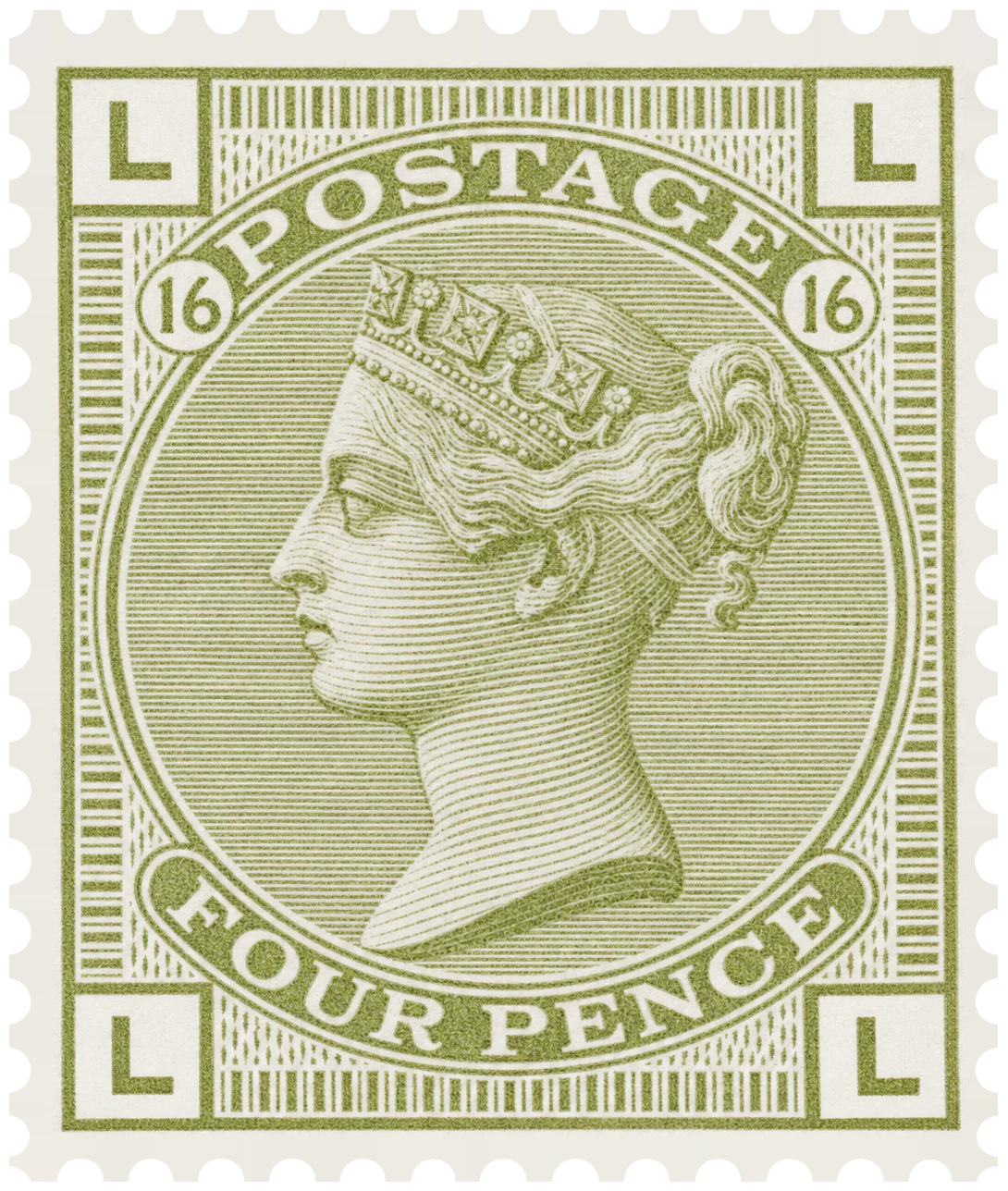
The fourpenny changed from vermilion to sage-green in 1877 after postal staff confused its red colour with the new eightpenny orange, particularly under gaslight. The Postmaster-General selected the green from several colour trials. De La Rue retained Victoria's portrait, the large coloured corner letters and the original printing plates. One plate prepared in green was never used for ordinary green-stamp production.
Stories
The colour chosen because of gaslight
The colour chosen because of gaslight
In 1876, the Post Office received complaints about two stamps that looked too much alike.
The fourpenny was vermilion and the new eightpenny was orange. Under post-office gaslight, staff checking postage could mistake one for the other, despite their different designs.
A report to the Postmaster-General on 23 October confirmed the problem. Rather than change the recently introduced eightpenny, officials decided to give the fourpenny a new colour. [5]
De La Rue prepared several trials. On 24 October 1876, the Postmaster-General selected a pale sage-green.
The new stamps appeared in February 1877.
The colour needed to be recognisable when postal staff checked postage under artificial light.
The issued designs involved in the change. The illustrations do not simulate gaslight or show the rejected colour trials.
Click a stamp to magnify
The printer whose colour trials became official
Changing a stamp's colour required more than asking a printer to use green instead of red.
De La Rue had to prepare trial inks and submit impressions for official approval. The new shade needed to be recognisable, sufficiently consistent and suitable for security printing.
The Postmaster-General approved sage-green on 24 October 1876. A Post Office circular dated 26 February 1877 announced that the fourpenny would thereafter be light green rather than light red. [5]
The old printing plates could continue working with the new ink.
The alteration had been decided at the highest level of postal administration, but carried out through the practical work of De La Rue's ink-makers and pressmen.
The plate that waited three years
De La Rue's plate 16 had been approved in August 1874, originally for the vermilion fourpenny.
It was not immediately required. Plate 15 continued supplying the stamps, even after the colour changed to sage-green.
Plate 16 finally entered production on 23 October 1877, more than three years after its approval. It remained in use until June 1880, producing approximately 30,000 sheets. [5]
A printing plate was expensive to prepare, but it could remain in reserve while another continued to work.
The plate prepared for a red stamp had eventually spent its working life printing green ones.
The stamp discovered seventeen years later
In August 1877, De La Rue registered another fourpenny plate, numbered 17.
It was never used for ordinary sage-green production. However, the usual five spare sheets were printed during registration, and some of these impressions entered circulation. [5]
The unusual stamps remained unrecognised until 1894, when the dealer Walter Morley identified the plate number on a green fourpenny.
Later investigations uncovered further examples, including stamps used in Bradford.
The plate itself would not enter ordinary production until 1880, when the fourpenny was printed in brown.
A small group of preliminary impressions had preserved evidence of a printing plate's existence years before its regular working life began.
Two kinds of fourpenny, one shade of green
The Post Office was also producing special stamps for its telegraph service.
When a fourpenny telegraph stamp was prepared in 1876–77, officials decided that it should use the same colour and paper as the corresponding postage stamp. [11]
The telegraph design was different, but both stamps were printed by De La Rue in sage-green on Large Garter watermarked paper.
Two printing plates were prepared for the telegraph issue, although only one was used for ordinary production.
The arrangement reveals how decisions about colour and paper were coordinated across different branches of government communications.
Why do some stories appear on several pages?
Every page is written to make sense on its own. Visitors often arrive directly at a particular stamp or subject, without having explored the rest of the site.
Some stories are relevant to several stamps, so they are repeated where they help explain what you're looking at. For those exploring a series, the details specific to each stamp generally come first, with the more familiar stories further down the page.
This way, you can explore the site in any order without missing interesting background.
Sage-green transformed a design previously printed in vermilion. Look closer at the portrait touching its frame, the coloured corner letters and the small plate numbers that reveal its production history. [12, 13]
De La Rue grew from a playing-card business into a major security printer. It supplied British postage stamps from the Victorian period and printed the Edward VII issues before the contract changed in 1911.
On this stamp
Thomas De La Rue & Co. printed the 1877 fourpenny sage-green by typography, reusing the vermilion design and plates. The illustration represents plate 16 on Large Garter paper; the few plate-17 green impressions came from registration sheets.
Jean Ferdinand Joubert de la Ferté was a French engraver and photographer. He trained in Paris and later worked in London, where his engraving helped establish De La Rue’s surface-printed postage stamps.
On this stamp
The 1877 fourpenny sage-green inherited Joubert’s portrait engraving for the earlier surface-printed stamps. This credit identifies the original portrait, not a separately documented commission to engrave a new portrait or frame for the 1877 colour change.
William Wyon was a medallist and engraver at the Royal Mint. His models of royal heads were made for coins and medals and also became sources for stamp portraits.
On this stamp
Wyon’s City of London medal supplied the youthful likeness inherited through Corbould’s drawing and Joubert’s engraving on the 1877 fourpenny sage-green.
Henry Corbould was a draughtsman and book illustrator. He trained with his father and at the Royal Academy Schools, where he received a silver medal for a life study.
On this stamp
Corbould’s drawing after Wyon’s medal supplied the model for Joubert’s earlier surface-printed portrait, inherited by the 1877 fourpenny sage-green.
The country identifies the postal authority that issued the stamp. The monarch identifies the ruler whose portrait it carries. A definitive is an everyday stamp intended for regular postal use.
On this stamp
The 4d sage-green is a Great Britain definitive from Victoria’s reign. Its portrait descends from the earlier surface-printed issues; the coloured corner letters identify a later stage of the designs.
The denomination is the stamp’s face value: the amount of postage it represents. Its price to a collector can be quite different.
In Britain’s old currency, 12 pence made one shilling and 20 shillings made one pound: 240 pence altogether. The abbreviations were d for pence, s for shillings and £ for pounds. The d comes from the Latin denarius. A halfpenny, written ½d, was half an old penny.
On this stamp
4d represents 4 old pence. The 240-stamp printing sheet was worth £4. The post-office accounting unit contained 60 stamps (one pane), worth £1.
A shade is a variation within a stamp’s colour. Some variations receive their own catalogue numbers even though the design and denomination stay the same.
Compare known examples under consistent lighting. Fading can change a stamp’s appearance, and photographs or screens can alter how colours look. A catalogue colour name helps describe a shade; it is not a colour test by itself.
On this stamp
This article represents sage-green in the SG153 family. The reconstruction is not a calibrated shade standard. Identify an original using its paper, plate and design as well as its colour.
A stamp can be printed, sent to post offices, put on sale and made valid for postage on different dates. An official notice or instruction can establish when it was intended to be used; a dated letter shows that a particular example was actually used.
An early surviving cover is evidence of use by that day. It does not necessarily identify the first day of sale. A year in the heading may also cover later printings of the same design.
On this stamp
The Post Office circular of 26 February 1877 announced light green in place of light red. Wright and Creeke placed public issue on 27 February, distinguishing a 7 February stock-book entry as probable distribution to suppliers. Illustrated plate 16 did not enter production until October 1877.
These designs reverse the earlier treatment of the corners: the letters are printed in colour on white fields. The threepence and shilling began the change in 1873; revised sixpenny and fourpenny stamps followed. The 2½d and 8d were new denominations within this family.
The change helped plate preparation. Separate letter plugs could supply the characters needed for each position. Some frames and portraits were retouched at the same time, so the difference is more than simply changing the colour of an old letter.
The dates on these articles identify first appearances of designs or colours. Later plates, new watermarked papers and further colour changes can retain the same basic design. The individual note identifies the stage represented by the illustration.
On this stamp
This 4d belongs to the large coloured-letter family, with the corner characters printed in the stamp’s ink on white fields. It retains the established royal likeness within a design adapted from an earlier denomination. Later paper and plate changes are explained separately.
A stamp catalogue gives each listed issue a reference number. SG means Stanley Gibbons, the publisher of the catalogue used here. These numbers help collectors refer to the same issue; they are not serial numbers printed on individual stamps.
A range of numbers groups related entries. Colour, paper or perforation differences may account for separate listings within that range.
On this stamp
SG153 is the intended catalogue family for the existing reconstruction, with lower letters LL and plate 16. The source record identifies the represented design; it does not authenticate hidden gum, watermark orientation or microscopic varieties.
Typography, or surface printing, uses a raised printing surface. Ink is applied to the raised parts, then transferred to paper under pressure. The lower spaces leave the paper unprinted.
Fine lines and solid areas are both part of that raised image. This is the same basic principle as letterpress printing.
De La Rue reproduced the relief design by electrotyping. A steel die supplied moulds; metal deposited on those moulds formed the repeated printing surfaces. The period account distinguishes the steel die from the electrotype printing plate and its protective facing. “Steel plate” is therefore not a safe description of every stage.
The paper was gummed before printing and used dry. One ink formed the portrait, lettering and ornament; white areas are unprinted paper. Coloured corner letters could be supplied by interchangeable plugs when preparing the moulds. Printing, gumming and perforating were distinct operations.
Surface printing, shown from the side. The paper is pressed onto the inked surface.Image information
Side view of surface printing. Paper is pressed down onto ink on the raised parts of a printing plate; the lower spaces do not touch the paper.
Credit
Stunning Stamps · 2026
On this stamp
De La Rue printed this 4d in one colour from a raised electrotype surface. Its corner letters and plate figures carry ink; their white backgrounds are unprinted paper. Gumming preceded printing on the dry sheet, and perforating followed separately.
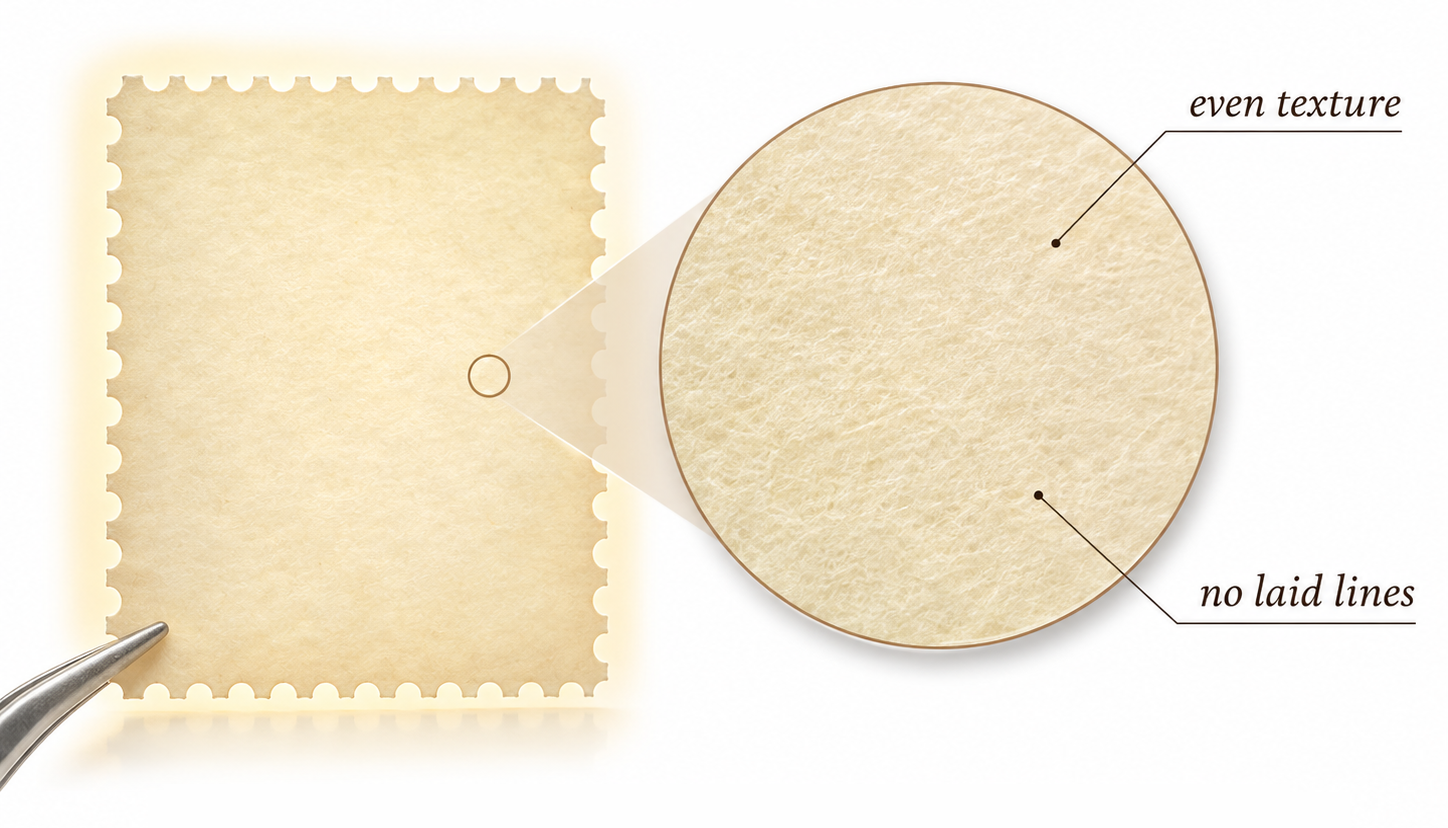
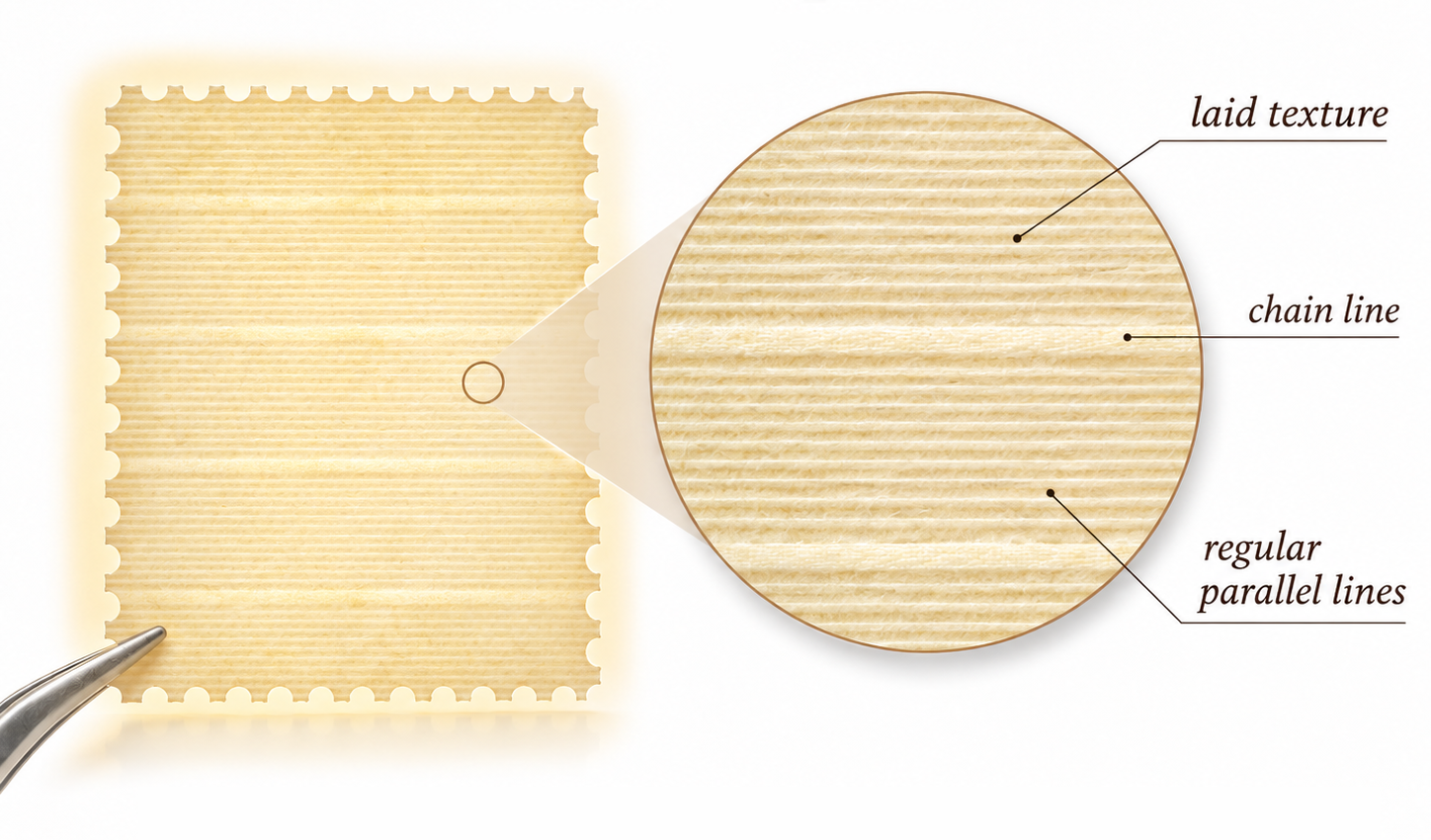
Wove describes the structure of the paper. Viewed against the light, it has a fairly even appearance. Laid paper instead shows a regular pattern of lines left by its manufacture.
Paper structure and watermark are separate characteristics: wove paper can carry a watermark. Both can help distinguish stamps with similar printed designs.
The issued stamps represented in this family use machine-made wove paper. A patterned dandy roll acted on the wet paper to form the watermark. Small Anchor fiscal paper was borrowed for the first 2½d, while other values used papers prepared for postage stamps. White, bluish and experimental papers must be identified separately.
Wove paper: even texture without laid lines.Image information
Click image to magnify
Diagram of wove paper with a magnified inset showing an even texture without laid lines.
Credit
Stunning Stamps · 2026
Notes
Digitally constructed
Laid paper: regular parallel lines, shown for comparison.Image information
Click image to magnify
Diagram of laid paper with a magnified inset showing regular parallel lines.
Credit
Stunning Stamps · 2026
Notes
Digitally constructed
On this stamp
The represented SG153 family uses machine-made white wove paper with Large Garter watermark. The watermark names the pattern within the paper; it does not describe a printed feature or a different perforation gauge.
Wove describes the paper’s structure; surface finish, thickness and colour are separate properties. The period manufacturing account describes the earlier surface-printed papers as firm and smooth after milling, while noting a change in quality around 1880.
The Small Anchor paper used for the first 2½d was fiscal paper and could be white or bluish. The blue tint of a paper must not be confused with blue printing ink. Later Orb paper was made specifically for the postage value.
This family predates the chalk-coated Edwardian issues. The face of a reconstruction cannot establish thickness, gum, a chemical treatment or watermark orientation. Those properties require examination of the paper itself.
On this stamp
The 4d is represented on ordinary white paper. Wove structure, surface finish and thickness are separate properties. The period manufacturing account describes the earlier paper as smooth after milling. No chalk coating or chemical test result is assigned to the reconstruction.
Printing ink had to show fine detail clearly and resist fraudulent reuse. A fugitive colour reacts to attempts to remove a cancellation. That aim is different from identifying an exact surviving shade, which may have been affected by light, moisture or treatment.
Several changes in this family were intended to make denominations easier to distinguish. The eightpence’s prepared purple-brown stock was replaced by orange; the vermilion fourpence then changed to sage-green after confusion with the orange eightpence. Blue replaced rosy mauve on the 2½d, and orange-brown replaced green on the shilling.
A new ink need not require a new design or plate. The 2½d plate 17 and shilling plate 13 each continued through a colour change. Later purple trials for postage-and-revenue use, including unissued values, must be distinguished from ordinary stamps and from the later issued surcharged 3d and 6d.
On this stamp
Sage-green was selected to separate the fourpence from the orange eightpence. The revised colour retained the same portrait and frame. Plate 16’s earlier vermilion registration does not mean the ordinary green printing is a new design.
A watermark is formed within the paper during manufacture. It is not printed on the face. These machine-made papers used a dandy roll with raised devices to create thinner areas. A single stamp may show only part of a mark.
The first rosy-mauve 2½d used Small Anchor fiscal paper, followed by purpose-made Orb paper. The blue 2½d began on Orb and later changed to Large Crown. These are distinct paper types despite the retained octagonal stamp design.
The threepence, sixpence and shilling represented here use Spray of Rose; the fourpenny colours and issued orange eightpence use Large Garter. Several continuing values changed to Large Crown paper in 1881. The orange eightpence did not thereby become a normal Crown-paper issue.
The same plate can occur on two papers. Conversely, the later Crown 2½d required larger plates because the sheet grew from 192 stamps to 240. Identify the paper, plate and colour together; an illustration of the front cannot authenticate a watermark or its orientation.
On this stamp
The sage-green SG153 family remains on Large Garter paper. Plates 15 and 16 produced the normal issue. Plate 17 was registered in green but entered ordinary production in grey-brown; the plate number and colour must be read together.
Perforations are the rows of punched holes that let neighbouring stamps separate. Their gauge describes the spacing over a standard distance of 2 centimetres, rather than the total number of holes along a stamp’s edge.
A perforation gauge has rows of dots or lines at known spacings. Match an edge against them: the marks should line up all the way along. A single number applies to both directions; two numbers give the horizontal gauge first, then the vertical.
All ten ordinary issues represented here gauge 14 horizontally and vertically. Watermark, colour, plate and design differences are not perforation alternatives. Issued imperforate exceptions, unissued trials and registration impressions need separate evidence.
Somerset House carried out perforating until the transfer to De La Rue in 1880. Wright and Creeke record the machinery moving from June to the end of August, with the contractor responsible from September. A change in responsibility did not change the nominal gauge.
Enlarged spacing diagram, not to scale. Match the spacing with a perforation gauge.Image information
Enlarged perforation spacing: fourteen equal intervals between hole centres span 20 millimetres. This is a schematic, not a ruler.
Credit
Stunning Stamps · 2026
On this stamp
The ordinary 4d sage-green gauges 14 horizontally and vertically. All ten articles in this set have that gauge and there is no grouped perforation alternative. Different plates, colours and watermarks must be distinguished separately from perforation.
Gum is the adhesive on the back of a stamp. For these De La Rue surface-printed issues, gum arabic was applied to the paper before printing. The sheet could then be printed without the preliminary dampening required by the earlier line-engraved method.
The gum and the printed ink are different layers with different purposes. A smooth printing face does not describe the adhesive on the reverse. On an unused original, the presence and condition of the gum are examined separately from the paper and watermark.
A front-view illustration supplies no evidence that original gum survives. Handling, removal from an album or later regumming may affect the back while leaving the printed design recognisable.
On this stamp
Gum arabic was applied to the paper before this 4d was printed. The face illustration does not establish whether an original retains its gum, has been hinged or has been regummed. Paper and adhesive condition require examination of the reverse.
A printing sheet is the set of impressions printed together. Panes are the separate blocks within it; gutters are the unprinted spaces between those blocks. The outside border is the sheet margin or selvedge.
The early 2½d used 192 stamps in two panes of 96, one above the other. Each pane was eight rows by twelve columns, with no vertical gutter through its middle. The first Small Anchor paper contained 240 watermark positions, so unused watermarks could fall under the margins and between panes.
The fourpence and eightpence used 240 stamps in four panes of sixty. The threepence, sixpence and shilling used 240 in twelve panes of twenty. Each arrangement gave twenty rows and twelve columns across the full printing sheet.
When Large Crown paper was introduced, continuing values used two panes of 120. Existing panes could be brought together, while the 2½d needed plates with more stamp positions. The diagram explains pane and gutter terminology; the note below gives this stamp’s actual layout.
Sheet, panes and margins: a simplified example.Image information
A schematic printing sheet contains two panes separated by an unprinted gutter and surrounded by a margin.
Credit
Stunning Stamps · 2026
On this stamp
Four panes, two across and two down, each held ten rows of six stamps. The full sheet therefore contained twenty rows of twelve: 240 stamps worth £4. The later Crown-paper grey-brown fourpence rearranged the four panes into two panes of 120.
The sheet used for printing and the smaller unit supplied for counter accounting need not contain the same number of stamps. Printed marginal inscriptions helped staff check the face value and divide the sheet correctly.
The early 2½d counter sheet held 96 stamps worth £1. Forty threepences made 10s; sixty fourpences, forty sixpences, thirty eightpences and twenty shillings each made £1. The thirty-stamp eightpenny unit was half a printing pane.
The Crown-paper 2½d changed to 120 stamps per counter sheet, worth 25s. Other continuing values could retain their established counter totals within newly arranged larger panes. These are original accounting values, not prices to collectors.
On this stamp
The post-office unit contained 60 stamps (one pane), worth £1. 60 stamps at 4d each total £1. That accounting unit is separate from the 240-stamp printing sheet worth £4.
The lower-left letter identifies the row and the lower-right the column. The upper pair repeats those letters in reverse order. A lower pair F–B therefore has B–F above. They are sheet positions, not an engraver’s initials or a postal office code.
Columns run A–L. On a 240-stamp sheet the rows run A–T; on the early 192-stamp 2½d they run A–P. Counting continues across pane boundaries rather than restarting in every pane.
The repeating pair helped expose stamps assembled from uncancelled pieces of different used stamps. In this family the characters print in the same ink as the portrait on fields of unprinted paper. Interchangeable letter plugs assisted preparation of the repeated plate positions.
A different valid pair is another position, not a variety by itself. Matching letters can legitimately appear in all four corners. A suspected error requires the exact plate and position, and a plausible pair alone does not prove authenticity.
On this stamp
The illustration reads L–L below; L–L above. The lower pair identifies row 12, column 12 of the full sheet. Rows run A–T and columns A–L; counting continues across pane boundaries. All four Ls are correct for this LL position.
A die holds the original design; a printing plate repeats it across a sheet. The paired small figures on the stamps identify the plate. The four corner letters instead identify one position within it.
A registered impression records approval of a plate. It is often called an imprimatur. The plate might then wait before production, remain unused, or continue through a new colour or paper. A registration date is not automatically a public issue date.
Small surplus printings made at registration account for some exceptional material called abnormals. A plate mentioned in a record is not necessarily an ordinary issued plate in every recorded colour or on every paper.
In 1881 several existing plates were rearranged for Crown paper by bringing smaller panes together. That altered their sheet layout without necessarily changing the design or plate number visible on an individual stamp.
On this stamp
The upper circles show 16. Registered in vermilion on 4 August 1874, it was used for the normal sage-green printing from 23 October 1877 to 14 June 1880. Plate 15 also printed sage-green; green plate-17 stamps come from exceptional surplus registration sheets.
Begin with the combination of frame, corner letters, plate figures, colour and paper. The coloured-letter grey sixpence differs from the preceding white-letter grey design; a shilling plate 13 may be green or orange-brown, and later orange-brown examples may use another watermark.
Proofs test a design or plate; registration sheets record approval; SPECIMEN overprints identify material prepared for official reference or distribution. These purposes differ from ordinary public sale. The origin of an unperforated or unusually coloured stamp must be established before calling it an issued variety.
The unused purple-brown eightpence stock and the very limited orange plate-2 printing are different exceptions. Likewise, plate 16 in vermilion and plate 17 in sage-green are not the ordinary fourpenny printings from those plates.
Historical authors sometimes inferred surplus registration sheets even when they had not seen surviving examples. Their inference must not be presented as a newly authenticated discovery. A reconstruction can show a design and a selected plate, but cannot certify a rare error, paper or microscopic feature.
On this stamp
LL means row 12, column 12, so all four corners carry L. It is a valid sheet position, not a repeated-letter error. The frame is the coloured-letter fourpence retained from the vermilion issue, with the same upper plate-number circles.
A wing margin is extra paper retained at the side of a stamp beside a vertical gutter. A perforating line down the middle of the gutter left a broad strip on each neighbouring stamp. The printed stamp design was not wider.
In the four-pane layout, columns F and G flank the central vertical gutter. In the twelve-pane layout, columns D/E and H/I flank the two vertical gutters. The early 2½d’s two full-width panes have no such vertical gutter, so that pattern must not be transferred to its letter positions.
The eightpence is a further exception: the period account records gutter perforation down the centre, close to the panes, or absent. After the 1880 transfer of perforating, De La Rue perforated close to pane edges; the later two-pane Crown layouts also removed the old internal vertical gutters.
A narrow illustrated margin is not proof that a represented position was away from a gutter. Wide margins can be trimmed or reperforated on surviving stamps. Use position, sheet layout, production period and the perforations together.
On this stamp
The represented LL position is row 12, column 12. It does not adjoin an internal vertical gutter. It is at an outer sheet edge; outside selvedge is different from an internal wing margin.
The denomination is the amount of postage supplied, but it does not identify a journey on its own. The charge depended on the date, destination, route, weight and service. A stamp might pay one rate, several rates or only part of the total.
The 2½d was created for the new Postal Union letter rate in 1875. The eightpence served particular overseas routes. Other values paid heavier inland items, overseas charges or combinations with registration fees. The inland registration fee fell from 4d to 2d in January 1878.
An intact cover can retain the address, routing instructions, date marks and other stamps that make a franking understandable. A loose cancelled stamp usually cannot establish all of those details. Postage stamps used on telegrams also require a different explanation from letter postage.
On this stamp
The inland registration fee was still 4d when this colour appeared in 1877, but fell to 2d on 1 January 1878. Sage-green stamps could continue to pay ordinary postage or contribute to larger totals after that change. A date and the complete cover establish which use applies.
The cancellation is the inked mark that prevents a stamp being used again. By the period of these issues, barred obliterators with office numbers had succeeded the Maltese Cross as the usual form. A town or date mark could be applied separately, or alongside the obliterator in a combined device.
The office number is part of the postmark, not a printing-plate number. A cancellation can cover the portrait, letters or fine plate details; it must be distinguished from marks produced during printing.
An unused reconstruction has no such mark. For a used original, the whole cover gives the strongest context for interpreting the date, route and postage. A loose stamp seldom establishes all three.
Postage stamps were also used for telegraph charges during part of this period. A telegraph cancellation or a stamp removed from a telegram does not prove a letter journey. The date and original document matter, especially when comparing use before and after separate telegraph stamps appeared.
On this stamp
The illustration is unused. A cancellation’s office numeral is separate from the printed plate 16 figures and corner letters. The original cover or telegram supplies the evidence for postal versus telegraph use, date and route; a detached stamp cannot establish those details by itself.