The sixpenny mauve of 1869 introduced a small but distinctive design change: the hyphen between SIX and PENCE disappeared. Behind the familiar portrait lay a troubled printing history, including a rejected plate and another that never entered regular production. De La Rue retained the large white corner letters, plate numbers and Spray of Rose watermark, while its inks produced shades ranging from lilac to deep purple.
Stories
The stamp that lost its hyphen
The stamp that lost its hyphen
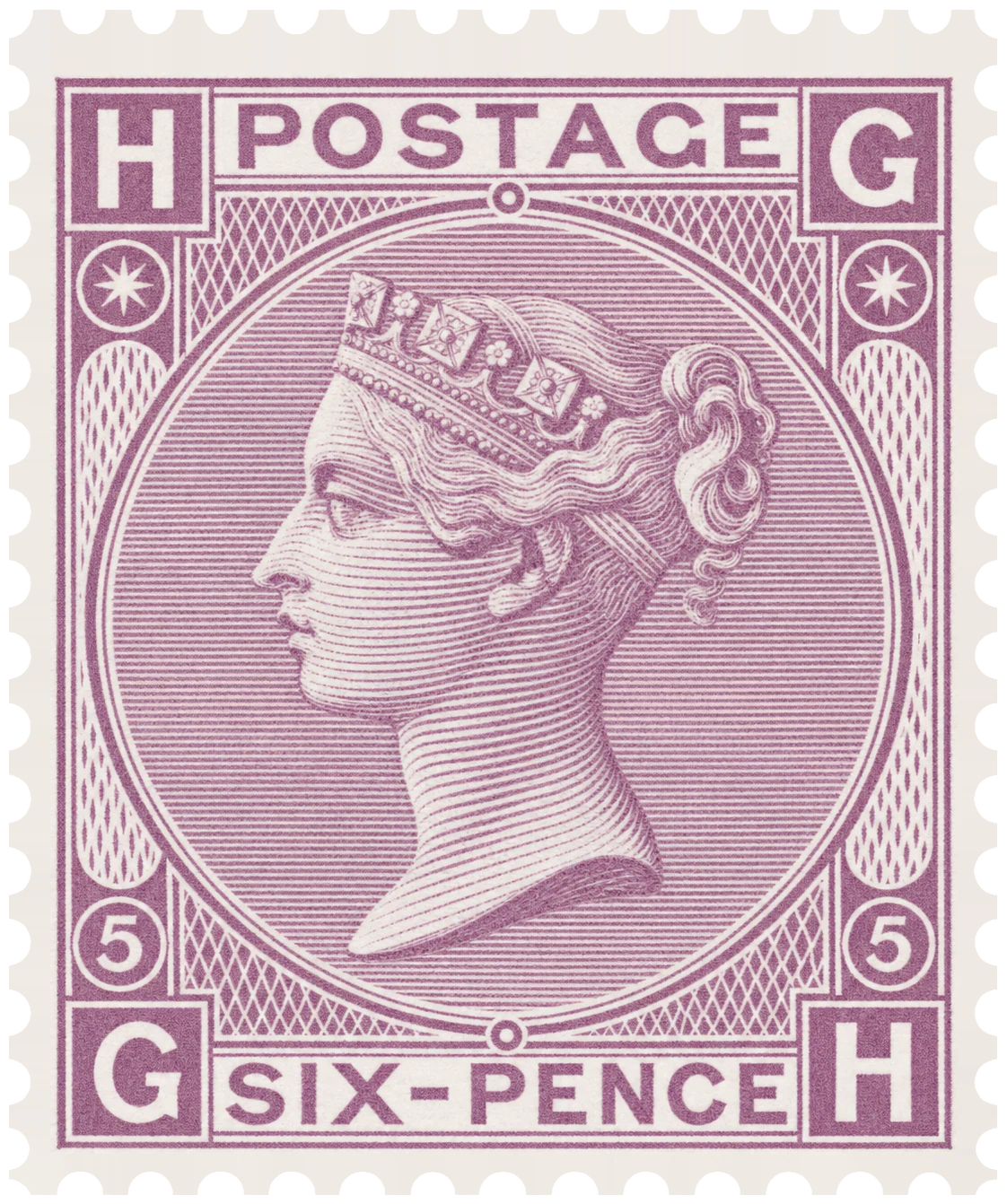
In 1869, De La Rue introduced a revised sixpenny stamp. The alteration was so slight that it could easily escape notice: the hyphen between SIX and PENCE had disappeared.
The change was made during the preparation of a new printing die. Victoria's portrait, the surrounding framework and the large white corner letters remained substantially unchanged. [4]
There was no special announcement. The philatelic historians Wright and Creeke later established that an example from the new plate had been used by 12 March 1869, although the issue was traditionally dated April.
The reason for removing the hyphen was not recorded. A tiny decision made in the engraving workshop had created a recognisable new version of the sixpenny.
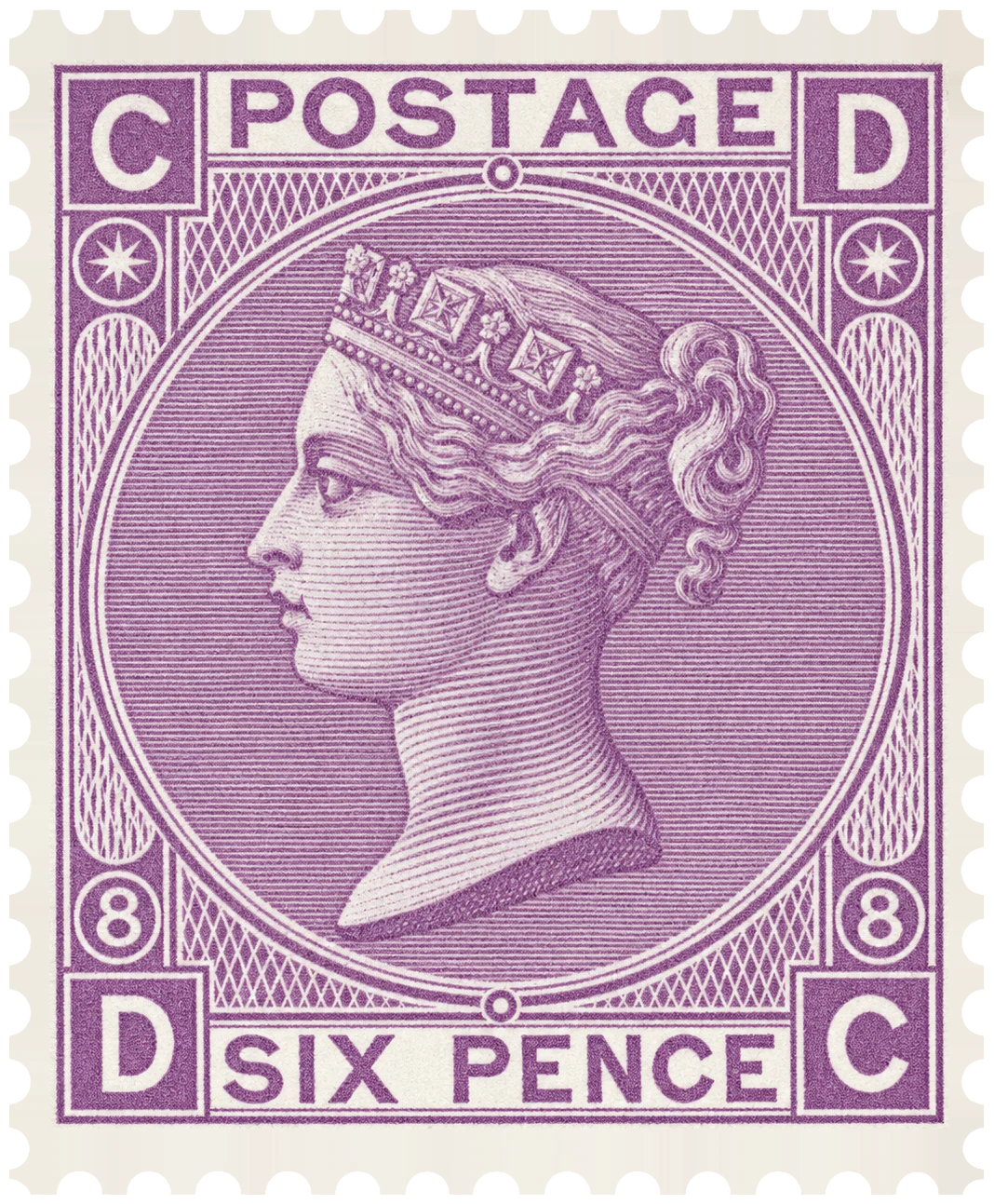
Magnify the denomination panel beneath the portrait to compare the inscriptions.
Click either stamp to magnify
The printing plate that failed inspection
Preparing a new stamp design involved considerable work. De La Rue had to produce a printing plate carrying 240 carefully arranged impressions.
But not every plate was successful.
Plate 7, prepared for the sixpenny, was found to be defective. It was never officially registered or brought into production and was destroyed on 25 March 1868. [4]
The printers turned instead to plate 8, registered in January 1868. It began printing in December and produced the first supplies of the revised design.
The rejected plate represented expensive work that could not be recovered. Even an established security printer could lose a complete printing tool before it had produced a single issued stamp.
The plate that was never needed — but still made stamps
Another curious episode involved plate 10, approved on 1 April 1869.
It was never brought into regular production. By the time De La Rue needed another plate, the authorities had decided to redesign the sixpenny completely. [4]
Yet impressions from plate 10 reached the public.
Wright and Creeke reported seeing a used example still attached to its original letter. They concluded that spare sheets printed during the plate's official registration must have been distributed.
The plate was finally destroyed in May 1872. A printing tool that had never enjoyed a proper working life had nevertheless left a few genuine postage stamps behind.
A printing plate makes fourteen million portraits
Plate 8 proved far more successful than its discarded companions.
It began work on 18 December 1868 and remained in use until 3 May 1870. During that period, De La Rue printed 60,500 sheets, containing more than 14.5 million stamps. [4]
Plate 9 followed, producing another 13.32 million impressions before its withdrawal in March 1872. [10]
Every impression carried the familiar youthful portrait of Victoria, reproduced from a single carefully prepared design.
The figures reveal the extraordinary scale of Victorian security printing. Millions of identical royal portraits could be produced from a small number of durable printing plates.
The French artist who photographed royalty
Jean Ferdinand Joubert de la Ferté engraved Victoria's portrait for De La Rue's surface-printed stamps.
He was a freelance artist rather than a salaried employee of the printing firm. His interests extended beyond engraving into the new art of photography. [11]
In 1859 and 1860, Joubert demonstrated methods of permanently reproducing photographic images to Prince Albert and Queen Victoria.
The sixpenny mauve retained the portrait created by an artist who was also experimenting with new ways of making and preserving images.
His contribution continued to appear on British stamps long after the original engraving had been completed.
Why do some stories appear on several pages?
Every page is written to make sense on its own. Visitors often arrive directly at a particular stamp or subject, without having explored the rest of the site.
Some stories are relevant to several stamps, so they are repeated where they help explain what you're looking at. For those exploring a series, the details specific to each stamp generally come first, with the more familiar stories further down the page.
This way, you can explore the site in any order without missing interesting background.
A missing hyphen distinguishes the mauve sixpenny from its predecessors. Explore the familiar portrait, changing shades, large corner letters and rose watermark behind the revised inscription. [12, 13]
De La Rue grew from a playing-card business into a major security printer. It supplied British postage stamps from the Victorian period and printed the Edward VII issues before the contract changed in 1911.
On this stamp
Thomas De La Rue & Co. printed the 1869 sixpenny mauve by typography. Its revised die omitted the hyphen from SIX PENCE while retaining the established portrait and large white corner letters.
Jean Ferdinand Joubert de la Ferté was a French engraver and photographer. He trained in Paris and later worked in London, where his engraving helped establish De La Rue’s surface-printed postage stamps.
On this stamp
The 1869 sixpenny mauve inherited Joubert’s portrait engraving for the earlier surface-printed stamps. This credit identifies the original portrait, not a separately documented commission to engrave the revised 1869 die.
William Wyon was a medallist and engraver at the Royal Mint. His models of royal heads were made for coins and medals and also became sources for stamp portraits.
On this stamp
Wyon’s City of London medal supplied the youthful likeness inherited through Corbould’s drawing and Joubert’s engraving on the 1869 sixpenny mauve.
Henry Corbould was a draughtsman and book illustrator. He trained with his father and at the Royal Academy Schools, where he received a silver medal for a life study.
On this stamp
Corbould’s drawing after Wyon’s medal supplied the model for Joubert’s earlier surface-printed portrait, inherited by the 1869 sixpenny mauve.
The country identifies the postal authority that issued the stamp. The monarch identifies the ruler whose portrait it carries. A definitive is an everyday stamp intended for regular postal use.
On this stamp
The 6d mauve was issued by Great Britain during Victoria’s reign. It is a definitive stamp, retaining the royal likeness used on earlier surface-printed issues.
The denomination is the stamp’s face value: the amount of postage it represents. Its price to a collector can be quite different.
In Britain’s old currency, 12 pence made one shilling and 20 shillings made one pound: 240 pence altogether. The abbreviations were d for pence, s for shillings and £ for pounds. The d comes from the Latin denarius. A halfpenny, written ½d, was half an old penny.
On this stamp
6d represents 6 old pence. The full printing sheet held 240 stamps worth £6. Its post-office accounting unit contained 40 stamps (two panes), worth £1.
A shade is a variation within a stamp’s colour. Some variations receive their own catalogue numbers even though the design and denomination stay the same.
Compare known examples under consistent lighting. Fading can change a stamp’s appearance, and photographs or screens can alter how colours look. A catalogue colour name helps describe a shade; it is not a colour test by itself.
On this stamp
The article represents the mauve colour family, associated here with SG109. The illustration is not a calibrated shade standard; paper and plate features must agree when identifying an original.
A stamp can be printed, sent to post offices, put on sale and made valid for postage on different dates. An official notice or instruction can establish when it was intended to be used; a dated letter shows that a particular example was actually used.
An early surviving cover is evidence of use by that day. It does not necessarily identify the first day of sale. A year in the heading may also cover later printings of the same design.
On this stamp
The no-hyphen sixpence is recorded on mail in March 1869. Wright and Creeke distinguished this evidence from the formerly quoted April date and found no official announcement for the small design change. Plate 8 had been approved in January 1868 and printing began that December.
The corner letters on De La Rue’s earlier surface-printed stamps were small and vulnerable to damage. The decision to enlarge them was made in 1864, and revised designs began appearing in 1865. “White” describes the paper showing through the printed colour, not an additional white ink.
The family includes more than one design or date. The 1865 values were followed by the tenpence and two-shilling in 1867. The sixpence lost its hyphen, then acquired a hexagonal frame and successive chestnut, buff and grey colours. The two-shilling changed from blue to brown in 1880.
Large coloured letters on white blocks belong to the succeeding family. A shared portrait, denomination or colour is not enough to distinguish them: check the letter blocks, plate figures and paper together.
On this stamp
This 6d belongs to the large white-letter family. It represents a later stage of the sixpenny design or colour sequence. The succeeding coloured-letter family is treated separately.
A stamp catalogue gives each listed issue a reference number. SG means Stanley Gibbons, the publisher of the catalogue used here. These numbers help collectors refer to the same issue; they are not serial numbers printed on individual stamps.
A range of numbers groups related entries. Colour, paper or perforation differences may account for separate listings within that range.
On this stamp
SG109 is the intended catalogue family for this reconstruction. Its recorded references document design, letters and colour comparisons, not every invisible property of an original. The DC reference title says plate 9, while the visible figures and the second reference support plate 8, which is the plate represented here.
Typography, or surface printing, uses a raised printing surface. Ink is applied to the raised parts, then transferred to paper under pressure. The lower spaces leave the paper unprinted.
Fine lines and solid areas are both part of that raised image. This is the same basic principle as letterpress printing.
De La Rue printed on dry, already gummed paper. The repeated design was reproduced in metal by electrotyping: metal was deposited on a mould to form a printing surface. One ink printed the design; the white corner letters and pale ornament were areas of paper left unprinted.
Surface printing, shown from the side. The paper is pressed onto the inked surface.Image information
Side view of surface printing. Paper is pressed down onto ink on the raised parts of a printing plate; the lower spaces do not touch the paper.
Credit
Stunning Stamps · 2026
On this stamp
De La Rue printed this 6d in a single colour from raised metal surfaces. The white letters and ornaments were left unprinted. The dry paper had already been gummed; perforating followed as a separate operation.
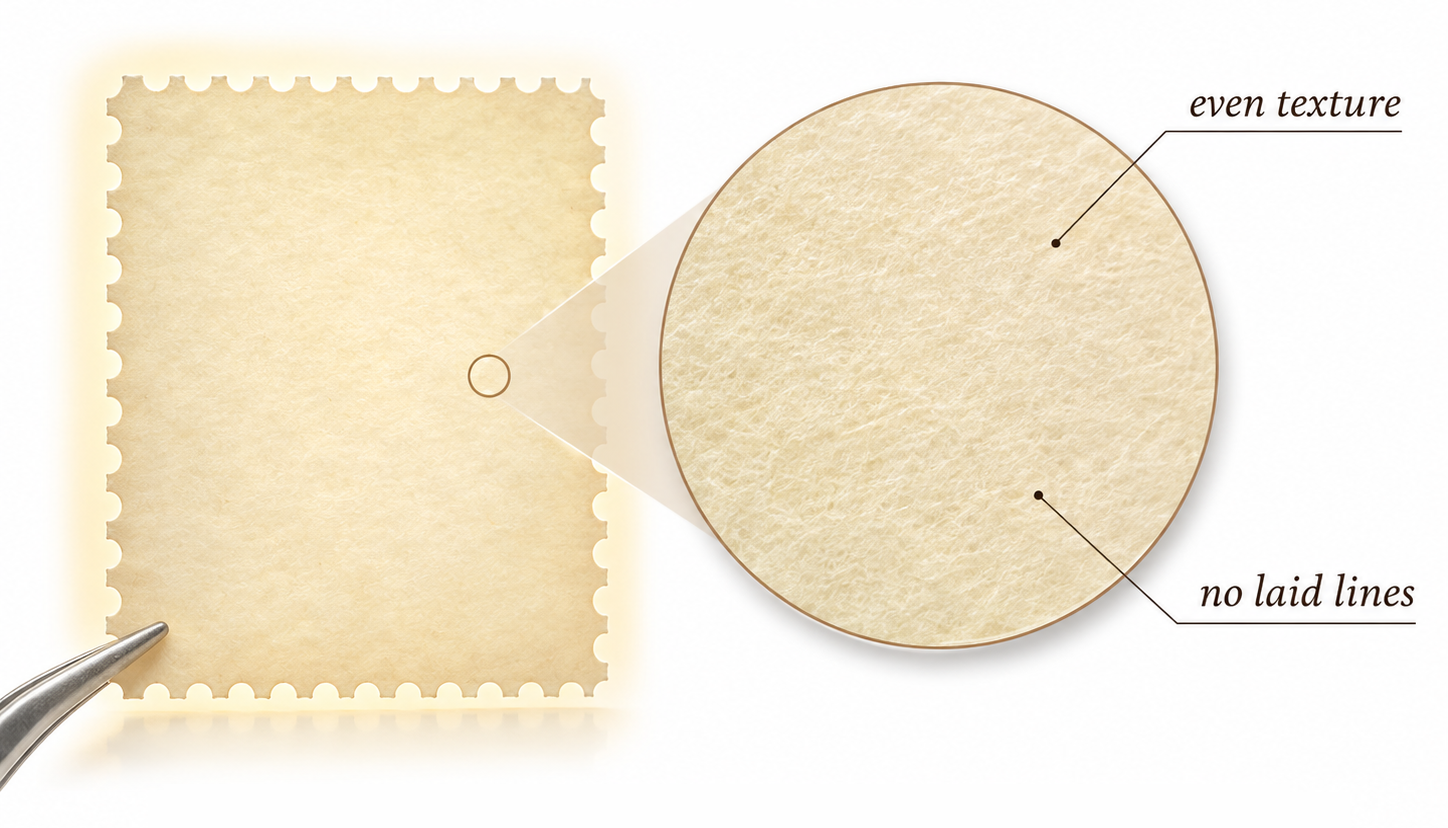
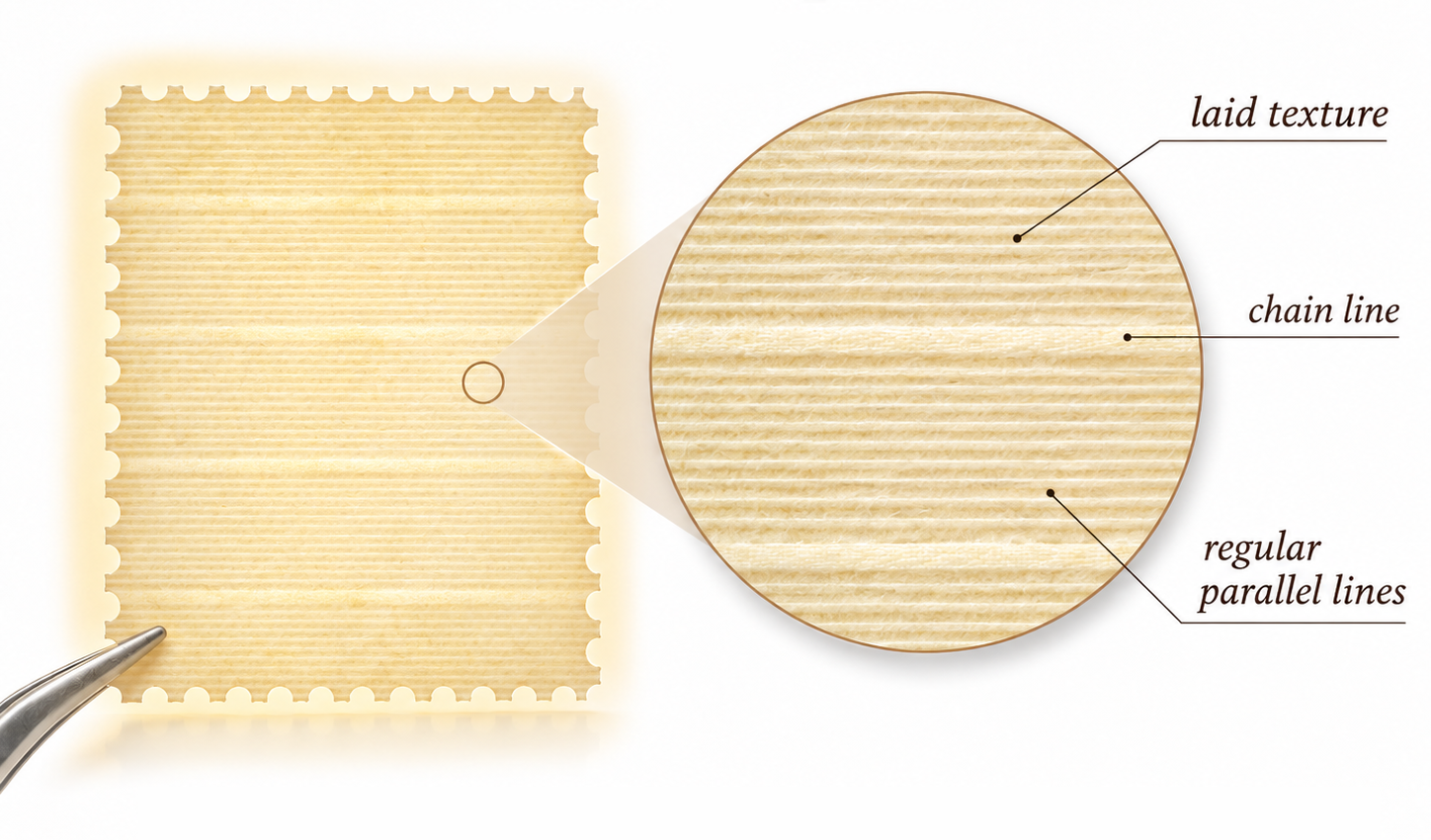
Wove describes the structure of the paper. Viewed against the light, it has a fairly even appearance. Laid paper instead shows a regular pattern of lines left by its manufacture.
Paper structure and watermark are separate characteristics: wove paper can carry a watermark. Both can help distinguish stamps with similar printed designs.
Wove does not mean machine-made. The earlier Emblems paper in this family was made by hand; the later Spray of Rose paper was made by machine. Large Garter paper had already changed to machine production before the large-letter fourpence appeared. The watermark and the date of printing help distinguish these papers.
Wove paper: even texture without laid lines.Image information
Click image to magnify
Diagram of wove paper with a magnified inset showing an even texture without laid lines.
Credit
Stunning Stamps · 2026
Notes
Digitally constructed
Laid paper: regular parallel lines, shown for comparison.Image information
Click image to magnify
Diagram of laid paper with a magnified inset showing regular parallel lines.
Credit
Stunning Stamps · 2026
Notes
Digitally constructed
On this stamp
This 6d normally uses machine-made white wove Spray of Rose paper. Wove describes the fibre structure; machine-made describes how the sheet was formed.
Paper structure, surface finish and thickness describe different properties. Wove paper can have a smooth printing surface. The contemporary manufacturing account describes paper finished by milling, which made it firm and smooth; it does not identify the later chalk coating familiar from some Edwardian issues.
Handmade Emblems paper can vary noticeably in thickness. On some sixpenny plate-5 stamps the watermark is difficult to see, leading to the historical claim of an unwatermarked “Maltese” sixpence. A faint watermark in thick paper is not evidence that the paper was deliberately unwatermarked.
Experimental blued safety papers also exist, but they must be separated from ordinary issued white-paper stamps. The front of an illustration cannot establish original paper thickness, an experimental treatment or a watermark’s orientation.
On this stamp
This is an ordinary white-paper 6d. The manufacturing account describes a firm wove paper with a milled printing surface. No chalk coating, experimental safety paper or particular thickness is assigned to this illustration.
Ink had to produce clear fine lines while making fraudulent reuse difficult. De La Rue investigated fugitive inks: colours intended to react when somebody tried to wash away a cancellation. This was a design aim, not a guarantee that every attempted fraud would fail.
The fourpenny’s vermilion colour required attention to the plate surface because the pigment reacted with copper; a silver facing protected the printing surface. Later sixpenny colour trials sought a suitable alternative to the lilac stamp, which resembled a penny Inland Revenue stamp.
A colour change need not mean a new die. The hexagonal sixpence continued from chestnut through buff to grey, while the two-shilling changed from blue to brown using the old plate. Surviving colour is also affected by light, moisture and treatment, so a screen image cannot certify a catalogue shade.
On this stamp
The mauve design was printed in one colour. De La Rue’s security experiments sought inks that reacted to attempts to remove postmarks; the front illustration does not demonstrate the chemical behaviour of an original.
A watermark is a pattern of thinner paper formed during manufacture. On handmade paper, raised devices on the mould displaced fibres; on machine-made paper, a patterned dandy roll acted on the still-wet sheet. The mark is within the paper, separate from the printed stamp design.
Heraldic Emblems places two roses, a shamrock and a thistle at each intended stamp position. It was used for the early large-letter threepence, sixpence, ninepence and shilling. Machine-made Spray of Rose paper replaced it in 1867, with a single rose spray for each stamp.
The fourpence kept Large Garter paper. The new tenpence and two-shilling normally used Spray of Rose from their introduction. An exceptional Emblems-paper tenpence exists; the brown two-shilling of 1880 still uses Spray, not the Crown paper of other issues from that year.
The same printing plate can occur on two papers, and a watermark can be inverted or displaced without changing the front design. Examine the actual paper before assigning a variety. The face illustration does not authenticate the invisible watermark or its orientation.
On this stamp
This mauve no-hyphen sixpence uses machine-made Spray of Rose paper. Its change from the hyphenated design did not introduce a new watermark. The earlier plate-5 Emblems sixpence is a different stage of the series.
Perforations are the rows of punched holes that let neighbouring stamps separate. Their gauge describes the spacing over a standard distance of 2 centimetres, rather than the total number of holes along a stamp’s edge.
A perforation gauge has rows of dots or lines at known spacings. Match an edge against them: the marks should line up all the way along. A single number applies to both directions; two numbers give the horizontal gauge first, then the vertical.
The ordinary issued stamps in this group are perforated 14 in both directions. A change of colour, paper, plate number or corner-letter design is not a change of gauge. Imperforate proofs, registration impressions and exceptional issued imperforates require their own identification; they are not another routine perforation option for these articles.
Enlarged spacing diagram, not to scale. Match the spacing with a perforation gauge.Image information
Enlarged perforation spacing: fourteen equal intervals between hole centres span 20 millimetres. This is a schematic, not a ruler.
Credit
Stunning Stamps · 2026
On this stamp
This article and the other eleven articles in this set use perforation 14 horizontally and vertically. There is no grouped perforation alternative here. Different paper, plate, colour or letter style must be identified separately from gauge.
Gum is the adhesive on the back of a stamp. For these De La Rue surface-printed issues, gum arabic was applied to the paper before printing. The sheet could then be printed without the preliminary dampening required by the earlier line-engraved method.
The gum and the printed ink are different layers with different purposes. A smooth printing face does not describe the adhesive on the reverse. On an unused original, the presence and condition of the gum are examined separately from the paper and watermark.
A front-view illustration supplies no evidence that original gum survives. Handling, removal from an album or later regumming may affect the back while leaving the printed design recognisable.
On this stamp
The paper for this 6d was coated with gum arabic before printing. This illustration shows the face, so it makes no claim that an original specimen retains its gum or has escaped later regumming.
A printing sheet holds the impressions made together. A pane is a block of stamp positions within it, a gutter is the blank space between panes, and the outer unprinted border is the sheet margin or selvedge.
The stamps in this group were printed in sheets of 240. The fourpence had four panes of sixty, two across and two down. The other values had twelve panes of twenty, three across and four down. Ignoring the gutters, each layout gives twenty rows and twelve columns.
Check letters continue across the full sheet, without restarting at each pane. Registration sheets with stamps removed still record the original arrangement. The diagram is schematic: it explains a pane and gutter, while the note below gives this issue’s actual layout.
Sheet, panes and margins: a simplified example.Image information
A schematic printing sheet contains two panes separated by an unprinted gutter and surrounded by a margin.
Credit
Stunning Stamps · 2026
On this stamp
Twelve panes, three across and four down, each held five rows of four stamps. Together they formed twenty rows of twelve positions: 240 stamps worth £6.
The printing sheet and the unit supplied for post-office accounting were not always the same size. A counter sheet could contain one pane or several, with its value determined by the denomination. Marginal inscriptions gave staff a ready check on the total.
Sixty fourpences, forty sixpences and twenty shillings each made one pound. The other denominations used different totals: forty threepences made 10s, twenty ninepences made 15s, twenty tenpences made 16s 8d, and twenty two-shilling stamps made £2.
These amounts refer to original face value, not present collecting prices. A surviving block with margins can retain the printed accounting instructions, helping explain how a large printing sheet was divided for use.
On this stamp
The counter unit contained 40 stamps (two panes), worth £1. 40 stamps at 6d each total £1. This is separate from the full 240-stamp printing sheet, whose face value was £6.
Read the lower-left letter for the row and the lower-right letter for the column. Rows run from A to T and columns from A to L: twenty times twelve gives 240 positions. The upper pair repeats the same letters in reverse order.
For example, A–B below is matched by B–A above. The sequence continues across gutters rather than beginning again in each pane. These are sheet positions, not a designer’s initials, a date or the office where the stamp was used.
Repeating the letters made it harder to join uncancelled pieces from different stamps into a convincing whole. The larger white letters were more durable than the earlier small ones. An impossible column letter beyond L can expose a forgery, although a correct pair does not prove authenticity.
A displayed pair identifies only the represented position. Other genuine stamps of the same issue have other pairs; when both lower letters match, the same letter appears in all four corners.
On this stamp
The illustration reads D–C below; C–D above. The lower pair identifies row 4, column 3 of the full printing sheet, counting across the gutters. Other positions of this issue have other letter pairs.
A die supplies the original design; a printing plate repeats it at many positions for printing a sheet. The small paired plate figures on these stamps identify the plate, while the corner letters identify a position within its sheet.
Registration recorded approval of a plate by retaining an impression, often called an imprimatur sheet. Approval, first use of the plate and sale of its stamps could happen at different times. A registered plate might wait years before production, or never be used for ordinary printing at all.
Limited sheets taken around registration account for several exceptional stamps known as abnormals. Their survival does not make that plate a normal successor in the production sequence. The same plate can also span a change of ink or watermark, so read all three together.
The large-letter shilling begins with actual plate 4, numbered 4 on the stamps. That correct agreement is a change from the earlier small-letter shilling, whose actual plate 2 bore the numeral 1.
On this stamp
The illustration shows plate 8; plate 9 also supplied ordinary no-hyphen printings. Plate 7 failed and was neither registered nor issued. Plate 10 was registered but never entered regular production, although a small amount of registration material survives. The recorded DC reference’s title says 9, but its visible figures and the independent reference support 8.
A useful identification combines visible design details with paper, plate and colour. For the sixpence, distinguish the design with a circular portrait frame and a hyphen, the corresponding design without the hyphen, and the later hexagonal portrait frame. The white or coloured corner letters then separate successive hexagonal designs.
Not every prepared plate supplied ordinary stamps. Examples of abnormal material include the no-hyphen sixpence from plate 10, ninepence from plate 5, tenpence from plate 2 and blue two-shilling from plate 3. Buff sixpence from plate 13 belongs to the new coloured-letter design, not the normal white-letter buff issue.
Proofs, specimens, experimental paper, imperforate material and issued stamps answer different questions. A SPECIMEN overprint or an unperforated edge must be assessed with the item’s origin; neither automatically identifies a normal postal variety.
Microscopic diagnostics require original material and documented comparisons. Reconstruction, wear, heavy cancellations or a poor scan can conceal a genuine feature. Rare errors and suspected forgeries need more than a matching colour or a plausible plate numeral.
On this stamp
The key visible combination is the circular portrait setting, the gap without a hyphen between SIX and PENCE, and plate 8. Plate numbers and paper should accompany a shade name: mauve alone does not identify a particular plate.
A wing margin is the unusually wide strip of paper attached to one side of some stamps from these sheets. It comes from a stamp beside a vertical gutter between panes. The perforating line passed down the middle of the gutter, leaving extra paper on each neighbouring stamp.
Ordinary narrow-margin stamps and wing-margin stamps could therefore come from the same printing sheet. The extra width is a consequence of sheet position and perforation, rather than a larger printed design or a different face value.
A wide margin should be examined with its perforations and neighbouring design in mind. Some surviving wing margins have been trimmed or altered. The width of a detached specimen alone is not enough to establish its original form.
On this stamp
The represented DC position is row 4, column 3. It is not beside a vertical gutter and the illustration shows ordinary narrow margins. Columns D/E and H/I flank the two vertical gutters in the twelve-pane layout.
A denomination states the amount of postage a stamp could pay. Higher values saved space when a letter required more than a penny. They could be used singly where a rate matched, or combined with other stamps for a heavier letter or an additional service.
Overseas postage depended on the destination, route, weight and date. Registration was a separate charge on top of ordinary postage. A rate that applied when an earlier design appeared may have changed by the time a new design replaced it.
A complete envelope or wrapper preserves information lost from a loose stamp: the destination, dated postmarks, route endorsements and the rest of the franking. These need to agree before a particular rate can be assigned.
On this stamp
The mauve sixpence continued the sixpenny denomination’s role in overseas and combined frankings. Its resemblance to the penny Inland Revenue stamp prompted trials and eventual redesign. That resemblance did not change the sixpence’s face value or turn it into a penny fiscal stamp.
The cancellation is the inked mark that prevents a stamp being used again. By the period of these issues, barred obliterators with office numbers had succeeded the Maltese Cross as the usual form. A town or date mark could be applied separately, or alongside the obliterator in a combined device.
The office number is part of the postmark, not a printing-plate number. A cancellation can cover the portrait, letters or fine plate details; it must be distinguished from marks produced during printing.
An unused reconstruction has no such mark. For a used original, the whole cover gives the strongest context for interpreting the date, route and postage. A loose stamp seldom establishes all three.
Postage stamps could also pay some telegraph charges. A telegraph-office cancellation or an origin on a telegram is therefore different from evidence of a letter journey. This distinction matters particularly for the shillings associated with the Stock Exchange fraud.
On this stamp
The illustration shows an unused 6d. A barred office numeral on a used stamp is separate from its printed plate figures and corner letters. A complete postal item supplies the date, destination and other evidence needed to interpret its use; a telegraph cancellation does not establish a letter journey.