
Understanding the stamp details
6d lilac with carmine value overprint · Thomas De La Rue & Co.
Printer
De La Rue grew from a playing-card business into a major security printer. It supplied British postage stamps from the Victorian period and printed the Edward VII issues before the contract changed in 1911.
On this stamp
Thomas De La Rue & Co. printed the 1883 sixpenny in lilac from the existing plate 18 and applied its carmine value separately. The underlying design had appeared in grey in 1874. Plate 18 was registered for the new issue on 23 November 1882. The altered colour and added value did not require a new portrait engraving.
Sources
- Robert B. Galland, The First Low Value Surface Printed Postage Stamps of Great Britain, 1855–1880 (RPSL, 2014), pp. 3–4
- Royal Philatelic Society London: The De La Rue Story, 1996
- The Postal Museum archive: Post Office Stamp Depot, administrative history
- The Shilling’s Tale (2022), frame C: De La Rue’s coloured-letter dies, interchangeable plugs and production proofs
- Wright and Creeke, A History of the Adhesive Stamps of the British Isles (1899), pp. 69, 84–85 and 116: De La Rue manufacture and the 1883 value overprints
Inherited portrait engraving
Jean Ferdinand Joubert de la Ferté was a French engraver and photographer. He trained in Paris and later worked in London, where his engraving helped establish De La Rue’s surface-printed postage stamps.
On this stamp
The 1883 sixpenny lilac with carmine overprint inherits the earlier surface-printed portrait engraved by Joubert after Corbould’s drawing. This credit identifies the portrait’s origin, not a newly documented commission to Joubert for the 1874 frame or the 1883 overprint.
Sources
- Robert B. Galland, The First Low Value Surface Printed Postage Stamps of Great Britain, 1855–1880 (RPSL, 2014), pp. 3–4
- Royal Collection Trust: Portrait by Mr F Joubert, 1860, RCIN 2932792
- National Portrait Gallery: Ferdinand Jean de la Ferté Joubert (1810–1884)
- Wright and Creeke, A History of the Adhesive Stamps of the British Isles (1899), pp. 69, 84–85 and 116: De La Rue manufacture and the 1883 value overprints
- Robert B. Galland, The First Low Value Surface Printed Postage Stamps of Great Britain (RPSL, 2014), p. 3: earlier Joubert portrait engraving after Corbould
- Douglas N. Muir, William Wyon & the Penny Black, Royal Mint Museum
Portrait source
William Wyon was a medallist and engraver at the Royal Mint. His models of royal heads were made for coins and medals and also became sources for stamp portraits.
On this stamp
Wyon’s City of London medal supplied the youthful likeness inherited through Corbould’s drawing and Joubert’s engraving on the 1883 sixpenny lilac with carmine overprint. He is credited as the earlier portrait source.
Sources
- Douglas N. Muir, William Wyon & the Penny Black, Royal Mint Museum
- Robert B. Galland, The First Low Value Surface Printed Postage Stamps of Great Britain, 1855–1880 (RPSL, 2014), pp. 3–4
- Museums Victoria: William Wyon, Medallist & Engraver
- Wright and Creeke, A History of the Adhesive Stamps of the British Isles (1899), pp. 11, 34–35
- Wright and Creeke, A History of the Adhesive Stamps of the British Isles (1899), pp. 69, 84–85 and 116: De La Rue manufacture and the 1883 value overprints
- Robert B. Galland, The First Low Value Surface Printed Postage Stamps of Great Britain (RPSL, 2014), p. 3: earlier Joubert portrait engraving after Corbould
- Douglas N. Muir, William Wyon & the Penny Black, Royal Mint Museum
Original portrait drawing
Henry Corbould was a draughtsman and book illustrator. He trained with his father and at the Royal Academy Schools, where he received a silver medal for a life study.
On this stamp
Corbould’s drawing after Wyon’s medal supplied the model for Joubert’s earlier surface-printed portrait, inherited by the 1883 sixpenny lilac with carmine overprint. His role belongs to that portrait source, rather than the later frame or overprint.
Sources
- Douglas N. Muir, William Wyon & the Penny Black, Royal Mint Museum
- Robert B. Galland, The First Low Value Surface Printed Postage Stamps of Great Britain, 1855–1880 (RPSL, 2014), pp. 3–4
- Lucy Peltz, Henry Corbould, Oxford Dictionary of National Biography — introductory extract
- Wright and Creeke, A History of the Adhesive Stamps of the British Isles (1899), pp. 11, 34–35
- Wright and Creeke, A History of the Adhesive Stamps of the British Isles (1899), pp. 69, 84–85 and 116: De La Rue manufacture and the 1883 value overprints
- Robert B. Galland, The First Low Value Surface Printed Postage Stamps of Great Britain (RPSL, 2014), p. 3: earlier Joubert portrait engraving after Corbould
- Douglas N. Muir, William Wyon & the Penny Black, Royal Mint Museum
Country and monarch
The country identifies the postal authority that issued the stamp. The monarch identifies the ruler whose portrait it carries. A definitive is an everyday stamp intended for regular postal use.
On this stamp
This 6d belongs to Victoria’s 1883 Value Overprints. De La Rue reused an established portrait and frame; the date does not signify a new portrait commission.
Old pence
The denomination is the stamp’s face value: the amount of postage it represents. Its price to a collector can be quite different.
In Britain’s old currency, 12 pence made one shilling and 20 shillings made one pound: 240 pence altogether. The abbreviations were d for pence, s for shillings and £ for pounds. The d comes from the Latin denarius. A halfpenny, written ½d, was half an old penny.
On this stamp
The 6d in carmine repeats the value written in the lilac frame. It is six old pence, not a revaluation of the stamp.
Sources
- Stanley Gibbons: Philatelic terms for beginners
- Royal Mint Museum: Pounds, Shillings and Pence
- Wright and Creeke (1899), pp. 83–85: threepenny die, plate 21, Crown sheet states and 1883 value overprint
- Wright and Creeke (1899), pp. 115–116: sixpenny design, plate 18, counter sheets and 1883 overprint varieties
Lilac and carmine
These stamps combine a lilac or purple base impression with a contrasting red value. Historical descriptions include purple and pink; modern catalogue names commonly use lilac and carmine. Such names describe ranges, not exact digital colour values.
Printing strength, ink batches and paper can affect the original appearance. Washing, chemical treatment and light can change it later. The security ink makes altered colour particularly important to recognise.
Compare original material under consistent light. A scan or digitally reconstructed face cannot authenticate a rare shade, and a faint red overprint must not automatically be described as an omitted one.
On this stamp
The 6d illustration uses lilac for the base design and carmine for the added value. It does not certify a rare shade or a particular degree of fading on an original.
Approval, announcement and issue
Registration approves a plate or its revised state. An official notice announces availability; a surviving postmark supplies evidence of use. These dates need not coincide.
Both value-overprinted stamps were announced in the Post Office notice of 19 December 1882 for issue on 1 January 1883. Their plates had been re-registered with the overprint on 23 November 1882.
The printed plate numbers belong to earlier designs, so their original registration dates are earlier still. Neither an early plate approval nor the date of a particular surviving cover replaces the announced 1883 issue date.
On this stamp
The notice of 19 December 1882 announced this 6d for 1 January 1883. Plate 18 had been re-registered with the overprint on 23 November 1882; that approval date is not the public issue date.
A temporary pair for combined duties
The 1883 arrangements expanded the use of suitable adhesive stamps for postage and general revenue duties. While a new series was being prepared, De La Rue reused existing threepenny and sixpenny designs in a security ink and added conspicuous red values.
These are the two issued denominations in this set. The overprint repeats the value already written in the frame. It is not a change from threepence or sixpence to a different postal rate.
Other denominations were explored in essays, and one-shilling plates were registered without the proposed overprint but not issued. Trial material should not enlarge the ordinary issued pair.
On this stamp
This is the 6d member of the issued pair. The larger red value helps distinguish it from the other lilac stamp while retaining the existing sixpenny design.
Sources
- Wright and Creeke (1899), pp. 83–85: threepenny die, plate 21, Crown sheet states and 1883 value overprint
- Wright and Creeke (1899), pp. 115–116: sixpenny design, plate 18, counter sheets and 1883 overprint varieties
- Robert B. Galland (RPSL, 2014), p. 26: the issued 3d and 6d and unissued value-overprint proposals
- Wright and Creeke (1899), p. 151: the combined postage and revenue provisions
Catalogue references
A stamp catalogue gives each listed issue a reference number. SG means Stanley Gibbons, the publisher of the catalogue used here. These numbers help collectors refer to the same issue; they are not serial numbers printed on individual stamps.
A range of numbers groups related entries. Colour, paper or perforation differences may account for separate listings within that range.
On this stamp
The reconstruction targets SG162, plate 18, with D–G below and G–D above. It shows a normal single red value with two dots, without assigning a calibrated dot-spacing variety.
Sources
- Stanley Gibbons: Philatelic terms for beginners
- Wright and Creeke (1899), pp. 83–85: threepenny die, plate 21, Crown sheet states and 1883 value overprint
- Wright and Creeke (1899), pp. 115–116: sixpenny design, plate 18, counter sheets and 1883 overprint varieties
- Recorded illustration reference: Primary detailed actual mint DG plate18, all drawing and letters
- Recorded illustration reference: Independent actual mint BI confirms design and overprint
Typography in two printing operations
Surface printing, or typography, transfers ink from raised surfaces. Areas below the printing level remain white paper. De La Rue reproduced the engraved design through moulds and electrotyping to make a plate containing many subjects.
The lilac stamp design and the red value were separate impressions. Their alignment can vary because the second printing has to register with the first. The red figures are not part of the lilac plate engraving.
The paper was gummed before printing; perforation was a later operation. The diagram explains relief printing, not the exact machinery or sheet dimensions used for these two overprints.
Image information
Side view of surface printing. Paper is pressed down onto ink on the raised parts of a printing plate; the lower spaces do not touch the paper.
- Credit
- Stunning Stamps · 2026
On this stamp
De La Rue printed the lilac 6d base from plate 18 and added the carmine value in a separate operation. The raised printing surfaces leave the white lettering and ornament unprinted.
Sources
- Wright and Creeke (1899), pp. 69–70: De La Rue typography, paper, gum and steam printing
- Wright and Creeke (1899), pp. 83–85: threepenny die, plate 21, Crown sheet states and 1883 value overprint
- Wright and Creeke (1899), pp. 115–116: sixpenny design, plate 18, counter sheets and 1883 overprint varieties
A repeated value, not a revaluation
An overprint is an additional printed inscription on an existing stamp design. A surcharge commonly changes its value, but older philatelic writing also uses that word for these added figures.
Here the carmine 3d or 6d repeats the denomination in the lilac frame. Its large numeral and raised lower-case d make the value easier to distinguish when both base designs are printed in similar purple ink.
Look separately at the base impression, the red printing and their alignment. A doubled red inscription is a second impression of the overprint; it does not establish that the lilac stamp itself was printed twice.
On this stamp
The large 6d lies across the lower portrait, with a raised d and two dots beneath it. It reinforces the written value; it does not change the stamp’s monetary value.
Sources
- Wright and Creeke (1899), pp. 83–85: threepenny die, plate 21, Crown sheet states and 1883 value overprint
- Wright and Creeke (1899), pp. 115–116: sixpenny design, plate 18, counter sheets and 1883 overprint varieties
- Allan Oliver (2015), Life Span of the Printing Plates for Queen Victoria Stamps, pp. 169–170: plates 21 and 18, telegraph use and doubled overprint
Machine-made wove paper
Wove paper has an even fibre structure, rather than the regular parallel lines associated with laid paper. The comparison illustrations explain the difference and do not depict an original 1883 sheet.
Both values used machine-made white wove paper with the Large (1880) Crown watermark. The watermark was formed in the wet paper before gumming and printing.
Structure, surface finish, watermark and gum are separate observations. The front illustration cannot establish the watermark orientation or the condition of the reverse of an original stamp.
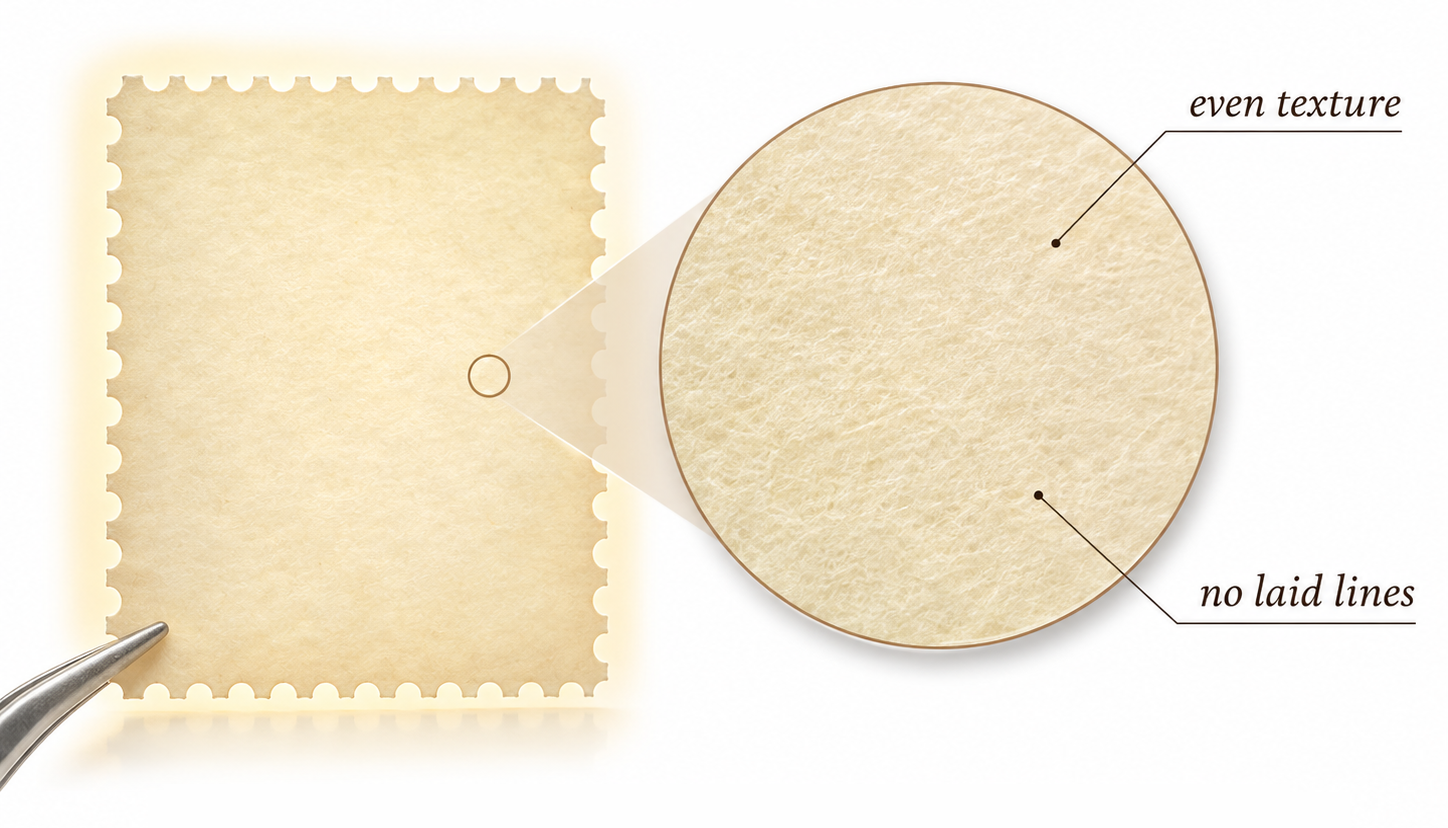
Image information
Click image to magnify
Diagram of wove paper with a magnified inset showing an even texture without laid lines.
- Credit
- Stunning Stamps · 2026
- Notes
- Digitally constructed
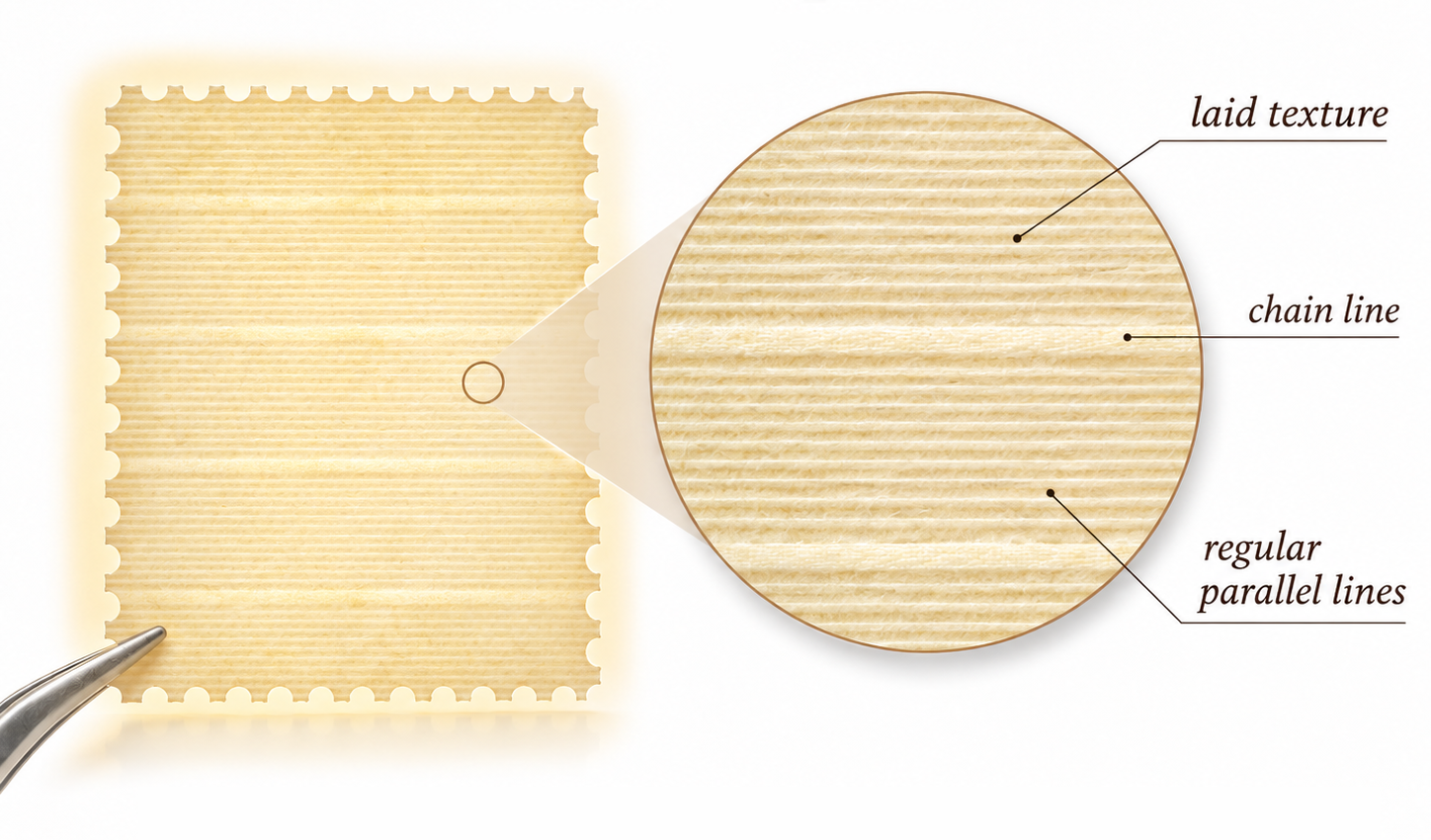
Image information
Click image to magnify
Diagram of laid paper with a magnified inset showing regular parallel lines.
- Credit
- Stunning Stamps · 2026
- Notes
- Digitally constructed
On this stamp
This 6d uses machine-made white wove Crown paper. The reused illustrations compare wove and laid structures; no laid-paper alternative is assigned to the issue.
Sources
- Fitzwilliam Museum: Wove paper
- American Philatelic Society: Watermarks — A Philatelic Introduction
- Wright and Creeke (1899), pp. 69–70: De La Rue typography, paper, gum and steam printing
- Wright and Creeke (1899), p. 77: Large (1880) Crown paper and double mill sheets
- Wright and Creeke (1899), pp. 83–85: threepenny die, plate 21, Crown sheet states and 1883 value overprint
- Wright and Creeke (1899), pp. 115–116: sixpenny design, plate 18, counter sheets and 1883 overprint varieties
Ordinary paper and surface finish
Paper structure describes the arrangement of fibres; finish describes the surface. Thickness, smoothness and colour do not by themselves establish a coating.
These two issues used ordinary Crown paper. The period account notes changes in the firmness of paper around 1880, but does not give a universal thickness specification for these stamps.
No Edwardian chalk-surface alternative is assigned to this set. Apparent gloss or whiteness in a reproduction is not evidence of such a paper variety.
On this stamp
The 6d is on ordinary Crown paper. No chalk-surface alternative is assigned. The illustrated front cannot establish the surface treatment or thickness of an original.
Security ink and the second colour
Fugitive ink is designed to change under treatment intended to remove a cancellation. Its vulnerability helps reveal an attempt to reuse a stamp.
Wright and Creeke describe the purple base ink of these issues as doubly fugitive, referring to its sensitivity to water and chemical treatment. The red value is a separate printing. Two ink colours and the expression doubly fugitive describe different things.
A faded or washed base may no longer resemble its original shade. Compare the lilac and red impressions separately and retain evidence from the original cover or document when interpreting an unusual appearance.
On this stamp
The lilac base of this 6d belongs to the doubly fugitive purple printing described by Wright and Creeke. The carmine inscription is a separate colour and operation; “doubly” does not mean two colours.
Large Crown of 1880
A watermark is a variation in the thickness of the paper, not an inked design. Raised patterns on the papermaking roll displace fibres while the sheet is wet.
The Large (1880) Crown provided one watermark position for each stamp. It differs from the Spray of Rose used for earlier printings of these basic designs, and from the Crown watermarks of early line-engraved issues.
Both ordinary 1883 value overprints belong on Large Crown paper. The front image cannot show whether a particular original has an inverted, displaced or incomplete watermark.
On this stamp
The 1883 6d uses Large Crown paper, not the Spray of Rose of earlier printings of the underlying design. Orientation cannot be established from this face illustration.
Sources
Perforation 14
A perforation gauge measures the spacing of holes over two centimetres. It does not count all the teeth on one edge. In a two-number description the horizontal gauge comes first.
Both ordinary value overprints are perforated 14 horizontally and vertically. Their overprint-dot spacings are printed design varieties and have no connection with the perforation gauge.
An imperforate proof or registration impression is a different class of object from an ordinary post-office stamp. Straight edges on a loose single do not prove an imperforate error; trimming, margins and provenance must be considered.
Image information
Enlarged perforation spacing: fourteen equal intervals between hole centres span 20 millimetres. This is a schematic, not a ruler.
- Credit
- Stunning Stamps · 2026
On this stamp
The ordinary 6d gauges 14 horizontally and vertically. Dot-spacing varieties concern the red printing, not the gauge. There are no grouped perforation alternatives in this article.
Gumming before printing
De La Rue applied white gum arabic to the paper before printing. The normal stamp impression was on the opposite face; perforation followed printing.
Original gum, disturbed gum, hinge traces, no gum and later regumming describe condition. They are not different denominations or designs.
An unused-looking face does not establish the state of the reverse. The illustrations here make no claim about surviving gum on a particular original.
On this stamp
The paper for this 6d was gummed before the printed impressions were applied. The illustration does not establish original gum, hinge traces or later regumming.
A 240-subject printing unit
A pane is a block within a sheet, a gutter is the gap between panes, and selvedge is the outside margin. The diagram explains those terms rather than drawing this issue to scale.
Each printing plate contained 240 subjects in two panes, one above the other. Each pane had ten rows of twelve. The full lettering grid therefore ran through twenty rows and twelve columns, interrupted by a horizontal gutter.
Crown paper was manufactured in double mill sheets, containing two such watermark units. A paper manufacturer’s sheet and a 240-subject printing plate are different units. Neither should be confused with the smaller forty-stamp sheets supplied for counter use.
Image information
A schematic printing sheet contains two panes separated by an unprinted gutter and surrounded by a margin.
- Credit
- Stunning Stamps · 2026
On this stamp
Plate 18 held two panes of ten rows by twelve columns. The 240-subject printing unit is distinct from the double-sized Crown mill paper and from the forty-stamp counter sheet.
Sources
Forty-stamp counter sheets
The 240-stamp printing unit was divided into six post-office sheets of forty. Each was ten rows deep and four stamps wide; three fitted across each 120-stamp pane.
Forty threepenny stamps were worth 120 old pence, or 10s. Forty sixpenny stamps were worth 240 old pence, or £1. A whole printing unit was consequently worth £3 or £6 respectively.
Marginal hexagons marked the divisions after the fourth and eighth columns. These were aids for dividing the sheet, not additional stamp designs or vertical gutters running through each pane.
On this stamp
For this 6d, each ten-row by four-column counter sheet contained forty stamps worth £1. A 120-stamp pane was worth £3 and the full 240-subject unit £6.
Reading the four corner letters
Read the lower-left and lower-right letters together. The first identifies the row, A to T; the second identifies the column, A to L. The upper pair reverses the lower pair.
These letters locate a subject within the 240-stamp printing unit. They are repeated for different printing plates, so a letter pair alone does not identify a plate.
Both the threepenny and sixpenny have white square corner fields containing coloured letters. Cutting the sheet into forty-stamp counter units does not restart its lettering.
On this stamp
The lower D–G identifies row 4, column 7 in the full printing grid. The upper pair is reversed. The coloured letters occupy white square fields and do not identify the plate by themselves.
The number belongs to the lilac plate
Small figures within the design identify the plate used for the base impression. The 1883 threepenny used plate 21; the sixpenny used plate 18.
Both numbers belong to plates made for earlier versions of their respective designs. Re-registration records changes in paper, sheet state or the added overprint; it need not mean a newly engraved portrait.
The visible 21 or 18 does not number the separate red-overprint forme. Read plate figures, corner letters and overprint details as distinct kinds of evidence.
On this stamp
The small 18 figures identify the lilac base plate. Plate 18 had already printed the Crown-paper sixpenny before being re-registered with the overprint. They do not identify a red-overprint plate.
Marginal hexagons and sheet divisions
Small hexagonal ornaments in the margins marked where each twelve-column pane could be divided into three groups of four columns. They appeared at the top, bottom and horizontal gutter positions relevant to those divisions.
For threepenny plate 21, the ornaments had been omitted in one earlier state and were restored for the overprinted issue registered in November 1882. Sixpenny plate 18 used the Crown-paper arrangement with forty-stamp counter divisions.
These marks belong outside the stamp designs. A detached single without selvedge cannot demonstrate the complete marginal arrangement, and its four corner fields should not be mistaken for cutting marks.
On this stamp
Plate 18 used marginal hexagons to mark the forty-stamp counter divisions after columns four and eight. This detached D–G stamp has no selvedge; its square corner fields are part of the stamp, not cutting marks.
The two dots beneath the d
The normal red inscription has two small dots beneath the raised lower-case d. Period descriptions distinguish spacings of about 1¼ mm and 1½ mm between the letter and the dots.
Contemporary correspondence records horizontal pairs showing both spacings together. The spacings can therefore occur on the same sheet; they should not automatically be treated as two distinct printings.
One-dot and no-dot sixpenny varieties are also recorded. Establish a missing dot from sound original material: weak printing, damage or an obstructing cancellation can conceal it. A digitally reconstructed, uncalibrated face cannot establish a quarter-millimetre spacing variety.
On this stamp
This 6d shows two dots beneath the raised d. Both recorded spacings can occur on one sheet, so no second article or printing is inferred. The one-dot and no-dot varieties are separate from this ordinary two-dot illustration; no exact sheet-position count is asserted.
Sources
- Wright and Creeke (1899), pp. 83–85: threepenny die, plate 21, Crown sheet states and 1883 value overprint
- Wright and Creeke (1899), pp. 115–116: sixpenny design, plate 18, counter sheets and 1883 overprint varieties
- Ewen’s Weekly Stamp News, no. 104 (21 September 1901), correspondence: both dot spacings in horizontal pairs
Essays, registration material and errors
An essay proposes a design, a proof tests it, and a registration impression records approval. Their existence does not establish that the same object was sold over a post-office counter.
The issued pair must be distinguished from proposed value overprints on other denominations. For the sixpenny, a doubled red overprint is documented. The two red impressions are separate from any question about doubling of the lilac base.
Missing dots, weak ink, doubled printing and an absent overprint require different evidence. Examine the original, adjoining stamps where available, and its provenance before assigning a catalogue variety. The two illustrations represent ordinary single overprints.
On this stamp
A doubled carmine overprint is documented for the sixpenny, as are missing-dot varieties. This SG162 reconstruction shows a single 6d with two dots, not a doubled lilac base, omitted overprint or missing-dot error.
Sources
- Wright and Creeke (1899), pp. 83–85: threepenny die, plate 21, Crown sheet states and 1883 value overprint
- Wright and Creeke (1899), pp. 115–116: sixpenny design, plate 18, counter sheets and 1883 overprint varieties
- Robert B. Galland (RPSL, 2014), p. 26: the issued 3d and 6d and unissued value-overprint proposals
- Allan Oliver (2015), Life Span of the Printing Plates for Queen Victoria Stamps, pp. 169–170: plates 21 and 18, telegraph use and doubled overprint
Denomination and postal use
A face value does not identify a single service. Weight, destination, date and any extra service determine the total postage; a stamp can pay all of it or form part of a larger franking.
Under the inland letter scale in force at the start of 1883, 3d paid a letter over 6 oz and up to 8 oz, while a letter over 13 oz and up to 14 oz required 1s 2d. Other services and destinations followed their own scales.
Those examples explain the values without assigning a journey to a loose stamp. A complete dated cover is needed to establish the applicable charge.
On this stamp
At introduction, this 6d could contribute to heavier inland letter postage or other frankings. A dated cover is needed to identify the actual service.
Postage, revenue and telegraphs
From 1 January 1883, the legislation allowed eligible general adhesive stamp duties up to 2s 6d and postage to be met with interchangeable stamps. Duties requiring an adhesive specifically appropriated to a particular instrument were excluded.
These permissions explain why protecting the purple ink against cleaning mattered even though the inherited frames say POSTAGE. Revenue use and payment for a telegraph service are different transactions; both must be identified from evidence rather than face value alone.
Specialist plate research records substantial telegraph use of the pair. A surviving form or document is stronger evidence of the transaction than a detached stamp with an ambiguous mark.
On this stamp
This 6d belongs to the issues introduced for the 1883 arrangements. Eligible general duties and telegraph charges were different uses; its POSTAGE inscription does not by itself prove a postal journey.
Sources
- Revenue, Friendly Societies, and National Debt Act 1882, section 13: general adhesive duties and postage from 1 January 1883
- Wright and Creeke (1899), p. 151: the combined postage and revenue provisions
- Allan Oliver (2015), Life Span of the Printing Plates for Queen Victoria Stamps, pp. 169–170: plates 21 and 18, telegraph use and doubled overprint
Distinguishing the printed value from later marks
The carmine value was added by the printer before issue. A postal cancellation, fiscal signature or telegraph marking was applied in use. The red 3d or 6d is therefore not itself a cancellation.
Date and place marks can help interpret a surviving item, but a pen stroke or numeral in isolation may not identify its whole purpose. Retain the cover, form or document when assessing postal, revenue or telegraph use.
Attempts to remove a cancellation can affect the security ink. Altered colour or a faint dot should be investigated as a condition question before it is treated as an original printing variety.
On this stamp
This 6d illustration is unused. The carmine value was printed before issue; a later postal strike, fiscal signature or telegraph marking is separate. No particular use can be assigned from this face alone.