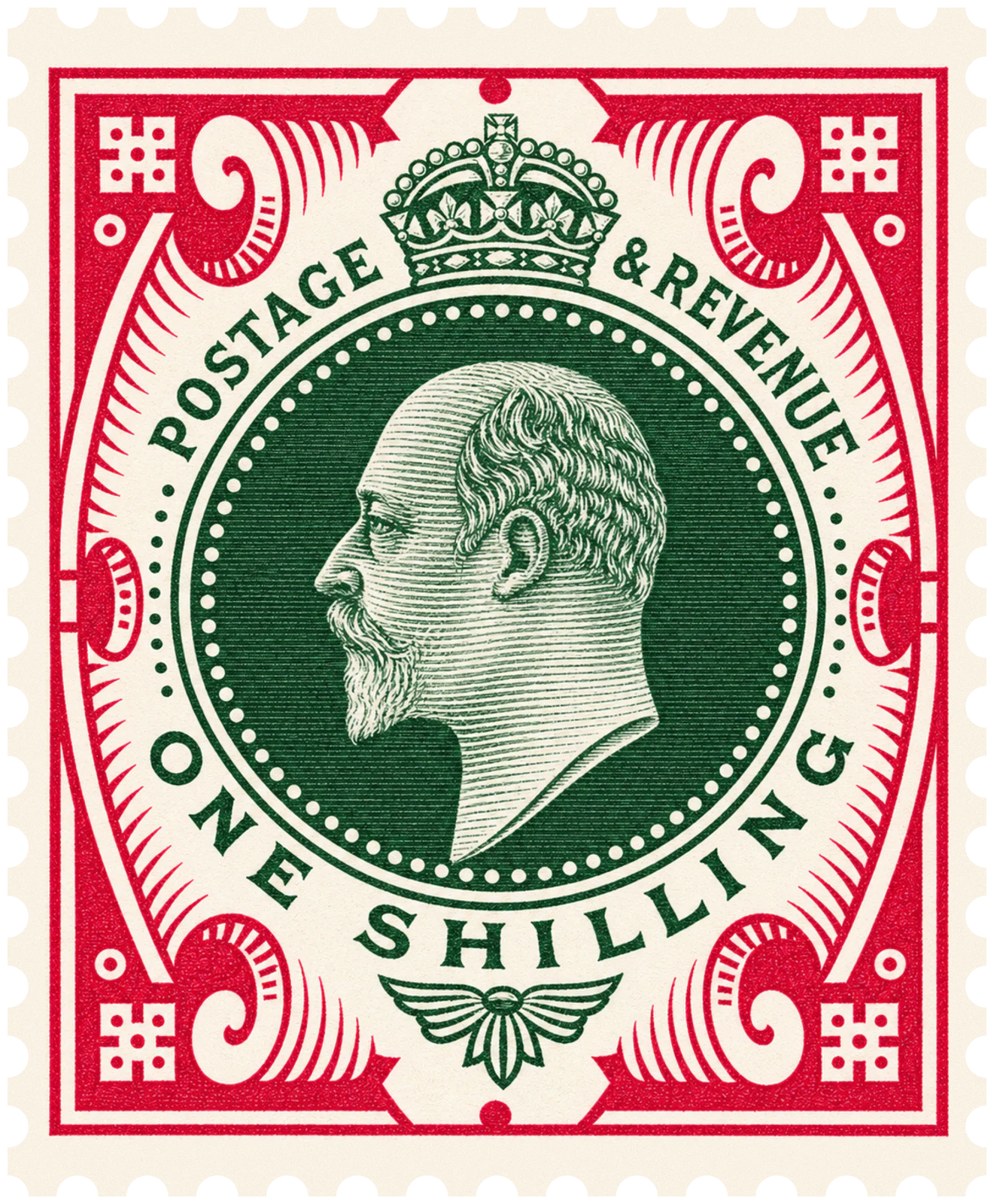
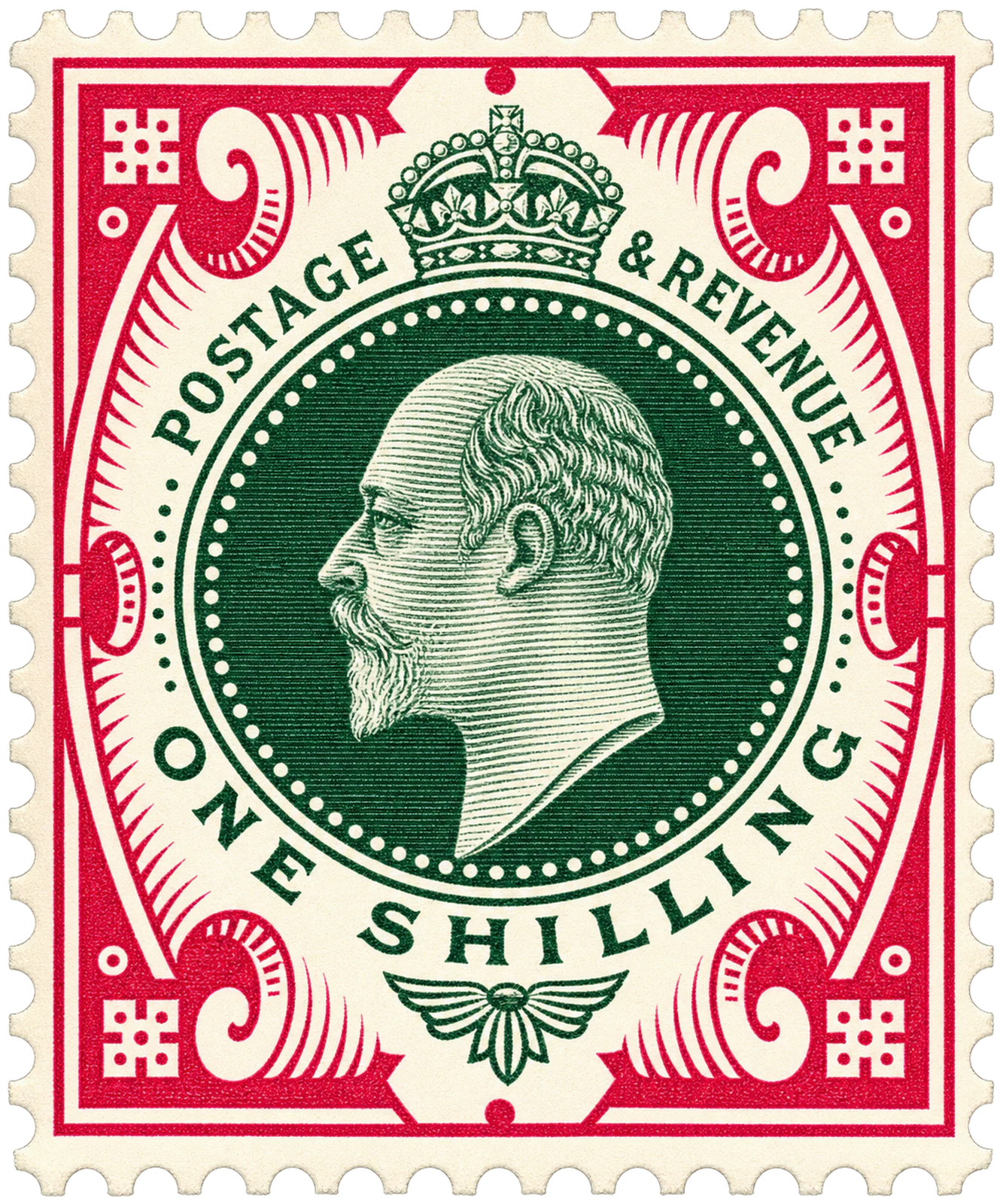
Somerset House includes dark or deep green with scarlet, as well as green with carmine. De La Rue also used carmine and scarlet combinations. A green-and-carmine stamp needs more than its colour names to establish the printer. [19]
A scratch behind the ear
A recorded Somerset House variety has a scratch behind the King’s ear and a broken frame at the foot: head plate 2b, border plate 5, row 20, stamp 11. This identifies a particular plate position and state, rather than a feature to expect on every Somerset House shilling. [20]
Check the paper
De La Rue used both ordinary and chalk-surfaced paper for the 1s; Somerset House used ordinary paper. A confirmed chalk surface identifies De La Rue for this denomination. Ordinary paper can belong to either printer. [21]
Features they share
Both retain the same principal design, the Imperial Crown watermark and perforation 14. These features do not separate the printers.
Summary
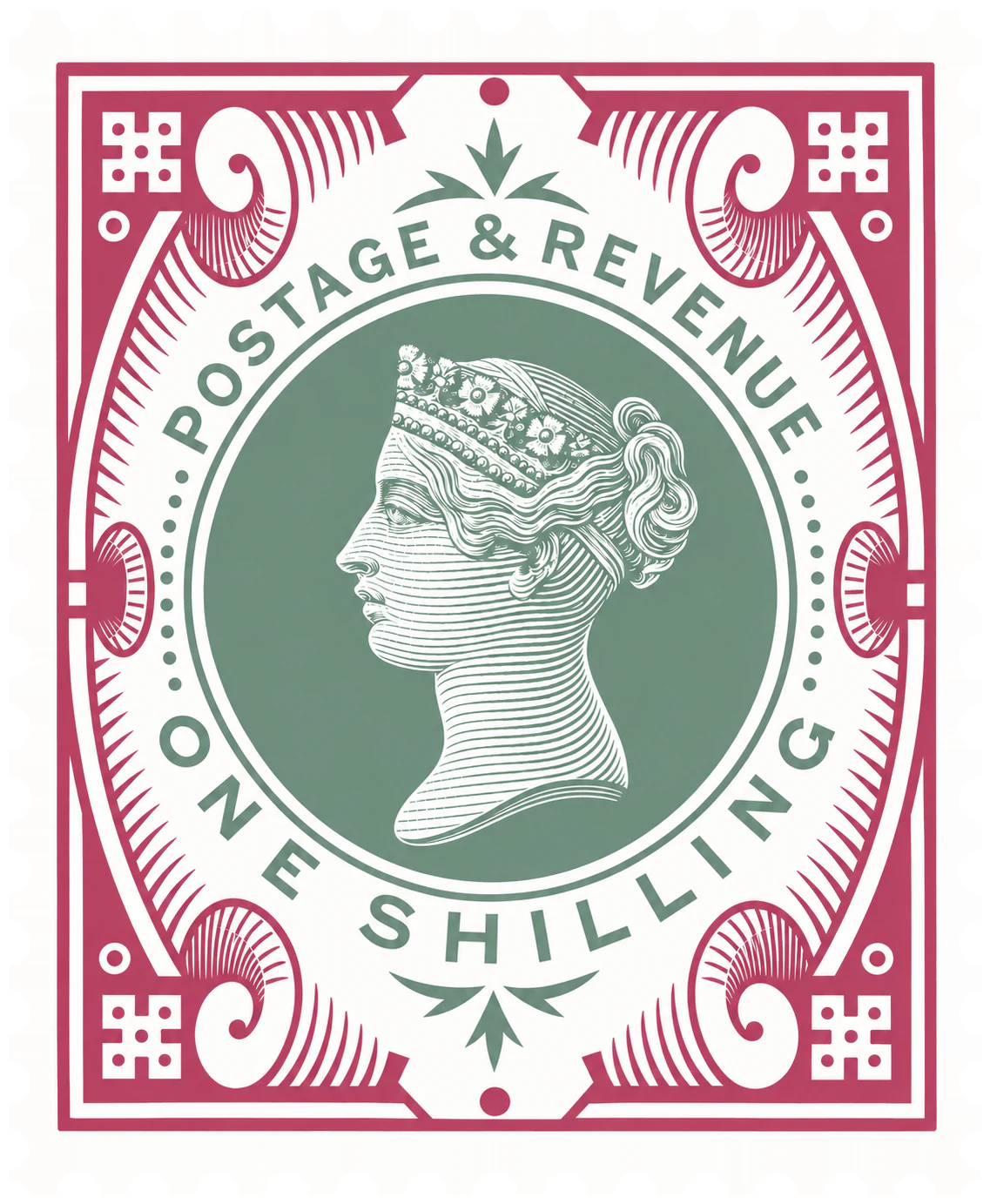
A printing plate from Queen Victoria’s reign helped produce this Edwardian shilling. De La Rue retained the border and combined it with the new King’s portrait. Surviving blocks from both reigns preserve the connection between the two designs. [1]
Stories
A Victorian plate serves a new king
A Victorian plate serves a new king
The shilling reused an actual printing plate from Queen Victoria’s reign, rather than merely copying the appearance of her stamp. A new Edward VII head plate was paired with the existing border plate. Surviving corner blocks of the Victorian and Edwardian shillings demonstrate the connection. The Edwardian block is identified as head plate 1 and border plate 2. [1]
The two-colour method made that combination possible: the royal portrait and the surrounding border were supplied by separate printing surfaces. One could be replaced for the new reign while the other continued in service. [1]
Compare the portrait setting and surrounding frame. The recorded corner blocks are not reproduced here.
Click either stamp to magnify
The “bullet hole” above the forehead
The “bullet hole” is a collector’s nickname for a circular gap above the King’s forehead. It is recorded in a chalk-paper block of twenty-four at row 7, stamp 4. The catalogue attributes the gap to foreign material attached during printing and subsequently removed. The interruption belongs to the printed image, not to a projectile passing through the stamp. [1]
The Board of Education shilling
The Edward VII 1s BOARD OF EDUCATION overprint, SG O87, has differing accounts of its issue. Rikki Hyde, writing in a Stanley Gibbons publication (2008, p. 34), states that it was never officially issued, although one or two examples were used. He records 114 mint copies in the Post Office archives. [9]
The GB Overprints Society instead lists 23 December 1902 as the issue date and 114 as the number issued. The two sources describe the figure differently; it is not a count of all surviving examples. [8, 9]
When elevenpence replaced a shilling
At the beginning of the reign, one shilling paid the highest ordinary inland parcel band: over nine pounds and up to eleven. A tariff reduction removed that particular use of the denomination. From 2 July 1906, even the eleven-pound maximum cost only elevenpence. No weight band in the ordinary inland parcel tariff then required exactly a shilling. [7]
The stamp remained available for other charges and combinations. The change concerned this parcel service, whose tariff stayed below a shilling until the increase of November 1915. [7]
A shilling becomes five piastres
Two added inscriptions adapted the shilling for British Levant post offices in different ways. LEVANT identified the area of use while retaining the British value; 5 PIASTRES restated it in local currency. The ordinary-paper LEVANT issue appeared in 1905, with 11,400 recorded. The De La Rue chalk-paper surcharge followed in 1909, with 41,400 recorded. [10]
The changing red of the shilling
The shilling’s red printing has its own range of shades. Specialist listings distinguish bright carmine, carmine-pink and paler combinations, while dull green and scarlet on chalk-surfaced paper has the separate number SG 259. The paper also changed, with chalk-surfaced printings recorded from September 1905. That supplies a second feature to examine alongside the ink. [4, 1, 3]
Why does the King face left?
Alternating portrait directions on British coins.Image information
Eleven British coins in a row, with royal portraits facing alternately right and left.
Credit
Stunning Stamps · 2026
Notes
Digitally constructed
For centuries, British monarchs have traditionally faced in opposite directions on successive reigns' coins. Queen Victoria looked to the left, so when her son Edward VII became King, his portrait on coins faced right. But should the same rule apply to postage stamps? [12, 13]
The question prompted an official discussion in February 1901. The Inland Revenue argued that stamps should follow a different principle. Placed in the top-right corner of an envelope, a left-facing King would appear to look inwards, towards the letter, rather than outwards, away from it. [13]
It was a surprisingly thoughtful detail for something so small. Instead of appearing to turn his back on the letter, the King would seem to take an interest in its contents. The left-facing portrait was adopted, continuing a convention that later British definitive stamps would follow. [13]
The artist who encountered two monarchs
When Queen Victoria died in January 1901, an Austrian-born artist named Emil Fuchs was summoned to Osborne House on the Isle of Wight to make a death mask of the Queen — a cast of her face intended to preserve her likeness after death. [14]
It was an unusual royal commission. Within weeks, Fuchs would find himself working on the image of Victoria's son and successor, King Edward VII. [14, 13, 15]
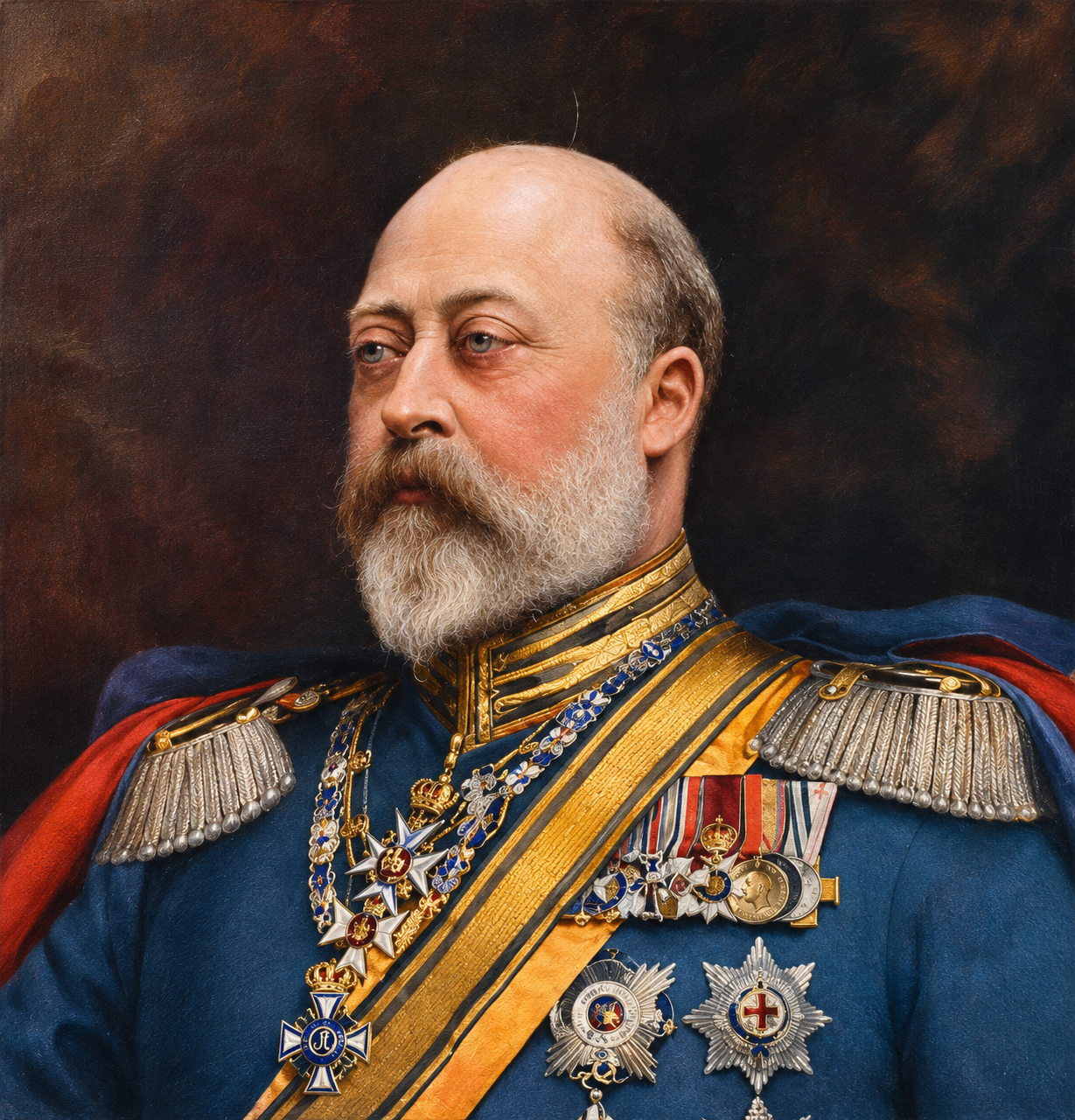
The first designs for the new King's postage stamps had failed to win his approval. Edward liked the work of Fuchs, who had already established a reputation as a talented portrait artist, and granted him a personal sitting. The resulting portrait became the familiar image that appeared on British stamps throughout Edward's reign. [13, 14]
Emil FuchsImage information
Click image to magnify
Emil Fuchs, with dark hair, a moustache and beard, wearing a dark suit.
Credit
Emil Fuchs, Self-Portrait (1905). Brooklyn Museum, via Wikimedia Commons. Public domain source.
Notes
Digitally reconstructed
King Edward VIIImage information
Click image to magnify
Portrait illustration of King Edward VII in ceremonial uniform.
Credit
Stunning Stamps · 2026
Notes
Digitally reconstructed
A printer loses the contract
For decades, De La Rue had been responsible for printing Britain's postage stamps. But in 1910, the company lost its valuable government contract after negotiations over the price failed. The existing arrangement had been worth £97,000 a year, covering everything from preparing the printing plates to producing the finished stamps. [16]
From January 1911, the printing contract passed to Harrison & Sons for £50,000 a year, while the Royal Mint took responsibility for making the printing plates. De La Rue even had to surrender its existing plates, some of which were handed to its successor to continue printing stamps bearing the portrait of the late King Edward VII. [16, 17]
The change was not without difficulties. The Royal Mint had little experience of making postage stamp plates, and the quality of some of the stamps produced under the new arrangements was criticised in Parliament. For De La Rue, losing such a longstanding contract — and seeing its own plates used by the new printers — can hardly have been a welcome outcome. [16, 18]
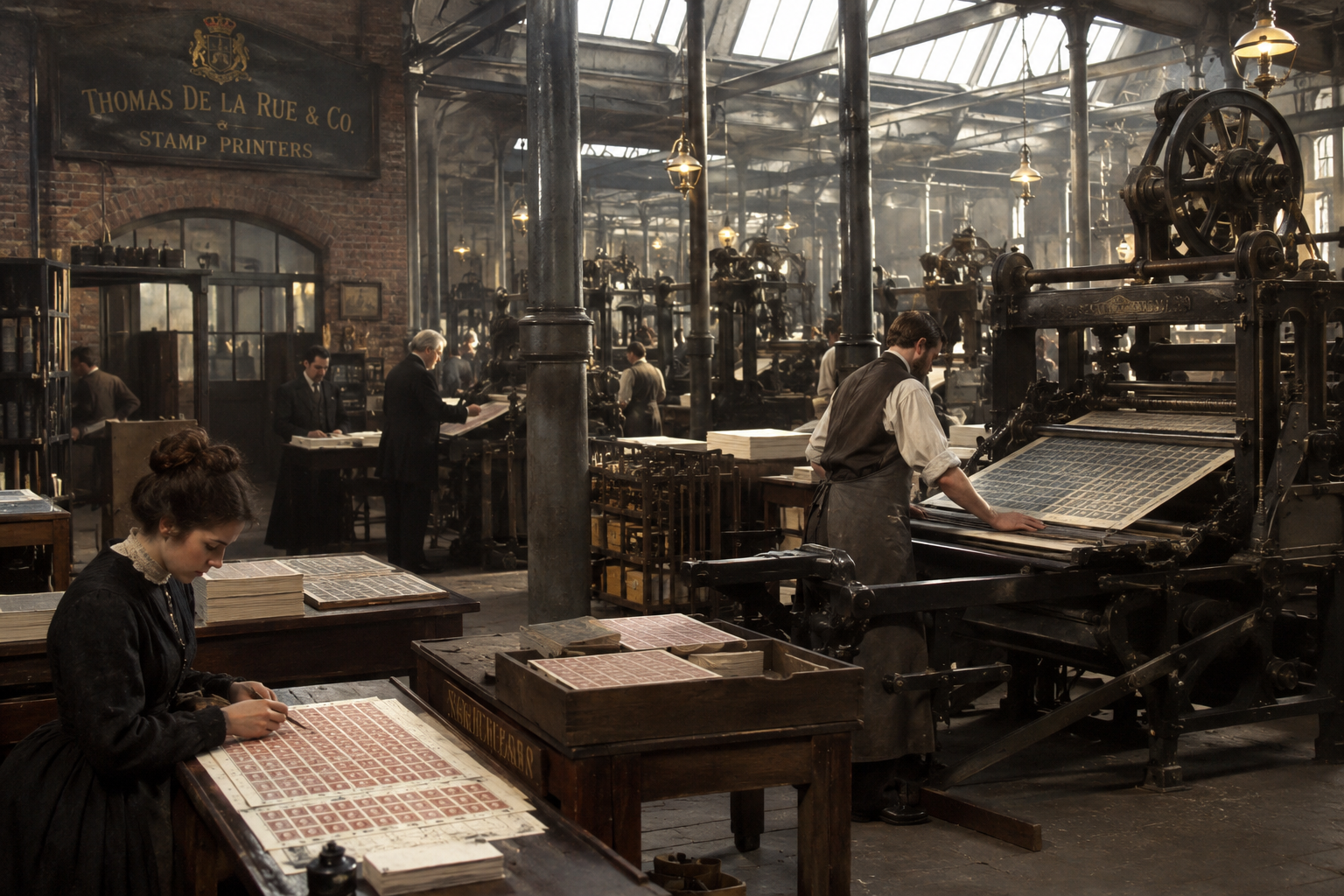
An imagined De La Rue stamp-printing workshop.Image information
Click image to magnify
Imagined De La Rue workshop, with printing presses, workers and sheets of stamps.
Credit
Stunning Stamps · 2026
Notes
Digitally reconstructed
Why do some stories appear on several pages?
Every page is written to make sense on its own. Visitors often arrive directly at a particular stamp or subject, without having explored the rest of the site.
Some stories are relevant to several stamps, so they are repeated where they help explain what you're looking at. For those exploring a series, the details specific to each stamp generally come first, with the more familiar stories further down the page.
This way, you can explore the site in any order without missing interesting background.
A new King did not mean an entirely new shilling. The design continued Queen Victoria’s Jubilee framework, adapted around Edward VII’s portrait. Separate green and carmine impressions brought the centre and border together. [22, 3]
The Design article follows the Victorian inheritance and explains why the stamp advertised both POSTAGE and REVENUE—two different ways its value could be used. [23, 24]
The country identifies the postal authority that issued the stamp. The monarch identifies the ruler whose portrait it carries. A definitive is an everyday stamp intended for regular postal use.
On this stamp
This 1s belongs to Great Britain’s everyday definitive stamps bearing Edward VII’s portrait. De La Rue produced this issue in the 1902–1910 period.
The first-issue date records when the stamp became available for use. Read it alongside the description: an entry may describe a new design, a replacement colour or a change of printer. A stamp can remain in production long after that first date.
On this stamp
24 March 1902. This records the introduction of the De La Rue issue described on this page. Later shades or changes of paper may have different dates.
A shade is a variation within a stamp’s colour. Some variations receive their own catalogue numbers even though the design and denomination stay the same.
Compare known examples under consistent lighting. Fading can change a stamp’s appearance, and photographs or screens can alter how colours look. A catalogue colour name helps describe a shade; it is not a colour test by itself.
On this stamp
Colours: Dull green and carmine. This name belongs to the specified printer’s colour range. Compare known examples under consistent lighting before assigning a shade.
A stamp catalogue gives each listed issue a reference number. SG means Stanley Gibbons, the publisher of the catalogue used here. These numbers help collectors refer to the same issue; they are not serial numbers printed on individual stamps.
A range of numbers groups related entries. Colour, paper or perforation differences may account for separate listings within that range.
Perforations are the rows of punched holes that let neighbouring stamps separate. Their gauge describes the spacing over a standard distance of 2 centimetres, rather than the total number of holes along a stamp’s edge.
A perforation gauge has rows of dots or lines at known spacings. Match an edge against them: the marks should line up all the way along. A single number applies to both directions; two numbers give the horizontal gauge first, then the vertical.
Enlarged spacing diagram, not to scale. Match the spacing with a perforation gauge.Image information
Enlarged perforation spacing: fourteen equal intervals between hole centres span 20 millimetres. This is a schematic, not a ruler.
Credit
Stunning Stamps · 2026
On this stamp
This De La Rue 1s is listed as perforation 14 in both directions. Match the hole spacing over 2 cm; the number does not mean that every edge has exactly fourteen holes.
These dimensions describe the complete stamp, including its perforated edges. Width is given first, followed by height. Measure from the outer tips of the perforations on one side to the outer tips on the opposite side.
The printed design occupies a smaller area inside the paper margins. Its size is a separate measurement.
Width × height of the complete stamp, across the perforation tips. Diagram enlarged; screen size is not calibrated.Image information
Complete stamp width 21 mm and height 24 mm, measured across the outer perforation tips. The printed area is smaller. Schematic, not actual size.
Credit
Stunning Stamps · 2026
On this stamp
The listed 21 × 24 mm is the complete stamp: width first, height second, measured across the outer perforation tips. The printed design sits inside those edges. It is a nominal reference size, not a measurement of the image on your screen.
De La Rue grew from a playing-card business into a major security printer. It supplied British postage stamps from the Victorian period and printed the Edward VII issues before the contract changed in 1911.
Warren de la Rue worked in the family business during the Victorian period. His biography explores the firm’s earlier history; he died before this issue.
On this stamp
De La Rue manufactured this 1s. Use the paper and colour description with the printer’s name: later firms continued many Edward VII designs, so the portrait alone cannot identify a De La Rue printing.
Typography, or surface printing, uses a raised printing surface. Ink is applied to the raised parts, then transferred to paper under pressure. The lower spaces leave the paper unprinted.
Fine lines and solid areas are both part of that raised image. This is the same basic principle as letterpress printing.
Surface printing, shown from the side. The paper is pressed onto the inked surface.Image information
Side view of surface printing. Paper is pressed down onto ink on the raised parts of a printing plate; the lower spaces do not touch the paper.
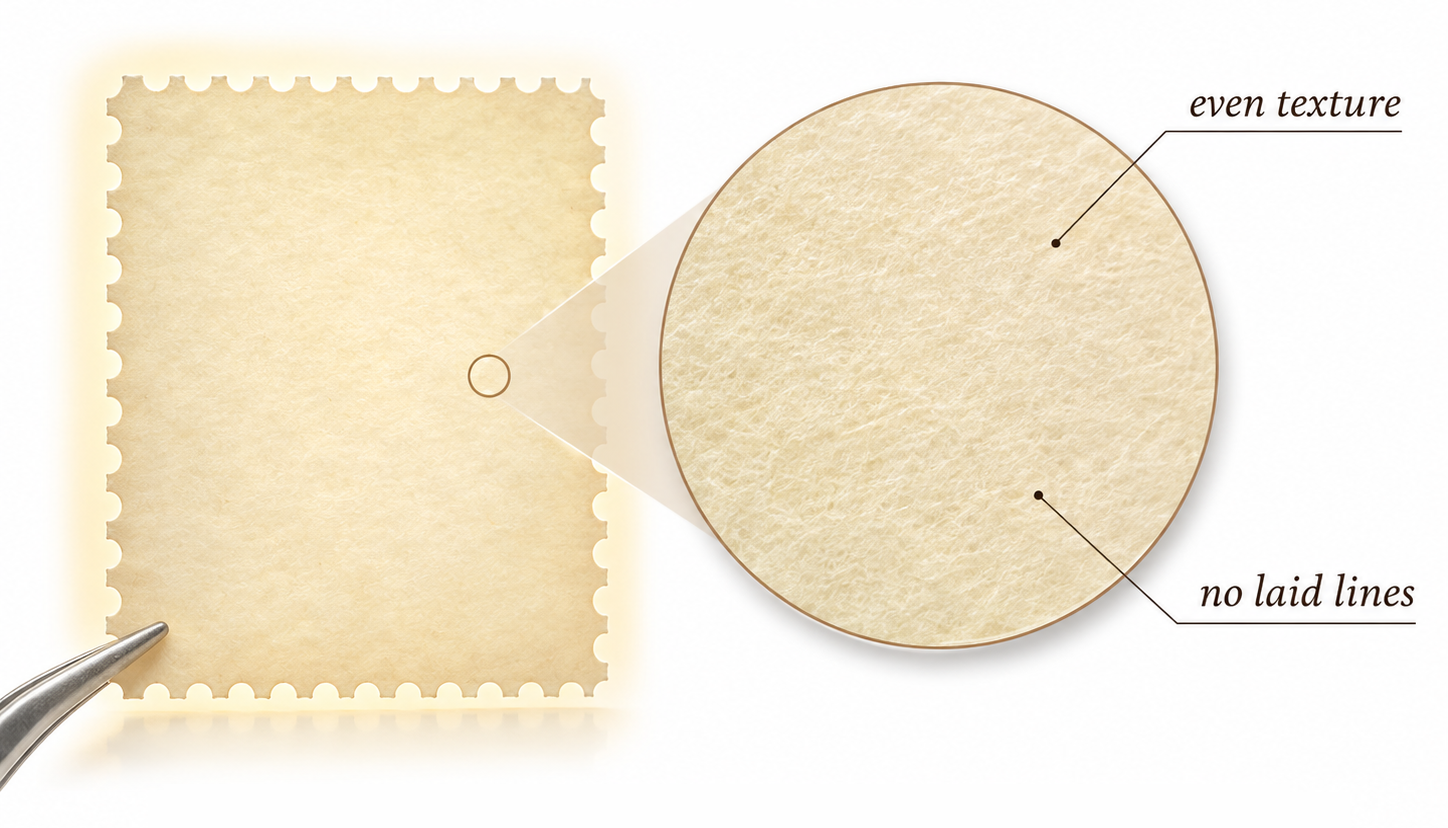
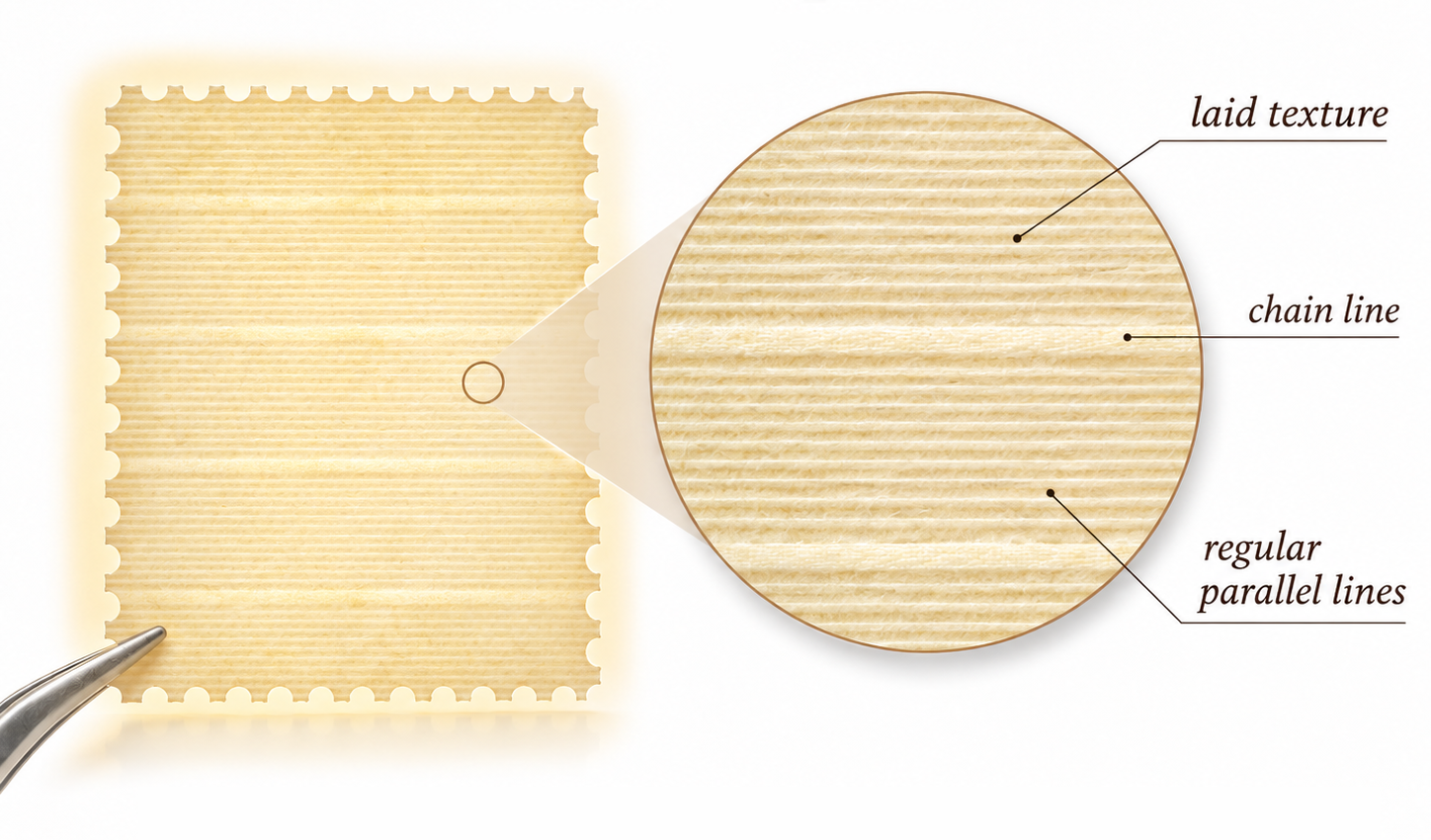
Wove describes the structure of the paper. Viewed against the light, it has a fairly even appearance. Laid paper instead shows a regular pattern of lines left by its manufacture.
Paper structure and watermark are separate characteristics: wove paper can carry a watermark. Both can help distinguish stamps with similar printed designs.
Wove paper: even texture without laid lines.Image information
Click image to magnify
Diagram of wove paper with a magnified inset showing an even texture without laid lines.
Credit
Stunning Stamps · 2026
Notes
Digitally constructed
Laid paper: regular parallel lines, shown for comparison.Image information
Click image to magnify
Diagram of laid paper with a magnified inset showing regular parallel lines.
Credit
Stunning Stamps · 2026
Notes
Digitally constructed
On this stamp
Ordinary wove. This describes the original paper for the issue. Later coated-paper entries must be identified separately even when the design looks the same.
A watermark is a pattern formed in the paper while it is being made. Variations in the paper allow the pattern to show when light passes through it. It is part of the paper itself, rather than an inked design.
A watermark may be faint or only partly visible on a single stamp. Collectors use it to identify the paper and distinguish otherwise similar issues.
Imperial Crown · front view · upright. The same Imperial Crown motif was used on Edward VII low values and the later George V Downey Heads. Enlarged; not a scale or stamp-position template.Image information
Imperial Crown watermark, front view, upright
Credit
Stunning Stamps · 2026
Notes
Digitally reconstructed
On this stamp
The De La Rue 1s uses the Imperial Crown watermark, also called the Crown of 1880 in period descriptions. Look within the paper for the crown pattern shown here. A faint or partial impression needs care when comparing it with the guide.
The denomination is the stamp’s face value: the amount of postage it represents. Its price to a collector can be quite different.
In Britain’s old currency, 12 pence made one shilling and 20 shillings made one pound: 240 pence altogether. The abbreviations were d for pence, s for shillings and £ for pounds. The d comes from the Latin denarius. A halfpenny, written ½d, was half an old penny.
A specialised catalogue divides an issue more finely than a general listing. For Edward VII, references beginning with M identify families in the Stanley Gibbons Specialised catalogue; a number in brackets distinguishes an entry within that family.
Several specialised entries may share one ordinary SG number. Read the complete reference alongside the printer, paper, perforation and shade. A plate number or a position in a sheet describes something different.
On this stamp
SG 257; specialist families M45–M46. The M reference gives the finer specialised classification. Keep its bracketed number, where present, with the reference; it can distinguish entries that share a general SG number.
A two-colour stamp needs separate printing elements for its two inks. On these Edward VII stamps, the head plate supplies the portrait and associated ornament. The other plate supplies the remaining parts of the design; it is usually called the duty plate, or the border plate on the shilling.
The two impressions have to line up. That alignment is called registration. A small shift can make the value tablet or frame sit off centre even when the perforations are well placed.
Principle of two-colour printing. Shapes and colours are schematic; this does not show a particular stamp’s plate design or printing order.Image information
Two separate coloured impressions align on the same paper to make a complete design. Abstract oval and tablet stand for the two printing elements.
Credit
Stunning Stamps · 2026
On this stamp
The De La Rue 1s combines two printed inks. The two printing elements are described as head and border plates. Compare the alignment of the red frame with the green portrait and curved value inscription; a shifted impression can disturb their registration.
Ordinary paper and chalk-surfaced paper can carry the same design. Chalk-surfaced paper has a prepared layer on its printing face. On Edward VII issues, this change was intended to make the removal of used cancellations more difficult.
The coating can change the surface and the way the ink looks. Paper type therefore matters when matching a stamp to its catalogue entry. A photograph alone may not establish it. The diagram explains the structure; it cannot identify a particular coating.
Exaggerated cross-sections. The surface layer is shown separately to explain the term; this is not a microscopic identification test.Image information
Side views of ordinary and coated paper. In both, ink lies on the printed face; the coated paper has a separate surface layer above its paper body.
Credit
Stunning Stamps · 2026
On this stamp
From September 1905. This paper entry is separate from the ordinary-paper printing. Read its date and catalogue reference with the paper type, rather than assigning it from colour alone.
A printing sheet may contain several groups of stamps, called panes. Unprinted gaps between panes are gutters; the outer paper margin is also called selvedge. A pane may occupy an entire printing sheet or be one of several panes.
The sheet supplied to a post office may be smaller than the sheet used for printing. Keep those two counts separate. Row and column counts explain how many stamps belong to each pane.
Sheet, panes and margins: a simplified example.Image information
A schematic printing sheet contains two panes separated by an unprinted gutter and surrounded by a margin.
Credit
Stunning Stamps · 2026
On this stamp
240 stamps in two panes of 120. Read the pane count separately from the total sheet count. The diagram explains the terms; the figures here give this issue’s arrangement.
The paper outside the stamps can carry useful evidence: coloured rules, control letters, cuts, dots or other marks associated with printing. A marginal block preserves these features alongside the stamps they accompanied.
Specialists compare the marks with documented plate states and positions. A margin mark is not automatically a flaw in the stamp design, and a plate state is not necessarily a new plate.
On this stamp
Carmine inside green, continuous around each pane. This marginal detail can help place a surviving block within the printing arrangement. It belongs to the surrounding paper or its printing, rather than the stamp’s postal value.
A shade is a variation within a stamp’s colour. Some variations receive their own catalogue numbers even though the design and denomination stay the same.
Compare known examples under consistent lighting. Fading can change a stamp’s appearance, and photographs or screens can alter how colours look. A catalogue colour name helps describe a shade; it is not a colour test by itself.
On this stamp
SG 257 / SG 257a: Dull green and carmine: ordinary / chalk-surfaced paper. The paper description is part of this identification; colour alone is insufficient.
A shade is a variation within a stamp’s colour. Some variations receive their own catalogue numbers even though the design and denomination stay the same.
Compare known examples under consistent lighting. Fading can change a stamp’s appearance, and photographs or screens can alter how colours look. A catalogue colour name helps describe a shade; it is not a colour test by itself.
On this stamp
Related De La Rue shade: Dull green and scarlet on chalk paper, SG 259. The paper description is part of this identification; colour alone is insufficient.
A shade is a variation within a stamp’s colour. Some variations receive their own catalogue numbers even though the design and denomination stay the same.
Compare known examples under consistent lighting. Fading can change a stamp’s appearance, and photographs or screens can alter how colours look. A catalogue colour name helps describe a shade; it is not a colour test by itself.
On this stamp
Specialist shades: Bright carmine, carmine-pink and paler combinations. This name belongs to the specified printer’s colour range. Compare known examples under consistent lighting before assigning a shade.
A plate flaw is a change in the printing surface that alters part of the design. When it repeats at the same position, it can help identify the plate and its state. A temporary printing blemish may appear in only part of a print run.
Descriptions often give a pane, row and stamp position. Use all of those details when comparing an example. A named flaw describes a particular variety, not a feature shared by every stamp of that value.
On this stamp
Above the forehead, R7/4, head plate 1. This describes the particular printing variety recorded for the De La Rue 1s. Compare the cited position or plate state where one is supplied; it is not expected on every example.
A stamp can combine work by several people: a portrait artist, frame designer, photographer or engraver. Their roles are identified separately here.
Emil Fuchs was a Vienna-born sculptor, medallist and portrait painter who worked in London and later New York. His portrait of Edward VII supplied the likeness used on the King’s British definitive stamps.
On this stamp
Fuchs supplied the Edward VII portrait retained on this 1s dull green and carmine stamp. The surrounding design was developed for De La Rue; later printers continued the established portrait and frame.