
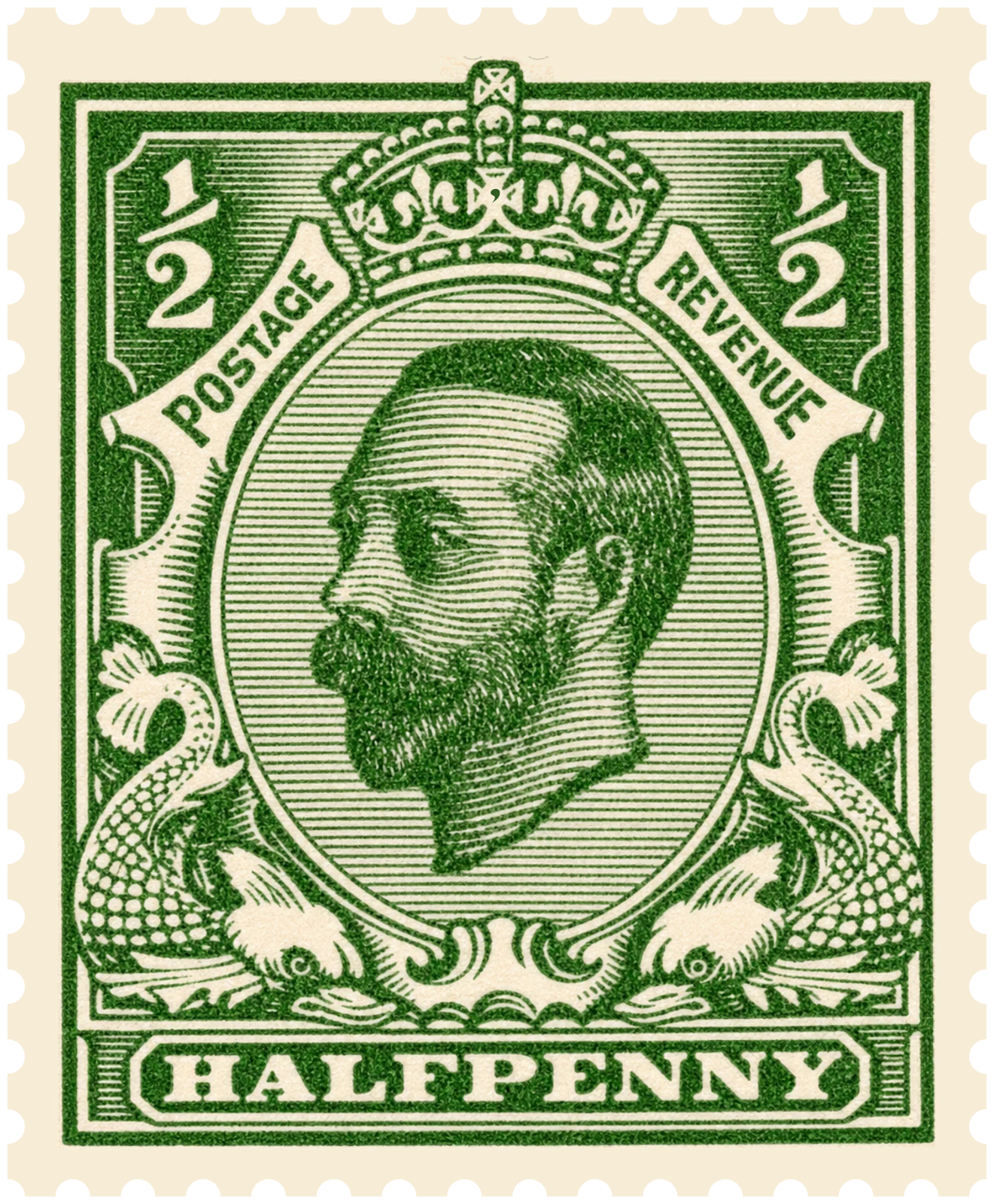
The design of the ½d green · Die 1A · Imperial Crown
King George V · Great Britain · Harrison & Sons · 22 June 1911
From the Embankment to the stamp
The dolphins have a connection with London’s riverside architecture. Writing in the British Philatelic Bulletin in 1993, James Mackay traced Mackennal’s halfpenny ornaments to the dolphins on the lamp-posts along the Victoria Embankment. Many of those lamp standards date from around 1870. [1, 2]
The broad heads, open mouths, scales and curling bodies belong to the same decorative vocabulary. On the lamps, these forms wrap around an upright shaft; on the stamp, the paired creatures curve around the King’s portrait.
The ornament puzzled some viewers when the Downey halfpenny appeared in 1911. Speaking in the House of Commons on 15 August, Lord Balcarres said that a fellow MP had told him the creatures were dolphins. Their bills reminded him of a duck-billed platypus; he called the halfpenny frame “fantastic” and said the penny’s heavy frame dwarfed the King’s head. [3, 4]
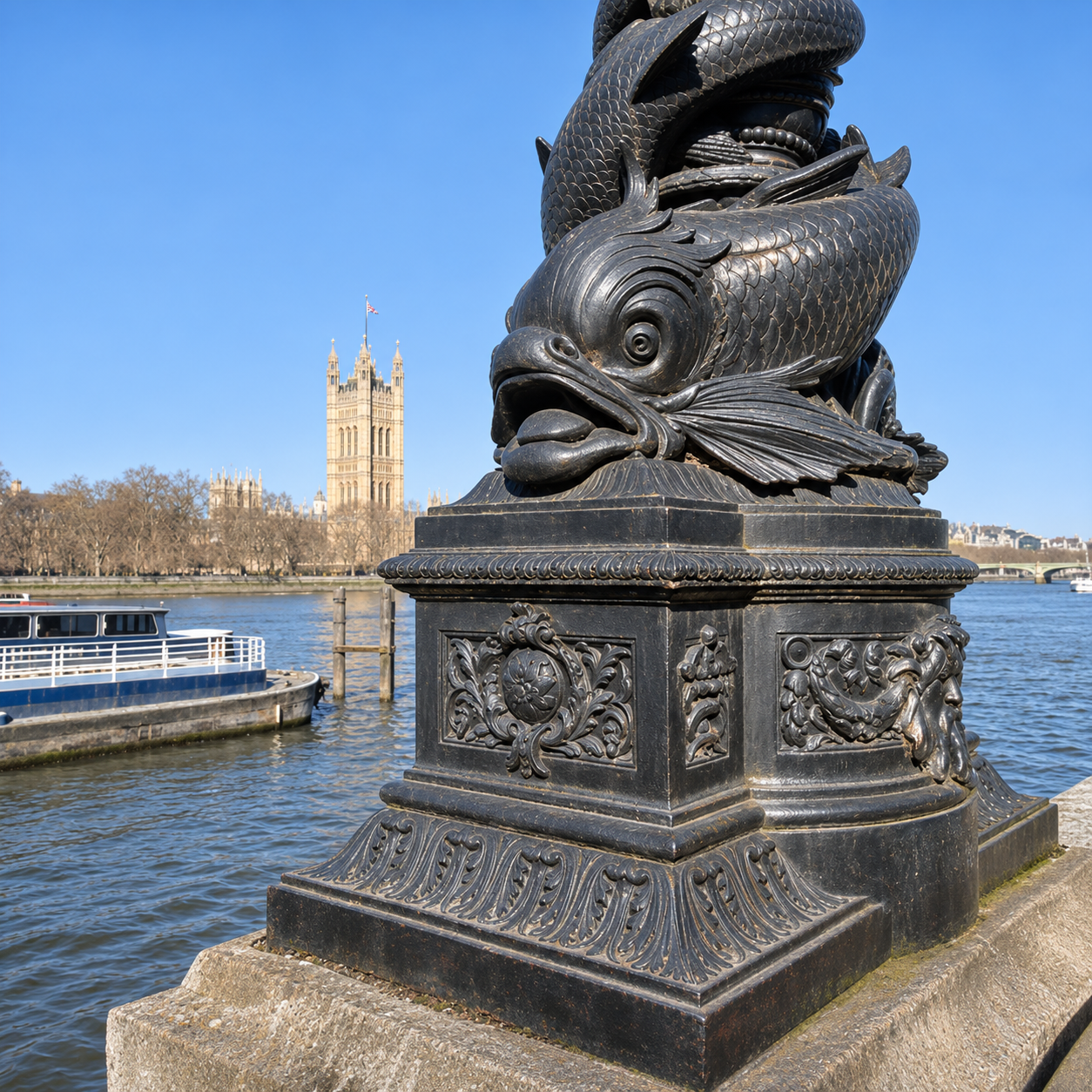
Image information
Click image to magnify
Reconstruction of a black cast-iron dolphin lamp base beside the Thames, with Westminster across the river.
- Credit
- Stunning Stamps · 2026
- Notes
- Digitally reconstructed
Two ornamental dolphins
The dolphins curl up beside the oval, with their heads turned inward beneath the portrait. Scales follow their bent bodies, while spreading tails fill the spaces below the inscription ribbons.
Mackennal’s stylised dolphins were later retained for the profile halfpenny and three-halfpenny. [5]
Click either stamp to magnify
The photograph the King and Queen liked
George V cared deeply about stamps: he was an enthusiastic collector who studied proofs and took an interest in their design. For his first British issue, he chose a photograph by W. & D. Downey that both he and Queen Mary particularly liked. The aim was a convincing likeness of the new King, with his face turned slightly towards the viewer. [5]
The photograph had to become an engraving small enough to print millions of times. J. A. C. Harrison worked on the portrait, translating its soft modelling into lines and dots. He was a separate person from Harrison & Sons, the printing firm. Bertram Mackennal supplied the ornamental frames around the head. [5, 6]
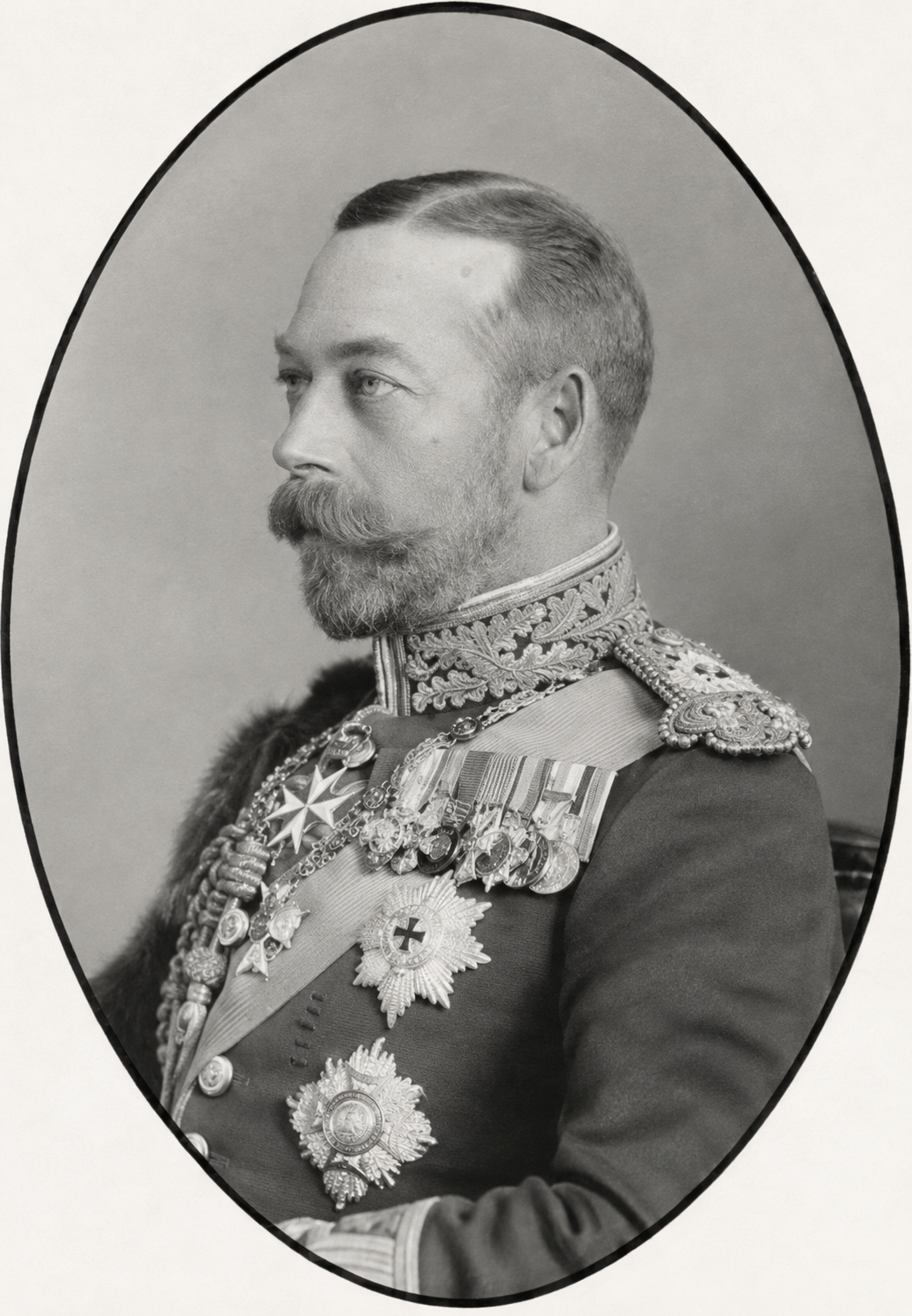
Image information
Click image to magnify
Reconstruction of the Downey photograph: George V bareheaded in naval dress, turned three-quarter left, with both eyes visible.
- Credit
- W. & D. Downey, original photograph; digital reconstruction by Stunning Stamps, 2026.
- Notes
- Digitally reconstructed from the photograph reproduced in David Thompson’s Downey Heads article, cross-checked with a catalogued Downey head photograph (Spink 22018, lot 387). The illustration preserves the pose and broad arrangement; it is not an archival photographic print or evidence of fine printing defects.
The portrait that disappointed the King
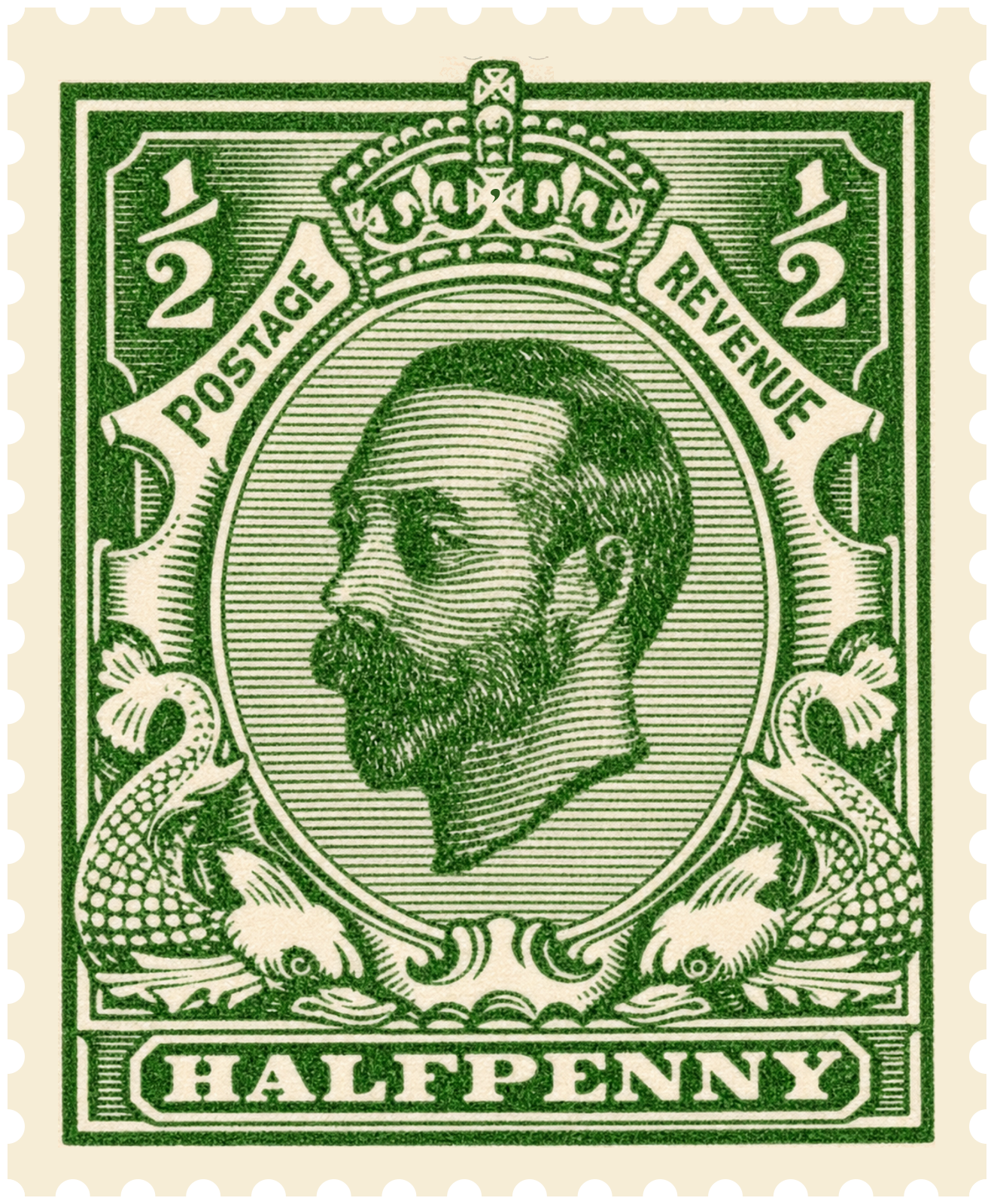
The three-quarter portrait broke with the familiar British stamp profile. Both eyes are visible, and the cheek turns towards the viewer. Beside Edward VII’s side-on likeness, the new approach is immediately apparent. [5]
The result provoked a storm of criticism. In Parliament on 15 August 1911, Sir Hildred Carlile called the likeness a “grotesque parody”. Other speakers attacked the crowded ornament and poor execution. When an MP said he had promised better stamps, Postmaster-General Herbert Samuel replied: “It was a hope, not a promise.” [7]
George V was disappointed with the issued stamps and suggested replacing the three-quarter portrait with a profile. The decision was taken in November 1911. His personal enthusiasm for the original photograph had given way to a different judgement of how it worked on a stamp. [5]
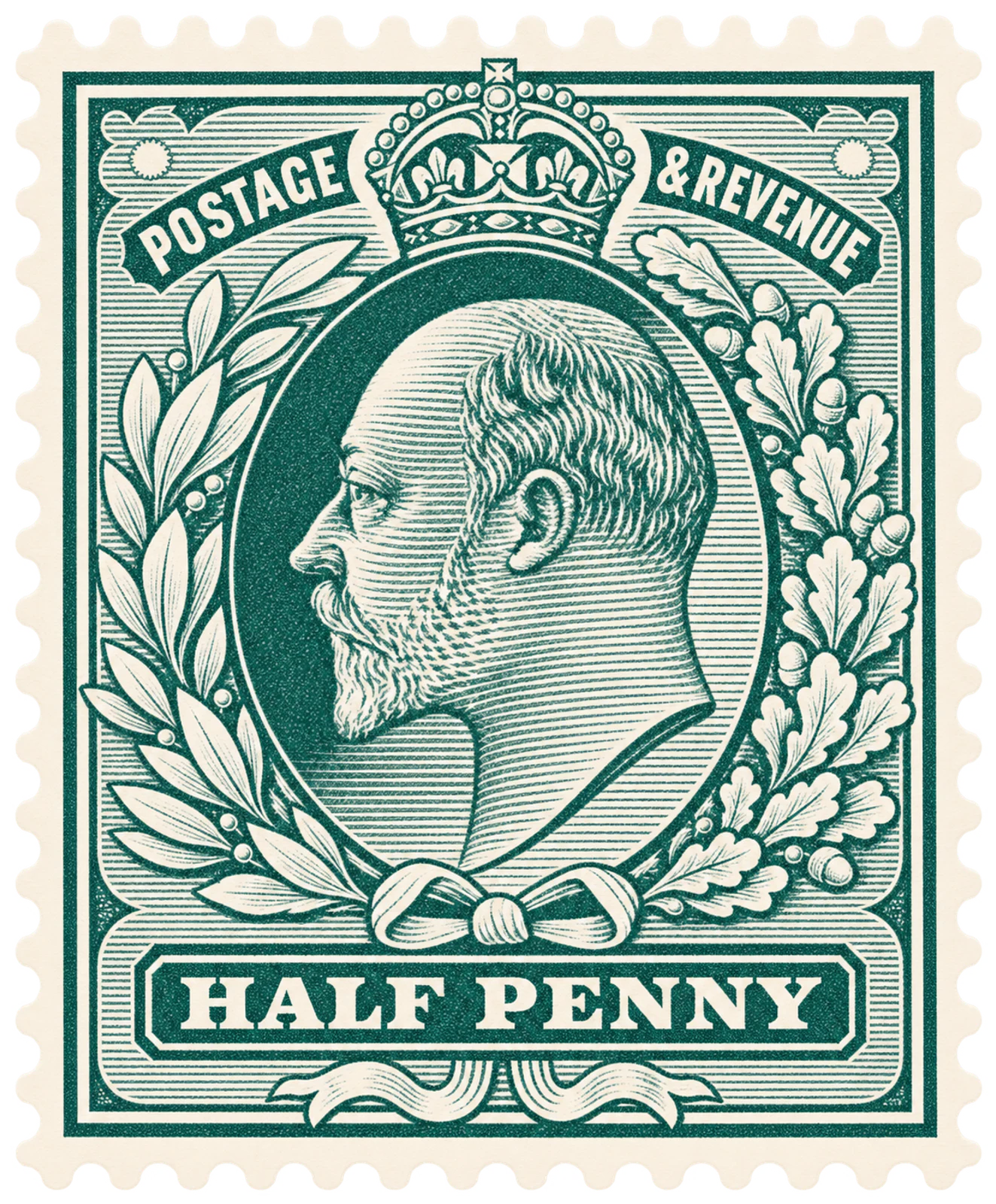
Click either stamp to magnify
Attempts to improve the engraving
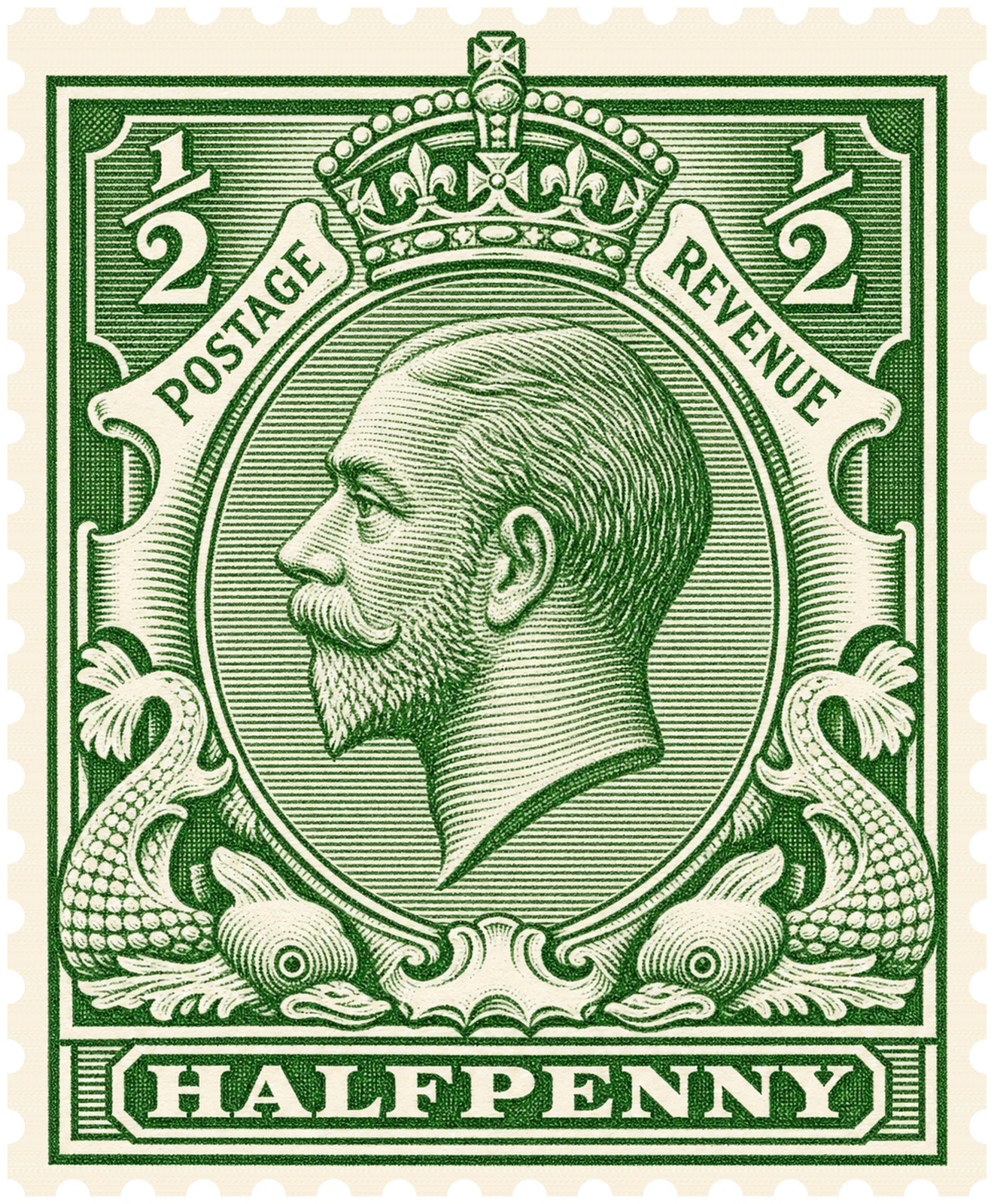
This is Die 1A, the first issued engraving. Its shortcomings prompted work on the early revision collectors call Die 1B, followed by a more extensive re-engraving of the head for Die 2. [5, 8]
The changes extended into Mackennal’s frame, but its two dolphins remained. They would survive the Downey portrait itself on the later profile halfpenny. [8, 5]
This Die 1A uses Imperial Crown paper, with a crown motif and no royal cypher. The paper connects the first George V stamps with the material already used for the preceding reign. Die 1A was issued on Imperial Crown paper; some later dies occur on more than one watermark paper. A paper change therefore need not mean a newly engraved design. [8, 9]
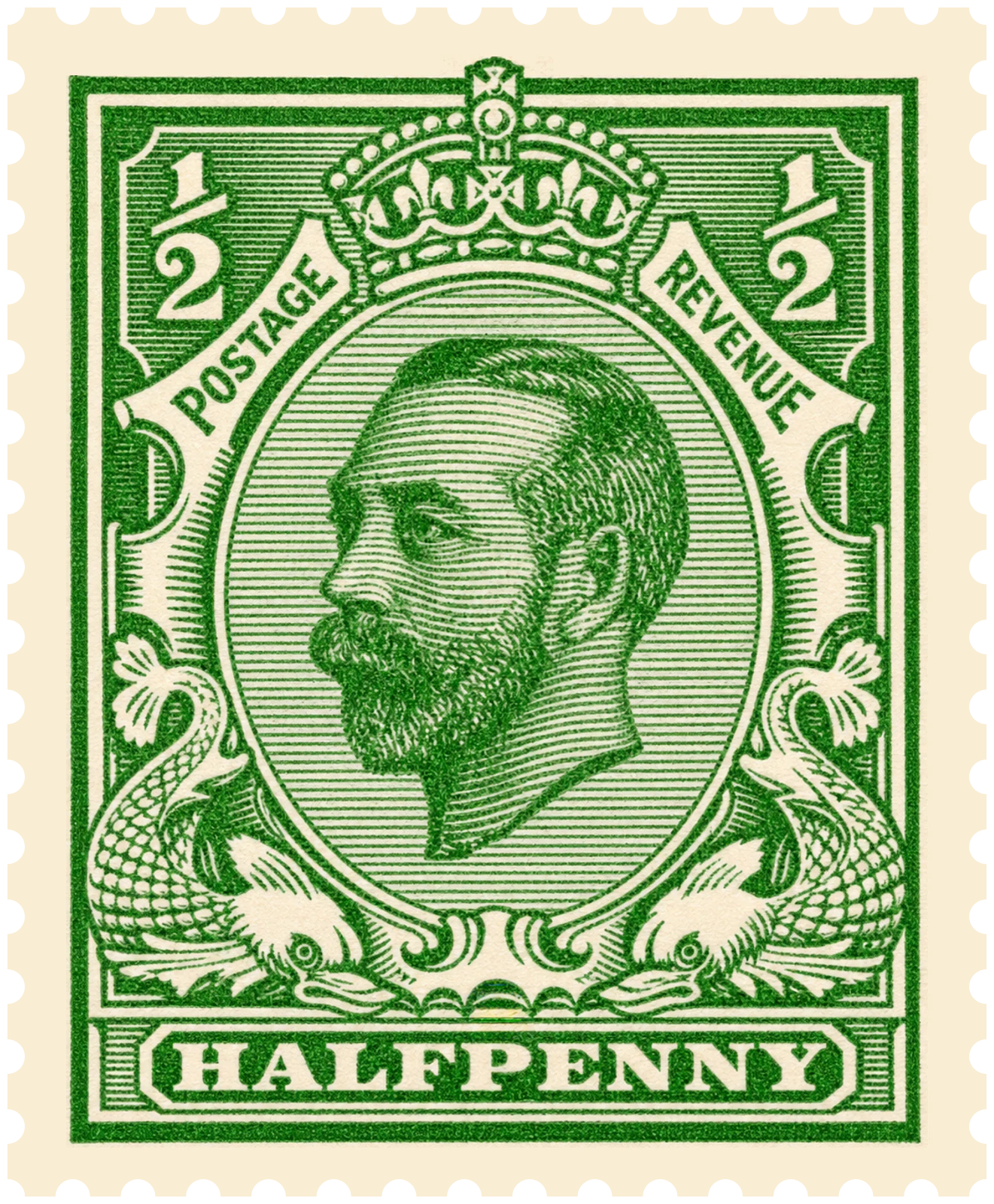
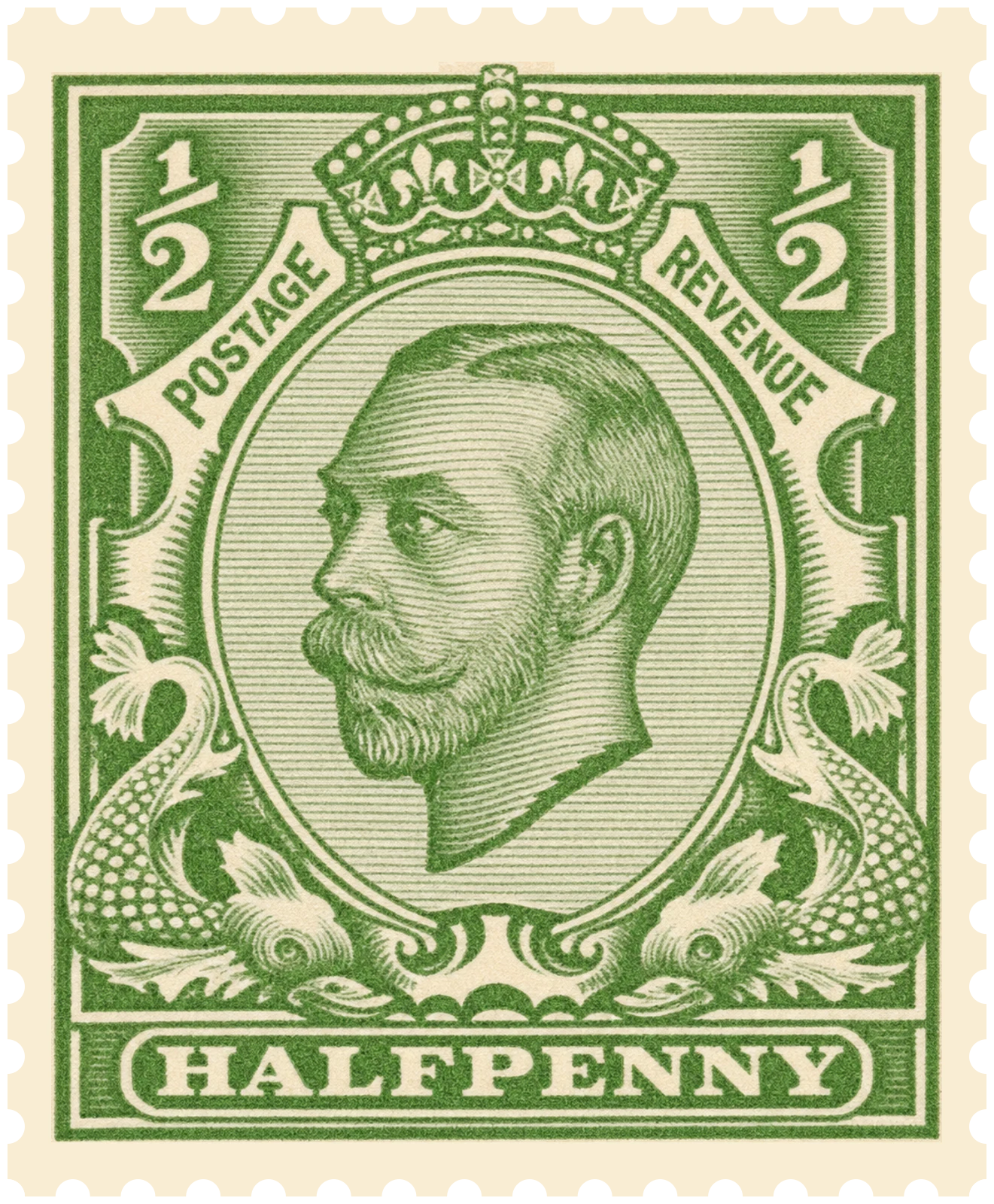
Compare the hair, beard and surrounding frame.
Click a stamp to magnify
Turning a photograph into a printed likeness
The photograph’s smooth tones had to be translated into marks that would reproduce at stamp size. The original dies were engraved, but the issued stamps were printed by letterpress: ink on raised printing surfaces was pressed onto the paper. This differs from recess printing, which holds ink in engraved hollows. [10, 5]
Green ink describes both the fine portrait shading and the stronger frame. Unprinted paper supplies the highlights and the pale bands around the lettering. Lines and dots set close together make the hair and beard appear darker; more open marks leave light on the face. The result depends on the balance between ink and unprinted paper, without a second colour.
A successful likeness depended on how that fine work survived ordinary production. The engraving and the quality of the resulting impressions were both part of the controversy over the new stamps. [7]
Image information
Click image to magnify
Decorative blue, green and white advertisement for Mander Brothers printing inks, Wolverhampton.
- Credit
- Stunning Stamps · 2026
- Notes
- Digitally constructed
Words, value and the surrounding frame
POSTAGE follows the ribbon at the upper left, with REVENUE on its counterpart at the upper right. The words describe the stamp’s postal and fiscal functions: paying to carry mail, or paying a tax or duty on a document. [11]
HALFPENNY spans the broad lower tablet. The fraction ½ is repeated in both upper corners beside the crown. Coloured letters stand on pale ribbons that slope towards the crown.
The slight turn of the King’s face contrasts with the nearly matching dolphins on either side of the frame. The repeated fractions help balance the crown above the portrait, while the full value anchors the foot of the design.
Image information
Click image to magnify
Illustration of five red pillar boxes with royal cyphers.
- Credit
- Stunning Stamps · 2026
- Notes
- Digitally reconstructed
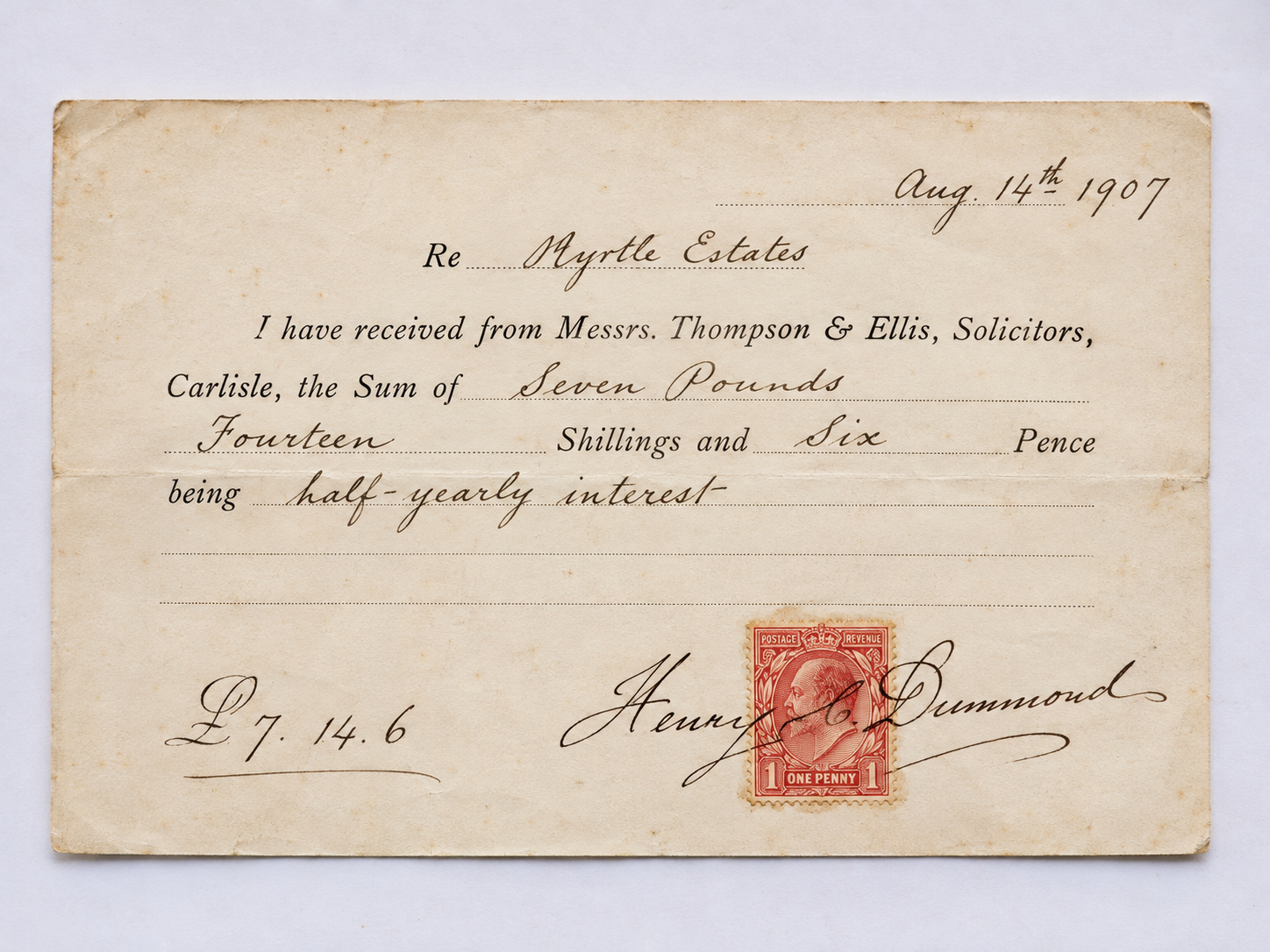
Image information
Click image to magnify
Illustration of a handwritten receipt with an Edward VII penny stamp cancelled by a signature.
- Credit
- Stunning Stamps · 2026
- Notes
- Digitally constructed
The crown above the head
A crown occupies the centre at the top. Rounded ornaments follow its arches above a patterned band, and a small cross completes the outline.
The crown sits in the frame above the King’s bare head. The upper fractions stand to either side, with the inscription ribbons sloping down towards the dolphins.
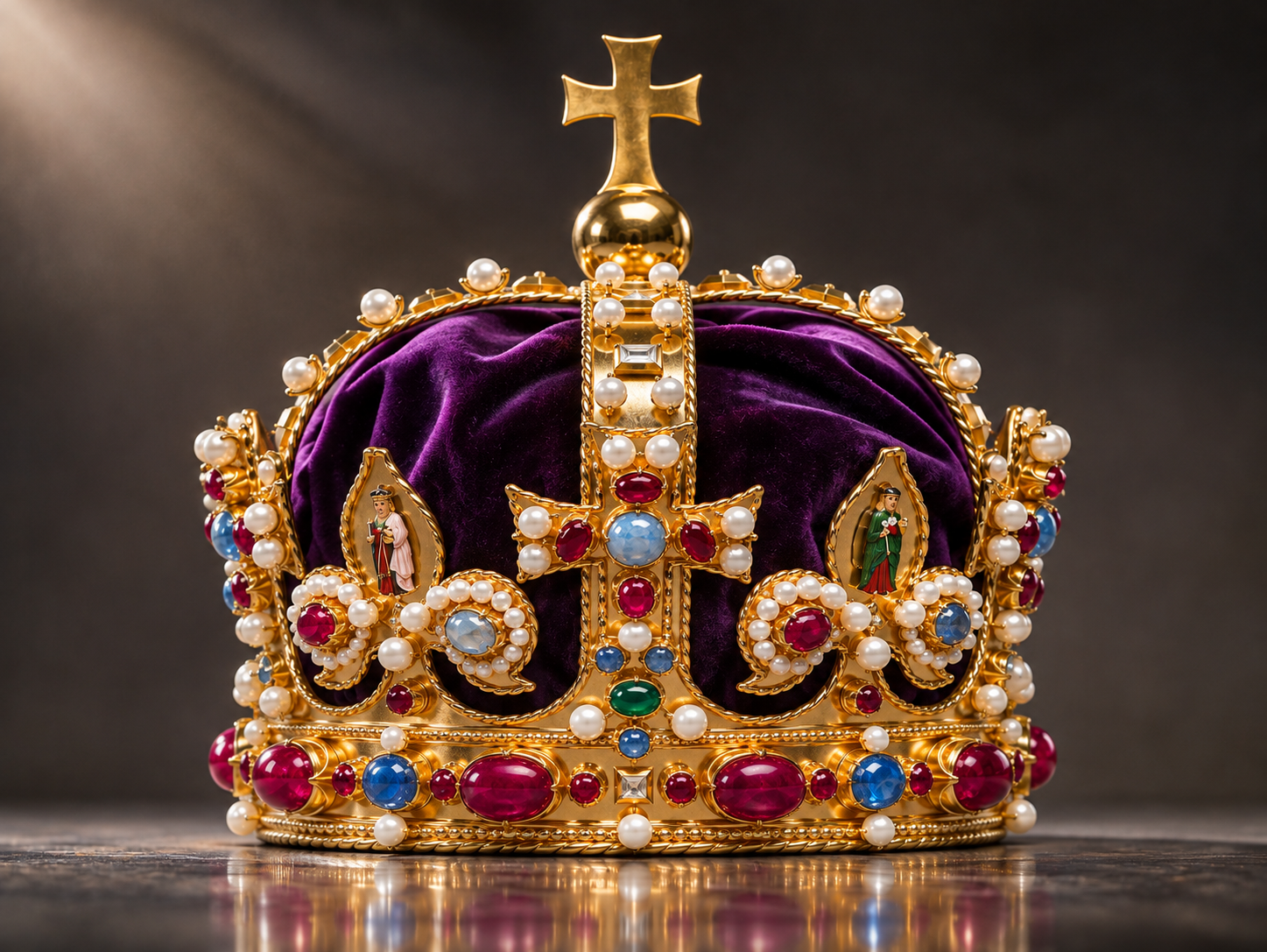
Image information
Click image to magnify
Gold Tudor royal crown with jewels, pearls, small figures and a purple cap.
- Credit
- Stunning Stamps · 2026
- Notes
- Digitally constructed
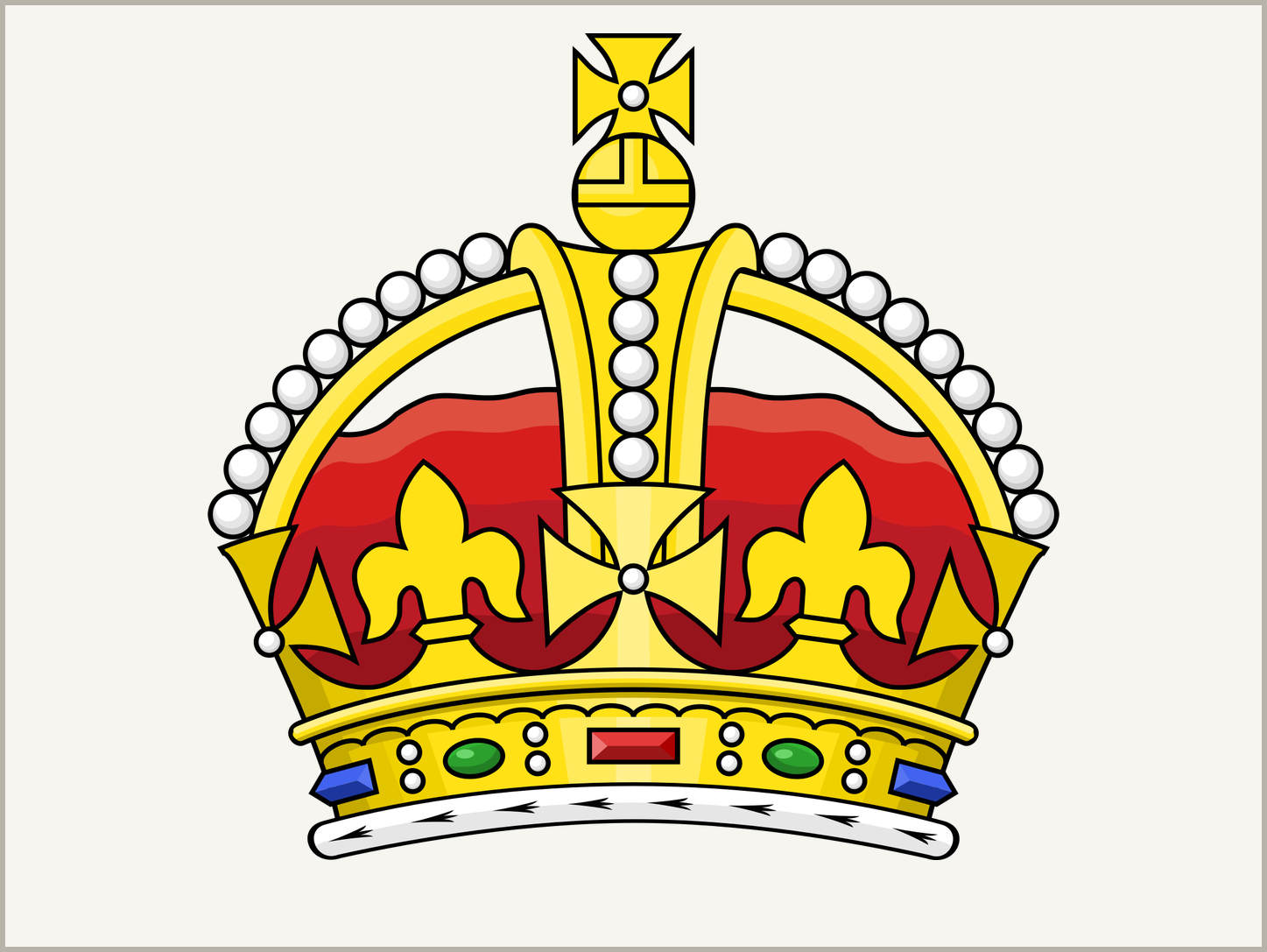
Image information
Click image to magnify
Heraldic Tudor Crown with rounded arches, a cross and orb, red cap, crosses and fleurs-de-lis.
- Credit
- Dgp4004 · Wikimedia Commons · CC0
The people and printer behind this stamp
W. & D. Downey supplied the photograph, J. A. C. Harrison engraved the stamp portrait, and Bertram Mackennal designed the ornamental frame. [12, 13]
This ½d Die 1A, Imperial Crown issue is attributed to Harrison & Sons. Somerset House also printed other Downey Head varieties, normally identifiable on surviving marginal controls by a stop after the control letter. [12, 13, 14, 15, 16]
Sources
- James Mackay, Stamps of the Four Kings: 3. The George V Downey Heads, British Philatelic Bulletin, November 1993, pp.74–75
- Historic England, Embankment River Wall, Stairs and Lamp Standards, Victoria Embankment: list entry 1237712
- Hansard, New Postage Stamps, 15 August 1911, cols.1839–1840: Lord Balcarres on the halfpenny’s dolphins
- Hansard, New Postage Stamps, 15 August 1911, cols.1839–1840, Lord Balcarres
- Alan N. Moorcroft, The King's Head, RPSL display, 25 February 2010
- David Thompson, The George V Downey Heads, illustrated W. & D. Downey photograph; reprinted in Mekeel’s & Stamps, 7 September 2018, p.18
- Hansard, New Postage Stamps, 15 August 1911, cols.1824–1843: public criticism and Herbert Samuel’s response
- Walter Owen, Mix and Match: Downey Head die differences, Stamp News, July 2000
- Ivybridge Heritage: Postage Stamp Paper, Simple and Multiple Cypher manufacture
- Adrian Keppel, The Four Kings, British Philatelic Bulletin 49, February 2012, pp.148–151
- The Postal Museum: British Empire Exhibition stamp history, p.16 — postage stamps and receipt duty
- Buckinghamshire Council: Harrison & Sons printworks
- Royal Philatelic Society London: The King’s Head, 2010
- Walter Owen, Mix and Match: Downey Head die differences, Stamp News, July 2000
- Spink: ½d Downey Head Die 1A, A 11 control strip, auction 26019, lot 1667
- Mike Jackson, Downey Head Somerset House Controls, The Philatelic Review, vol. 3 no. 4, October 1979, pp. 53–55
← Return to the ½d green · Die 1A · Imperial Crown stamp
Last reviewed · Facts checked