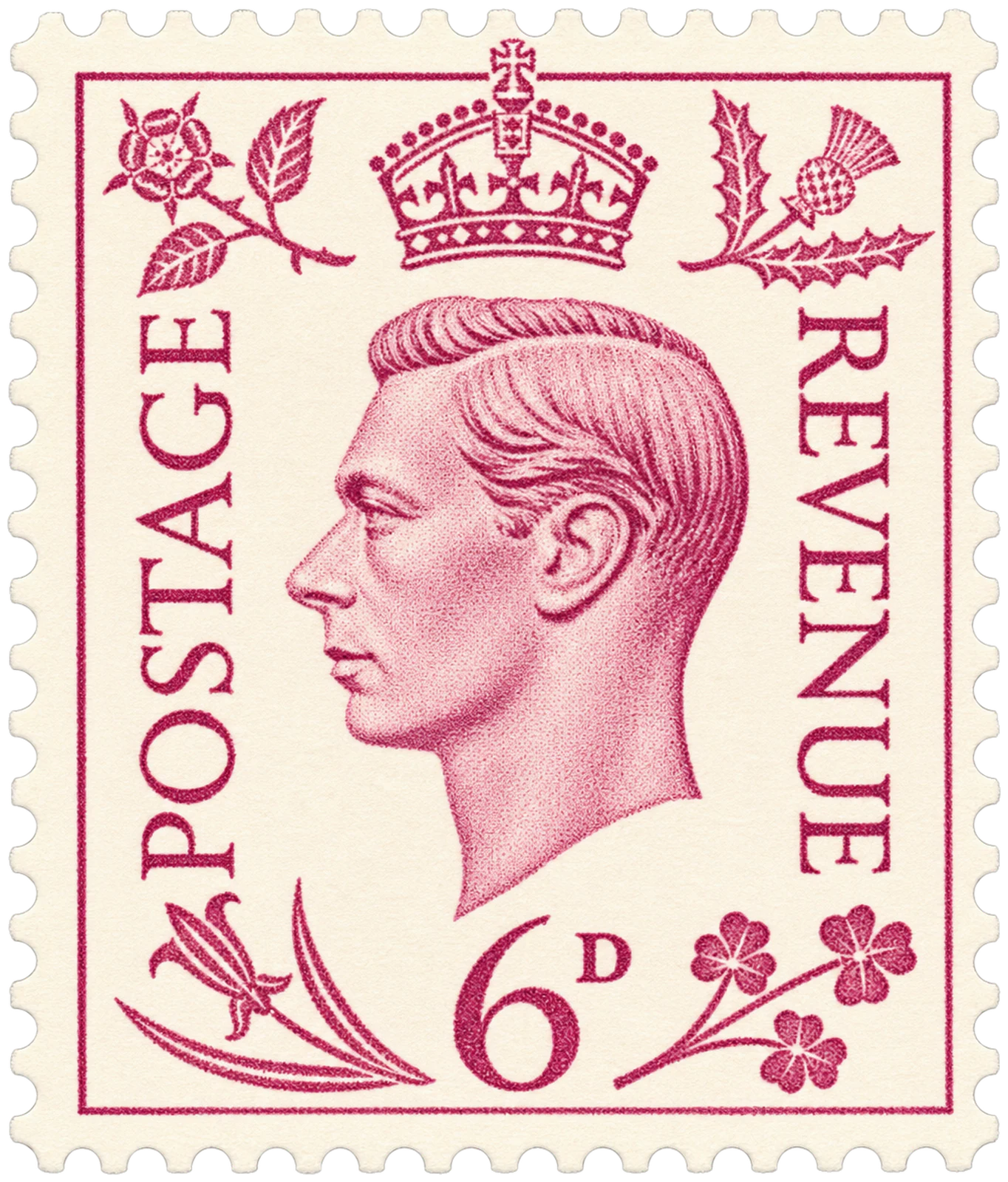
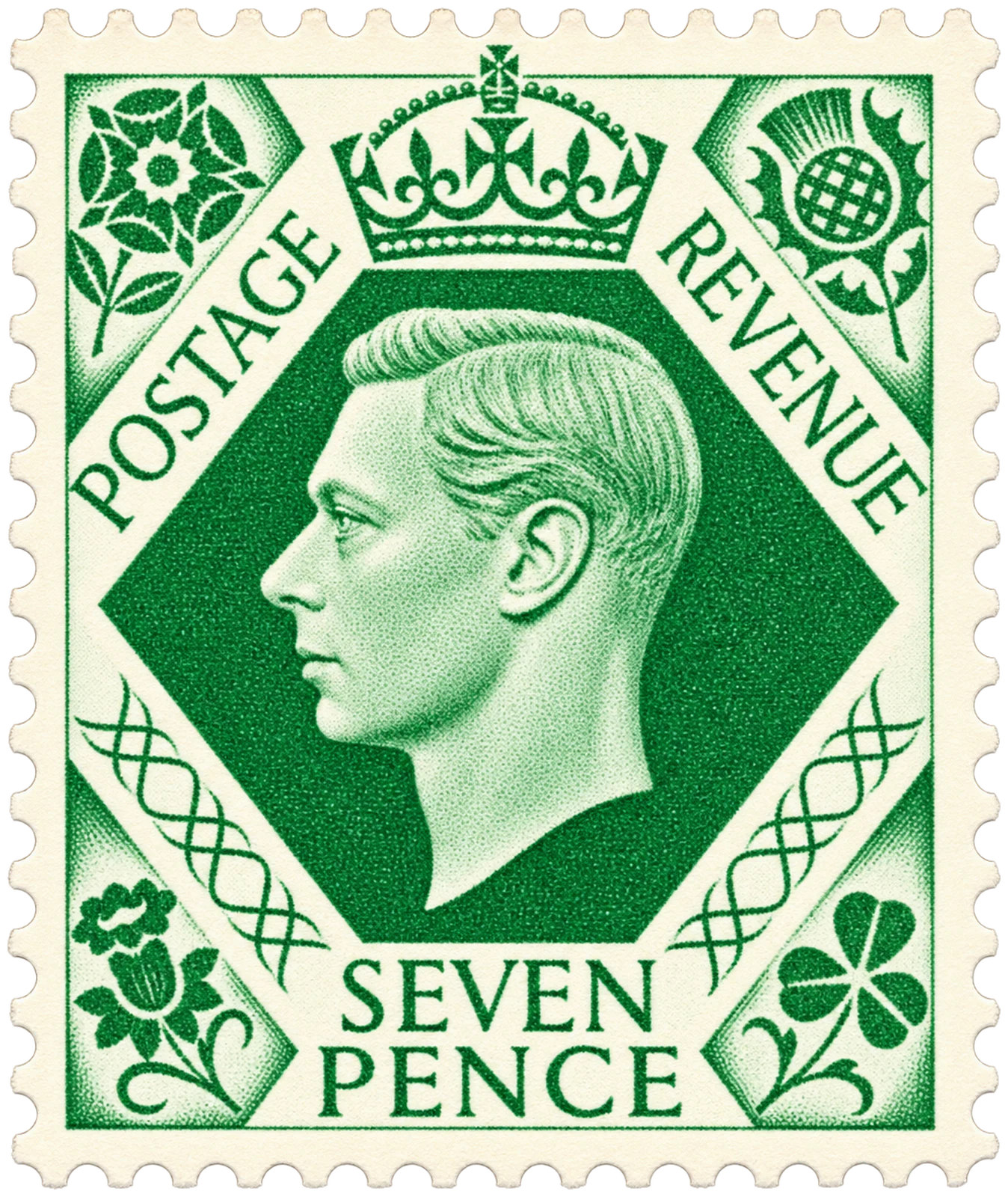
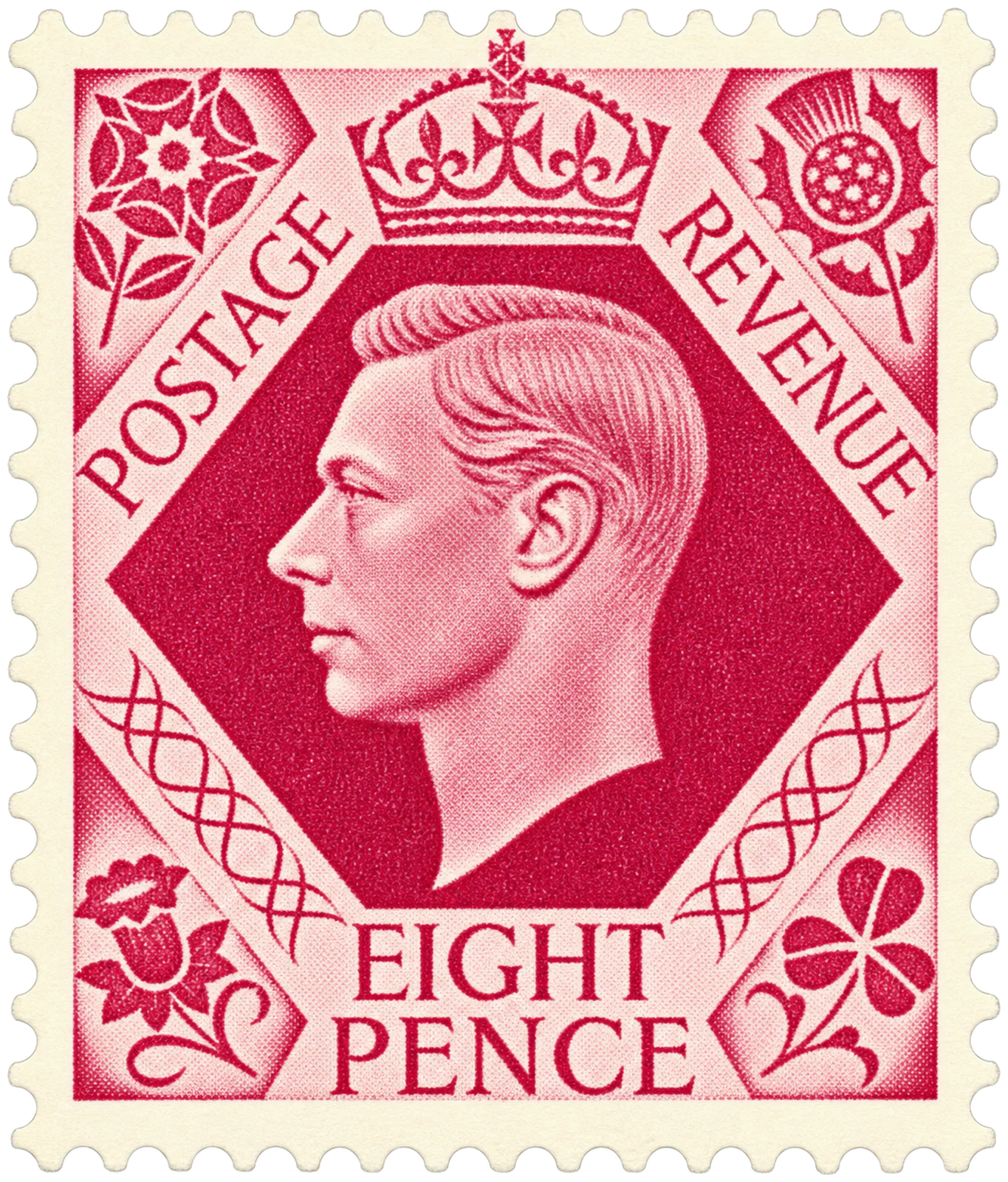
The series jumps from fivepence to ninepence. A sixpenny ran into inking problems, while work on the proposed sevenpenny and eightpenny stopped after George V died. None of those three values was issued in this reign, leaving a complete set of eleven denominations. [1]
Stories
A gap that belongs in the album
A gap that belongs in the album
There is no issued George V photogravure sixpenny to place before this ninepenny. Technical problems with inking delayed that value, while work on proposed sevenpenny and eightpenny stamps ceased after the King’s death. The eleven-value set is complete without them. [1]
The ninepenny and fourpenny reached post offices together on 2 December 1935. The fivepenny, tenpenny and shilling followed in February 1936, after George V’s death. The ninepenny therefore appeared before the lower-valued fivepenny that precedes it in an album arranged by denomination. [11, 1]
George VI’s photogravure sixpenny, sevenpenny and eightpenny eventually appeared in 1939. [1]
These belong to George VI. They do not fill the gaps in the George V photogravure set.
Click a stamp to magnify
A better-looking stamp—but was it a new design?
The Post Office wanted a better-looking everyday stamp. When photogravure was considered, Harrison’s quoted price was £2,500 a year above the cost of retaining letterpress. Appearance mattered enough for the experiments to go ahead. [3]
The new printing won praise, but the familiar design divided opinion. The trade journal Printing commended Harrison’s work while asking for more pictorial stamps: “we now have the process, we want the design”. Better printing and a better design were not necessarily the same achievement. [3]
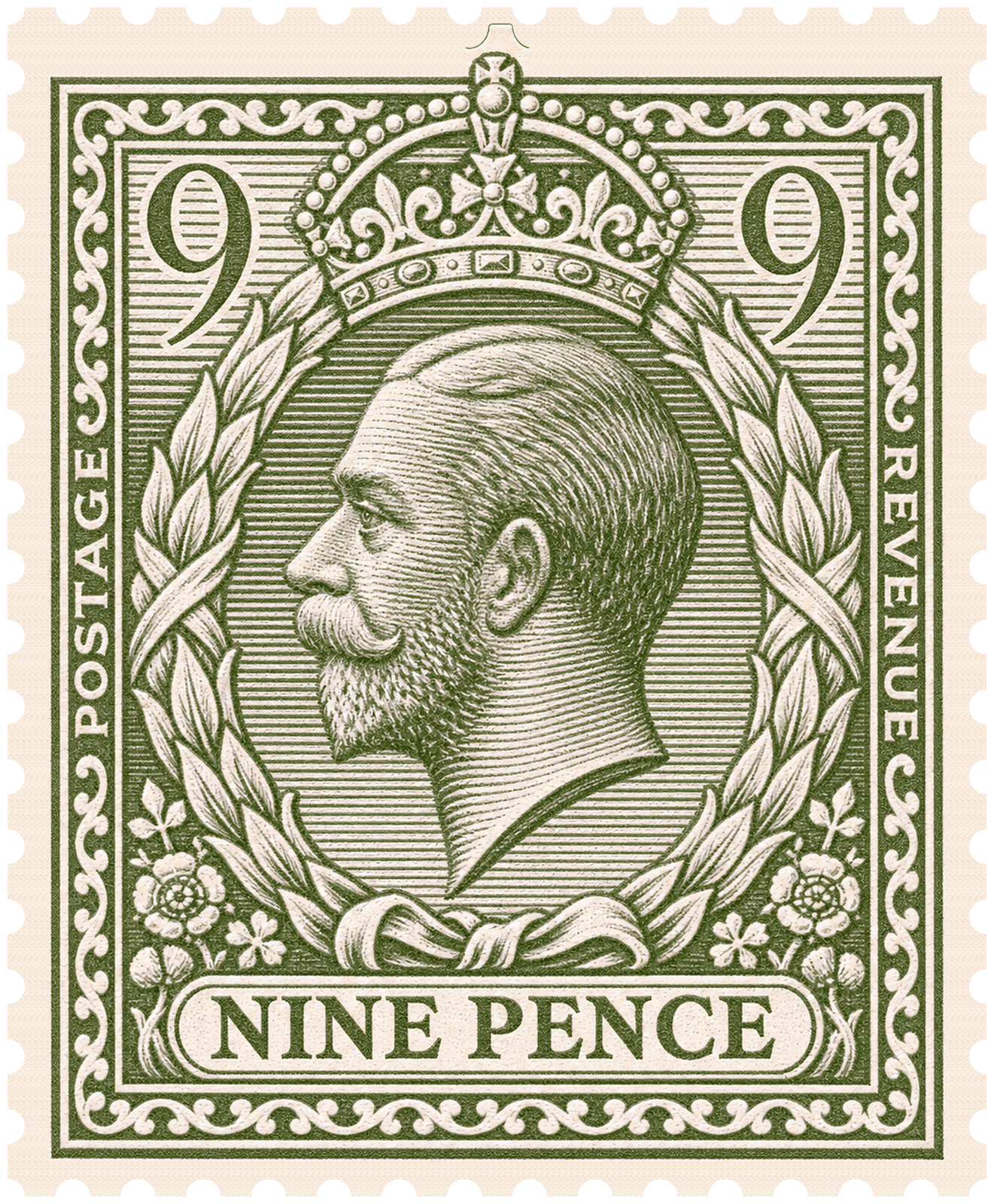
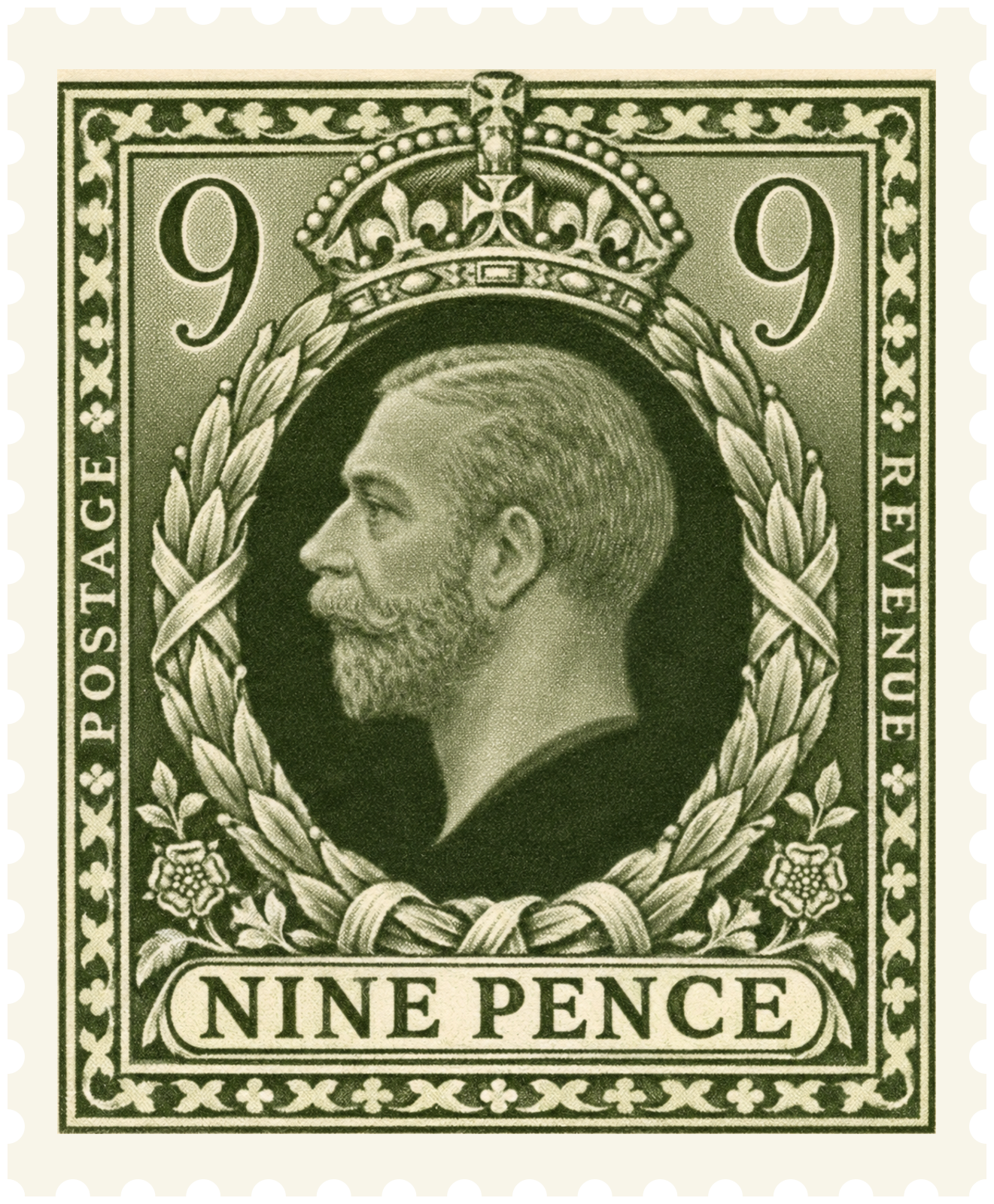
Compare the two versions. The lined background of the letterpress stamp gives way to a darker, more continuous oval, while the family resemblance remains in the portrait and ornament. The new process changed how an established design looked. [12]
Earlier letterpress designPhotogravure adaptation
A picture built from tiny cells
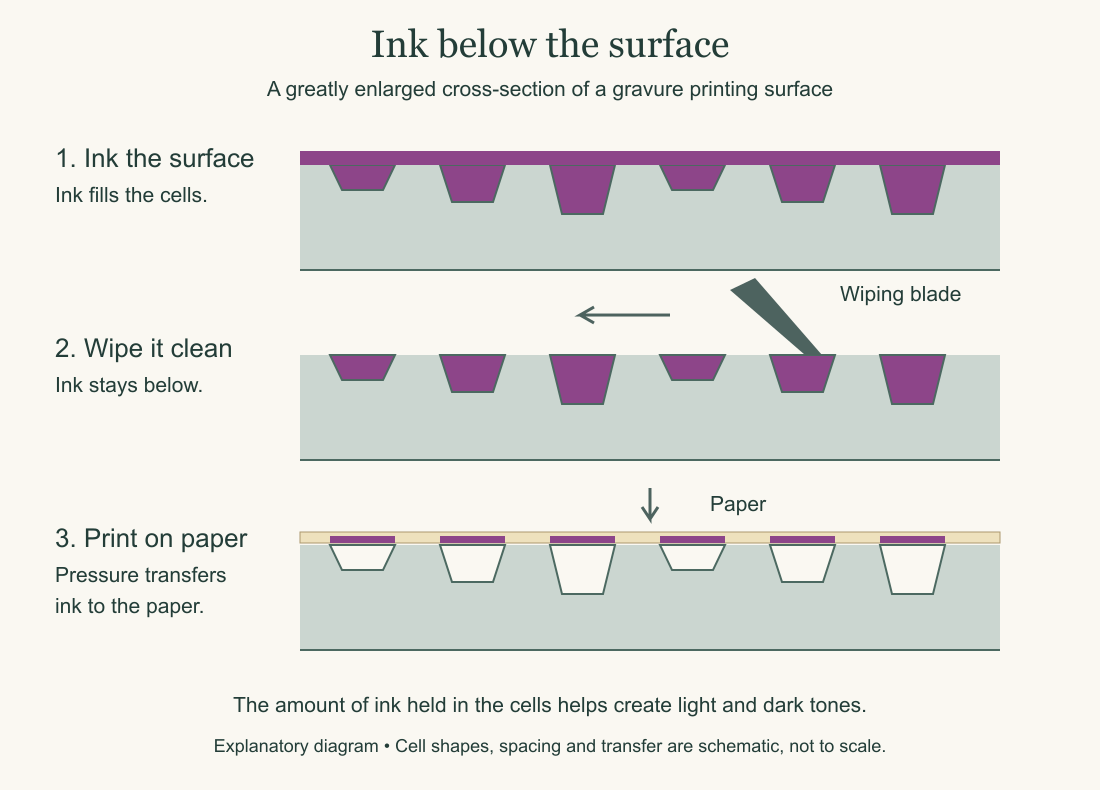
Ink remains in recessed cells after the surface is wiped clean.Image information
Click image to magnify
Three-stage cross-section: ink fills recessed cells, a wiping blade clears the surface, then paper receives the ink under pressure.
Credit
Stunning Stamps · 2026
Notes
Digitally constructed explanatory diagram. Cell shapes, spacing and ink transfer are schematic, not to scale. This does not reproduce the microscopic texture of an original stamp.
A photogravure stamp is built from tiny pockets of ink. A photographic process prepares the image on a printing cylinder, whose microscopic recessed cells hold the ink. A blade wipes the cylinder’s surface clean, leaving ink in the cells to transfer to the paper. [3]
The earlier letterpress stamps were printed from raised surfaces. On original photogravure stamps, magnification can reveal the fine pattern of cells that held the ink. Their size and depth controlled how much ink reached the paper, producing the different tones. [3]
A new process needed a new factory
Harrison & Sons acquired premises at High Wycombe, installed equipment and trained staff for the new production. Trials and preparations took longer than planned. The Post Office still needed a steady supply of everyday stamps while that work continued, so the existing letterpress issues remained in production. The first photogravure definitive, the penny-halfpenny, finally appeared in August 1934. [3, 2]
The other denominations followed over the next eighteen months. This gradual release explains why “the 1934 issue” includes stamps first sold in 1935 and 1936. The final fivepenny, tenpenny and shilling reached post offices after George V’s death, completing the issued range with eleven values. [3, 2]
Why do some stories appear on several pages?
Every page is written to make sense on its own. Visitors often arrive directly at a particular stamp or subject, without having explored the rest of the site.
Some stories are relevant to several stamps, so they are repeated where they help explain what you're looking at. For those exploring a series, the details specific to each stamp generally come first, with the more familiar stories further down the page.
This way, you can explore the site in any order without missing interesting background.
Design
9d deep olive-green · Small design, 1935Stunning StampsOptions
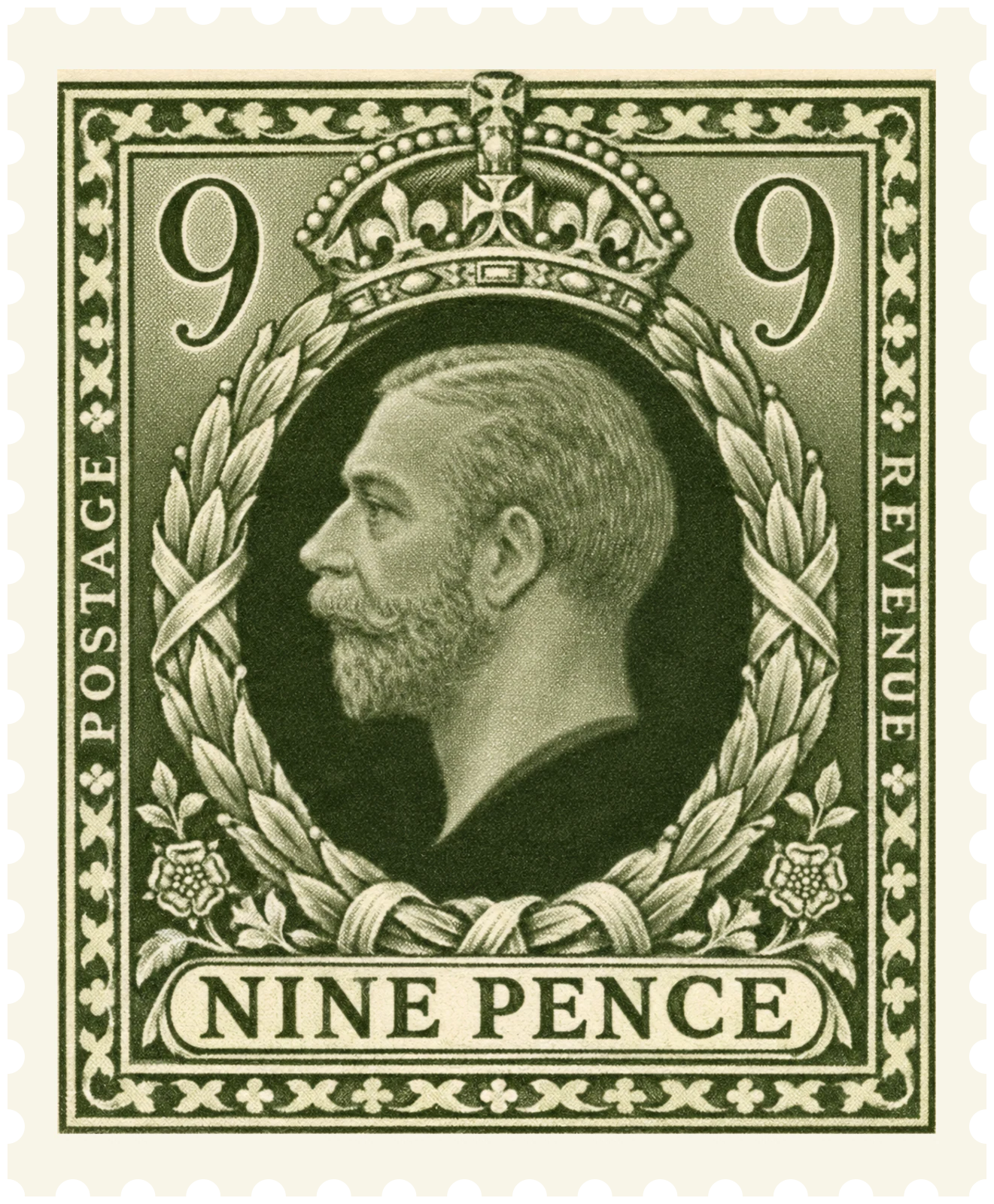
The series jumps from fivepence to this ninepence. Printing difficulties and the King’s death left three proposed values unissued. The wreath has its own story of rejection and reuse, while green continued an earlier practical colour choice. [1, 13]
An issue date records when a stamp became available for use. A design can remain in production for years, with changes of printer, colour, paper or perforation along the way.
“Denomination introduced” refers to the first appearance of that value in the issue family. The particular printing or design format illustrated may be later. Read the date with the rest of the description.
The printer manufactured the stamps. The designer planned their appearance, and the engraver prepared the original image for reproduction. These are separate jobs, even when the same person or firm undertook more than one.
George V designs passed between firms and the government’s stamp-printing department. A portrait or colour alone may not identify the printing; paper, marginal marks and details of the impression can supply further evidence.
The Royal Cypher low values were printed from raised surfaces by typography. The Seahorses used recess printing, with ink held in engraved lines. The later photogravure issue used a cylinder carrying a fine pattern of ink-bearing cells.
The process describes how ink reached the paper. It is separate from the name of the printer and the way the original artwork was designed.
A shade is a variation within a stamp’s colour. Some variations receive their own catalogue numbers even though the design and denomination stay the same.
Compare known examples under consistent lighting. Fading can change a stamp’s appearance, and photographs or screens can alter how colours look. A catalogue colour name helps describe a shade; it is not a colour test by itself.
A stamp catalogue gives each listed issue a reference number. SG means Stanley Gibbons, the publisher of the catalogue used here. These numbers help collectors refer to the same issue; they are not serial numbers printed on individual stamps.
A range of numbers groups related entries. Colour, paper or perforation differences may account for separate listings within that range.
Perforations are the punched holes that let stamps separate. The gauge describes their spacing over 2 centimetres, not the total number of holes along an edge.
Two numbers give the horizontal gauge first, then the vertical: top and bottom, followed by the two sides. A higher number means closer spacing. Match an actual stamp with a perforation gauge rather than measuring the image on a screen.
Illustrative spacing, not a measuring gauge. The number describes spacing over 2 cm, not the total holes along an edge.Image information
Horizontal gauge 15 and vertical gauge 14: the same 20 mm distance is used in each direction. Enlarged spacing diagram, not a ruler.
Dimensions are given as width × height. Here the listed figures describe the overall stamp format. The printed design sits inside it and has a separate, smaller measurement.
These are nominal reference sizes. They are not measurements of the illustration on your screen, or a claim that every separated example has exactly the same outer edges.
Nominal reference format, enlarged. The inner rectangle explains the separate printed area; its size is illustrative.Image information
Nominal overall format: 20.32 millimetres wide and 24.13 millimetres high. The printed design is a separate, smaller measurement.
Credit
Stunning Stamps · 2026
An issue date records when a stamp became available for use. A design can remain in production for years, with changes of printer, colour, paper or perforation along the way.
“Denomination introduced” refers to the first appearance of that value in the issue family. The particular printing or design format illustrated may be later. Read the date with the rest of the description.
On this stamp
2 December 1935 records the first photogravure issue of the 9d. The illustration represents the small design. The design-format date and the denomination’s first issue are separate facts.
The denomination is the stamp’s face value: the amount of postage it represents. Its price to a collector can be quite different.
In Britain’s old currency, 12 pence made one shilling and 20 shillings made one pound: 240 pence altogether. The abbreviations were d for pence, s for shillings and £ for pounds. The d comes from the Latin denarius. A halfpenny, written ½d, was half an old penny.
The early photogravure designs were reduced in size to leave more room for accurate perforating. The overall stamp format stayed the same. “Large”, “intermediate” and “small” therefore describe the printed image.
The 1d and 1½d occur in all three sizes. The ½d and 2d have intermediate and small designs. The remaining issued values use the small design. All the photogravure stamps illustrated in this archive represent the small format.
The printed design became smaller, leaving more space for perforations. Diagram simplified; the available formats vary by denomination.Image information
Three photogravure design widths inside an unchanged overall stamp format: large 18.7 mm, intermediate 18.4 mm, small 17.9 mm. Not every denomination has all three.
Credit
Stunning Stamps · 2026
On this stamp
Small format, 1935 is the form illustrated here. “Small” refers to the printed design, with more surrounding room for perforations; the nominal overall stamp format did not shrink.
Harrison & Sons was a security-printing firm that supplied stamps as well as passports and other documents. It printed British letterpress stamps before introducing photogravure for the George V definitives in 1934.
On this stamp
Harrison & Sons printed this 9d by photogravure. The firm’s photogravure production belongs to the 1934–1936 series.
Photogravure carries ink in tiny recessed cells on a printing cylinder. A blade removes surplus ink from the surface before the cells transfer their ink to the paper. The cell pattern allows the image to reproduce different tones.
Harrison introduced the process for British definitive postage stamps in 1934. On original stamps, the fine grid visible under magnification can help distinguish photogravure from the earlier letterpress printing.
Simplified cell pattern, not a scan of the stamp. Photogravure uses tiny recesses in a printing cylinder to carry the ink.Image information
Enlarged plan view of a gravure cell grid. Separate recessed cells carry ink; varying the ink they hold creates tone.
Credit
Stunning Stamps · 2026
On this stamp
This 9d uses a cylinder with recessed cells. It is part of the small-format photogravure series, rather than the earlier Royal Cypher letterpress issue.
A watermark is formed within the paper during manufacture. Differences in the paper let the pattern show when light passes through it. It is not a design printed on the back.
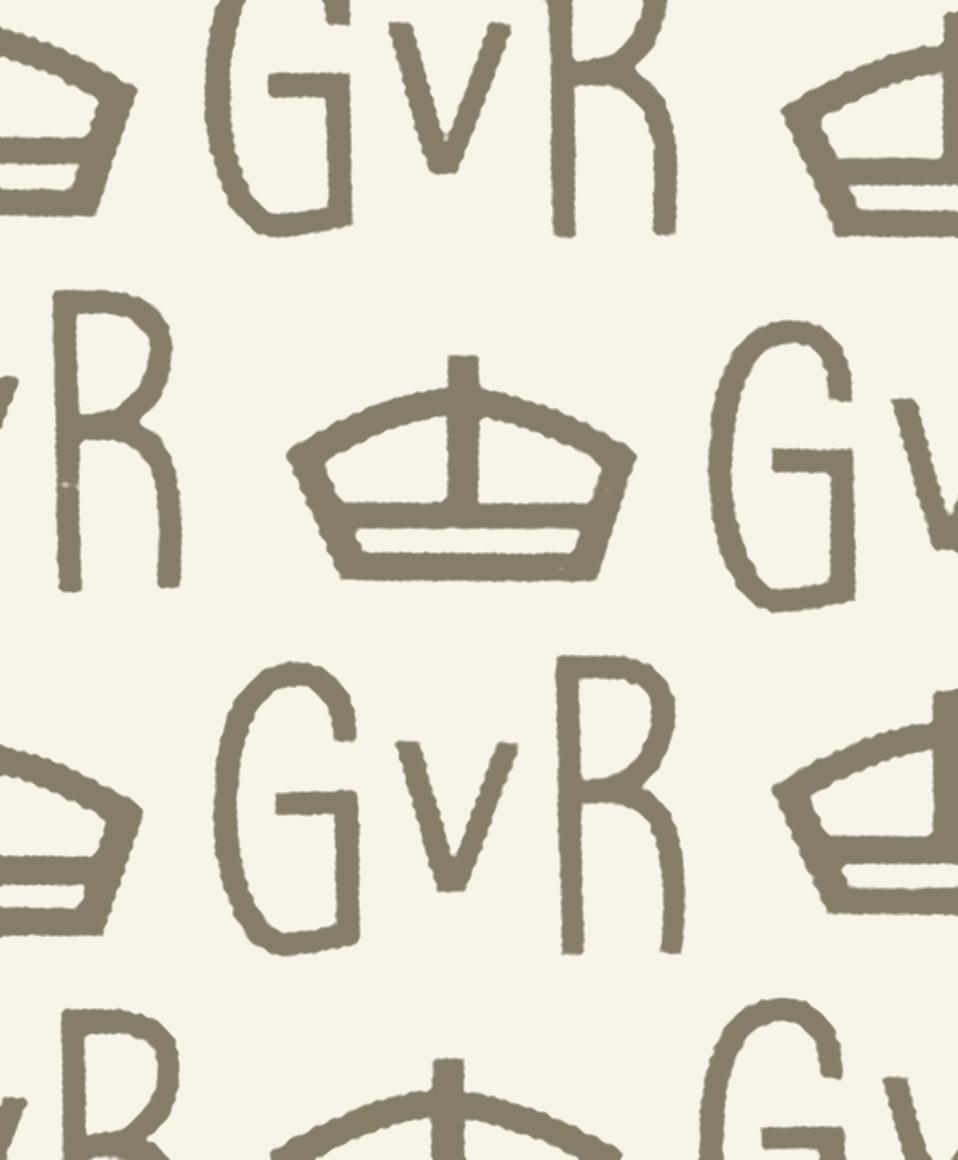
A royal cypher is a monogram identifying the monarch. George V’s cyphers use GvR. Simple Cypher (often called Royal Cypher) has small script cyphers in vertical strips; Multiple Cypher has an all-over arrangement. Single Cypher is the larger individual motif used for Seahorses. Block Cypher uses plain block lettering. These names are not interchangeable.
The illustration is shown from the front of the stamp. From the back, the letters of a normal watermark appear mirrored. That change of viewing direction is not itself a reversed-watermark variety.
Block Cypher · front view · upright. Repeating crowns and plain block GvR lettering, used for the later letterpress and photogravure definitives. Enlarged; not a scale or stamp-position template. From the back, the cypher lettering appears mirrored.Image information
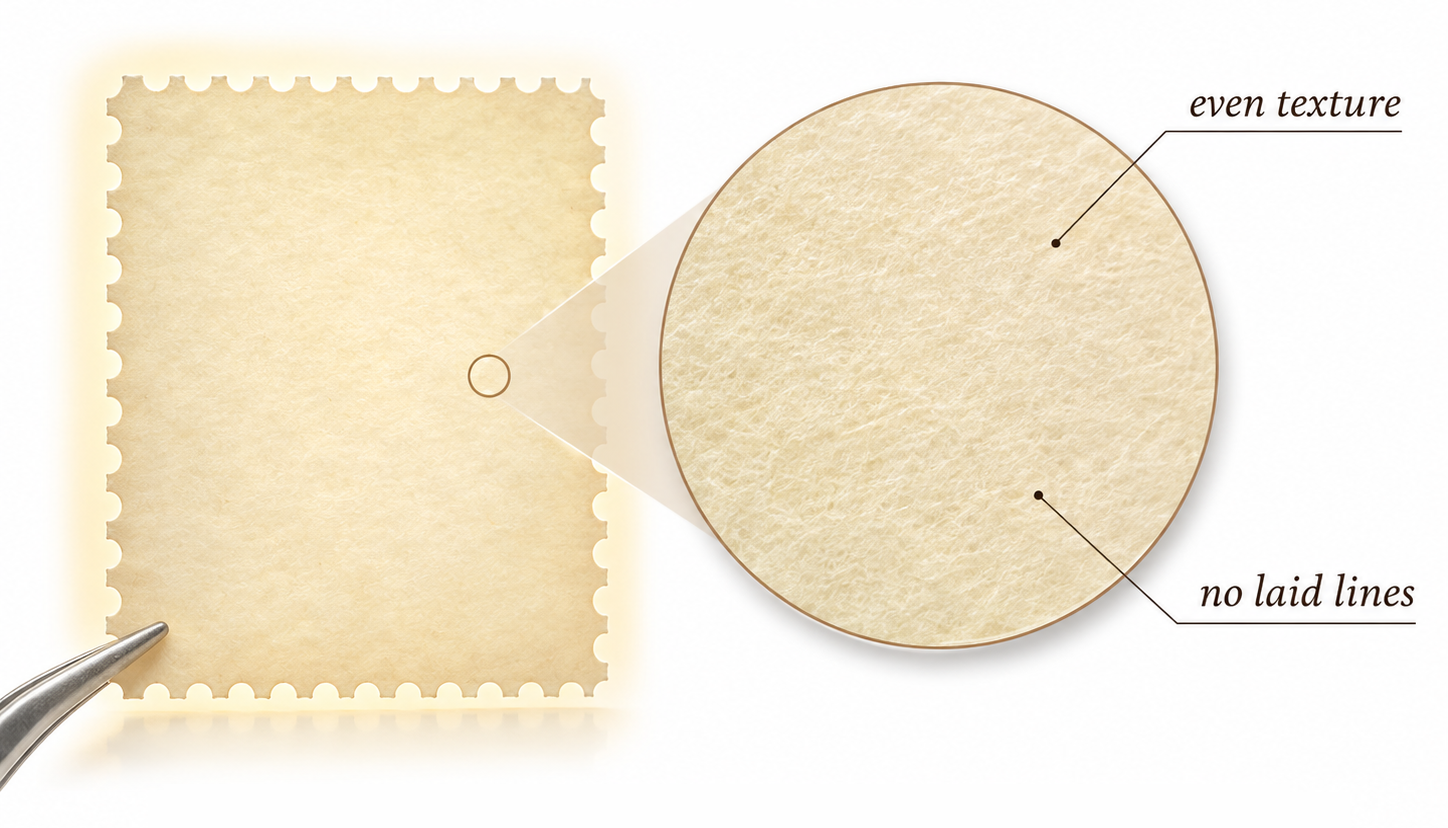
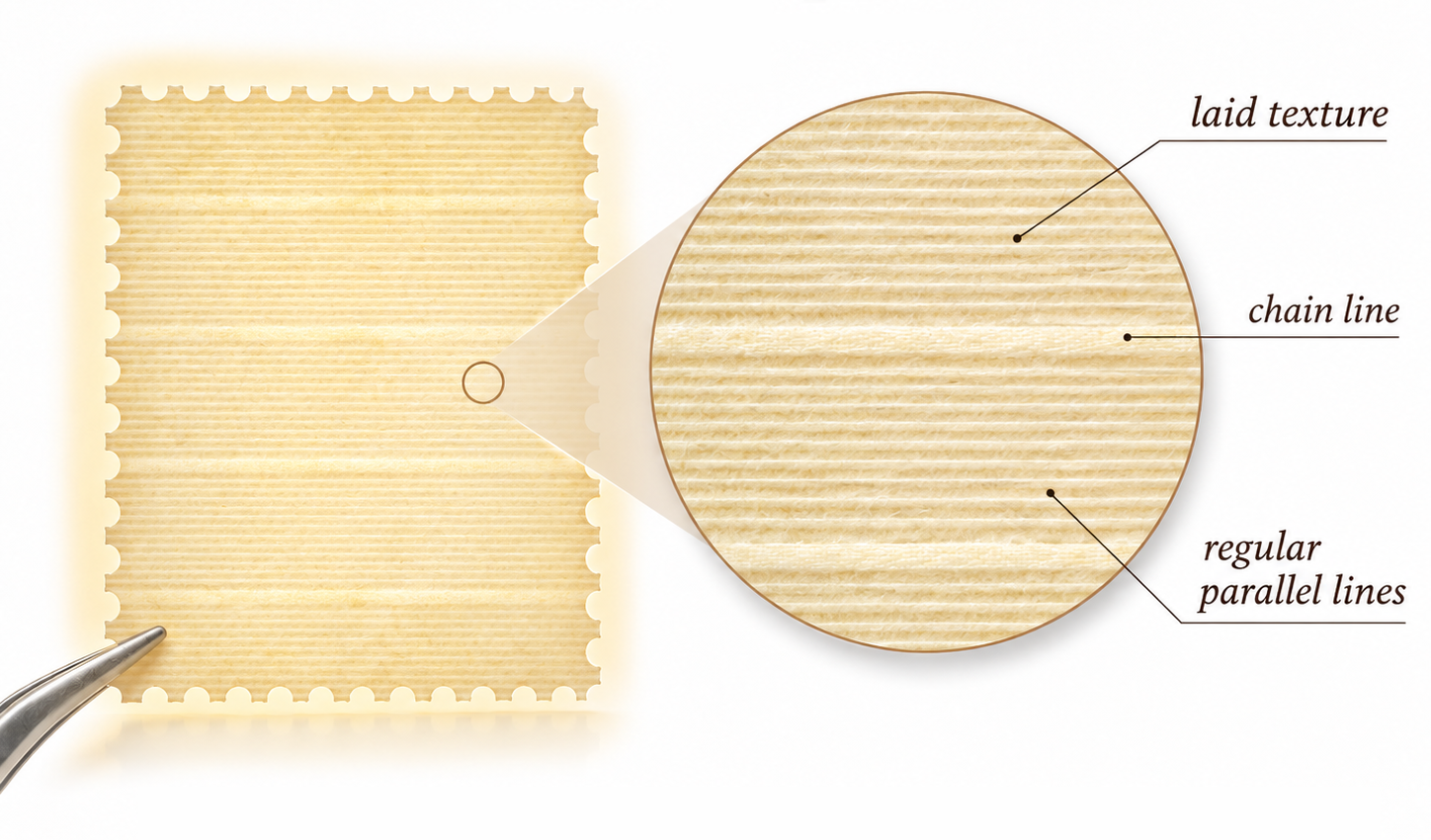
Paper is the material carrying the stamp’s design. Its structure, surface, colour and watermark are separate characteristics. Wove paper has a fairly even structure, unlike laid paper with its regular lines.
A paper description can distinguish stamps with otherwise similar designs. A coloured sheet supplies colour even in areas left untouched by the printing ink.
Wove paper: even texture without laid lines.Image information
Click image to magnify
Diagram of wove paper with a magnified inset showing an even texture without laid lines.
Credit
Stunning Stamps · 2026
Notes
Digitally constructed
Laid paper: regular parallel lines, shown for comparison.Image information
Click image to magnify
Diagram of laid paper with a magnified inset showing regular parallel lines.
A watermark is formed within the paper during manufacture. Differences in the paper let the pattern show when light passes through it. It is not a design printed on the back.
A royal cypher is a monogram identifying the monarch. George V’s cyphers use GvR. Simple Cypher (often called Royal Cypher) has small script cyphers in vertical strips; Multiple Cypher has an all-over arrangement. Single Cypher is the larger individual motif used for Seahorses. Block Cypher uses plain block lettering. These names are not interchangeable.
The illustration is shown from the front of the stamp. From the back, the letters of a normal watermark appear mirrored. That change of viewing direction is not itself a reversed-watermark variety.
Block Cypher · front view · upright. Repeating crowns and plain block GvR lettering, used for the later letterpress and photogravure definitives. Enlarged; not a scale or stamp-position template. From the back, the cypher lettering appears mirrored.Image information
Block Cypher watermark, front view, upright
Credit
Stunning Stamps · 2026
Notes
Digitally reconstructed
On this stamp
Block Cypher uses plain block letters in a repeating crown-and-GvR pattern. It differs from the script Royal Cypher paper of the earlier low values.
Perforations are the punched holes that let stamps separate. The gauge describes their spacing over 2 centimetres, not the total number of holes along an edge.
Two numbers give the horizontal gauge first, then the vertical: top and bottom, followed by the two sides. A higher number means closer spacing. Match an actual stamp with a perforation gauge rather than measuring the image on a screen.
Illustrative spacing, not a measuring gauge. The number describes spacing over 2 cm, not the total holes along an edge.Image information
Horizontal gauge 15 and vertical gauge 14: the same 20 mm distance is used in each direction. Enlarged spacing diagram, not a ruler.
Credit
Stunning Stamps · 2026
On this stamp
15 × 14: gauge 15 across the top and bottom, gauge 14 down the sides. Check both directions when matching a catalogue listing.
A shade is a variation within a stamp’s colour. Some variations receive their own catalogue numbers even though the design and denomination stay the same.
Compare known examples under consistent lighting. Fading can change a stamp’s appearance, and photographs or screens can alter how colours look. A catalogue colour name helps describe a shade; it is not a colour test by itself.
On this stamp
Deep olive-green is the colour description used for this 9d by Harrison & Sons. It identifies the represented issue; more specialised shade distinctions need comparison with known examples.
Dimensions are given as width × height. Here the listed figures describe the overall stamp format. The printed design sits inside it and has a separate, smaller measurement.
These are nominal reference sizes. They are not measurements of the illustration on your screen, or a claim that every separated example has exactly the same outer edges.
Nominal reference format, enlarged. The inner rectangle explains the separate printed area; its size is illustrative.Image information
Nominal overall format: 20.32 millimetres wide and 24.13 millimetres high. The printed design is a separate, smaller measurement.
Credit
Stunning Stamps · 2026
On this stamp
20.32 × 24.13 mm converts the documented overall format of 0.8 × 0.95 inches. These figures do not describe the small printed design: its width is about 17.9 mm. The decimal precision comes from the conversion.
The early photogravure designs were reduced in size to leave more room for accurate perforating. The overall stamp format stayed the same. “Large”, “intermediate” and “small” therefore describe the printed image.
The 1d and 1½d occur in all three sizes. The ½d and 2d have intermediate and small designs. The remaining issued values use the small design. All the photogravure stamps illustrated in this archive represent the small format.
The printed design became smaller, leaving more space for perforations. Diagram simplified; the available formats vary by denomination.Image information
Three photogravure design widths inside an unchanged overall stamp format: large 18.7 mm, intermediate 18.4 mm, small 17.9 mm. Not every denomination has all three.
Credit
Stunning Stamps · 2026
On this stamp
Small only. This 9d was issued only with the small design.
A stamp catalogue gives each listed issue a reference number. SG means Stanley Gibbons, the publisher of the catalogue used here. These numbers help collectors refer to the same issue; they are not serial numbers printed on individual stamps.
A range of numbers groups related entries. Colour, paper or perforation differences may account for separate listings within that range.
On this stamp
SG 447 identifies the photogravure 9d, issued in the small design only. Specialised descriptions may distinguish shades and production varieties.
An issue family need not contain every denomination, and its values need not appear together. New requirements could bring additions, replacement colours or the end of production for a particular value.
The end of printing does not by itself mean that existing stocks immediately ceased to be sold or used. Keep production history separate from the date on a used example.
A deliberate change of colour can mark a new stage in an issue. It is different from a small shade variation within the same colour, or a change caused by fading.
Contrast mattered in everyday use. Colours helped people recognise denominations, and a cancellation needed to remain visible against the printed design.
An issue family need not contain every denomination, and its values need not appear together. New requirements could bring additions, replacement colours or the end of production for a particular value.
The end of printing does not by itself mean that existing stocks immediately ceased to be sold or used. Keep production history separate from the date on a used example.
On this stamp
The issued George V photogravure range has no 6d, 7d or 8d. Its values were introduced separately rather than as a complete consecutive run.
A stamp can combine work by several people: a portrait artist, frame designer, photographer or engraver. Their roles are identified separately here.
Bertram Mackennal was an Australian-born sculptor whose royal portraits appeared on coins, medals and stamps. He also designed stamp frames and the Seahorse composition, joining portrait modelling to ornamental design.
George William Eve was an etcher and heraldic artist, known for bookplates and decorative lettering. His work on George V stamps included the Pillar and Wreath frames and lettering for the Seahorse value tablets.
On this stamp
This 9d deep olive-green stamp continues Mackennal’s royal profile, within a frame derived from George W. Eve’s design. Harrison & Sons adapted the established design for photogravure; this was not a new portrait commission. The 9d deep olive-green stamp uses a photogravure adaptation of Eve’s Wreath frame, with foliage tied by ribbons.