
Understanding the stamp details
1½d pale red-brown · Harrison & Sons
Pounds, shillings and pence
Before decimalisation, a pound contained twenty shillings and a shilling twelve pence. The letters s and d stand for shillings and old pence.
Pounds, shillings and pence
Before decimalisation, a pound contained twenty shillings and a shilling twelve pence. The letters s and d stand for shillings and old pence.
On this stamp
Three-halfpence, written 1½d, meant one old penny and a half. Eight stamps of this value made one shilling, or twelve old pence.
First issued
The first-issue date records when the stamp became available for use. Read it alongside the description: an entry may describe a new design, a replacement colour or a change of printer. A stamp can remain in production long after that first date.
A replacement colour
A deliberate change of colour can mark a new stage in an issue. It is different from a small shade variation within the same colour, or a change caused by fading.
Contrast mattered in everyday use. Colours helped people recognise denominations, and a cancellation needed to remain visible against the printed design.
Stamp shades
A shade is a variation within a stamp’s colour. Some variations receive their own catalogue numbers even though the design and denomination stay the same.
Compare known examples under consistent lighting. Fading can change a stamp’s appearance, and photographs or screens can alter how colours look. A catalogue colour name helps describe a shade; it is not a colour test by itself.
Catalogue references
A stamp catalogue gives each listed issue a reference number. SG means Stanley Gibbons, the publisher of the catalogue used here. These numbers help collectors refer to the same issue; they are not serial numbers printed on individual stamps.
A range of numbers groups related entries. Colour, paper or perforation differences may account for separate listings within that range.
Perforation
Perforations are the rows of punched holes that let neighbouring stamps separate. Their gauge describes the spacing over a standard distance of 2 centimetres, rather than the total number of holes along a stamp’s edge.
A perforation gauge has rows of dots or lines at known spacings. Match an edge against them: the marks should line up all the way along. A single number applies to both directions; two numbers give the horizontal gauge first, then the vertical.
Image information
Enlarged perforation spacing: fourteen equal intervals between hole centres span 20 millimetres. This is a schematic, not a ruler.
- Credit
- Stunning Stamps · 2026
The printer
The printer is the firm or government department that manufactured the stamp. A design can pass from one printer to another. Paper, ink, perforations and small differences in the impression help collectors distinguish their work.
Photogravure
Photogravure carries ink in tiny recessed cells on a printing cylinder. A blade removes surplus ink from the surface before the cells transfer their ink to the paper. The cell pattern allows the image to reproduce different tones.
Harrison & Sons introduced the process for British definitive postage stamps in 1934. On original stamps, the fine grid visible under magnification can help distinguish photogravure from the earlier letterpress printing.
Image information
Enlarged plan view of a gravure cell grid. Separate recessed cells carry ink; varying the ink they hold creates tone.
- Credit
- Stunning Stamps · 2026
Paper and the printed image
Paper is the material carrying the stamp’s design. Its structure, surface, colour and watermark are separate characteristics. Wove paper has a fairly even structure, unlike laid paper with its regular lines.
A paper description can distinguish stamps with otherwise similar designs. A coloured sheet supplies colour even in areas left untouched by the printing ink.
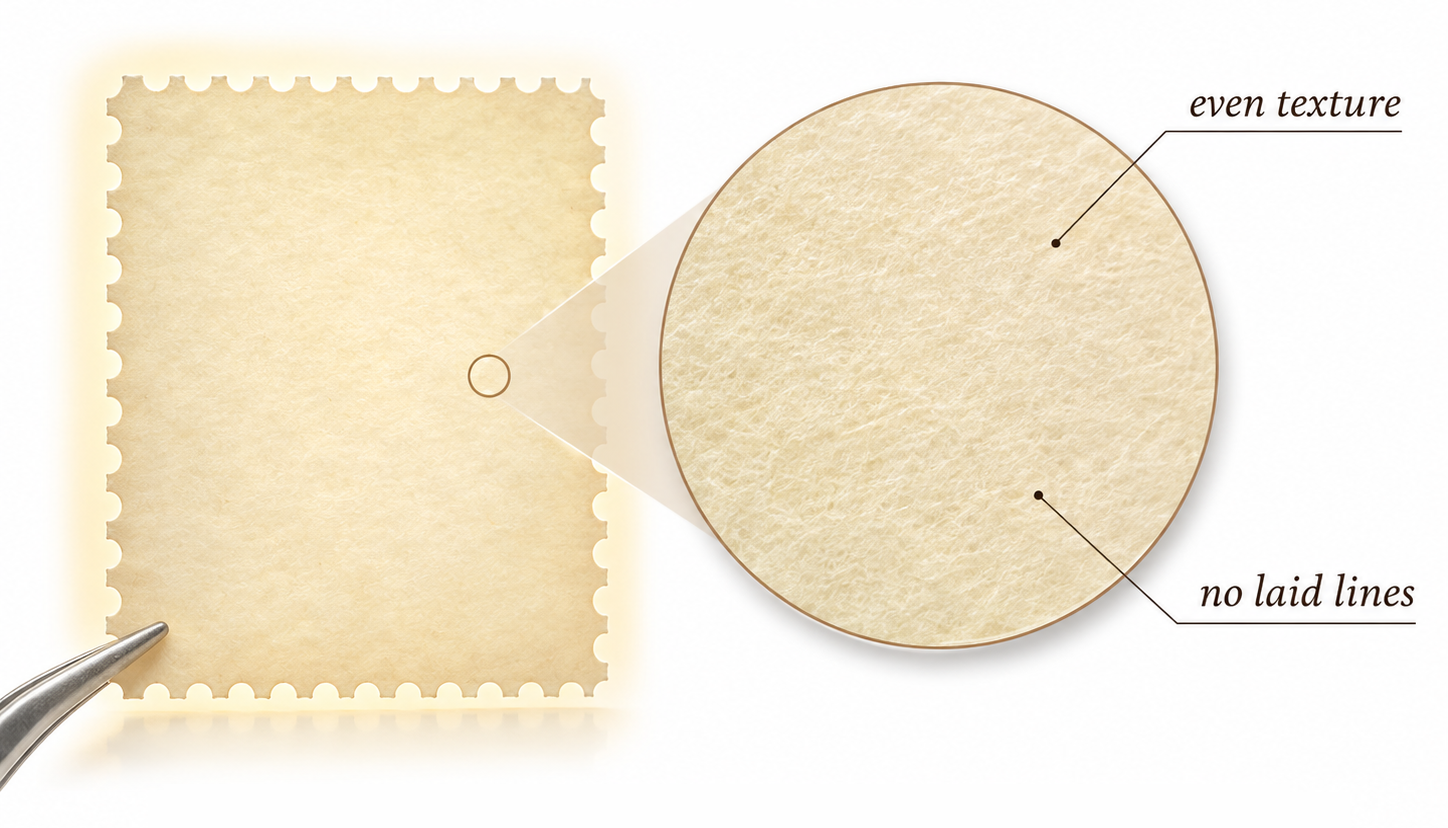
Image information
Click image to magnify
Diagram of wove paper with a magnified inset showing an even texture without laid lines.
- Credit
- Stunning Stamps · 2026
- Notes
- Digitally constructed
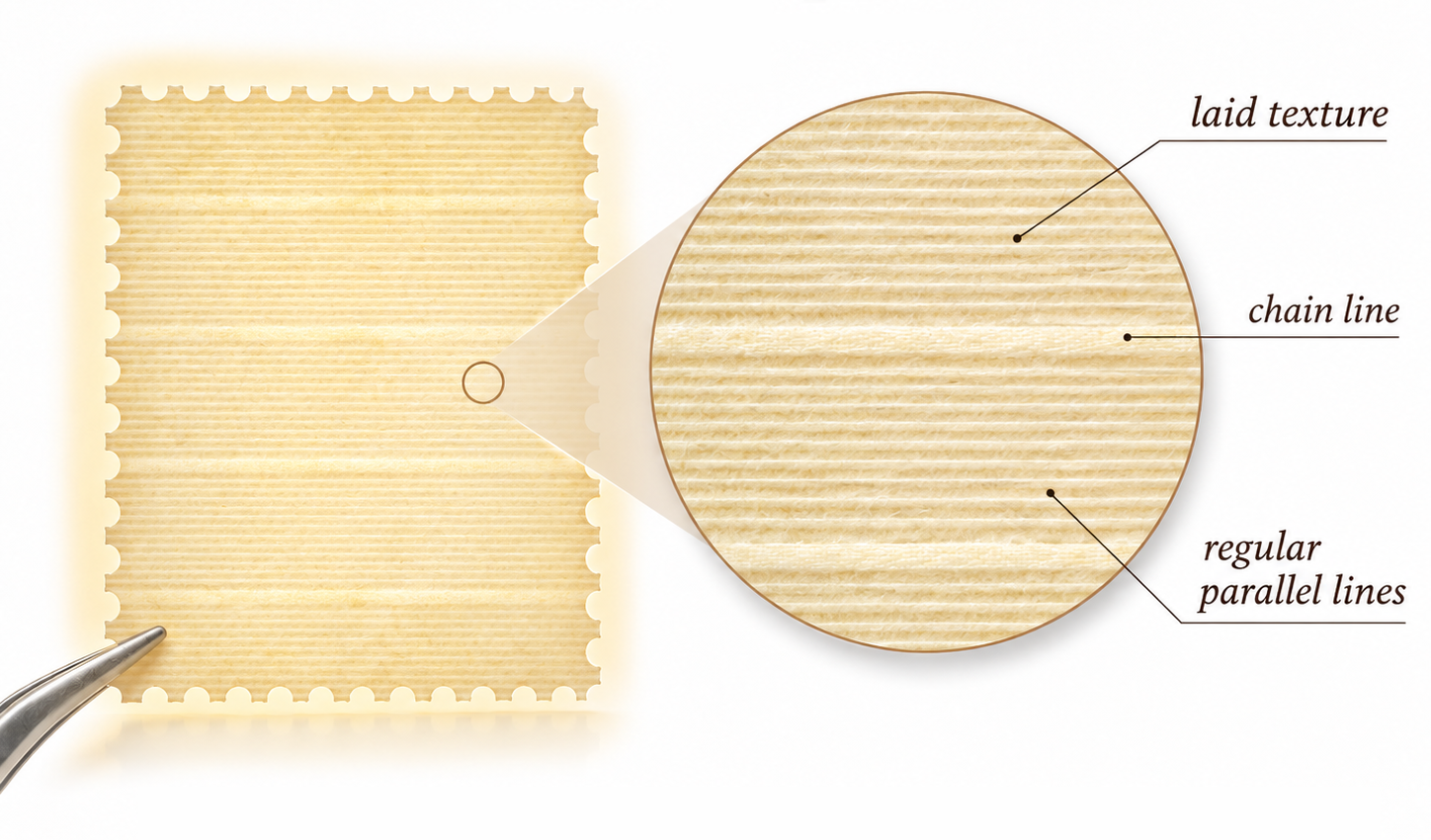
Image information
Click image to magnify
Diagram of laid paper with a magnified inset showing regular parallel lines.
- Credit
- Stunning Stamps · 2026
- Notes
- Digitally constructed
Watermark
A watermark is a pattern formed in the paper while it is being made. Variations in the paper allow the pattern to show when light passes through it. It is part of the paper itself, rather than an inked design.
A watermark may be faint or only partly visible on a single stamp. Collectors use it to identify the paper and distinguish otherwise similar issues.
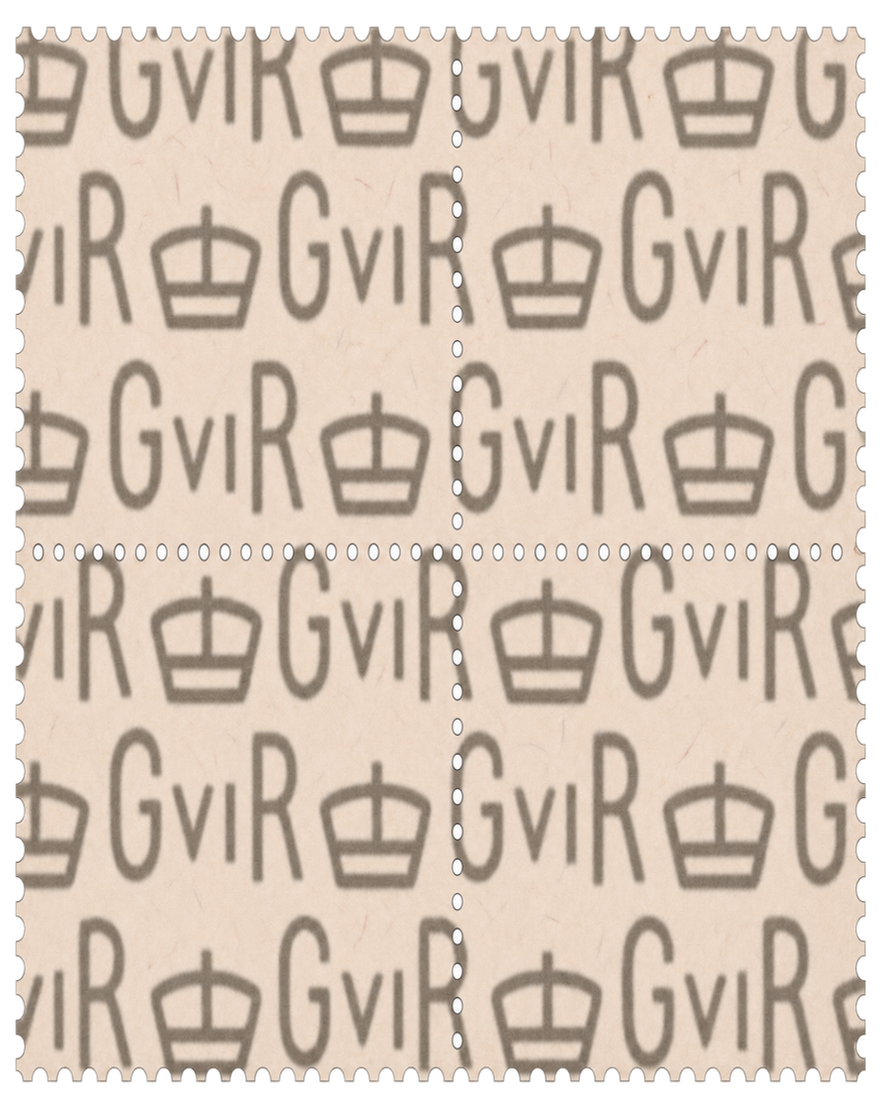
Image information
Multiple Crown and GVIR watermark, front view, upright
- Credit
- Stunning Stamps · 2026
- Notes
- Digitally reconstructed
First issued
The first-issue date records when the stamp became available for use. Read it alongside the description: an entry may describe a new design, a replacement colour or a change of printer. A stamp can remain in production long after that first date.
On this stamp
28 September 1942. This dates the pale-colour issue. The earlier red-brown design appeared on 30 July 1937.
Catalogue references
A stamp catalogue gives each listed issue a reference number. SG means Stanley Gibbons, the publisher of the catalogue used here. These numbers help collectors refer to the same issue; they are not serial numbers printed on individual stamps.
A range of numbers groups related entries. Colour, paper or perforation differences may account for separate listings within that range.
On this stamp
SG 487 identifies the pale red-brown issue. The original red-brown stamp is SG 464.
Stamp shades
A shade is a variation within a stamp’s colour. Some variations receive their own catalogue numbers even though the design and denomination stay the same.
Compare known examples under consistent lighting. Fading can change a stamp’s appearance, and photographs or screens can alter how colours look. A catalogue colour name helps describe a shade; it is not a colour test by itself.
On this stamp
This is the named pale-colour issue. Screen colours and this reconstruction cannot authenticate an actual stamp or distinguish every printing shade.
The printer
Harrison & Sons was a security-printing firm that supplied stamps as well as passports and other documents. It printed British letterpress stamps before introducing photogravure for the George V definitives in 1934.
On this stamp
Harrison & Sons printed this 1½d definitive by photogravure.
Photogravure
Photogravure carries ink in tiny recessed cells on a printing cylinder. A blade removes surplus ink from the surface before the cells transfer their ink to the paper. The cell pattern allows the image to reproduce different tones.
Harrison & Sons introduced the process for British definitive postage stamps in 1934. On original stamps, the fine grid visible under magnification can help distinguish photogravure from the earlier letterpress printing.
Image information
Enlarged plan view of a gravure cell grid. Separate recessed cells carry ink; varying the ink they hold creates tone.
- Credit
- Stunning Stamps · 2026
On this stamp
The portrait, frame and lettering were printed together in pale red-brown. Photogravure uses ink held in small recessed cells on a printing cylinder.
Paper and the printed image
Paper is the material carrying the stamp’s design. Its structure, surface, colour and watermark are separate characteristics. Wove paper has a fairly even structure, unlike laid paper with its regular lines.
A paper description can distinguish stamps with otherwise similar designs. A coloured sheet supplies colour even in areas left untouched by the printing ink.
Image information
Click image to magnify
Diagram of wove paper with a magnified inset showing an even texture without laid lines.
- Credit
- Stunning Stamps · 2026
- Notes
- Digitally constructed
Image information
Click image to magnify
Diagram of laid paper with a magnified inset showing regular parallel lines.
- Credit
- Stunning Stamps · 2026
- Notes
- Digitally constructed
On this stamp
The pale colour describes the printed ink, not a deliberately coloured paper.
Watermark
A watermark is a pattern formed in the paper while it is being made. Variations in the paper allow the pattern to show when light passes through it. It is part of the paper itself, rather than an inked design.
A watermark may be faint or only partly visible on a single stamp. Collectors use it to identify the paper and distinguish otherwise similar issues.
Image information
Multiple Crown and GVIR watermark, front view, upright
- Credit
- Stunning Stamps · 2026
- Notes
- Digitally reconstructed
On this stamp
The paper bears a repeating crown and GVIR pattern. The standard pale red-brown three-halfpence has upright watermark; do not import the original red-brown issue’s sideways-watermark listing into this issue.
Perforation
Perforations are the rows of punched holes that let neighbouring stamps separate. Their gauge describes the spacing over a standard distance of 2 centimetres, rather than the total number of holes along a stamp’s edge.
A perforation gauge has rows of dots or lines at known spacings. Match an edge against them: the marks should line up all the way along. A single number applies to both directions; two numbers give the horizontal gauge first, then the vertical.
Image information
Enlarged perforation spacing: fourteen equal intervals between hole centres span 20 millimetres. This is a schematic, not a ruler.
- Credit
- Stunning Stamps · 2026
On this stamp
The horizontal and vertical gauges are 15 and 14 respectively. Use a perforation gauge on a real stamp, not the reconstruction.
Sheets and panes
A printing sheet may contain several groups of stamps, called panes. Unprinted gaps between panes are gutters; the outer paper margin is also called selvedge. A pane may occupy an entire printing sheet or be one of several panes.
The sheet supplied to a post office may be smaller than the sheet used for printing. Keep those two counts separate. Row and column counts explain how many stamps belong to each pane.
Image information
A schematic printing sheet contains two panes separated by an unprinted gutter and surrounded by a margin.
- Credit
- Stunning Stamps · 2026
On this stamp
This is the counter-sheet total. Booklet panes and machine rolls are separate supply formats; the diagram explains sheet terminology.
Postal rates and other uses
The face value tells you how much postage a stamp represents. The charge for sending an item depended on its date, destination, weight and the service used. A denomination could serve several purposes or be combined with other stamps.
Registration was an additional service with its own fee. A stamp’s use on a document for a tax or duty is described as fiscal use, rather than payment for carrying a letter.
On this stamp
Registered here means the periodical was registered as a newspaper, not that each packet used the separate registered-mail service.
Postal rates and other uses
The face value tells you how much postage a stamp represents. The charge for sending an item depended on its date, destination, weight and the service used. A denomination could serve several purposes or be combined with other stamps.
Registration was an additional service with its own fee. A stamp’s use on a document for a tax or duty is described as fiscal use, rather than payment for carrying a letter.
On this stamp
This is a different class of mail from the newspaper service, even though both could require 1½d.
Machine rolls
Roll formats reflect the machine that dispensed or affixed the stamps. A roll code identifies a supply format, not a denomination by itself.
Machine rolls
Roll formats reflect the machine that dispensed or affixed the stamps. A roll code identifies a supply format, not a denomination by itself.
On this stamp
Joined strips supplied these rolls. Their 1950 listing does not establish a 1942 roll release.
Photogravure
Photogravure carries ink in tiny recessed cells on a printing cylinder. A blade removes surplus ink from the surface before the cells transfer their ink to the paper. The cell pattern allows the image to reproduce different tones.
Harrison & Sons introduced the process for British definitive postage stamps in 1934. On original stamps, the fine grid visible under magnification can help distinguish photogravure from the earlier letterpress printing.
Image information
Enlarged plan view of a gravure cell grid. Separate recessed cells carry ink; varying the ink they hold creates tone.
- Credit
- Stunning Stamps · 2026
On this stamp
The counts describe positions within the block, not sixty fully printed stamps. A dry print is an ink-transfer failure.
Dimensions
These dimensions describe the complete stamp, including its perforated edges. Width is given first, followed by height. Measure from the outer tips of the perforations on one side to the outer tips on the opposite side.
The printed design occupies a smaller area inside the paper margins. Its size is a separate measurement.
Image information
Complete stamp width 21 mm and height 24 mm, measured across the outer perforation tips. The printed area is smaller. Schematic, not actual size.
- Credit
- Stunning Stamps · 2026
On this stamp
Approximately 21 mm wide and 24 mm high, measured across the outer perforation tips. This is the complete stamp, including its paper margins. The same approximate format is used throughout the George VI low-value issues; individual separated stamps can vary slightly. These figures do not measure the smaller printed design.
The people behind the design
A stamp can combine work by several people: a portrait artist, frame designer, photographer or engraver. Their roles are identified separately here.
The people behind the design
Edmund Dulac was a French-born illustrator who made his career in Britain. His work ranged from illustrated books to royal stamp portraits, combining a concern for clear composition with finely modelled images.
Eric Gill was a letter-carver, sculptor and type designer. His stamp work included frames for George VI’s low values. The full biography also addresses the documented abuse that forms part of his life and legacy.
On this stamp
Dulac supplied the royal portrait, while Eric Gill designed the frame for the design used on this 1½d pale red-brown stamp. The later colour retained this established artwork. Gill supplied the frame around Dulac’s royal portrait for the design used on this 1½d pale red-brown stamp. A later colour did not mean a new frame commission.