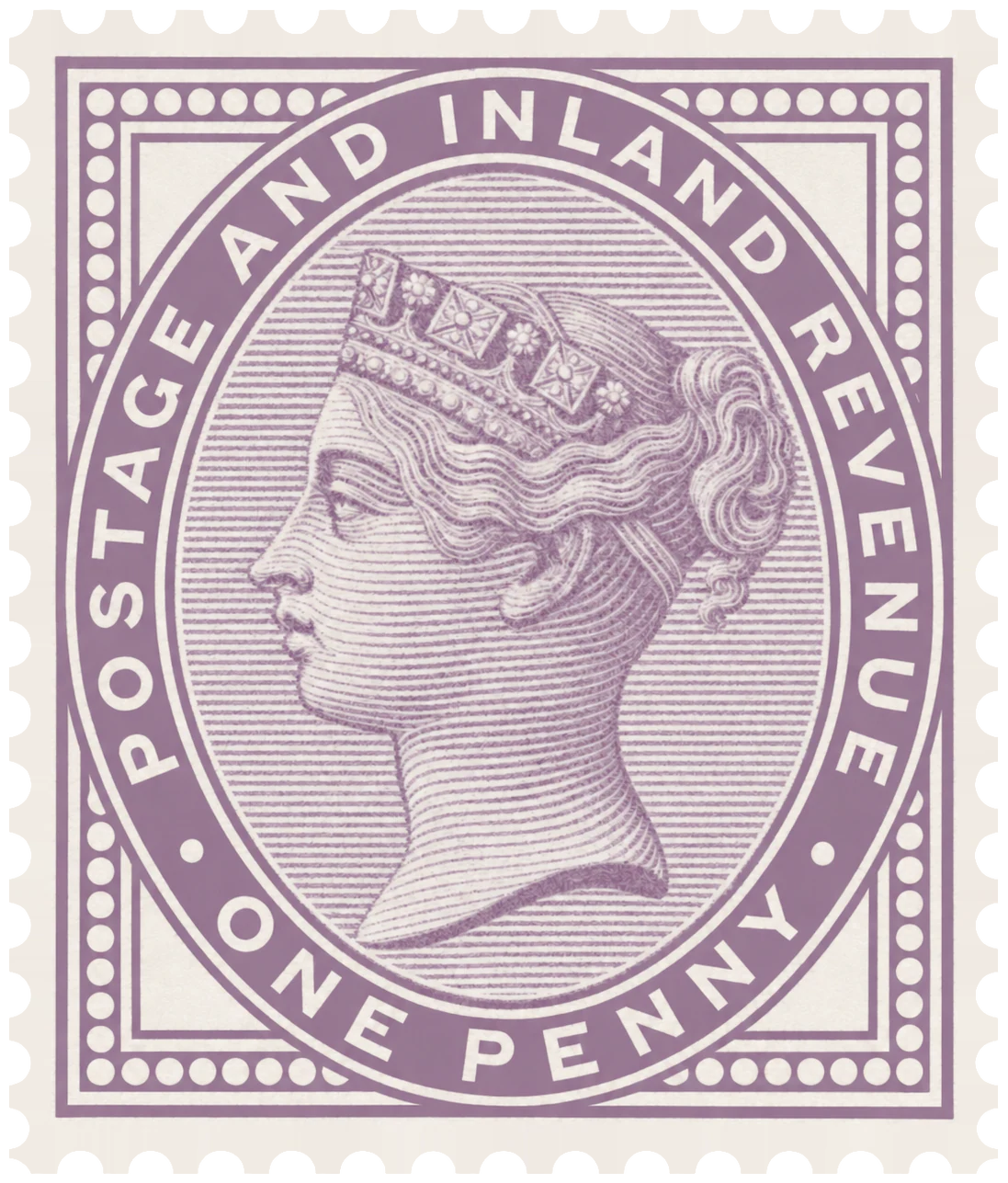
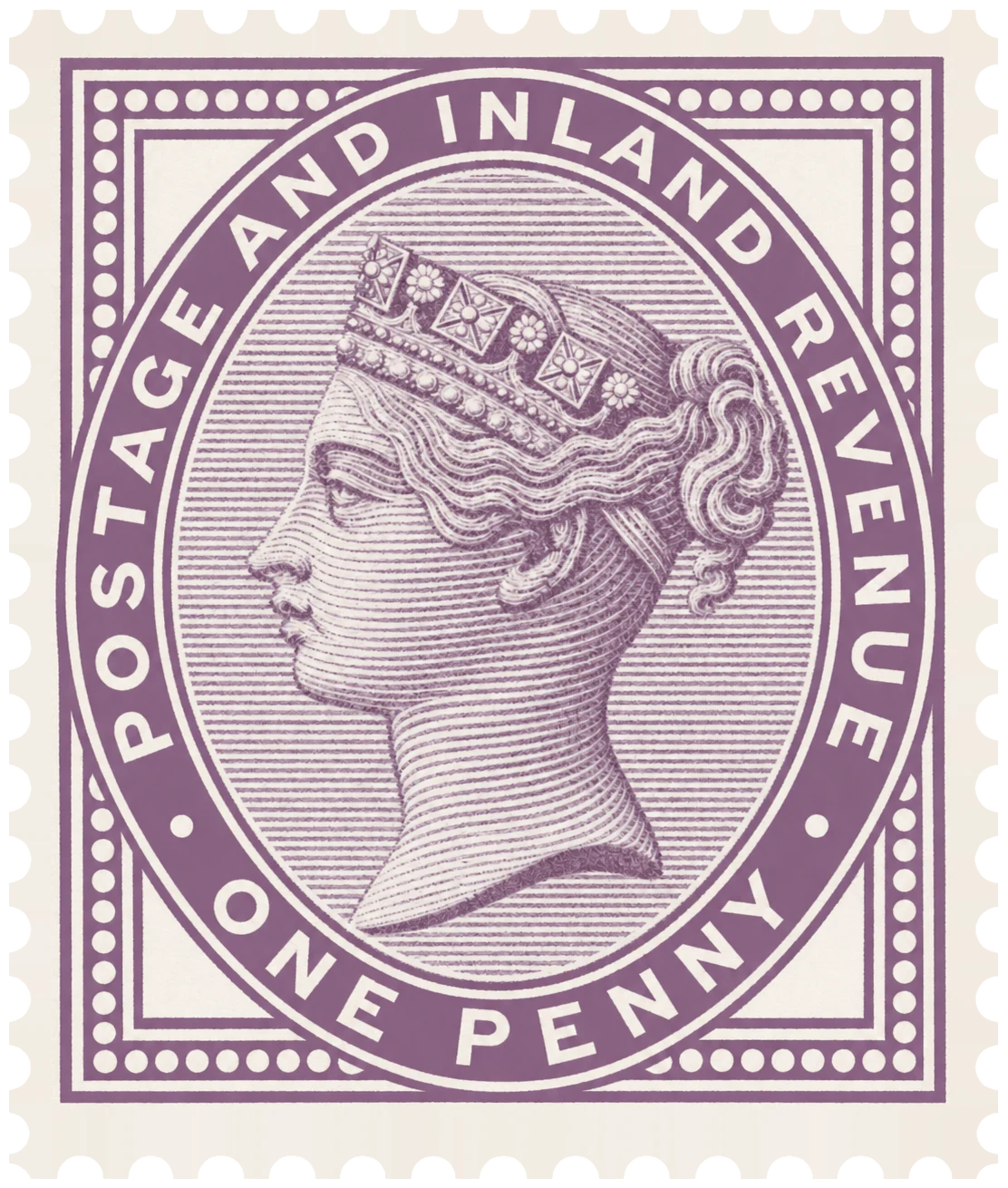
The Penny Lilac appeared on 12 July 1881, created in less than three months after legislation allowed one stamp to serve both postage and penny revenue duties. De La Rue adapted the oval design of earlier revenue stamps, using a new lilac security ink. The first engraving, Die I, had fourteen small pearls in each corner, but its lettering was considered too cramped. It was replaced by a revised die before the year ended.
Stories
The stamp created in less than three months
The stamp created in less than three months
In 1881, a change in the law gave De La Rue an unexpected opportunity.
The Customs and Inland Revenue Act allowed ordinary penny postage stamps to be used for certain revenue duties, and vice versa. Until then, the government had needed separate stamps for these purposes.
De La Rue was already producing both kinds. The firm proposed combining them into one design, printed in a security ink suitable for either use. [14]
The new Penny Lilac was developed in less than three months.
Its first printing plate was approved on 25 May 1881, and the stamp appeared on 12 July.
A change in legislation had produced one of the most familiar stamps of Victoria's reign with remarkable speed.
The lettering that was too small
The first Penny Lilac looked satisfactory at a glance, but De La Rue soon discovered a problem.
The inscription around Victoria's portrait was cramped. POSTAGE AND INLAND REVENUE had to fit into the upper part of a narrow oval band, with ONE PENNY below.
The lettering was considered too small for satisfactory reproduction. The first lilac ink also failed to meet the preferred standard of resistance to fraudulent cleaning. [14]
Nevertheless, the authorities allowed production to continue.
Within months, De La Rue prepared a second die with larger lettering and a modified frame.
The original stamp had been rushed into production, but the engravers were already correcting its weaknesses.
The colour that depended on where you lived
The earliest Penny Lilacs did not all look the same.
De La Rue prepared two inks. One produced a reddish purple-lilac, while the other was a cooler purple without the reddish tint.
The first printing, in reddish lilac, was distributed to country post offices. London received the cooler purple impressions. [15]
The different colours appeared almost simultaneously.
Later printings used the cooler shade, but the earliest impressions preserve evidence of two separate preparations in the ink-making department.
A stamp's appearance could therefore depend on where the initial supplies had been sent.
The engraver's proof dated 6 May
A surviving De La Rue proof records the Penny Lilac before the first printing plates were made.
It is dated 6 May 1881 and bears the instruction BEFORE HARDENING. The portrait and inscriptions are complete, but the steel die has not yet entered its final stage of preparation. [14]
Less than three weeks later, the first printing plates were registered.
The proof captures the speed with which the new stamp was developed.
A small impression on card preserves a moment in the engraver's workshop, between the completion of the design and the beginning of mass production.
Eight printing plates — then a new beginning
De La Rue prepared only eight printing plates from the original Penny Lilac die.
The first two were registered on 25 May 1881. Six more followed by 15 June. All eight entered production. [16, 17]
Together, they produced more than two million sheets, containing approximately 496 million stamps.
By November, production from the original plates was ending. The revised Die II was ready to take over.
The first Penny Lilac had enjoyed a remarkably brief career. Yet in only a few months, De La Rue's workers had reproduced Victoria's portrait almost half a billion times.
Magnify the corners and inscription band to compare the two engravings.
Click either stamp to magnify
Why do some stories appear on several pages?
Every page is written to make sense on its own. Visitors often arrive directly at a particular stamp or subject, without having explored the rest of the site.
Some stories are relevant to several stamps, so they are repeated where they help explain what you're looking at. For those exploring a series, the details specific to each stamp generally come first, with the more familiar stories further down the page.
This way, you can explore the site in any order without missing interesting background.
Fourteen pearls in each corner identify the first Penny Lilac. Explore the crowded oval inscription, its revenue-stamp origins and the security ink chosen to reveal attempts at reuse. [18, 19]
De La Rue grew from a playing-card business into a major security printer. It supplied British postage stamps from the Victorian period and printed the Edward VII issues before the contract changed in 1911.
On this stamp
Thomas De La Rue & Co. designed and surface-printed the Penny Lilac introduced on 12 July 1881. Die I combined postage and penny revenue use in an oval design with fourteen pearls in each corner. Eight printing plates were made from this die. The firm is credited with the 1881 design; the individual engraver of the adaptation is not established by the sources used here.
Jean Ferdinand Joubert de la Ferté was a French engraver and photographer. He trained in Paris and later worked in London, where his engraving helped establish De La Rue’s surface-printed postage stamps.
On this stamp
Joubert engraved the earlier surface-printed Queen’s head after Corbould’s drawing. On the 1881 Penny Lilac Die I, this is a credit to the earlier portrait model. The 1881 Penny Lilac design is attributed to De La Rue; its individual engraver is not established by the sources used here.
William Wyon was a medallist and engraver at the Royal Mint. His models of royal heads were made for coins and medals and also became sources for stamp portraits.
On this stamp
Wyon’s City of London medal supplied the youthful likeness behind the 1881 Penny Lilac Die I. The familiar portrait was adapted through drawings and engravings for British stamps; Wyon is credited as the earlier artistic source, not as the designer of the 1881 frame.
Henry Corbould was a draughtsman and book illustrator. He trained with his father and at the Royal Academy Schools, where he received a silver medal for a life study.
On this stamp
Corbould’s drawing after Wyon’s medal supplied the model for the earlier surface-printed Queen’s head. His connection to the 1881 Penny Lilac Die I is that inherited portrait source; he did not prepare its 1881 frame or new engraving.
The country identifies the postal authority that issued the stamp. The monarch identifies the ruler whose portrait it carries. A definitive is an everyday stamp intended for regular postal use.
On this stamp
This is the Die I Penny Lilac from Victoria’s reign. Its youthful royal likeness is inherited from earlier portrait sources; the 1881 oval design belongs to De La Rue.
The denomination is the stamp’s face value: the amount of postage it represents. Its price to a collector can be quite different.
In Britain’s old currency, 12 pence made one shilling and 20 shillings made one pound: 240 pence altogether. The abbreviations were d for pence, s for shillings and £ for pounds. The d comes from the Latin denarius. A halfpenny, written ½d, was half an old penny.
On this stamp
ONE PENNY represents one old penny, or one two-hundred-and-fortieth of a pound. A 240-stamp sheet of this Die I was worth £1.
Colour varies with ink, printing strength, paper and later treatment. A catalogue shade is a recognised range, not a colour code that can reliably be read from an ordinary photograph.
Wright and Creeke describe purple-lilac and purple printings, including a reddish early Die I printing. That account does not make a reddish cast on any surviving stamp proof of its dispatch date or destination.
Fugitive ink, light exposure and washing can change the appearance. Establish the die from its engraved features first, then compare shade with sound reference material under consistent conditions.
On this stamp
The illustration represents the lilac family of Die I. It does not certify a rare shade, an early reddish printing or the effect of a particular ink batch. The 14 complete corner dots establish the die more securely than colour alone.
A plate may be approved and printed from before stamps reach a post-office counter. A registration date records an official production step; a dated cancellation records the use of one surviving stamp.
Die I went on sale on 12 July 1881. Die II appeared in December without a separate official announcement. Wright and Creeke used an early postmark of 12 December; later accounts commonly give 13 December.
December 1881 is the level of precision used here for Die II. Neither an October registration nor a historical earliest-known postmark should silently become a newly established official issue day.
On this stamp
Die I went on sale on 12 July 1881 after the circular of 28 June. The first plate had been approved on 25 May; plate approval and public issue are different events.
The Penny Lilac replaced the Venetian-red penny in July 1881 and combined postal use with the penny stamp duties covered by the new legislation. Its long inscription makes that dual purpose visible.
The two dies are versions of the same denomination and basic oval design. The first has fourteen complete dots in each corner; the revision has sixteen and larger lettering. These are design distinctions, not different perforation gauges.
The revised design continued while the surrounding definitive series changed. Its later marginal controls and rules belong to production management, rather than to new denominations or a commemorative issue.
On this stamp
This is the first fourteen-dot version, introduced when the penny adhesive combined postage with eligible revenue duties. It was replaced by the sixteen-dot revision later in 1881.
A stamp catalogue gives each listed issue a reference number. SG means Stanley Gibbons, the publisher of the catalogue used here. These numbers help collectors refer to the same issue; they are not serial numbers printed on individual stamps.
A range of numbers groups related entries. Colour, paper or perforation differences may account for separate listings within that range.
On this stamp
The reconstruction targets SG170 lilac, Die I. A pale-lilac Die I reference was used for the drawing, with an independently catalogued SG170 example for corroboration. This does not make the illustration a calibrated shade reference.
Surface printing, or typography, transfers ink from the raised parts of a printing surface. Recessed spaces receive no ink, leaving white lettering and ornament as exposed paper.
De La Rue reproduced the engraved die through moulds and electrotyping to obtain the many repeated subjects on a printing plate. The original die and a working plate are different objects: one supplies a design, the other prints a sheet.
For the Penny Lilac the paper was gummed before printing. Steam presses printed the lilac design; perforation was a separate later operation. The white dots are flat unprinted areas, not embossed pearls.
Surface printing, shown from the side. The paper is pressed onto the inked surface.Image information
Side view of surface printing. Paper is pressed down onto ink on the raised parts of a printing plate; the lower spaces do not touch the paper.
Credit
Stunning Stamps · 2026
On this stamp
De La Rue printed Die I from a raised surface in one lilac ink. The corner dots and inscriptions are white paper left unprinted. Paper preparation and gumming preceded printing; perforating followed.
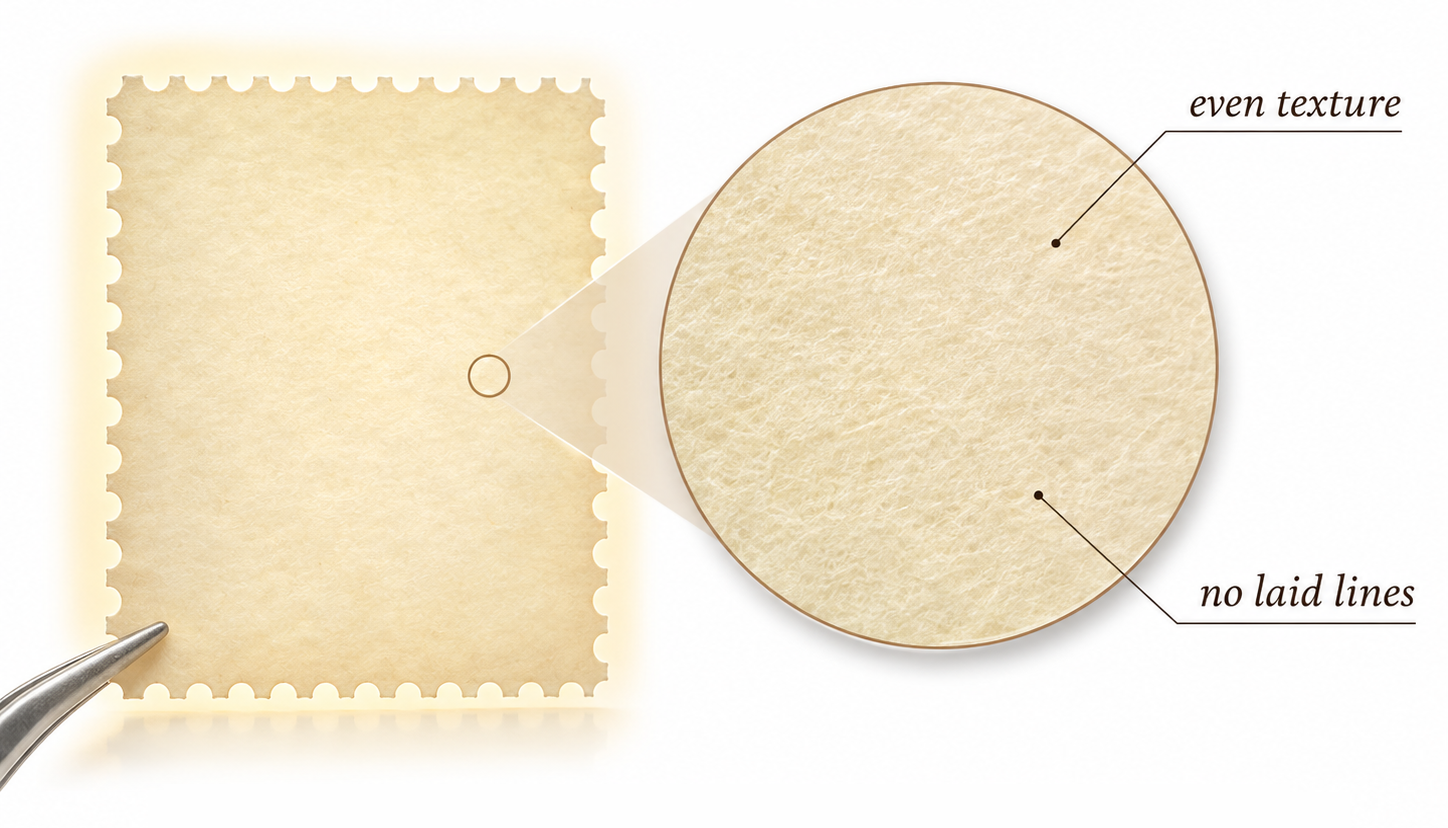
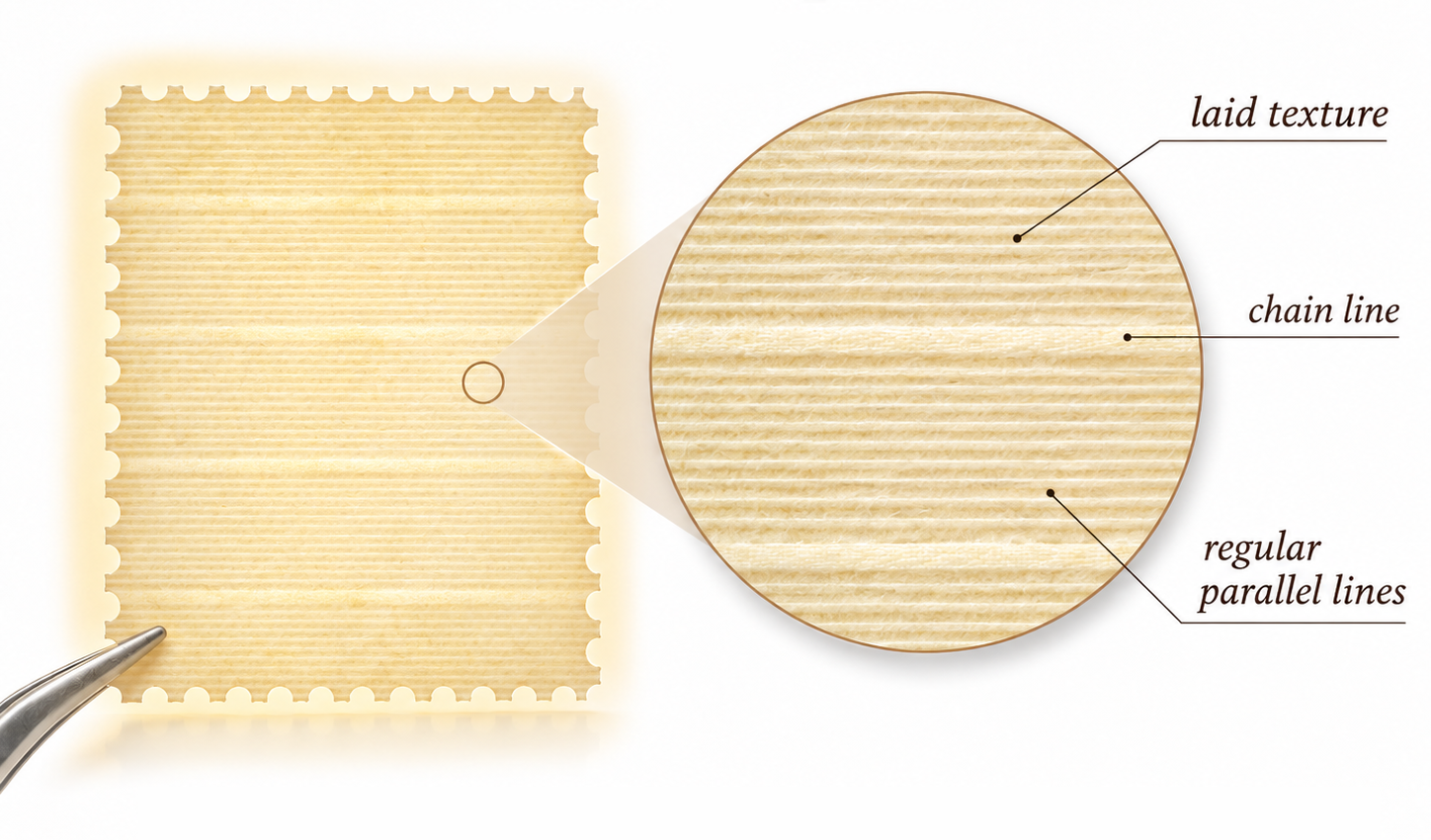
Wove paper has an even structure, unlike the regular parallel lines of laid paper. The comparison illustrations explain those structures; they do not depict a particular original Penny Lilac sheet.
Both dies used machine-made white wove paper with the Large (1880) Crown. The watermark was formed while the sheet was wet, before drying, gumming and printing.
Paper structure, surface finish and watermark are separate observations. A front illustration cannot establish watermark orientation, thickness or the condition of the gum on an original.
Wove paper: even texture without laid lines.Image information
Click image to magnify
Diagram of wove paper with a magnified inset showing an even texture without laid lines.
Credit
Stunning Stamps · 2026
Notes
Digitally constructed
Laid paper: regular parallel lines, shown for comparison.Image information
Click image to magnify
Diagram of laid paper with a magnified inset showing regular parallel lines.
Credit
Stunning Stamps · 2026
Notes
Digitally constructed
On this stamp
The Die I Penny Lilac uses machine-made white wove Crown paper. The reused diagrams compare wove and laid structures; there is no laid-paper alternative assigned to this issue.
Structure describes how the fibres form the sheet; finish describes the surface. Smoothness, thickness, colour and a watermark are separate properties, and a smooth surface does not by itself establish a coating.
The period account describes paper from about 1880 as less firm than some earlier surface-printing papers. This is a general observation, not an exact thickness specification for every Penny Lilac.
These issues use ordinary Crown paper. No Edwardian chalk-surface alternative is assigned to either die. Assess the original object rather than transferring a paper variety from a later reign.
On this stamp
The Die I illustration represents ordinary white paper. Smoothness and thickness must be assessed on an original; neither a coating nor a chalk-surface variety is established from this face image.
A fugitive ink is deliberately vulnerable to treatment intended to remove a cancellation. That vulnerability protects revenue by making an attempt to reuse the stamp more apparent.
The Penny Lilac was printed in one ink. “Doubly fugitive” describes the intended sensitivity to water and chemical treatment; it is not a claim that every batch behaved identically. The early ink and the later formulation should not be assumed to have equal resistance.
Wright and Creeke record a range of purple tones. Fading or washing can change the colour further. The appearance of a scan or reconstruction cannot establish a rare original shade or a particular chemical formulation.
On this stamp
The first die was printed in purple-lilac and purple shades. The early security ink did not necessarily perform like later doubly fugitive formulations. This illustration cannot authenticate an early reddish batch.
The Crown is formed in the paper, not printed in ink. Raised patterns on the papermaking roll leave thinner areas that become visible in transmitted light. It is separate from the diadem in Victoria’s portrait.
The Large (1880) Crown paper provided a watermark position for each stamp. Each 240-position unit had two groups of 120, with watermarked lettering and other marks in the surrounding paper.
This Crown must not be confused with the Small and Large Crowns of earlier line-engraved stamps. An inverted or incomplete watermark has to be established from the original paper; the ordinary face design remains the same.
On this stamp
Both dies use the Large (1880) Crown. On this Die I the printed dots identify the engraving, while the watermark belongs to the paper. Its orientation and completeness require inspection of an original.
The gauge measures hole spacing over two centimetres. It does not count all the teeth on a complete edge. Two numbers give the horizontal gauge first and the vertical gauge second.
Both ordinary Penny Lilac dies gauge 14 in each direction. Fourteen or sixteen printed corner dots identify the die and have no connection with this perforation measurement.
Wright and Creeke distinguish unissued imperforate Die I impressions from Die II imperforates which they believed had been issued. Proofs, registration material, errors and trimmed perforated singles require separate examination. None is a routine second gauge for the illustrated articles.
Enlarged spacing diagram, not to scale. Match the spacing with a perforation gauge.Image information
Enlarged perforation spacing: fourteen equal intervals between hole centres span 20 millimetres. This is a schematic, not a ruler.
Credit
Stunning Stamps · 2026
On this stamp
The ordinary Die I is perforated 14 horizontally and vertically. Its fourteen printed corner dots are unrelated to that gauge. Imperforate proof and registration impressions do not create a second ordinary issue or a grouped alternative.
Gum arabic is the adhesive applied to the back of these stamps. De La Rue gummed the paper before printing, so the normal impression lay on the opposite face.
A mint stamp may retain original gum, show hinge marks or have lost or replaced gum. Those conditions are different from the design, colour and perforation of the issue.
Printed-on-gum Die II errors are documented. They arose from printing on the wrong face of the prepared paper; they should not be confused with ordinary stamps whose gum has been disturbed later.
On this stamp
The paper for Die I was gummed before printing. The illustration shows the face only and does not establish original gum, hinge condition or regumming.
A pane is a block within a sheet; a gutter is the gap between panes; selvedge is the outside margin. The diagram explains these terms rather than providing a measured Penny Lilac layout.
A Penny Lilac plate contained 240 subjects in two panes, one above the other. Each pane had ten rows of twelve stamps. The whole unit therefore had twenty rows and twelve columns, interrupted by the horizontal gutter.
Two plates printed across the double mill sheet, producing 480 stamps in four panes. A reference to a 240-subject plate and another to a 480-stamp printer’s sheet describe different units, not conflicting capacities.
Sheet, panes and margins: a simplified example.Image information
A schematic printing sheet contains two panes separated by an unprinted gutter and surrounded by a margin.
Credit
Stunning Stamps · 2026
On this stamp
For Die I, each plate held two panes of 120, each ten rows by twelve columns. The double mill sheet took two plates side by side, yielding four panes and 480 stamps.
There were twelve old pence to a shilling and twenty shillings to a pound. A full unit of 240 penny stamps was therefore worth £1.
For both Penny Lilac dies this 240-stamp unit was the post-office sheet. Each 120-stamp pane was worth 10s; the double 480-stamp mill sheet used in production represented £2.
Keep those units separate when reading an archive description or a sale catalogue. A surviving part-sheet can contain fewer stamps because examples were removed, not because the printing plate originally held fewer subjects.
On this stamp
A complete 240-stamp unit of Die I formed the £1 post-office sheet. One pane was 120 stamps worth 10s; the 480-stamp double mill sheet represented £2.
Earlier Victorian pennies used letter pairs to identify positions in the sheet. The Penny Lilac dispensed with these printed corner letters.
Its corner dots are ornament and a diagnostic feature of the die. They do not encode row or column. Both dies have the same absence of letters.
Later control letters are printed in the sheet margin and serve a different purpose. Without an adjoining margin or specialist evidence, an isolated Penny Lilac cannot be assigned a sheet position or production control merely by looking at its corners.
On this stamp
The Die I has no check letters. Its 14 dots in each corner identify the die, not a row, column or plate. There is no missing-letter error in the illustrated design.
The die establishes the design; plates reproduce it many times. A new plate is not automatically a new die. Penny Lilacs carry no printed plate number on their faces.
Eight plates were made and used from Die I. The revised Die II began with plate 9. Wright and Creeke’s later count is explicitly an end-of-1898 record and must not be treated as a final lifetime production total.
A registration sheet records approval and may carry manuscript numbers. It can preserve a plate’s identity after examples have been removed. The illustrations here represent the two dies, without assigning either single stamp to an otherwise unidentified plate.
On this stamp
All eight Die I plates were registered and employed. The first was approved and put to press on 25 May 1881 and the last was brought into use on 15 June. No particular plate can be assigned to this illustrated single.
Count the complete white dots in one corner, where a horizontal row meets a vertical row. Count the shared corner dot once. Tiny partial remnants at the oval’s edge do not add another complete dot.
Die I has fourteen complete dots in each corner; Die II has sixteen. Die II also has slightly larger lettering. The four corner groups distinguish the design revision even though both stamps read ONE PENNY and have the same basic oval frame.
These are areas left white by surface printing. “Pearls” is a descriptive name, not a statement that the paper was embossed. Ink spread, wear or a cancellation can hide small details, so compare more than one corner on an original.
On this stamp
Count 14 complete white dots in each corner, counting the shared corner dot only once. Die I has smaller lettering than the later revision. Tiny partial terminal fragments where the oval meets the rows are excluded.
A control letter helped De La Rue account for production. It was printed in the lower sheet margin, under the eleventh stamp in the last row, rather than on each stamp.
Controls belong to later Die II production. Their lettering, setting and accompanying marginal rule provide evidence about a retained sheet margin; they are not corner letters, a denomination or a visible plate number.
The barred N and adjoining O combination has been interpreted differently in historical and later accounts. The visible combination should be described separately from a proposed explanation of how it arose. Neither it nor an exact control can be inferred from a single stamp without selvedge.
On this stamp
The later alphabetic production controls belong to Die II. They must not be added to the fourteen-dot Die I. This single also has no selvedge in which a marginal mark could be read.
A marginal rule is a line printed around a pane, outside the stamp designs. These rules were introduced during Die II production in 1887, giving rise to the name Jubilee lines.
They helped protect the edges of the printing surfaces and improve working conditions at the edge of a pane. They were added printer’s rules, not an extra border engraved on each individual stamp.
A stamp with its selvedge can show the rule and its relationship to a control letter. An ordinary detached single cannot. A Penny Lilac with this feature remains a Penny Lilac; it does not become a member of the separate multi-value Jubilee series.
On this stamp
Die I belongs to 1881. The marginal rules introduced during later Die II production in 1887 do not apply to this fourteen-dot issue.
A die proof tests a design, a plate proof tests its repeated impressions, and a registration impression records approval. Material marked SPECIMEN also needs to be distinguished from ordinary stamps sold over the counter.
The two dies require different care when discussing imperforates. Wright and Creeke state that Die I imperforate impressions were not issued for use, while recording Die II imperforates believed to have been issued. Straight edges alone cannot establish either status.
For Die II they also record impressions on the gummed face and printing on both sides. Enough original paper, an adjoining stamp, the reverse and reliable provenance are needed to assess such material. The reconstructions illustrate ordinary perforated stamps, not these exceptions.
On this stamp
Wright and Creeke explicitly distinguish imperforate Die I impressions from stamps issued for use. The illustrated SG170 family is the ordinary perforated stamp; an unperforated single requires evidence of its origin.
The face value does not reveal the full journey. Date, weight, destination and service determine the charge; one stamp may pay all of it or form part of a larger franking.
At the Penny Lilac’s introduction, 1d paid an ordinary inland letter up to 1 oz. From 22 June 1897 the same penny rate covered up to 4 oz. Die II spans that change.
A dated cover and its complete franking establish which scale applies. A loose Penny Lilac cannot prove the weight or destination of the item on which it was used.
On this stamp
When Die I appeared in July 1881, one penny prepaid an ordinary inland letter not exceeding 1 oz. Other services and heavier letters required their own rates.
A revenue stamp records payment of a tax or duty on a document. That function is different from paying for delivery of a letter, even when the same stamp can serve either purpose.
The 1881 arrangements allowed the penny adhesive to meet postage and the applicable general penny stamp duties. Duties requiring a stamp specifically appropriated to a particular instrument were not simply swept into that permission.
A fiscal signature or date, an official overprint, and a postal cancellation have different meanings. Read the original document or cover before assigning a use. The inscription does not license using one stamp twice.
On this stamp
The inscription on Die I expressly includes INLAND REVENUE. It could pay the eligible penny duties as well as postage. A fiscal cancellation or document needs to be distinguished from a postal use.
A cancellation prevents reuse; a date stamp can also record when and where an item was handled. Its figures or letters are later marks, not part of the engraved design.
Penny Lilacs could be used postally or for eligible fiscal duties. A pen mark alone does not establish the whole transaction, and an unusual strike should be interpreted with its document rather than by appearance alone.
The ink’s vulnerability was part of the protection against cleaning. Disturbed colour is therefore a condition issue to investigate, not automatic evidence of a new shade or die.
On this stamp
This illustration is unused. On a surviving Die I, read the cancellation with the original cover or fiscal document. The printed corner dots are part of the design; a later numeral, signature or date is a separate mark.