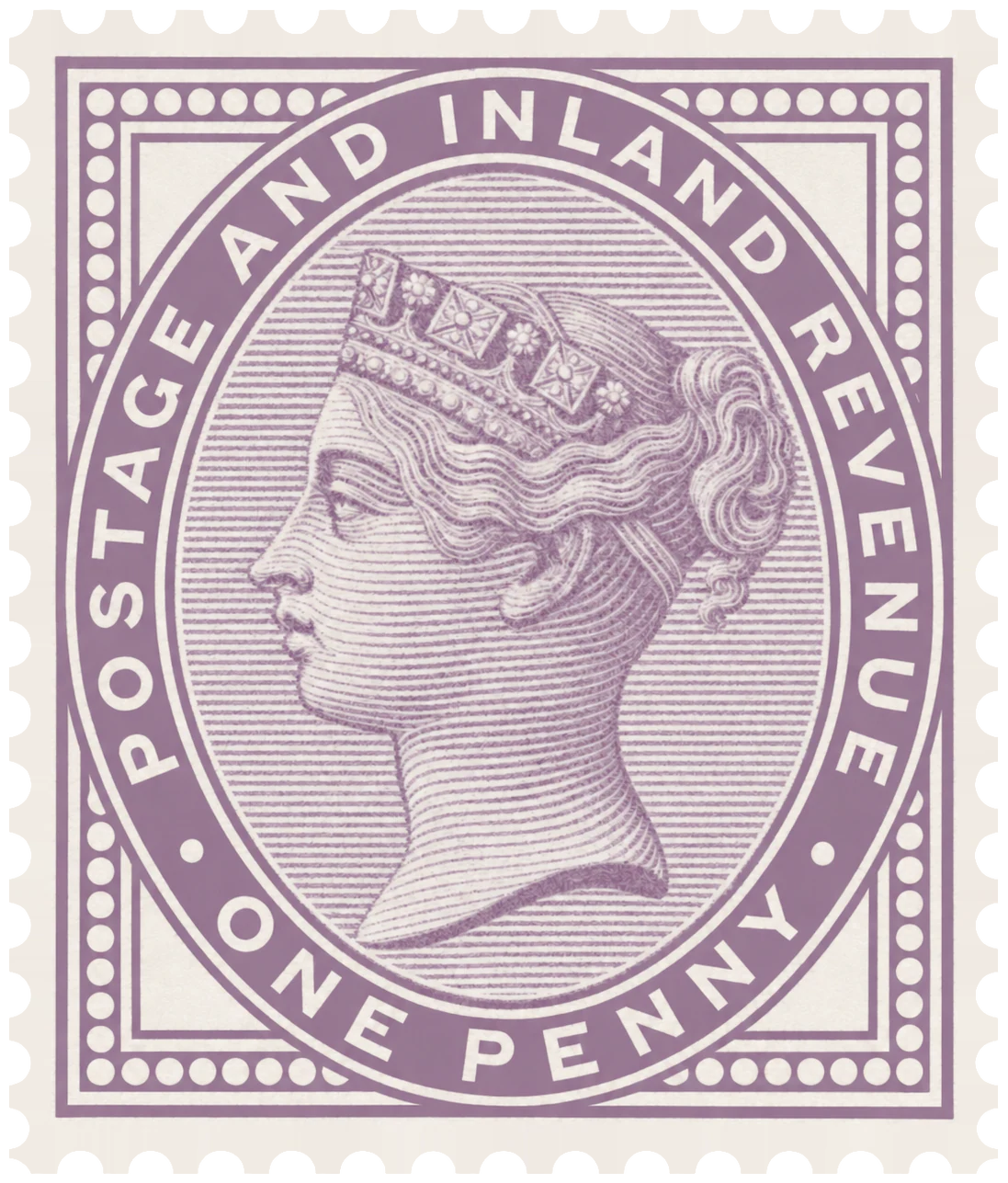
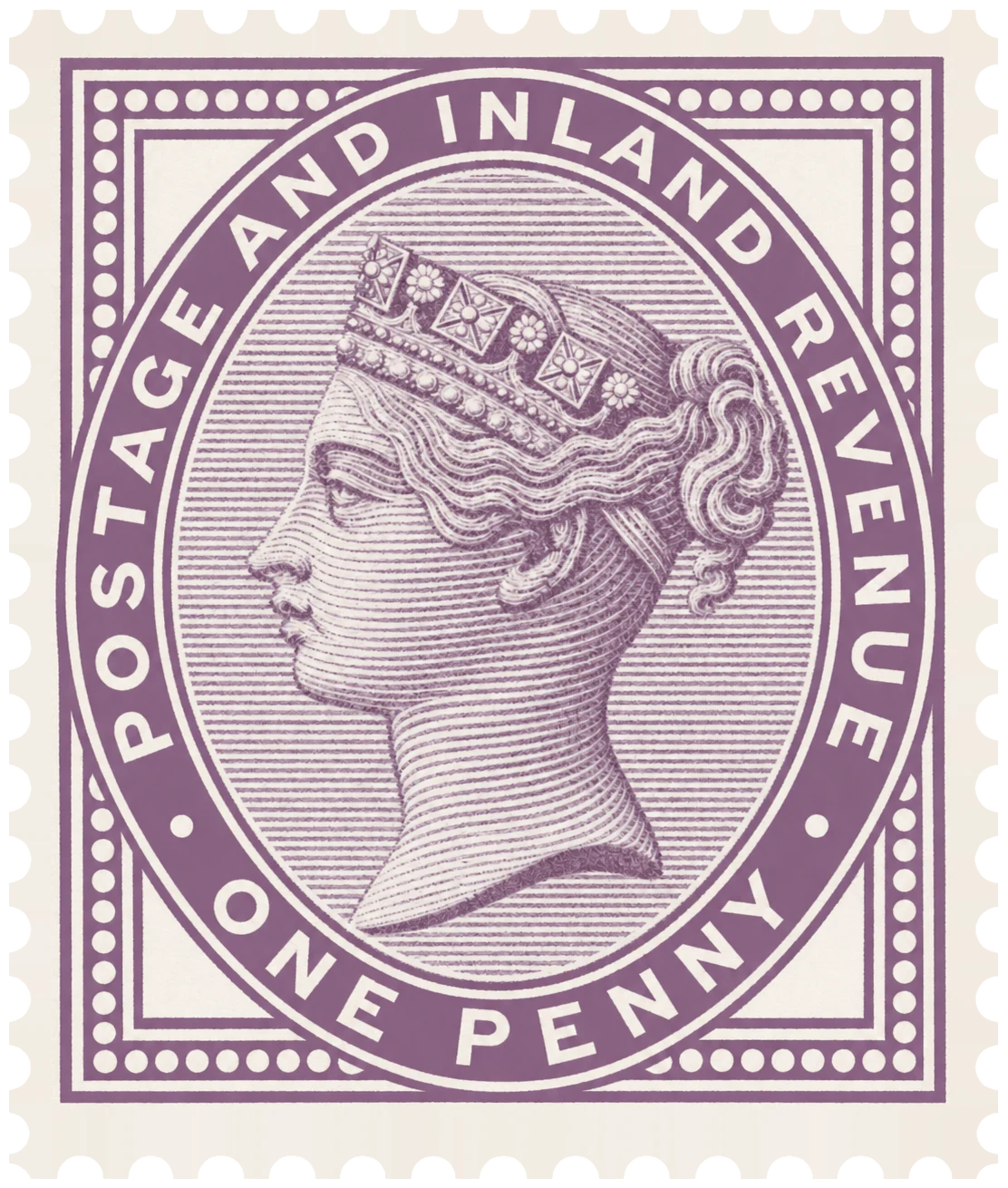
The Penny Lilac was revised in December 1881, only five months after its introduction. De La Rue enlarged the cramped lettering and increased the decorative pearls from fourteen to sixteen in each corner. The improved Die II remained in production for nearly twenty years, with approximately 33.6 billion impressions. During that time, the printers introduced protective lines around the printing plates, experimented with advertisements on the backs of stamps and continued improving their manufacturing methods.
Stories
The engravers who had to do the job twice
The engravers who had to do the job twice
The Penny Lilac had been introduced in July 1881, but its first engraving was not entirely satisfactory.
The inscription around Victoria's portrait was considered too cramped. The government wanted a more legible design, while De La Rue was also working to improve the security of its printing inks. [13]
The printers prepared a replacement die with larger lettering and a slightly altered ornamental frame.
The first two plates made from the new die were registered on 14 October 1881. The revised stamps appeared in December, without a special announcement.
The original design had lasted only five months.
A small complaint about lettering had required new engraving and the preparation of fresh printing plates for Britain's most heavily used stamp.
Magnify the corners and inscription band to compare the two engravings.
Click either stamp to magnify
Thirty-three billion portraits from one design
The revised Penny Lilac proved extraordinarily successful.
From December 1881 until the beginning of Edward VII's reign, De La Rue produced approximately 33.6 billion impressions from Die II. [14]
The scale is almost unimaginable. Every stamp required paper, ink, printing, gumming and perforation.
Over the years, De La Rue prepared more than a hundred printing plates, replacing those that wore out and improving the machinery used to manufacture the stamps.
The familiar lilac portrait was the product of thousands of hours of skilled industrial work.
A design that had begun as a hurried replacement in 1881 became one of the most extensively reproduced images of Victorian Britain.
The advertising man who wanted the backs of stamps
Thomas J. Barratt, the celebrated advertising manager of Pears' Soap, had an ambitious idea: turn the backs of British postage stamps into advertisements.
Around 1889, the Postmaster-General asked De La Rue to investigate the proposal. The printers produced experimental Penny Lilacs with PEARS' SOAP printed in mauve beneath the gum. [15]
De La Rue reported difficulties, and the government did not proceed.
Pears nevertheless conducted further experiments, printing advertisements in blue, orange and mauve on top of the gum.
The trials were never adopted for ordinary postage stamps.
Barratt had recognised that a tiny object handled by millions of people might also become an extraordinarily effective advertising medium.
The dummy sheet sent to Somerset House
In January 1887, De La Rue wanted to protect its printing plates from unnecessary wear.
The firm proposed adding narrow lines around the outer edges of the printing panes. Before introducing the change, it prepared a dummy sheet containing 240 blank labels.
Four Penny Lilacs were attached to the corners of each pane, each marked CANCELLED diagonally in black. [16]
The sheet was sent to Mr Purcell at Somerset House, asking permission to experiment with the proposed lines.
The trial was successful, and protective rules were introduced later that year.
A simple sheet of blank labels had helped De La Rue solve a problem caused by the repeated pressure of printing billions of stamps.
The letter N that became O
From 1884, De La Rue printed small control letters in the margins of Penny Lilac sheets.
These helped the firm keep track of production. The letters were changed periodically, but occasionally older printing equipment remained in service during a later control period.
One unusual result shows the letter N crossed by two bars, with O printed beside it. [17]
At first glance, the arrangement looks like someone correcting a mistake.
Wright and Creeke argued that both characters were printed together to identify older equipment; a later specialist exhibit instead suggests that previously printed sheets were overprinted to correct the control. [18]
A small mark in the sheet margin reveals the practical difficulties of managing many printing plates at once.
The stamps printed on both sides
Even the most experienced printers occasionally made mistakes.
A remarkable block of four Penny Lilacs survives in the Reginald M. Phillips Collection. The stamps were printed on both sides of the paper, including the gummed reverse. [19]
Other examples were accidentally printed on the gummed side alone.
Such errors reveal the separate stages of production. The paper had to be prepared, gummed, printed and perforated, with each operation correctly coordinated.
A mistake could produce a stamp carrying Victoria's portrait where the adhesive should have been.
The unusual block preserves evidence of what could happen when the manufacturing process went wrong.
Why do some stories appear on several pages?
Every page is written to make sense on its own. Visitors often arrive directly at a particular stamp or subject, without having explored the rest of the site.
Some stories are relevant to several stamps, so they are repeated where they help explain what you're looking at. For those exploring a series, the details specific to each stamp generally come first, with the more familiar stories further down the page.
This way, you can explore the site in any order without missing interesting background.
Sixteen corner pearls and larger lettering distinguish the revised Penny Lilac. Follow the design beyond its oval frame to the protective sheet lines, control letters and experimental advertisements on the back. [20, 21, 22, 23]
De La Rue grew from a playing-card business into a major security printer. It supplied British postage stamps from the Victorian period and printed the Edward VII issues before the contract changed in 1911.
On this stamp
Thomas De La Rue & Co. prepared the revised Penny Lilac Die II, introduced in December 1881, with larger lettering and sixteen pearls in each corner. The firm printed it through the remainder of Victoria’s reign and into the transition to Edward VII. The later marginal rules and control letters belong to production management, not to a new portrait commission. No individual engraver of Die II is established by the sources used here.
Jean Ferdinand Joubert de la Ferté was a French engraver and photographer. He trained in Paris and later worked in London, where his engraving helped establish De La Rue’s surface-printed postage stamps.
On this stamp
Joubert engraved the earlier surface-printed Queen’s head after Corbould’s drawing. On the 1881 Penny Lilac Die II, this is a credit to the earlier portrait model. The 1881 Penny Lilac design is attributed to De La Rue; its individual engraver is not established by the sources used here.
William Wyon was a medallist and engraver at the Royal Mint. His models of royal heads were made for coins and medals and also became sources for stamp portraits.
On this stamp
Wyon’s City of London medal supplied the youthful likeness behind the 1881 Penny Lilac Die II. The familiar portrait was adapted through drawings and engravings for British stamps; Wyon is credited as the earlier artistic source, not as the designer of the 1881 frame.
Henry Corbould was a draughtsman and book illustrator. He trained with his father and at the Royal Academy Schools, where he received a silver medal for a life study.
On this stamp
Corbould’s drawing after Wyon’s medal supplied the model for the earlier surface-printed Queen’s head. His connection to the 1881 Penny Lilac Die II is that inherited portrait source; he did not prepare its 1881 frame or new engraving.
The country identifies the postal authority that issued the stamp. The monarch identifies the ruler whose portrait it carries. A definitive is an everyday stamp intended for regular postal use.
On this stamp
This is the Die II Penny Lilac from Victoria’s reign. Its youthful royal likeness is inherited from earlier portrait sources; the 1881 oval design belongs to De La Rue.
The denomination is the stamp’s face value: the amount of postage it represents. Its price to a collector can be quite different.
In Britain’s old currency, 12 pence made one shilling and 20 shillings made one pound: 240 pence altogether. The abbreviations were d for pence, s for shillings and £ for pounds. The d comes from the Latin denarius. A halfpenny, written ½d, was half an old penny.
On this stamp
ONE PENNY represents one old penny, or one two-hundred-and-fortieth of a pound. A 240-stamp sheet of this Die II was worth £1.
Colour varies with ink, printing strength, paper and later treatment. A catalogue shade is a recognised range, not a colour code that can reliably be read from an ordinary photograph.
Wright and Creeke describe purple-lilac and purple printings, including a reddish early Die I printing. That account does not make a reddish cast on any surviving stamp proof of its dispatch date or destination.
Fugitive ink, light exposure and washing can change the appearance. Establish the die from its engraved features first, then compare shade with sound reference material under consistent conditions.
On this stamp
The illustration represents the lilac family of Die II. It does not certify a rare shade, an early reddish printing or the effect of a particular ink batch. The 16 complete corner dots establish the die more securely than colour alone.
A plate may be approved and printed from before stamps reach a post-office counter. A registration date records an official production step; a dated cancellation records the use of one surviving stamp.
Die I went on sale on 12 July 1881. Die II appeared in December without a separate official announcement. Wright and Creeke used an early postmark of 12 December; later accounts commonly give 13 December.
December 1881 is the level of precision used here for Die II. Neither an October registration nor a historical earliest-known postmark should silently become a newly established official issue day.
On this stamp
Die II appeared in December 1881. Wright and Creeke record an early 12 December postmark; the later exhibit gives 13 December. No new official day is asserted here. Plate 9 had already been registered and put to press on 14 October.
The Penny Lilac replaced the Venetian-red penny in July 1881 and combined postal use with the penny stamp duties covered by the new legislation. Its long inscription makes that dual purpose visible.
The two dies are versions of the same denomination and basic oval design. The first has fourteen complete dots in each corner; the revision has sixteen and larger lettering. These are design distinctions, not different perforation gauges.
The revised design continued while the surrounding definitive series changed. Its later marginal controls and rules belong to production management, rather than to new denominations or a commemorative issue.
On this stamp
This is the sixteen-dot revision of the 1881 Penny Lilac. It continued through subsequent changes to the other definitive values, including the 1887 Jubilee series.
A stamp catalogue gives each listed issue a reference number. SG means Stanley Gibbons, the publisher of the catalogue used here. These numbers help collectors refer to the same issue; they are not serial numbers printed on individual stamps.
A range of numbers groups related entries. Colour, paper or perforation differences may account for separate listings within that range.
On this stamp
The reconstruction targets SG172 lilac, Die II. Its original face references included specimens catalogued with inverted watermarks. The watermark is invisible from the front, so their listed orientation is not assigned to this illustration.
Surface printing, or typography, transfers ink from the raised parts of a printing surface. Recessed spaces receive no ink, leaving white lettering and ornament as exposed paper.
De La Rue reproduced the engraved die through moulds and electrotyping to obtain the many repeated subjects on a printing plate. The original die and a working plate are different objects: one supplies a design, the other prints a sheet.
For the Penny Lilac the paper was gummed before printing. Steam presses printed the lilac design; perforation was a separate later operation. The white dots are flat unprinted areas, not embossed pearls.
Surface printing, shown from the side. The paper is pressed onto the inked surface.Image information
Side view of surface printing. Paper is pressed down onto ink on the raised parts of a printing plate; the lower spaces do not touch the paper.
Credit
Stunning Stamps · 2026
On this stamp
De La Rue printed Die II from a raised surface in one lilac ink. The corner dots and inscriptions are white paper left unprinted. Paper preparation and gumming preceded printing; perforating followed.
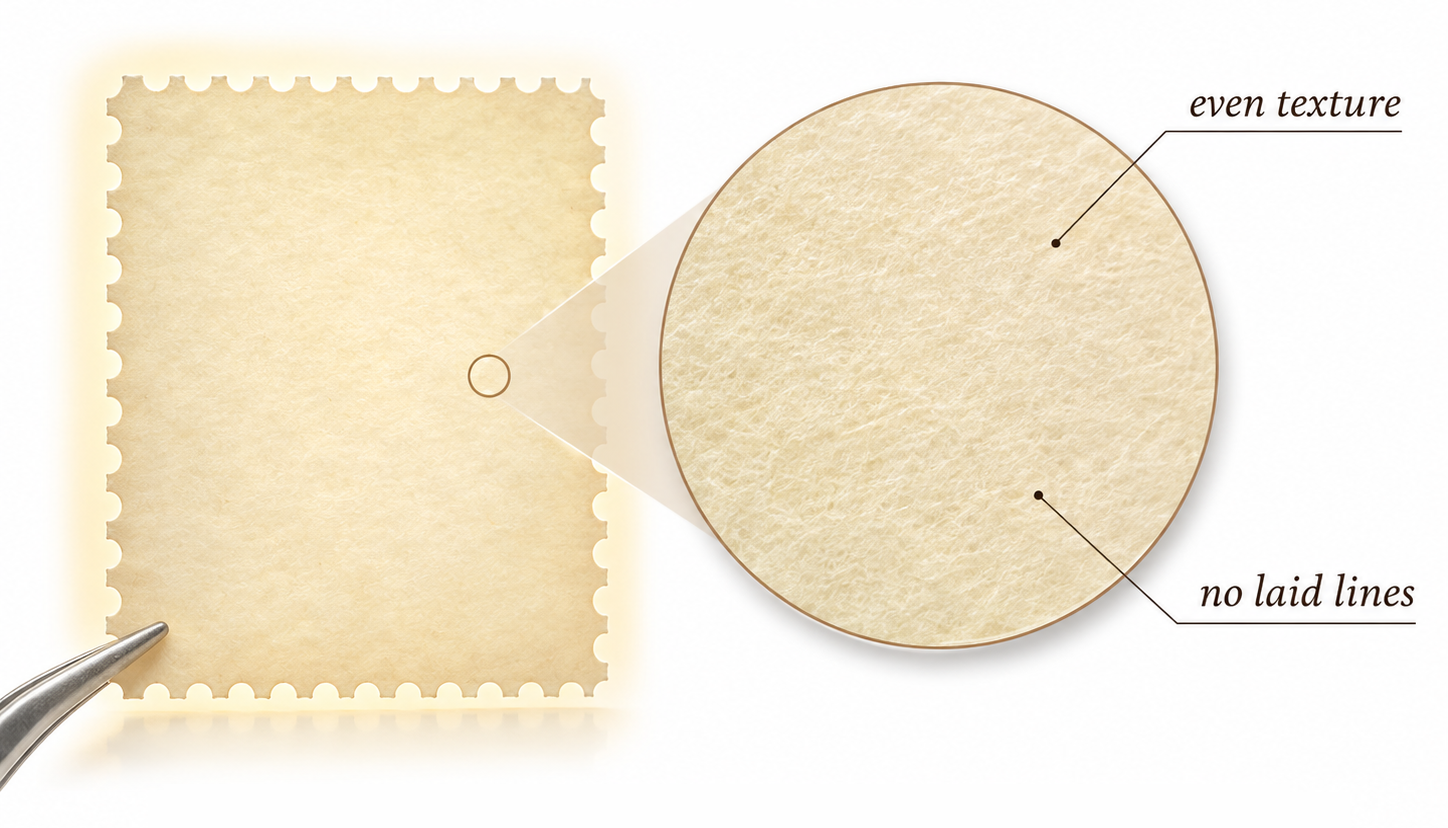
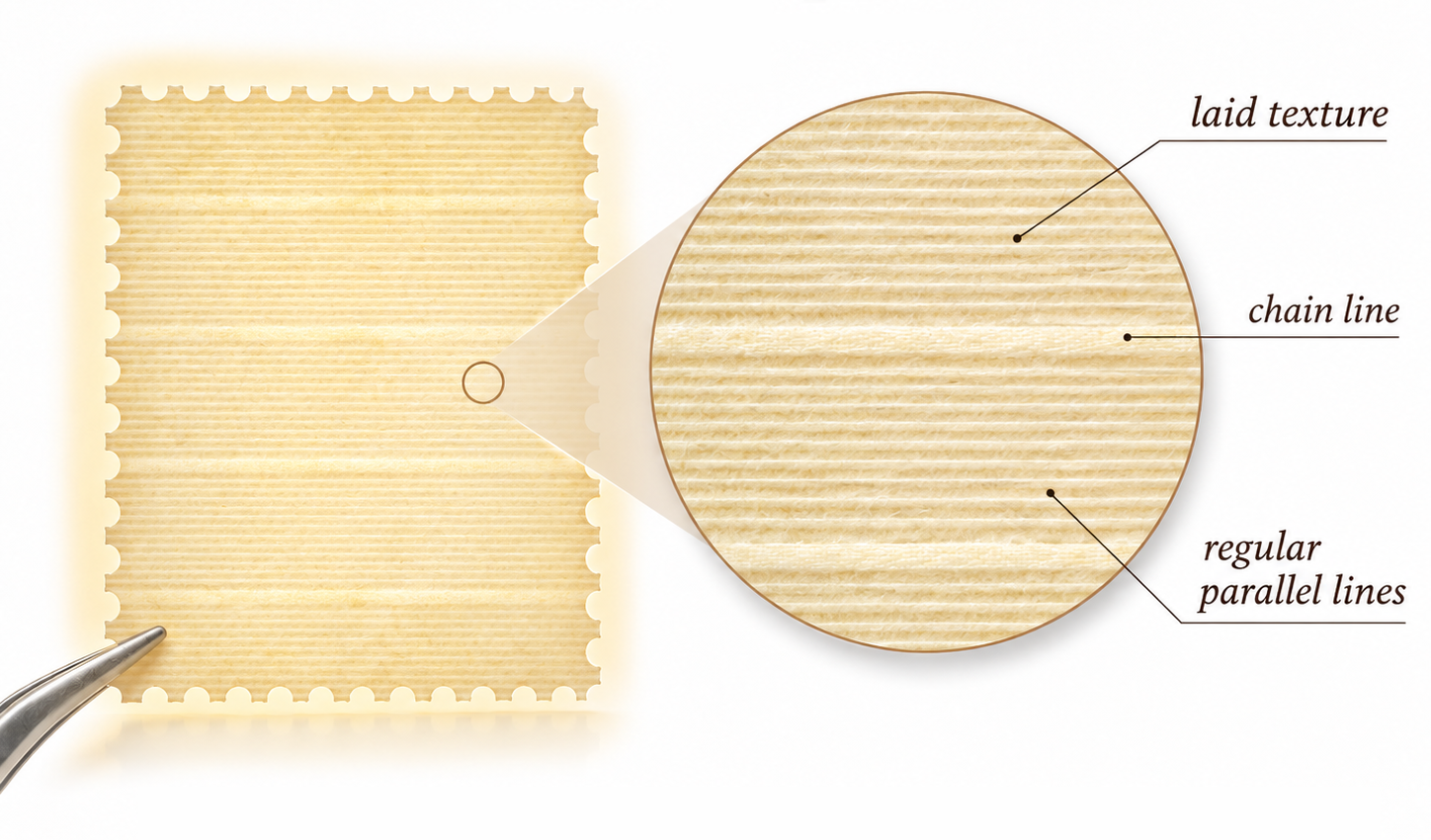
Wove paper has an even structure, unlike the regular parallel lines of laid paper. The comparison illustrations explain those structures; they do not depict a particular original Penny Lilac sheet.
Both dies used machine-made white wove paper with the Large (1880) Crown. The watermark was formed while the sheet was wet, before drying, gumming and printing.
Paper structure, surface finish and watermark are separate observations. A front illustration cannot establish watermark orientation, thickness or the condition of the gum on an original.
Wove paper: even texture without laid lines.Image information
Click image to magnify
Diagram of wove paper with a magnified inset showing an even texture without laid lines.
Credit
Stunning Stamps · 2026
Notes
Digitally constructed
Laid paper: regular parallel lines, shown for comparison.Image information
Click image to magnify
Diagram of laid paper with a magnified inset showing regular parallel lines.
Credit
Stunning Stamps · 2026
Notes
Digitally constructed
On this stamp
The Die II Penny Lilac uses machine-made white wove Crown paper. The reused diagrams compare wove and laid structures; there is no laid-paper alternative assigned to this issue.
Structure describes how the fibres form the sheet; finish describes the surface. Smoothness, thickness, colour and a watermark are separate properties, and a smooth surface does not by itself establish a coating.
The period account describes paper from about 1880 as less firm than some earlier surface-printing papers. This is a general observation, not an exact thickness specification for every Penny Lilac.
These issues use ordinary Crown paper. No Edwardian chalk-surface alternative is assigned to either die. Assess the original object rather than transferring a paper variety from a later reign.
On this stamp
The Die II illustration represents ordinary white paper. Smoothness and thickness must be assessed on an original; neither a coating nor a chalk-surface variety is established from this face image.
A fugitive ink is deliberately vulnerable to treatment intended to remove a cancellation. That vulnerability protects revenue by making an attempt to reuse the stamp more apparent.
The Penny Lilac was printed in one ink. “Doubly fugitive” describes the intended sensitivity to water and chemical treatment; it is not a claim that every batch behaved identically. The early ink and the later formulation should not be assumed to have equal resistance.
Wright and Creeke record a range of purple tones. Fading or washing can change the colour further. The appearance of a scan or reconstruction cannot establish a rare original shade or a particular chemical formulation.
On this stamp
Die II was printed in a wide range of purple and lilac tones over its long life. Security ink could be altered by treatment, so a changed or faded colour is not by itself a separately catalogued original shade.
The Crown is formed in the paper, not printed in ink. Raised patterns on the papermaking roll leave thinner areas that become visible in transmitted light. It is separate from the diadem in Victoria’s portrait.
The Large (1880) Crown paper provided a watermark position for each stamp. Each 240-position unit had two groups of 120, with watermarked lettering and other marks in the surrounding paper.
This Crown must not be confused with the Small and Large Crowns of earlier line-engraved stamps. An inverted or incomplete watermark has to be established from the original paper; the ordinary face design remains the same.
On this stamp
Both dies use the Large (1880) Crown. On this Die II the printed dots identify the engraving, while the watermark belongs to the paper. Its orientation and completeness require inspection of an original.
The gauge measures hole spacing over two centimetres. It does not count all the teeth on a complete edge. Two numbers give the horizontal gauge first and the vertical gauge second.
Both ordinary Penny Lilac dies gauge 14 in each direction. Fourteen or sixteen printed corner dots identify the die and have no connection with this perforation measurement.
Wright and Creeke distinguish unissued imperforate Die I impressions from Die II imperforates which they believed had been issued. Proofs, registration material, errors and trimmed perforated singles require separate examination. None is a routine second gauge for the illustrated articles.
Enlarged spacing diagram, not to scale. Match the spacing with a perforation gauge.Image information
Enlarged perforation spacing: fourteen equal intervals between hole centres span 20 millimetres. This is a schematic, not a ruler.
Credit
Stunning Stamps · 2026
On this stamp
The ordinary Die II is perforated 14 horizontally and vertically despite having sixteen printed corner dots. Historical imperforate material is discussed as an exception; no routine gauge-16 alternative or additional grouped article is created.
Gum arabic is the adhesive applied to the back of these stamps. De La Rue gummed the paper before printing, so the normal impression lay on the opposite face.
A mint stamp may retain original gum, show hinge marks or have lost or replaced gum. Those conditions are different from the design, colour and perforation of the issue.
Printed-on-gum Die II errors are documented. They arose from printing on the wrong face of the prepared paper; they should not be confused with ordinary stamps whose gum has been disturbed later.
On this stamp
The paper for Die II was gummed before printing. The illustration shows the face only and does not establish original gum, hinge condition or regumming. Printed-on-gum Die II material is an exceptional printing error.
A pane is a block within a sheet; a gutter is the gap between panes; selvedge is the outside margin. The diagram explains these terms rather than providing a measured Penny Lilac layout.
A Penny Lilac plate contained 240 subjects in two panes, one above the other. Each pane had ten rows of twelve stamps. The whole unit therefore had twenty rows and twelve columns, interrupted by the horizontal gutter.
Two plates printed across the double mill sheet, producing 480 stamps in four panes. A reference to a 240-subject plate and another to a 480-stamp printer’s sheet describe different units, not conflicting capacities.
Sheet, panes and margins: a simplified example.Image information
A schematic printing sheet contains two panes separated by an unprinted gutter and surrounded by a margin.
Credit
Stunning Stamps · 2026
On this stamp
For Die II, each plate held two panes of 120, each ten rows by twelve columns. The double mill sheet took two plates side by side, yielding four panes and 480 stamps.
There were twelve old pence to a shilling and twenty shillings to a pound. A full unit of 240 penny stamps was therefore worth £1.
For both Penny Lilac dies this 240-stamp unit was the post-office sheet. Each 120-stamp pane was worth 10s; the double 480-stamp mill sheet used in production represented £2.
Keep those units separate when reading an archive description or a sale catalogue. A surviving part-sheet can contain fewer stamps because examples were removed, not because the printing plate originally held fewer subjects.
On this stamp
A complete 240-stamp unit of Die II formed the £1 post-office sheet. One pane was 120 stamps worth 10s; the 480-stamp double mill sheet represented £2.
Earlier Victorian pennies used letter pairs to identify positions in the sheet. The Penny Lilac dispensed with these printed corner letters.
Its corner dots are ornament and a diagnostic feature of the die. They do not encode row or column. Both dies have the same absence of letters.
Later control letters are printed in the sheet margin and serve a different purpose. Without an adjoining margin or specialist evidence, an isolated Penny Lilac cannot be assigned a sheet position or production control merely by looking at its corners.
On this stamp
The Die II has no check letters. Its 16 dots in each corner identify the die, not a row, column or plate. There is no missing-letter error in the illustrated design.
The die establishes the design; plates reproduce it many times. A new plate is not automatically a new die. Penny Lilacs carry no printed plate number on their faces.
Eight plates were made and used from Die I. The revised Die II began with plate 9. Wright and Creeke’s later count is explicitly an end-of-1898 record and must not be treated as a final lifetime production total.
A registration sheet records approval and may carry manuscript numbers. It can preserve a plate’s identity after examples have been removed. The illustrations here represent the two dies, without assigning either single stamp to an otherwise unidentified plate.
On this stamp
Plate 9 began Die II production in October 1881. Later plates included unused and spoiled examples. The number 111 in Wright and Creeke is a count made by the end of 1898, not the completed lifetime total. This single has no printed plate number.
Count the complete white dots in one corner, where a horizontal row meets a vertical row. Count the shared corner dot once. Tiny partial remnants at the oval’s edge do not add another complete dot.
Die I has fourteen complete dots in each corner; Die II has sixteen. Die II also has slightly larger lettering. The four corner groups distinguish the design revision even though both stamps read ONE PENNY and have the same basic oval frame.
These are areas left white by surface printing. “Pearls” is a descriptive name, not a statement that the paper was embossed. Ink spread, wear or a cancellation can hide small details, so compare more than one corner on an original.
On this stamp
Count 16 complete white dots in each corner, counting the shared corner dot only once. Die II has larger lettering and more, smaller corner dots than Die I. Tiny partial terminal fragments where the oval meets the rows are excluded.
A control letter helped De La Rue account for production. It was printed in the lower sheet margin, under the eleventh stamp in the last row, rather than on each stamp.
Controls belong to later Die II production. Their lettering, setting and accompanying marginal rule provide evidence about a retained sheet margin; they are not corner letters, a denomination or a visible plate number.
The barred N and adjoining O combination has been interpreted differently in historical and later accounts. The visible combination should be described separately from a proposed explanation of how it arose. Neither it nor an exact control can be inferred from a single stamp without selvedge.
On this stamp
Controls occur in the lower margin of later Die II sheets, not on this detached single. No control letter or date is assigned to the illustration. The disputed explanation of the barred N/O combination is kept separate from identifying the marks.
A marginal rule is a line printed around a pane, outside the stamp designs. These rules were introduced during Die II production in 1887, giving rise to the name Jubilee lines.
They helped protect the edges of the printing surfaces and improve working conditions at the edge of a pane. They were added printer’s rules, not an extra border engraved on each individual stamp.
A stamp with its selvedge can show the rule and its relationship to a control letter. An ordinary detached single cannot. A Penny Lilac with this feature remains a Penny Lilac; it does not become a member of the separate multi-value Jubilee series.
On this stamp
Later Die II panes acquired marginal rules in 1887. This single has no selvedge, so it cannot demonstrate either the presence or absence of a rule on its original sheet. The rule is separate from the stamp’s own outer frame.
A die proof tests a design, a plate proof tests its repeated impressions, and a registration impression records approval. Material marked SPECIMEN also needs to be distinguished from ordinary stamps sold over the counter.
The two dies require different care when discussing imperforates. Wright and Creeke state that Die I imperforate impressions were not issued for use, while recording Die II imperforates believed to have been issued. Straight edges alone cannot establish either status.
For Die II they also record impressions on the gummed face and printing on both sides. Enough original paper, an adjoining stamp, the reverse and reliable provenance are needed to assess such material. The reconstructions illustrate ordinary perforated stamps, not these exceptions.
On this stamp
Wright and Creeke record Die II printed on the gummed face, printed on both sides, and imperforates they believed issued. The reconstruction represents none of those errors. Provenance and examination of original paper are needed.
The face value does not reveal the full journey. Date, weight, destination and service determine the charge; one stamp may pay all of it or form part of a larger franking.
At the Penny Lilac’s introduction, 1d paid an ordinary inland letter up to 1 oz. From 22 June 1897 the same penny rate covered up to 4 oz. Die II spans that change.
A dated cover and its complete franking establish which scale applies. A loose Penny Lilac cannot prove the weight or destination of the item on which it was used.
On this stamp
Die II spans two penny inland-letter limits: up to 1 oz at introduction, then up to 4 oz from 22 June 1897. A dated cover is needed to choose the applicable limit.
A revenue stamp records payment of a tax or duty on a document. That function is different from paying for delivery of a letter, even when the same stamp can serve either purpose.
The 1881 arrangements allowed the penny adhesive to meet postage and the applicable general penny stamp duties. Duties requiring a stamp specifically appropriated to a particular instrument were not simply swept into that permission.
A fiscal signature or date, an official overprint, and a postal cancellation have different meanings. Read the original document or cover before assigning a use. The inscription does not license using one stamp twice.
On this stamp
The inscription on Die II expressly includes INLAND REVENUE. It could pay the eligible penny duties as well as postage. A fiscal cancellation or document needs to be distinguished from a postal use.
A cancellation prevents reuse; a date stamp can also record when and where an item was handled. Its figures or letters are later marks, not part of the engraved design.
Penny Lilacs could be used postally or for eligible fiscal duties. A pen mark alone does not establish the whole transaction, and an unusual strike should be interpreted with its document rather than by appearance alone.
The ink’s vulnerability was part of the protection against cleaning. Disturbed colour is therefore a condition issue to investigate, not automatic evidence of a new shade or die.
On this stamp
This illustration is unused. On a surviving Die II, read the cancellation with the original cover or fiscal document. The printed corner dots are part of the design; a later numeral, signature or date is a separate mark.